
Himuga
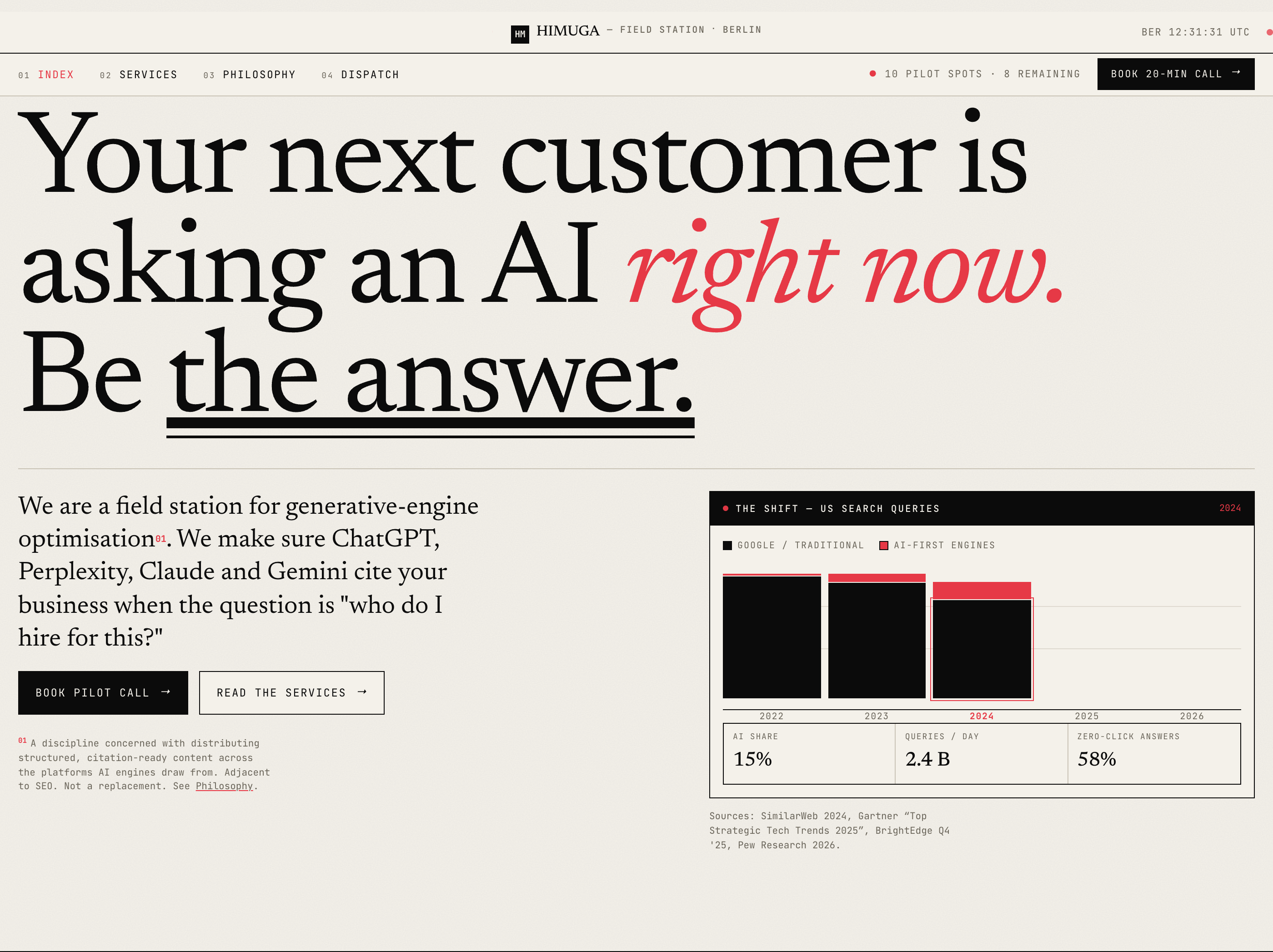
Himuga helps businesses get cited and recommended by AI
Features
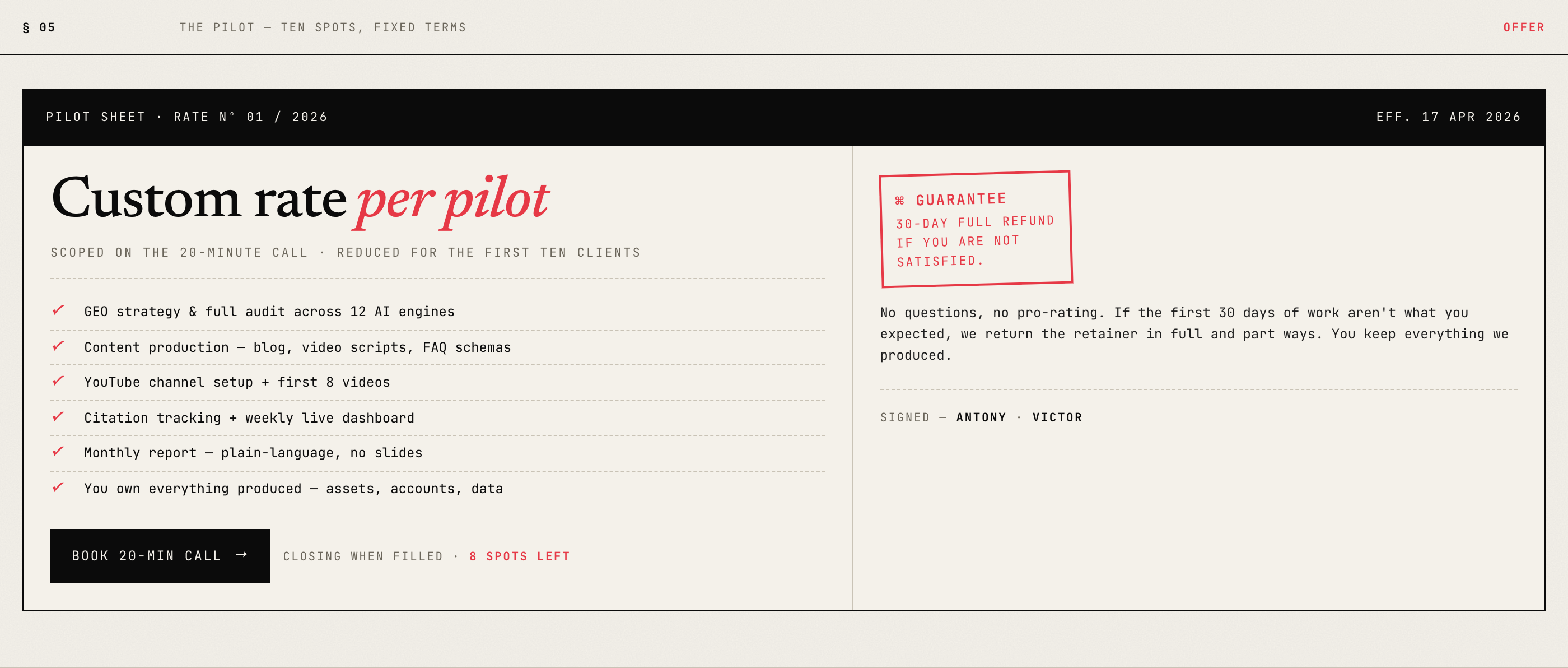
- AI search visibility audit across ChatGPT, Perplexity, Claude and Gemini
- Generative Engine Optimization strategy
- AI citation gap analysis
- Competitor visibility tracking in AI answers
- Structured, citation-ready content production
- FAQ schema and entity optimization
- Third-party source distribution
- YouTube content and video script production
- Reddit and community visibility strategy
- AI recommendation query mapping
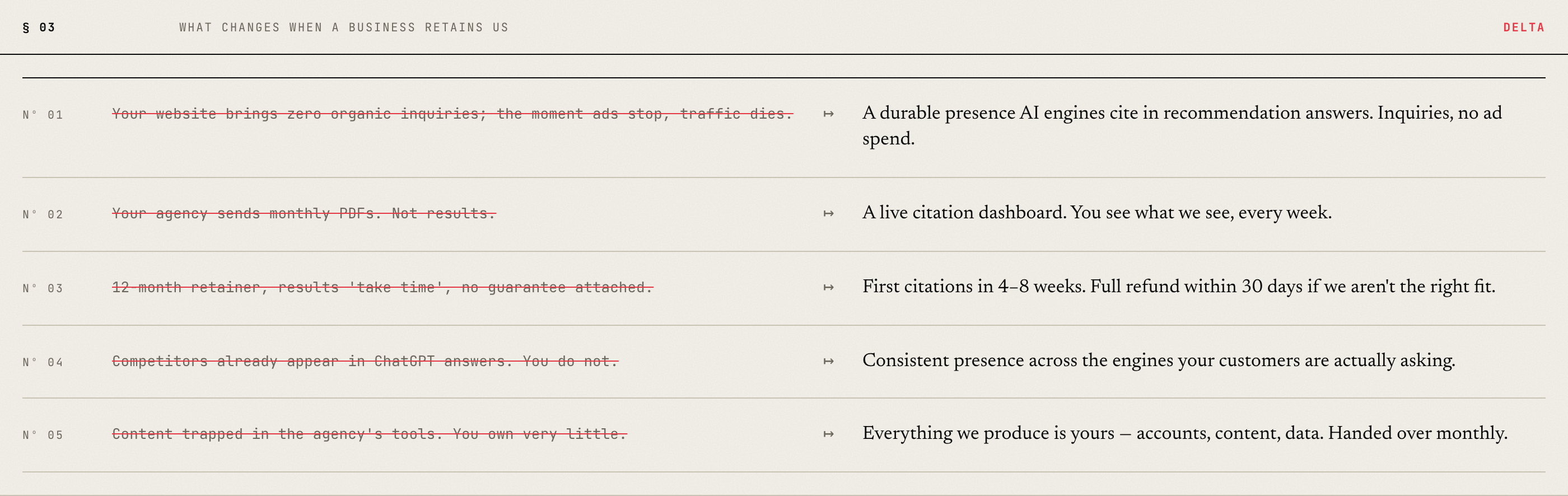
- Live citation tracking dashboard
- Weekly visibility reports
- Brand entity strengthening across trusted sources
- AI search keyword and prompt research
- Content roadmap based on AI engine behavior
- Source-of-truth optimization for LLMs
- Local AI search visibility for service businesses
- Ongoing monitoring of AI-generated recommendations
- Owned asset handover: content, accounts, data and reports
- Pilot-based implementation with fast iteration
Use Cases
- Get your business recommended by ChatGPT, Perplexity, Claude and Gemini
- Find out whether AI engines mention your company for relevant buying queries
- Identify why competitors appear in AI answers while your business does not
- Improve visibility for “best provider”, “agency near me” and comparison-style AI searches
- Build structured content that AI engines can understand, cite and reuse
- Turn existing expertise into AI-readable articles, FAQs, videos and transcripts
- Track how often your brand appears in AI-generated recommendations
- Increase trust signals around a new or unknown brand
- Support SEO with external citation sources and entity-building
- Launch a new brand with stronger visibility across AI search surfaces
- Help local businesses appear in AI-powered recommendation answers
- Create a repeatable GEO workflow for content, distribution and tracking
- Audit your current AI search presence before investing in SEO or ads
- Replace vague agency reports with live visibility and citation tracking
- Build long-term discoverability beyond Google search
- Prepare your brand for the shift from search results to AI answers
- Validate whether AI search can become a new acquisition channel
- Improve how AI systems understand your company, offer and category
- Create third-party mentions that support AI retrieval and brand credibility
- Monitor AI search performance after publishing new content or external listings
Fazier Deal

Comments






I like that Himuga focuses on AI search visibility instead of just traditional SEO metrics. The combination of citation tracking, competitor monitoring, and recommendation analysis across ChatGPT, Claude, Gemini, and Perplexity addresses a growing challenge for businesses trying to understand how they're represented in AI-generated answers. I'm interested to see how frequently the visibility data is updated.

I like that Himuga focuses on AI search visibility instead of only traditional SEO metrics. The combination of citation tracking, competitor visibility, AI recommendation query mapping, and third-party source distribution feels very relevant as more users discover products through ChatGPT, Claude, Gemini, and Perplexity. One thing I’d be curious to see is how you define a “successful citation” over time — is it based on brand mention frequency, recommendation position, source quality, or conversion impact? A clear scoring model could make this even more actionable for teams.



This reframes SEO for the AI era. Most businesses are still chasing Google visibility while their competitors appear in ChatGPT and Claude responses - the distribution channels where answers actually happen now. Citation tracking, generative-engine optimization, structured content that AI systems can cite - Himuga is solving the right problem at the right moment. The gap analysis component is brilliant too, showing why competitors show up in AI answers while you don't is exactly the intelligence teams need to compete in this new search landscape.

Premium Products



































Fazier Deal
Sponsors
Buy



Makers

Makers
Comments
I like that Himuga focuses on AI search visibility instead of just traditional SEO metrics. The combination of citation tracking, competitor monitoring, and recommendation analysis across ChatGPT, Claude, Gemini, and Perplexity addresses a growing challenge for businesses trying to understand how they're represented in AI-generated answers. I'm interested to see how frequently the visibility data is updated.
I like that Himuga focuses on AI search visibility instead of only traditional SEO metrics. The combination of citation tracking, competitor visibility, AI recommendation query mapping, and third-party source distribution feels very relevant as more users discover products through ChatGPT, Claude, Gemini, and Perplexity. One thing I’d be curious to see is how you define a “successful citation” over time — is it based on brand mention frequency, recommendation position, source quality, or conversion impact? A clear scoring model could make this even more actionable for teams.
This reframes SEO for the AI era. Most businesses are still chasing Google visibility while their competitors appear in ChatGPT and Claude responses - the distribution channels where answers actually happen now. Citation tracking, generative-engine optimization, structured content that AI systems can cite - Himuga is solving the right problem at the right moment. The gap analysis component is brilliant too, showing why competitors show up in AI answers while you don't is exactly the intelligence teams need to compete in this new search landscape.
Premium Products
New to Fazier?

Find your next favorite product or submit your own. Made by @FalakDigital.
Copyright ©2026. All Rights Reserved