
Sublyx
One API key for OpenAI, Claude, Gemini and more
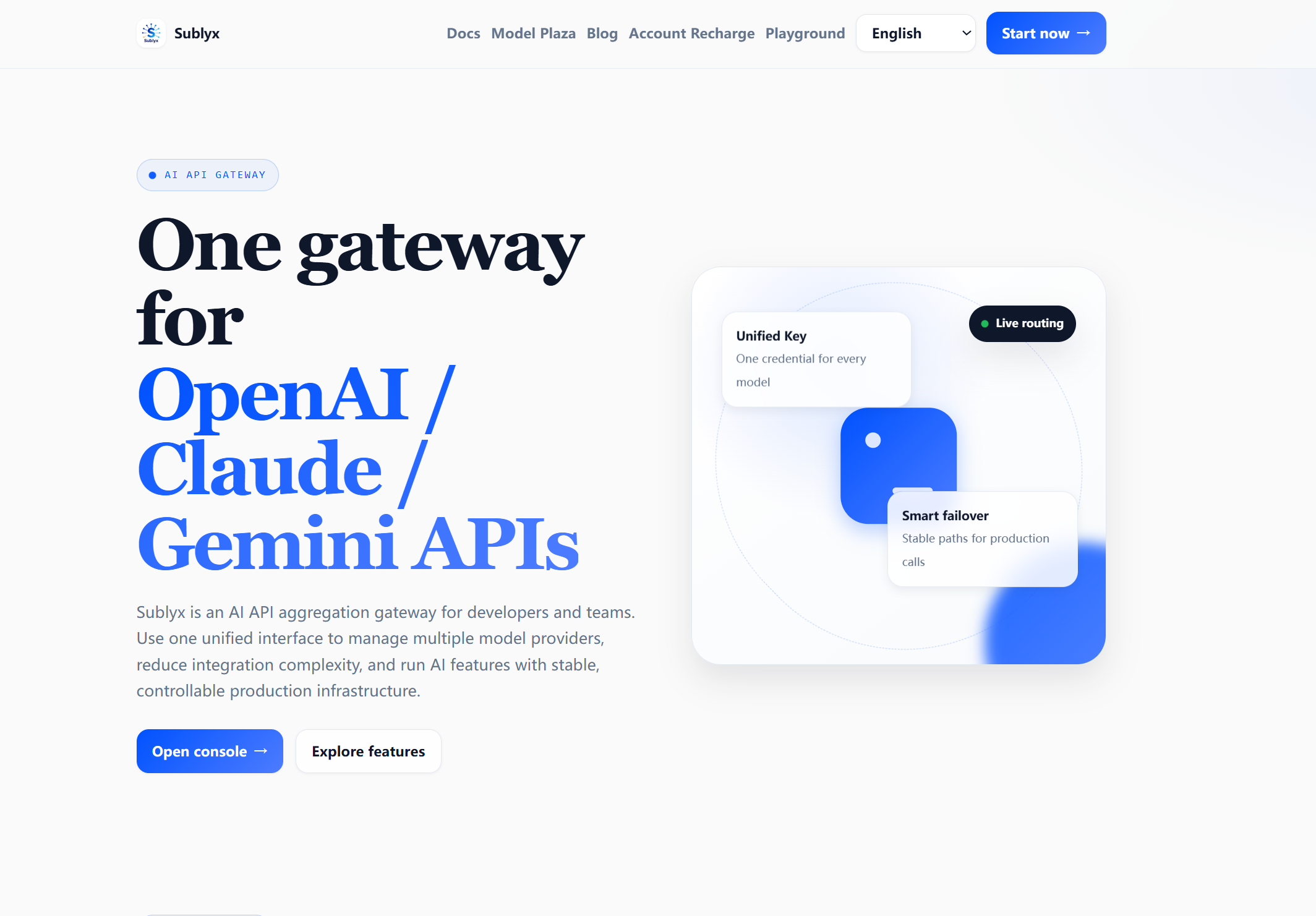
Sublyx is a unified AI API gateway for developers, teams and AI agents.
Access OpenAI, Claude, Gemini, Grok and other leading models through one API key and compatible endpoint. Sublyx works with Codex, Claude Code, Cherry Studio and popular OpenAI or Anthropic SDKs.
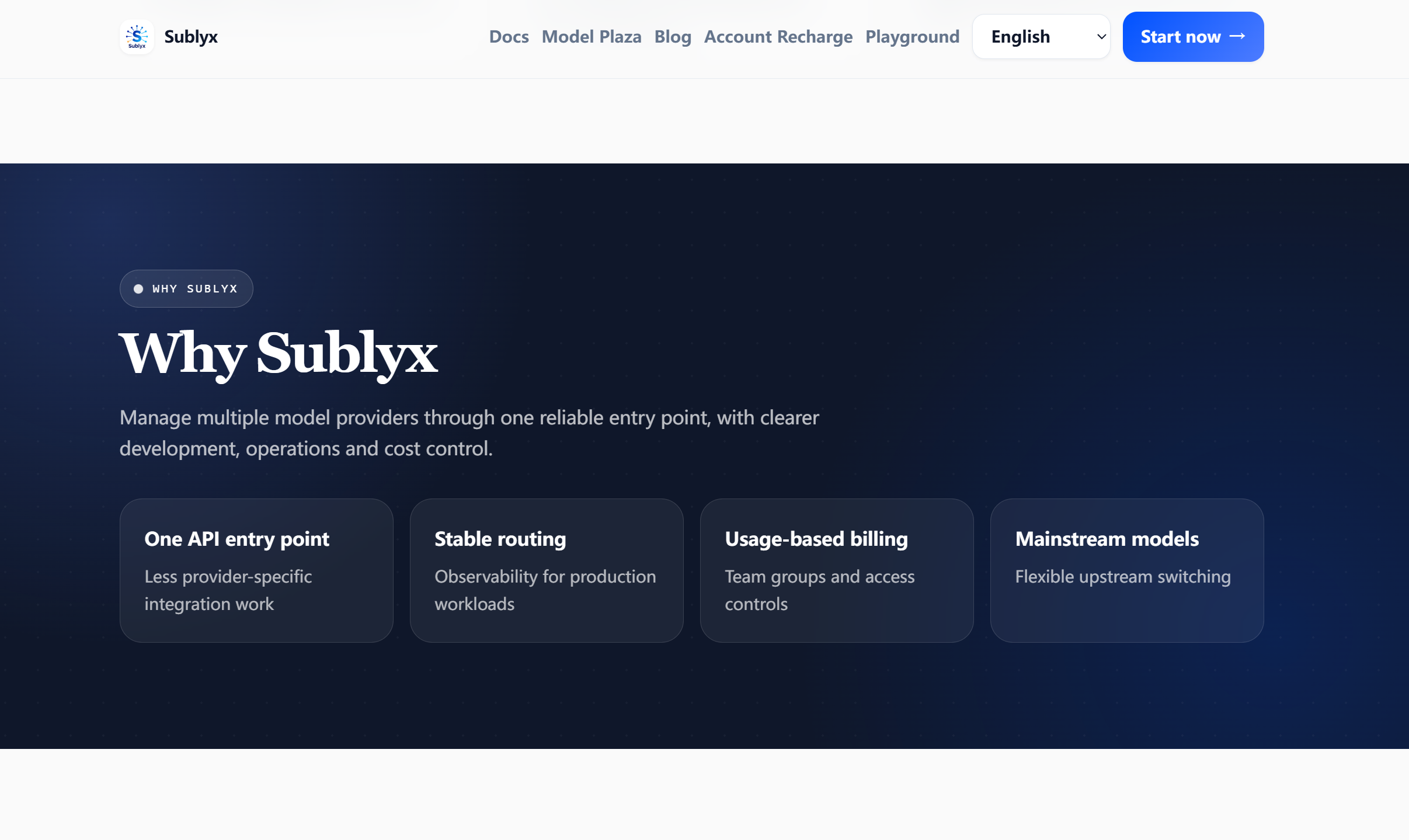
It provides pay-as-you-go pricing, centralized usage tracking, smart routing and automatic failover, reducing the cost and complexity of managing multiple AI providers.
Features
• Unified access to OpenAI, Claude, Gemini, Grok and other leading AI models
• One API key and endpoint for multiple model providers
• OpenAI-compatible and Anthropic-compatible API formats
• Smart routing and automatic failover across upstream providers
• Pay-as-you-go pricing with centralized balance and usage tracking
• API key management, quotas and request monitoring
• Quick integration with Codex, Claude Code, Cherry Studio and popular SDKs
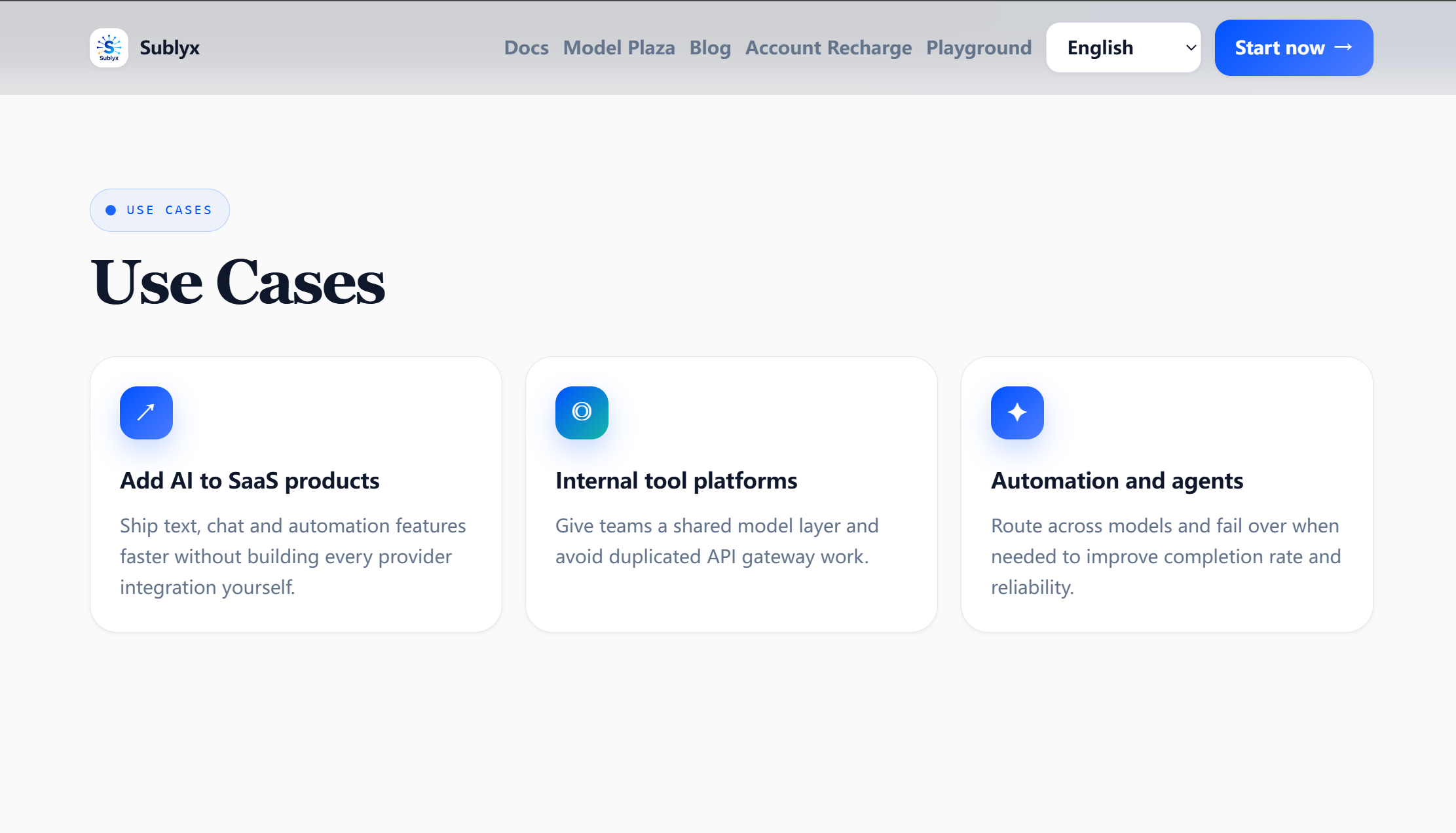
Use Cases
• Connect Codex and Claude Code to multiple AI models through one configuration
• Add AI chat, content generation and automation features to SaaS products
• Build reliable AI agents with multi-model routing and fallback
• Compare and switch between models without rewriting integrations
• Provide a shared AI gateway for development teams and internal tools
• Centralize API keys, usage monitoring and AI spending management
• Prototype applications using OpenAI, Anthropic and Google-compatible SDKs

Comments


We built Sublyx after repeatedly dealing with separate accounts, API keys, balances and incompatible endpoints across AI providers. Our goal is simple: give developers one reliable API for connecting Codex, Claude Code and their applications to leading AI models. Sublyx combines unified model access, pay-as-you-go billing, usage tracking and automatic failover, so teams can spend less time maintaining integrations and more time building. We are launching early and would love feedback on model coverage, documentation and the overall developer experience.

Automatic failover is the claim I would want spelled out, because the hard part is not the routing, it is that the upstream providers disagree about tool-call shapes and streaming chunk formats. Does failover only fire before the first token, or can it recover mid-stream after an upstream drops? And when a request carrying tool definitions fails over, is the schema translated or passed straight through? Those two answers decide whether this is safe for agent traffic or really only for plain chat completions.

Someone below already asked the failover question, so a different one: how is the pay-as-you-go price expressed relative to going direct? A gateway either takes a percentage markup, charges a flat platform fee, or resells at cost with volume margin, and each implies a very different long-run answer to "should I keep this in the path once my usage grows". Publishing that mechanic up front tends to convert better than a per-token table, because the objection is not the number, it is not knowing whether the number moves once you depend on it.

The API key fragmentation problem is real for teams experimenting with multiple LLM providers. Most teams maintain separate API keys for OpenAI, Claude, Gemini - scattered across 3-5 different dashboards, each with its own SDK, rate limit handling, and billing interface. You need custom fallover logic if one provider is down, and monitoring cost across providers becomes a spreadsheet nightmare. Sublyx removes that friction by giving one unified key, compatible endpoint, and centralized billing. Being able to swap between providers without rewriting integration code transforms the entire evaluation and deployment process. For teams especially, that consolidation is what unblocks multi-provider strategies.

Sublyx has great potential! A few improvements could make it even better. I'd love to share my feedback and suggestions. Email: [email protected]

Both of the questions I arrived with are already asked above, so a third one: a gateway sits in the path of every prompt, so what does Sublyx log and for how long? Full request and response bodies, or metadata and token counts only? Anyone putting this in front of production traffic needs a stated retention window and a DPA before legal will sign off, and a team that negotiated zero-retention terms directly with a provider loses that guarantee the moment a middleman is in the path unless you can pass it through. That belongs next to the pricing in the docs, because it is the objection that kills the deal after the trial rather than during it.
Premium Products


































Makers
Makers
Comments
We built Sublyx after repeatedly dealing with separate accounts, API keys, balances and incompatible endpoints across AI providers. Our goal is simple: give developers one reliable API for connecting Codex, Claude Code and their applications to leading AI models. Sublyx combines unified model access, pay-as-you-go billing, usage tracking and automatic failover, so teams can spend less time maintaining integrations and more time building. We are launching early and would love feedback on model coverage, documentation and the overall developer experience.
Automatic failover is the claim I would want spelled out, because the hard part is not the routing, it is that the upstream providers disagree about tool-call shapes and streaming chunk formats. Does failover only fire before the first token, or can it recover mid-stream after an upstream drops? And when a request carrying tool definitions fails over, is the schema translated or passed straight through? Those two answers decide whether this is safe for agent traffic or really only for plain chat completions.
Someone below already asked the failover question, so a different one: how is the pay-as-you-go price expressed relative to going direct? A gateway either takes a percentage markup, charges a flat platform fee, or resells at cost with volume margin, and each implies a very different long-run answer to "should I keep this in the path once my usage grows". Publishing that mechanic up front tends to convert better than a per-token table, because the objection is not the number, it is not knowing whether the number moves once you depend on it.
The API key fragmentation problem is real for teams experimenting with multiple LLM providers. Most teams maintain separate API keys for OpenAI, Claude, Gemini - scattered across 3-5 different dashboards, each with its own SDK, rate limit handling, and billing interface. You need custom fallover logic if one provider is down, and monitoring cost across providers becomes a spreadsheet nightmare. Sublyx removes that friction by giving one unified key, compatible endpoint, and centralized billing. Being able to swap between providers without rewriting integration code transforms the entire evaluation and deployment process. For teams especially, that consolidation is what unblocks multi-provider strategies.
Sublyx has great potential! A few improvements could make it even better. I'd love to share my feedback and suggestions. Email: [email protected]
Both of the questions I arrived with are already asked above, so a third one: a gateway sits in the path of every prompt, so what does Sublyx log and for how long? Full request and response bodies, or metadata and token counts only? Anyone putting this in front of production traffic needs a stated retention window and a DPA before legal will sign off, and a team that negotiated zero-retention terms directly with a provider loses that guarantee the moment a middleman is in the path unless you can pass it through. That belongs next to the pricing in the docs, because it is the objection that kills the deal after the trial rather than during it.
Premium Products
New to Fazier?

Find your next favorite product or submit your own. Made by @FalakDigital.
Copyright ©2026. All Rights Reserved