Stillpoint
The calm, private speed reader for PDFs and EPUBs
You still think of yourself as a reader. The unread pile says otherwise. The problem usually isn't time. Your eyes jump ahead and dart back until you've read the same paragraph four times, and the book goes back on the pile.
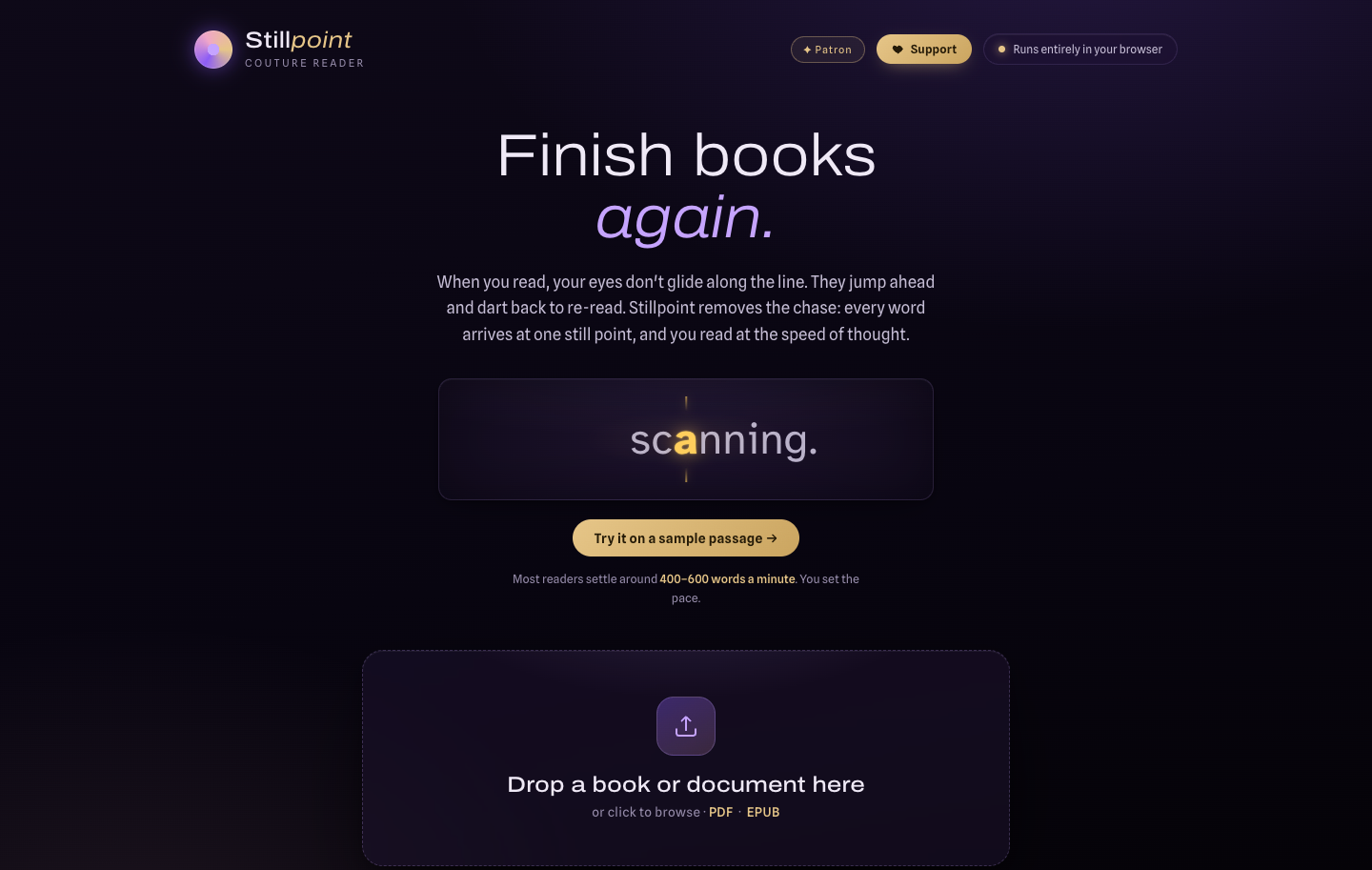
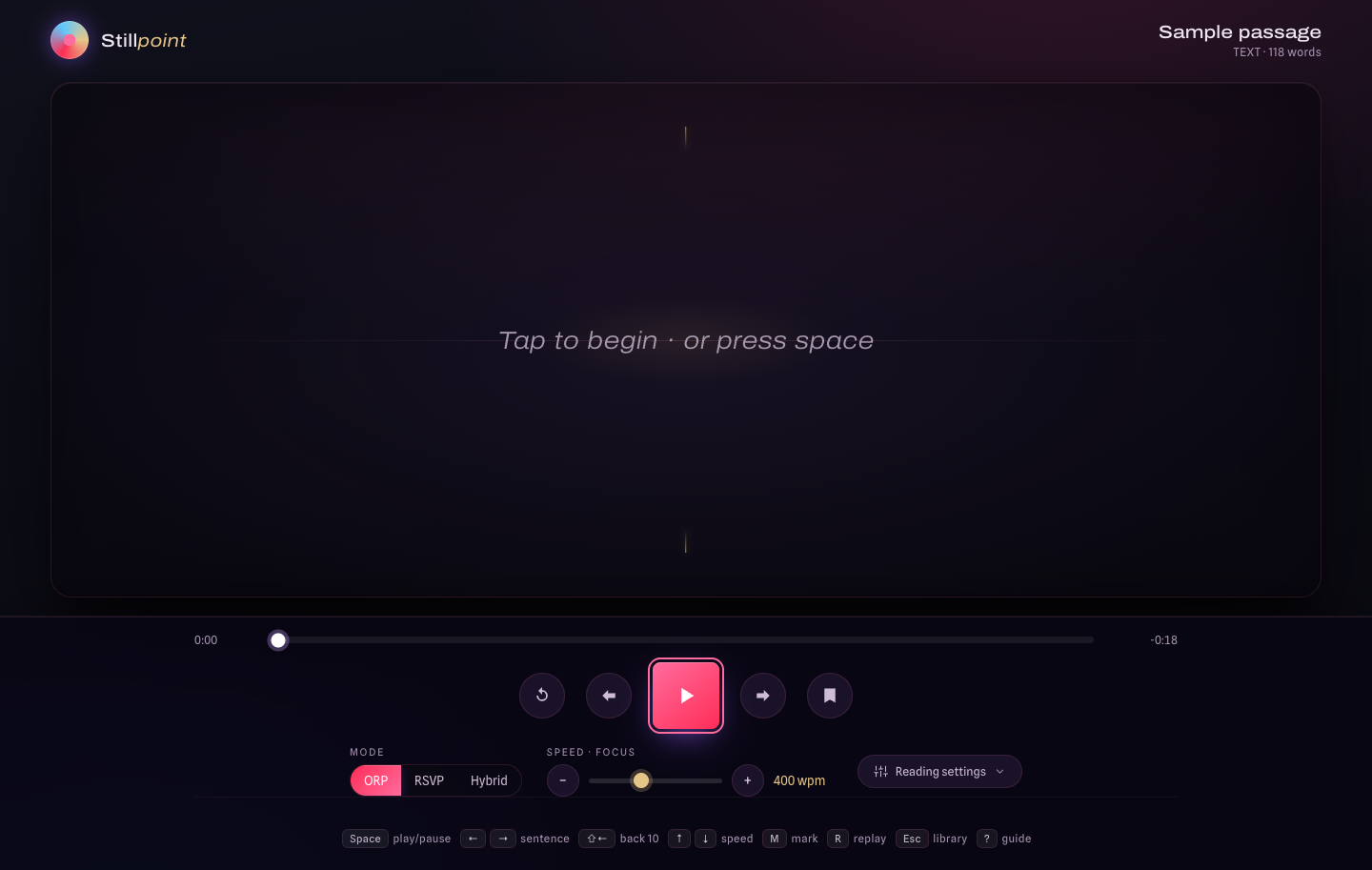
Stillpoint holds every word at one still point instead. Drop in a PDF or EPUB and the words come to you, one at a time or in short phrases, aligned so the letter your eye locks onto never moves. After a minute it feels less like reading and more like listening.
Privacy you can verify: there is no server. Parsing, your library, highlights and reading positions all live in your browser, and your files never leave the device. Open the network tab and check.
Documents survive the stream: tables, images, figures and code are shown as the real thing, not read out as word soup.
Built for finishing: no speed-reading hype. Most people settle around 400 to 600 words a minute, dense sentences slow down by themselves, and progress is chapter-scoped like an audiobook.
No account, no upload, works offline as an installable PWA. Free forever, funded by a tip jar. Honest limits: scanned image-only PDFs need OCR and there is none yet, and DRM'd EPUBs won't open.
Features
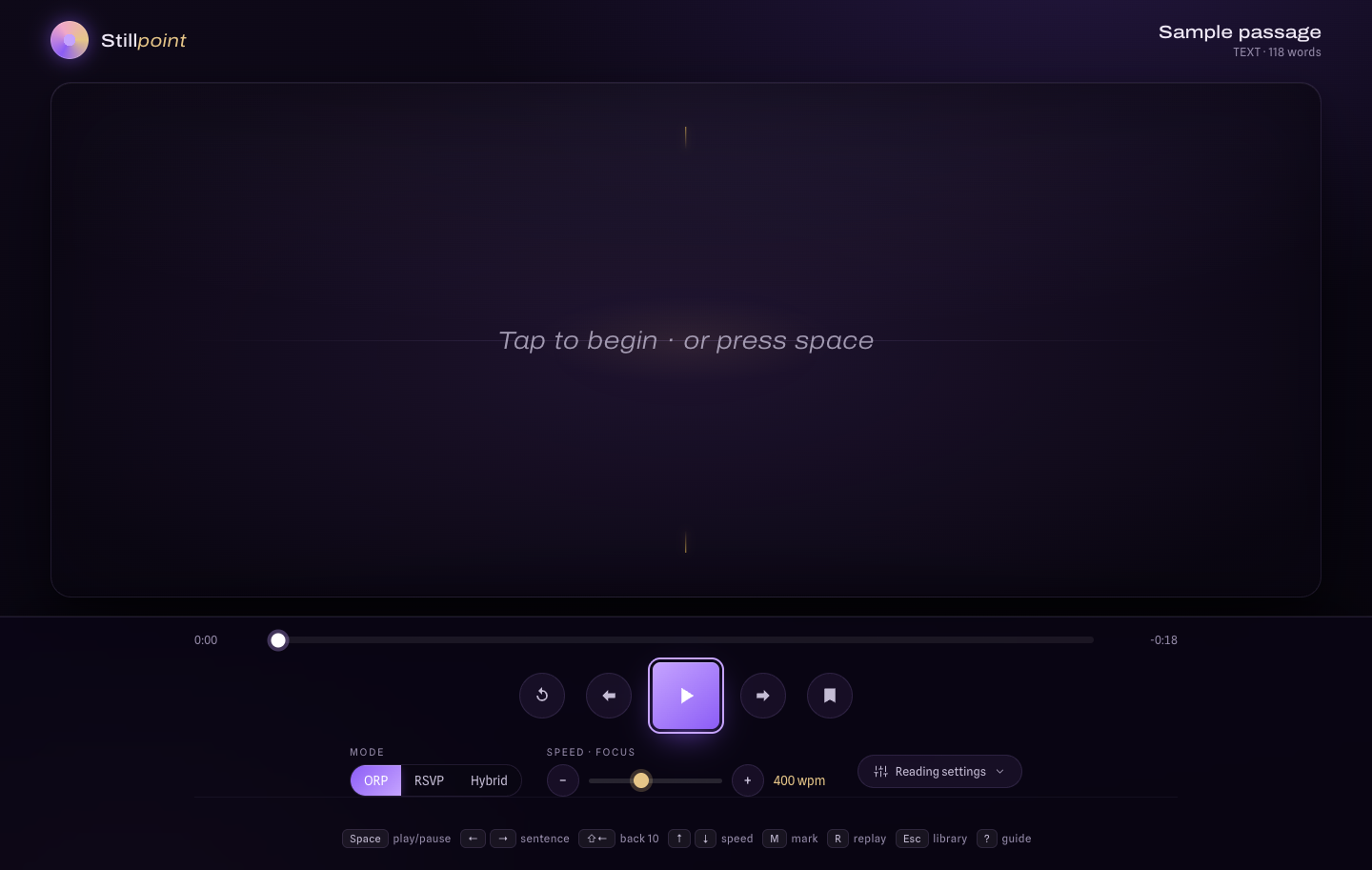
Focal-point reading: ORP, RSVP and Hybrid modes, with the letter your eye locks onto never moving
In-browser PDF and EPUB parsing: no upload, no server
Structure-aware reading: tables, images, figures and code shown as the real thing
Chapter-scoped progress: time left in the current chapter, like an audiobook
Retention aids: rewind on unpause, sentence replay, highlights with Markdown export
Offline PWA with an on-device library and a self-contained backup file for moving devices
Use Cases
Finishing the PDFs and EPUBs that pile up on your devices
Long reports and papers that need sustained attention
Reading with ADHD, when your eyes wander and you re-read the same paragraph
Private reading: nothing you read leaves your device
Offline reading on flights and commutes
Comments


A clean interface and a straightforward workflow often matter more than having dozens of extra features. Simplicity is a big plus for this type of tool. https://tombofthe-mask.com/

Hi Fazier. I built Stillpoint because I wanted to actually finish the PDFs and EPUBs piling up on my devices, and every RSVP reader I tried either wanted an account and a subscription or wanted my files on their server. So it runs entirely in the browser: parsing, library, highlights and positions all stay on your device, and you can verify that in the network tab. Tables and figures are shown as the real thing instead of being streamed as word soup, and progress is chapter-scoped like an audiobook, because minutes left in this chapter keeps you going and a 17-hour countdown does not. It's free, with no account. If you have a PDF you've been avoiding, feed it this and tell me where it stumbles. I reply to everything.


"Privacy you can verify: there is no server" is the right way to make that claim credible, and it resonates with how we think about privacy too. Curious about two things: how do highlights and reading positions move between devices without a server (export file?), and does the phrase mode adapt to punctuation or use fixed chunk sizes?

Reading friction solved for real. Most PDFs and long documents trap you in endless re-reading cycles - your eyes jump around paragraphs, you lose focus, and hours evaporate in inefficiency. Stillpoint's focal-point approach changes that completely by anchoring your eye to one word at a time. The speed reader becomes accessible without sacrificing comprehension like speed-reading hype always does. Privacy-first matters too - highlights and reading positions staying on your device removes the surveillance tax other tools impose. Offline PWA means flights, commutes, and offline time don't force you back to browser tabs. The ADHD-friendly angle especially smart - re-reading friction disappears when your attention naturally wanders. Real win for knowledge workers buried in documents.


The chapter-scoped progress is a smart detail. A 17 hour countdown on a big PDF is exactly why I abandon most readers, but minutes left in this chapter is a promise you can keep. Also respect for the verifiable no-server approach, I did open the network tab and it holds up. Question: how do you handle two column academic layouts? That is where every PDF parser I have tried falls apart.

The self-contained backup file is a smart substitute for cloud sync. For sensitive documents, does the export include the original PDFs/EPUBs or only library metadata, highlights, and positions—and can it be encrypted before moving devices? That detail determines whether the privacy model stays intact during backup.


The on-device, offline model is a refreshing fit for long reports and sensitive material, and chapter-scoped time remaining sounds far more motivating than a huge document-wide countdown. The honest limits are appreciated too. A particularly useful next detail would be a short guide or sample showing how Stillpoint treats common academic PDFs—two-column pages, footnotes, inline citations, and code blocks—because that is where many readers lose their place.
Reading overload solved. Most professionals drown in documentation - dense research papers, long reports, compliance documents - and lose focus by paragraph two. The eye-scanning problem is real: we jump ahead, miss context, then have to re-read. Stillpoint fixes this at the mechanical level by anchoring your eyes to one word at a time, which forces active reading and eliminates that cognitive tax. The beauty is it works offline and doesn't need account creation, so no friction on adoption. For researchers, students, and people managing ADHD or dyslexia, this removes a massive accessibility barrier. The chapter-scoped progress tracking is clever too - it converts reading from a dreaded obligation into something trackable and achievable. Real win for knowledge workers who need to absorb dense information without losing hours to re-reading.

Stillpoint has great potential! A few improvements could make it even better. I'd love to share my feedback and suggestions. WhatsApp: https://wa.me/447307349530 Telegram: t.me/rforrank

Rewind-on-unpause and sentence replay are the details that make this ADHD-viable rather than just ADHD-mentioned — most RSVP readers assume you never look away, but the real failure mode isn't losing focus mid-stream, it's an interruption yanking you out entirely (Slack ping, someone walks in) and coming back with zero memory of the last 30 seconds. We deal with the same problem building Unstuck, just for calendar gaps instead of reading. Does rewind-on-unpause use a fixed lookback window, or does it try to detect how long you were actually away and scale the rewind to that?
Premium Products































Sponsors
Buy

Awards
View all
Awards
View allMakers
Makers
Comments
A clean interface and a straightforward workflow often matter more than having dozens of extra features. Simplicity is a big plus for this type of tool. https://tombofthe-mask.com/
Hi Fazier. I built Stillpoint because I wanted to actually finish the PDFs and EPUBs piling up on my devices, and every RSVP reader I tried either wanted an account and a subscription or wanted my files on their server. So it runs entirely in the browser: parsing, library, highlights and positions all stay on your device, and you can verify that in the network tab. Tables and figures are shown as the real thing instead of being streamed as word soup, and progress is chapter-scoped like an audiobook, because minutes left in this chapter keeps you going and a 17-hour countdown does not. It's free, with no account. If you have a PDF you've been avoiding, feed it this and tell me where it stumbles. I reply to everything.
"Privacy you can verify: there is no server" is the right way to make that claim credible, and it resonates with how we think about privacy too. Curious about two things: how do highlights and reading positions move between devices without a server (export file?), and does the phrase mode adapt to punctuation or use fixed chunk sizes?
Reading friction solved for real. Most PDFs and long documents trap you in endless re-reading cycles - your eyes jump around paragraphs, you lose focus, and hours evaporate in inefficiency. Stillpoint's focal-point approach changes that completely by anchoring your eye to one word at a time. The speed reader becomes accessible without sacrificing comprehension like speed-reading hype always does. Privacy-first matters too - highlights and reading positions staying on your device removes the surveillance tax other tools impose. Offline PWA means flights, commutes, and offline time don't force you back to browser tabs. The ADHD-friendly angle especially smart - re-reading friction disappears when your attention naturally wanders. Real win for knowledge workers buried in documents.
The chapter-scoped progress is a smart detail. A 17 hour countdown on a big PDF is exactly why I abandon most readers, but minutes left in this chapter is a promise you can keep. Also respect for the verifiable no-server approach, I did open the network tab and it holds up. Question: how do you handle two column academic layouts? That is where every PDF parser I have tried falls apart.
The self-contained backup file is a smart substitute for cloud sync. For sensitive documents, does the export include the original PDFs/EPUBs or only library metadata, highlights, and positions—and can it be encrypted before moving devices? That detail determines whether the privacy model stays intact during backup.
The on-device, offline model is a refreshing fit for long reports and sensitive material, and chapter-scoped time remaining sounds far more motivating than a huge document-wide countdown. The honest limits are appreciated too. A particularly useful next detail would be a short guide or sample showing how Stillpoint treats common academic PDFs—two-column pages, footnotes, inline citations, and code blocks—because that is where many readers lose their place.
Reading overload solved. Most professionals drown in documentation - dense research papers, long reports, compliance documents - and lose focus by paragraph two. The eye-scanning problem is real: we jump ahead, miss context, then have to re-read. Stillpoint fixes this at the mechanical level by anchoring your eyes to one word at a time, which forces active reading and eliminates that cognitive tax. The beauty is it works offline and doesn't need account creation, so no friction on adoption. For researchers, students, and people managing ADHD or dyslexia, this removes a massive accessibility barrier. The chapter-scoped progress tracking is clever too - it converts reading from a dreaded obligation into something trackable and achievable. Real win for knowledge workers who need to absorb dense information without losing hours to re-reading.
Stillpoint has great potential! A few improvements could make it even better. I'd love to share my feedback and suggestions. WhatsApp: https://wa.me/447307349530 Telegram: t.me/rforrank
Rewind-on-unpause and sentence replay are the details that make this ADHD-viable rather than just ADHD-mentioned — most RSVP readers assume you never look away, but the real failure mode isn't losing focus mid-stream, it's an interruption yanking you out entirely (Slack ping, someone walks in) and coming back with zero memory of the last 30 seconds. We deal with the same problem building Unstuck, just for calendar gaps instead of reading. Does rewind-on-unpause use a fixed lookback window, or does it try to detect how long you were actually away and scale the rewind to that?
Premium Products
New to Fazier?

Find your next favorite product or submit your own. Made by @FalakDigital.
Copyright ©2026. All Rights Reserved