Recommd
See if AI answer engines recommend your business
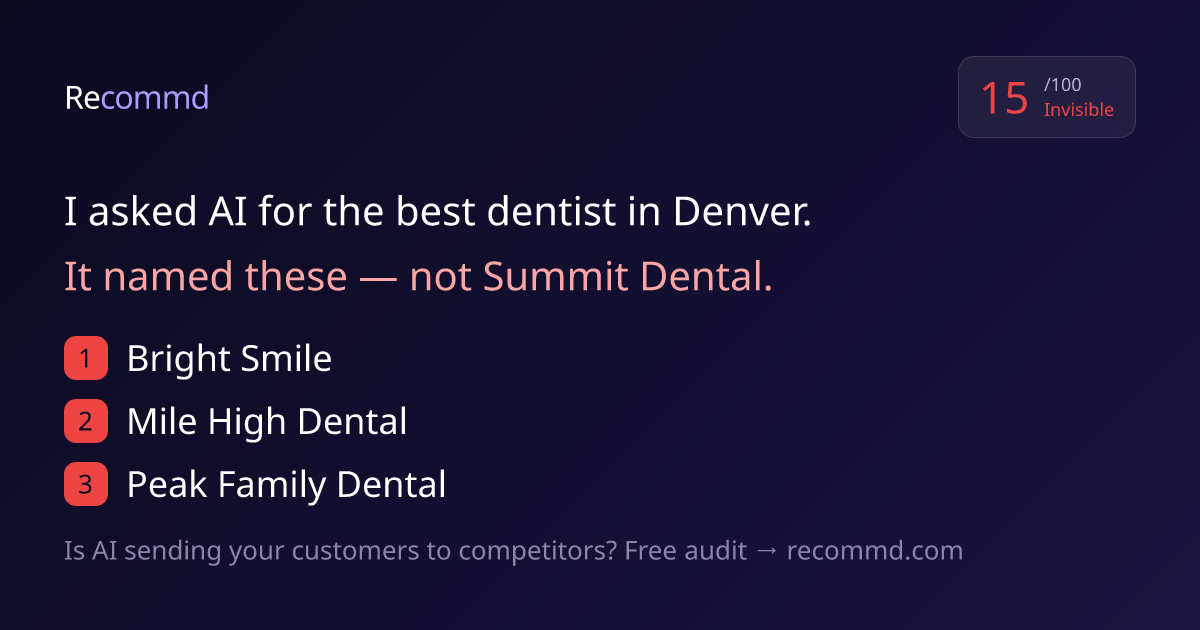
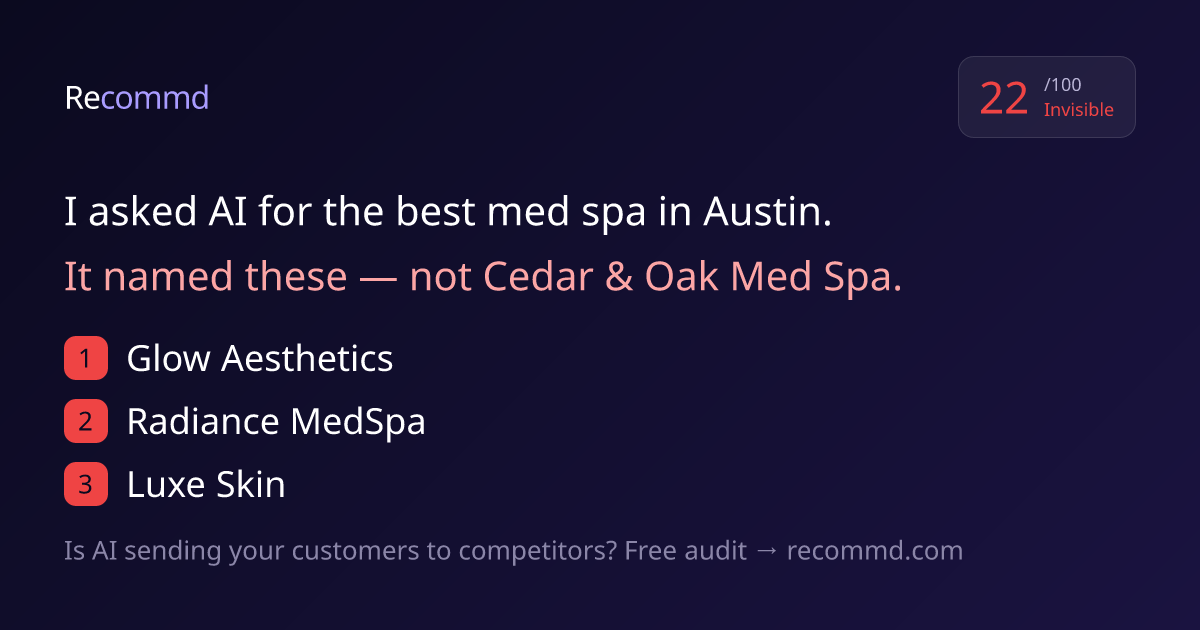
Recommd shows you whether AI answer engines — ChatGPT, Perplexity, Google AI Overviews, Gemini, and Claude — actually recommend your business when potential customers ask for one. Run a free audit on your domain and Recommd uses live, grounded AI search to check how these engines describe you, whether they cite you at all, and which competitors they surface instead. You get a plain-English breakdown of where you stand and the concrete fixes that move you into AI answers. No signup required for the free audit. Built for local businesses, agencies, and SaaS teams who realize that being invisible to AI search is the new being invisible on Google.
Features
Free AI-visibility audit on any domain — no signup required
Live, grounded checks across ChatGPT, Perplexity, Google AI Overviews, Gemini and Claude
Plain-English score showing whether AI engines cite, describe, or ignore you
Competitor surfacing — see who AI recommends instead of you
Concrete, prioritized fixes to earn AI citations (answer-engine optimization)
Use Cases
Local businesses checking if AI assistants recommend them over competitors
Agencies offering AI-visibility / AEO audits as a client service
SaaS teams tracking whether ChatGPT and Perplexity cite their product
Marketers benchmarking AI search presence before and after content changes
Founders validating that a new site is discoverable by AI answer engines

Comments






This is solving a real problem that most SEO tools are still ignoring. AI-visibility is the new search visibility. Love the plain-English scoring and competitor surfacing feature - makes it easy to understand what you're up against in the AI era. Free audit angle smart for building trust with agencies.


AI search visibility is becoming just as important as traditional SEO. I really like how Recommd checks whether platforms like ChatGPT, Perplexity, Gemini, and AI Overviews actually recommend a business. The competitor comparison and actionable fixes make this especially useful for marketers, SaaS teams, and agencies.


Hey Fazier 👋 I'm the maker of Recommd. I built this after watching a friend's local business slowly lose customers — not to a competitor's ads, but because when people asked ChatGPT or Perplexity "who's the best [her category] near me," the AI kept naming three other shops and never hers. She had no idea it was even happening. That's the shift Recommd is built for: more buying decisions now start with "ask an AI" instead of a Google search, and most businesses have zero visibility into whether AI recommends them or their competitors. So Recommd runs a free 30-second audit that shows you exactly which businesses ChatGPT, Perplexity, and Google's AI name for your category — and where you stand. There's a paid report with 90-day monitoring for the full picture, but the free check stands on its own. Would genuinely love this community's feedback on the audit itself — what would make it more useful to you?
This is a very relevant problem right now. Most businesses still think SEO visibility ends with Google rankings, but buyers are increasingly asking AI tools for recommendations before they even visit search results. I like that Recommd shows not just whether a brand is mentioned, but also which competitors are being surfaced instead. That competitor visibility angle makes the audit much more actionable.

recommd has great potential and offers some useful features, but I encountered a few issues that could be improved. Please contact me so I can share detailed feedback and suggest the changes I'd like to see. WhatsApp: https://wa.me/447307349530 Email: [email protected] Telegram: t.me/rforrank

AI visibility is quickly becoming as important as traditional SEO, so this solves a very real problem. I like that the audit compares multiple AI answer engines instead of focusing on just one. Does Recommd keep historical snapshots so users can measure improvements after implementing the suggested fixes?

The competitor part is what would actually make me use this. Finding out an AI ignores me is one thing, but seeing which competitors it names instead is what would make me do something about it. One question though: these engines give a slightly different answer every time you ask, so does the audit run the query a few times and average it, or is it just one snapshot? If agencies are putting this in front of clients, that consistency is going to matter a lot. Going to run it on my own domain



Congrats on the launch! This resonates — we run an SEO service for e-commerce clients and built an internal module for exactly this problem (making product data legible to AI assistants), so I've seen firsthand how invisible most SMBs are in AI answers. The no-signup audit is a smart wedge; that's the demo that sells itself. Question: how do you handle the non-determinism? Same prompt to ChatGPT can name different businesses run-to-run — do you sample multiple times per engine, or is the score based on a single pass? That's the part that made our internal monitoring tricky. Curious about the 90-day monitoring cadence too.

Really useful tool for understanding how your brand shows up across AI search engines. The audit is quick, easy to understand, and gives actionable insights instead of just another SEO score. Definitely worth trying if you care about visibility in ChatGPT, Perplexity, Gemini, and other AI answer engines.

The most actionable piece for me would be seeing which sources the engines pulled from when they recommend a competitor — AI answers lean heavily on a handful of listicles and directories, so knowing the exact cited pages turns "improve your AI visibility" into "go get featured on these three roundups." Does the audit expose the citations behind each engine's answer? For agencies packaging this for clients, that source-level detail feels like the difference between a diagnostic and a to-do list.


The "being invisible to AI search is the new being invisible on Google" line really lands. I build websites for local businesses in Japan, and almost none of the owners know whether ChatGPT or Gemini surface them at all — so the no-signup free audit is a smart wedge for exactly that skeptical, non-technical crowd. Genuine question: does the grounded search handle non-English queries? A lot of local discovery for my users happens in Japanese, and I'd love to know if the audit reflects how the engines describe a business when the customer asks in another language.

A lot of AI-answer traffic is shifting from chat UIs to agents calling tools/APIs directly (MCP servers, function calling) rather than someone typing a question into ChatGPT. Does the audit account for that path at all, or is it purely modeling the conversational-answer surface? Curious how "AI visibility" changes once the requester is another program instead of a person.


Hi, I just discovered your project on Fazier and I really like the direction you’re taking. I noticed a strong growth opportunity that could help you reach more targeted users, especially through Reddit community marketing, citation building, and strategic email outreach. Many brands are missing thousands of potential customers because their audience is already discussing their problems, looking for recommendations, and searching for solutions inside niche communities. I help businesses turn those conversations into brand visibility, trust, traffic, and qualified leads through authentic Reddit engagement and conversion-focused email strategies. I’d love to share a few growth ideas tailored specifically to your project. Best Regards, Olayinka Adeoye +1 479 739 7382 (WHATSAPP)

I run a single-page web app, which means most of what a crawler could read only exists after JavaScript executes. I ended up shipping llms.txt and a plain-HTML FAQ mostly as a bet that the engines would rather read that than run my app. So my question: when an engine does describe a business, does the audit show whether the description was grounded in the business's own site or in third-party pages? For JS-heavy sites that distinction decides whether the fix lives on your own domain or out in the world earning mentions. The no-signup audit is the right wedge either way. I'll run it on mine.
Running this on a three-day-old domain was humbling — and it raises my genuine question: can the audit distinguish "the engines don't know this site exists yet" from "they know it but recommend competitors"? For new sites those are opposite action plans (wait and build citations vs. reposition), and as someone who just launched a finance calculator site into AI-search headwinds, that distinction is the whole diagnosis. The no-signup audit is the right wedge either way.

I ran the free audit on my own site before commenting. I publish a house hacking calculator, and the audit scored me 50 out of 100 with AI answer engines recommending 15 other tools instead of mine, even though a separate crawler check shows every AI bot can access my site without issues. That gap between being crawlable and being recommended is very useful, and turning it into a number with a culprit list makes it something you can work on. Good launch.


Congrats on the launch — this hits a real shift in how people “search.” Most businesses still only watch Google rankings, but more buying journeys now start with “ask ChatGPT/Perplexity who’s best in my category,” so treating AI visibility as the new SEO metric makes a lot of sense. I especially like that the audit doesn’t stop at “are you mentioned” — it shows which competitors AI recommends instead and gives concrete fixes, which makes it actionable for founders and agencies. One thing I’m curious about: do you run each query multiple times per engine to smooth out non‑deterministic answers, or is it a single snapshot? That detail feels important if agencies are using the score in client reports.





Premium Products


























Sponsors
Buy


Makers
Makers
Comments
This is solving a real problem that most SEO tools are still ignoring. AI-visibility is the new search visibility. Love the plain-English scoring and competitor surfacing feature - makes it easy to understand what you're up against in the AI era. Free audit angle smart for building trust with agencies.
AI search visibility is becoming just as important as traditional SEO. I really like how Recommd checks whether platforms like ChatGPT, Perplexity, Gemini, and AI Overviews actually recommend a business. The competitor comparison and actionable fixes make this especially useful for marketers, SaaS teams, and agencies.
Hey Fazier 👋 I'm the maker of Recommd. I built this after watching a friend's local business slowly lose customers — not to a competitor's ads, but because when people asked ChatGPT or Perplexity "who's the best [her category] near me," the AI kept naming three other shops and never hers. She had no idea it was even happening. That's the shift Recommd is built for: more buying decisions now start with "ask an AI" instead of a Google search, and most businesses have zero visibility into whether AI recommends them or their competitors. So Recommd runs a free 30-second audit that shows you exactly which businesses ChatGPT, Perplexity, and Google's AI name for your category — and where you stand. There's a paid report with 90-day monitoring for the full picture, but the free check stands on its own. Would genuinely love this community's feedback on the audit itself — what would make it more useful to you?
This is a very relevant problem right now. Most businesses still think SEO visibility ends with Google rankings, but buyers are increasingly asking AI tools for recommendations before they even visit search results. I like that Recommd shows not just whether a brand is mentioned, but also which competitors are being surfaced instead. That competitor visibility angle makes the audit much more actionable.
recommd has great potential and offers some useful features, but I encountered a few issues that could be improved. Please contact me so I can share detailed feedback and suggest the changes I'd like to see. WhatsApp: https://wa.me/447307349530 Email: [email protected] Telegram: t.me/rforrank
AI visibility is quickly becoming as important as traditional SEO, so this solves a very real problem. I like that the audit compares multiple AI answer engines instead of focusing on just one. Does Recommd keep historical snapshots so users can measure improvements after implementing the suggested fixes?
The competitor part is what would actually make me use this. Finding out an AI ignores me is one thing, but seeing which competitors it names instead is what would make me do something about it. One question though: these engines give a slightly different answer every time you ask, so does the audit run the query a few times and average it, or is it just one snapshot? If agencies are putting this in front of clients, that consistency is going to matter a lot. Going to run it on my own domain
Congrats on the launch! This resonates — we run an SEO service for e-commerce clients and built an internal module for exactly this problem (making product data legible to AI assistants), so I've seen firsthand how invisible most SMBs are in AI answers. The no-signup audit is a smart wedge; that's the demo that sells itself. Question: how do you handle the non-determinism? Same prompt to ChatGPT can name different businesses run-to-run — do you sample multiple times per engine, or is the score based on a single pass? That's the part that made our internal monitoring tricky. Curious about the 90-day monitoring cadence too.
Really useful tool for understanding how your brand shows up across AI search engines. The audit is quick, easy to understand, and gives actionable insights instead of just another SEO score. Definitely worth trying if you care about visibility in ChatGPT, Perplexity, Gemini, and other AI answer engines.
The most actionable piece for me would be seeing which sources the engines pulled from when they recommend a competitor — AI answers lean heavily on a handful of listicles and directories, so knowing the exact cited pages turns "improve your AI visibility" into "go get featured on these three roundups." Does the audit expose the citations behind each engine's answer? For agencies packaging this for clients, that source-level detail feels like the difference between a diagnostic and a to-do list.
The "being invisible to AI search is the new being invisible on Google" line really lands. I build websites for local businesses in Japan, and almost none of the owners know whether ChatGPT or Gemini surface them at all — so the no-signup free audit is a smart wedge for exactly that skeptical, non-technical crowd. Genuine question: does the grounded search handle non-English queries? A lot of local discovery for my users happens in Japanese, and I'd love to know if the audit reflects how the engines describe a business when the customer asks in another language.
A lot of AI-answer traffic is shifting from chat UIs to agents calling tools/APIs directly (MCP servers, function calling) rather than someone typing a question into ChatGPT. Does the audit account for that path at all, or is it purely modeling the conversational-answer surface? Curious how "AI visibility" changes once the requester is another program instead of a person.
Hi, I just discovered your project on Fazier and I really like the direction you’re taking. I noticed a strong growth opportunity that could help you reach more targeted users, especially through Reddit community marketing, citation building, and strategic email outreach. Many brands are missing thousands of potential customers because their audience is already discussing their problems, looking for recommendations, and searching for solutions inside niche communities. I help businesses turn those conversations into brand visibility, trust, traffic, and qualified leads through authentic Reddit engagement and conversion-focused email strategies. I’d love to share a few growth ideas tailored specifically to your project. Best Regards, Olayinka Adeoye +1 479 739 7382 (WHATSAPP)
I run a single-page web app, which means most of what a crawler could read only exists after JavaScript executes. I ended up shipping llms.txt and a plain-HTML FAQ mostly as a bet that the engines would rather read that than run my app. So my question: when an engine does describe a business, does the audit show whether the description was grounded in the business's own site or in third-party pages? For JS-heavy sites that distinction decides whether the fix lives on your own domain or out in the world earning mentions. The no-signup audit is the right wedge either way. I'll run it on mine.
Running this on a three-day-old domain was humbling — and it raises my genuine question: can the audit distinguish "the engines don't know this site exists yet" from "they know it but recommend competitors"? For new sites those are opposite action plans (wait and build citations vs. reposition), and as someone who just launched a finance calculator site into AI-search headwinds, that distinction is the whole diagnosis. The no-signup audit is the right wedge either way.
I ran the free audit on my own site before commenting. I publish a house hacking calculator, and the audit scored me 50 out of 100 with AI answer engines recommending 15 other tools instead of mine, even though a separate crawler check shows every AI bot can access my site without issues. That gap between being crawlable and being recommended is very useful, and turning it into a number with a culprit list makes it something you can work on. Good launch.
Congrats on the launch — this hits a real shift in how people “search.” Most businesses still only watch Google rankings, but more buying journeys now start with “ask ChatGPT/Perplexity who’s best in my category,” so treating AI visibility as the new SEO metric makes a lot of sense. I especially like that the audit doesn’t stop at “are you mentioned” — it shows which competitors AI recommends instead and gives concrete fixes, which makes it actionable for founders and agencies. One thing I’m curious about: do you run each query multiple times per engine to smooth out non‑deterministic answers, or is it a single snapshot? That detail feels important if agencies are using the score in client reports.
Premium Products
New to Fazier?
Find your next favorite product or submit your own. Made by @FalakDigital.
Copyright ©2026. All Rights Reserved