
Your list manages itself.
Owlonit is the to-do app for people who will never do a weekly review.
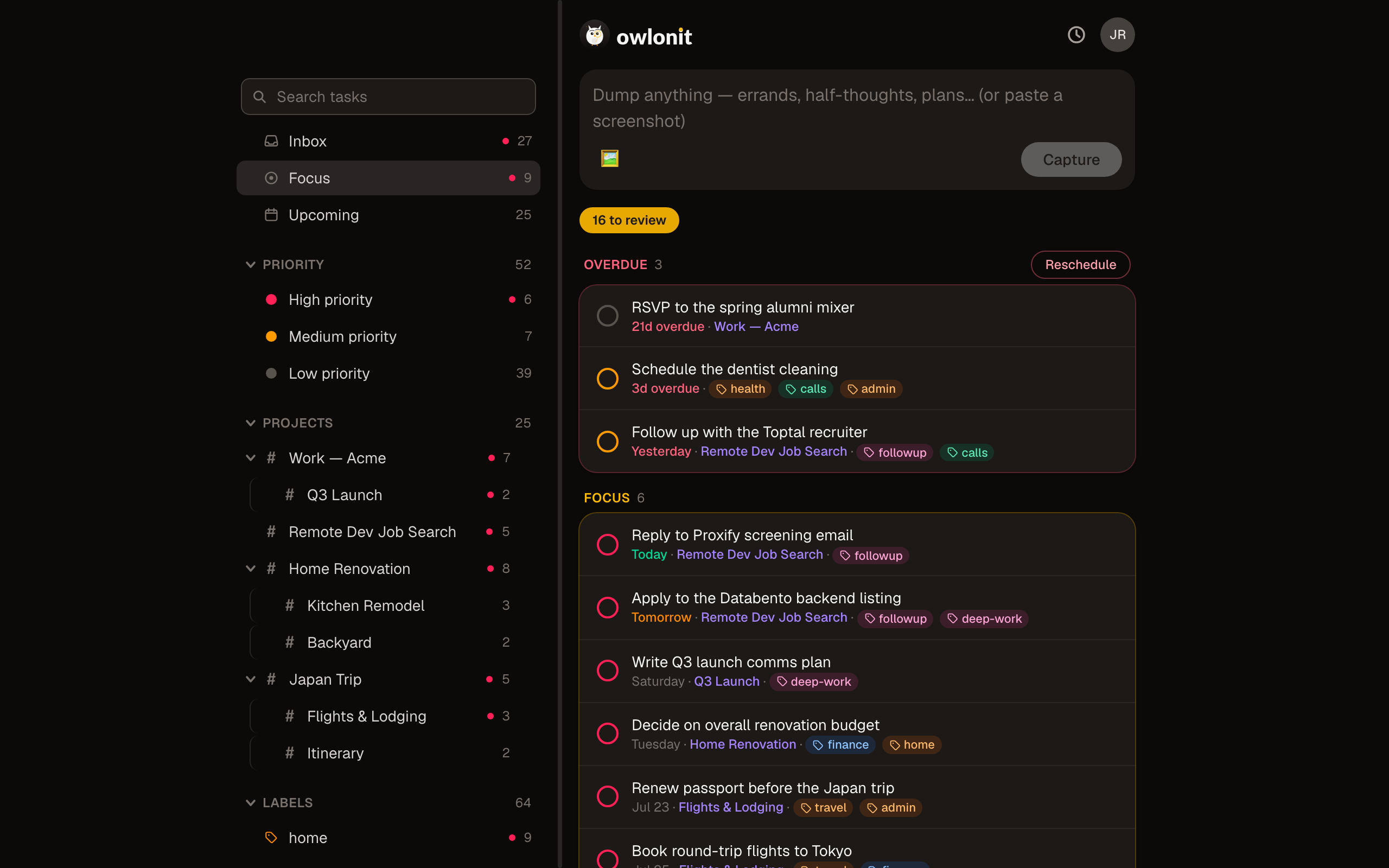
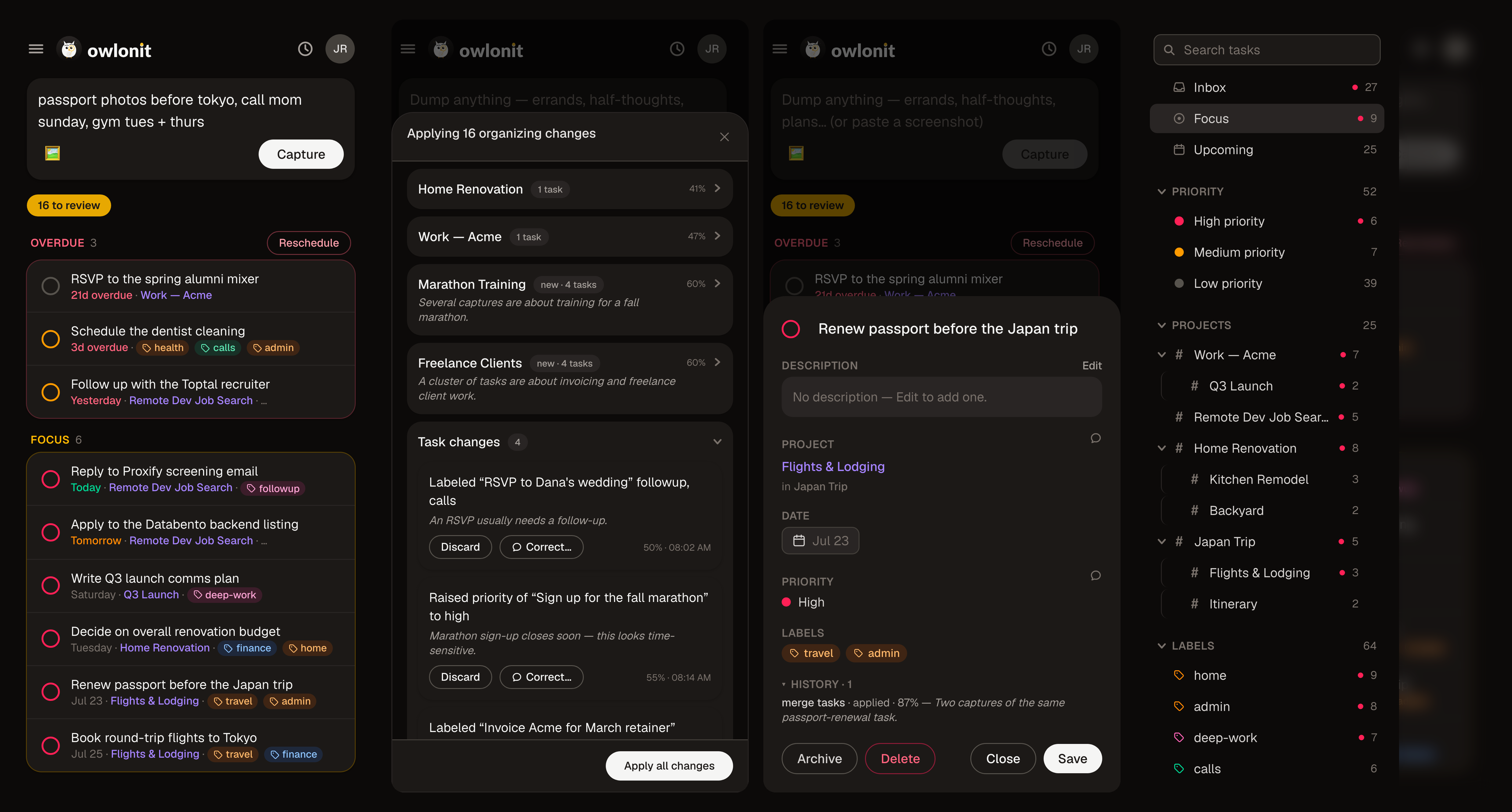
You capture however you think: half a sentence, a screenshot, a forwarded email, and the AI turns it into an organized, prioritized, self-maintaining list.
There's no project picker, no priority dropdown, and no inbox you're supposed to sort. That's not a missing feature, it's the product!
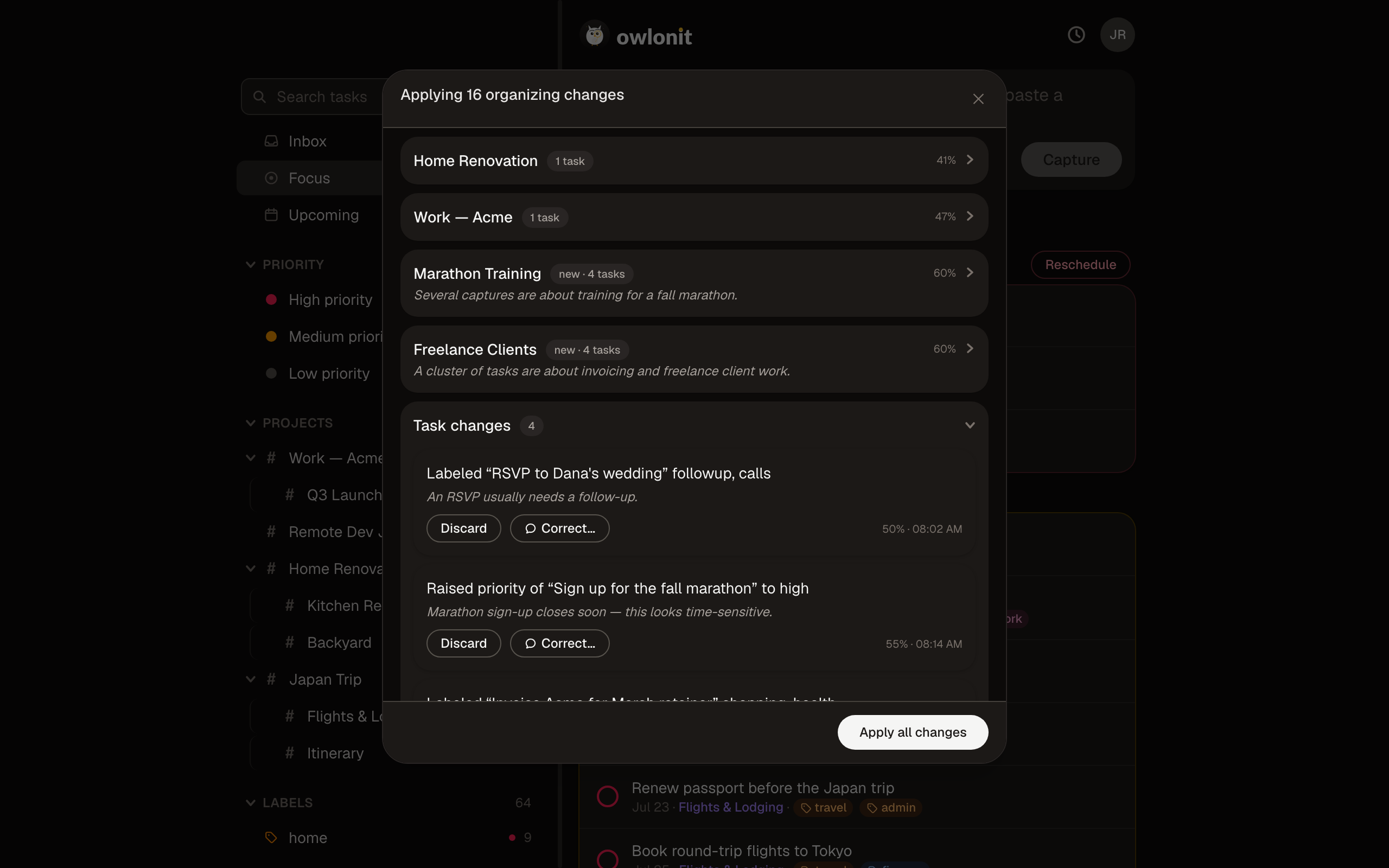
Every change the AI makes comes with a one-line reason and is undoable in one tap. When it isn't confident, it proposes instead of acting, and earns autonomy as you keep its calls.
Free during beta. Your data is never used to train AI models.
Features
- Capture anything: type it, dictate it, paste a screenshot, or forward an email, and Owlonit reads the tasks out of it
- Share straight from any app into Owlonit (Android)
- Dates, priorities, durations, and "every Monday" recurrences are inferred, never asked
- Tasks are filed into projects the AI creates, merges, renames, and retires on its own
- A Focus view judges what actually deserves attention today, not just what's dated today
- Reminders fire only when something is genuinely time-bound
- Every change carries a one-line reason; everything is undoable in one tap, including whole batches
- Low-confidence changes are proposed for review, not applied
- Correct it in plain words: "this belongs with the wedding stuff", and it refiles and remembers
- Learns from what you finish, ignore, and correct, not from settings
- Installable web app, free during beta
Use Cases
- You remember three things at once while walking...dictate them and keep walking; they're sorted by the time you look
- A screenshot of a concert lineup, a recipe, or a doctor's instructions becomes real tasks instead of dying in your camera roll
- A confirmation email needs two follow-ups: forward it and never open it again
- You've abandoned two or three to-do apps because keeping them tidy became the actual work
- Your real system is Notes plus screenshots plus "I'll remember," and it isn't working
- You're coming from Todoist or TickTick with a graveyard of half-dead projects. One sweep rebuilds the mess into something coherent
- Weeks of small commitments have piled up and you have no idea what matters today. 'Focus' decides instead of showing you everything dated today
- Your life changes: new job, a move, a wedding...and the old structure is wrong; the workspace restructures itself rather than waiting for you to
- You will never sit down for a weekly review, and you shouldn't have to

Comments


A month ago I pointed OpenClaw at my own Todoist and told it to keep the thing organized overnight: file tasks into projects, fix priorities, clean up after me. It worked. What surprised me wasn't that it worked; it was how fast I stopped opening the log to check what it had changed. That's the moment I wanted to build a product around. Not "a to-do app with AI features"...every incumbent has those now, but a list where organizing simply isn't your job. No project picker, no priority dropdown, no inbox you're supposed to triage. You capture however you think, and structure is the system's problem. The hard part turned out to be trust, not extraction. So every change comes with a one-line reason, everything is one tap from undone, and when the AI isn't confident it proposes instead of acting and earns autonomy as you keep its calls. It's free during beta and I'm mostly looking for people who'll tell me when it gets something wrong. That feedback is the product right now. If you've got a Todoist graveyard, paste a token and watch it rebuild the mess; that's the fastest way to find out whether the idea holds up. Would love to hear your feedback. I read it all!

This is a refreshing approach to productivity reducing admin so people can focus on what really matters. The same philosophy applies in healthcare, where clear, evidence-based treatment plans can make recovery feel less overwhelming. For those exploring https://www.physio1stuk.com/shock-wave-therapy-eswt/ personalized care helps keep the focus on achieving better outcomes. 💙
This is a refreshing approach to productivity reducing admin so people can focus on what really matters. The same philosophy applies in healthcare, where clear, evidence-based treatment plans can make recovery feel less overwhelming. For those exploring https://www.physio1stuk.com/shock-wave-therapy-eswt/ personalized care helps keep the focus on achieving better outcomes. 💙


Tired of task management apps becoming the actual work. You dump your thoughts in Owlonit and it figures out the structure, dates, priorities, and recurring patterns without asking you fifty questions. The idea of a to-do app that stops trying to be a project management tool and just handles organization automatically is exactly what was missing.


Most task managers put the burden on you to organize. You capture tasks, label them, set priorities, then hope you remembered to review weekly. Owlonit flips that. Instead of me telling the system what matters, it watches what I actually do and infers the priorities. The multi-format capture (text, dictation, screenshot, forwarded email) means friction isn't a blocker. And the AI learning from my corrections over time means it gets better at knowing what genuinely deserves attention vs. just what's dated today.
This is a refreshing approach to productivity reducing admin so people can focus on what really matters. The same philosophy applies in healthcare, where clear, evidence-based treatment plans can make recovery feel less overwhelming. For those exploring https://www.physio1stuk.com/shock-wave-therapy-eswt/ personalized care helps keep the focus on achieving better outcomes. 💙


"When it isn't confident, it proposes instead of acting" is the design decision doing the real work here, and it is the one most AI-organising tools skip. The one-line reason plus one-tap undo is what makes the autonomy legible; people rarely distrust automation itself, they distrust automation they cannot audit. Worth making that reason log browsable after the fact, not only at the moment of the change. The trust question tends to arrive a week later, when someone wants to know why a thing quietly got deprioritised.
Premium Products


























Sponsors
Buy
Awards
View all
Awards
View allMakers
Makers
Comments
A month ago I pointed OpenClaw at my own Todoist and told it to keep the thing organized overnight: file tasks into projects, fix priorities, clean up after me. It worked. What surprised me wasn't that it worked; it was how fast I stopped opening the log to check what it had changed. That's the moment I wanted to build a product around. Not "a to-do app with AI features"...every incumbent has those now, but a list where organizing simply isn't your job. No project picker, no priority dropdown, no inbox you're supposed to triage. You capture however you think, and structure is the system's problem. The hard part turned out to be trust, not extraction. So every change comes with a one-line reason, everything is one tap from undone, and when the AI isn't confident it proposes instead of acting and earns autonomy as you keep its calls. It's free during beta and I'm mostly looking for people who'll tell me when it gets something wrong. That feedback is the product right now. If you've got a Todoist graveyard, paste a token and watch it rebuild the mess; that's the fastest way to find out whether the idea holds up. Would love to hear your feedback. I read it all!
This is a refreshing approach to productivity reducing admin so people can focus on what really matters. The same philosophy applies in healthcare, where clear, evidence-based treatment plans can make recovery feel less overwhelming. For those exploring https://www.physio1stuk.com/shock-wave-therapy-eswt/ personalized care helps keep the focus on achieving better outcomes. 💙
This is a refreshing approach to productivity reducing admin so people can focus on what really matters. The same philosophy applies in healthcare, where clear, evidence-based treatment plans can make recovery feel less overwhelming. For those exploring https://www.physio1stuk.com/shock-wave-therapy-eswt/ personalized care helps keep the focus on achieving better outcomes. 💙
Tired of task management apps becoming the actual work. You dump your thoughts in Owlonit and it figures out the structure, dates, priorities, and recurring patterns without asking you fifty questions. The idea of a to-do app that stops trying to be a project management tool and just handles organization automatically is exactly what was missing.
Most task managers put the burden on you to organize. You capture tasks, label them, set priorities, then hope you remembered to review weekly. Owlonit flips that. Instead of me telling the system what matters, it watches what I actually do and infers the priorities. The multi-format capture (text, dictation, screenshot, forwarded email) means friction isn't a blocker. And the AI learning from my corrections over time means it gets better at knowing what genuinely deserves attention vs. just what's dated today.
This is a refreshing approach to productivity reducing admin so people can focus on what really matters. The same philosophy applies in healthcare, where clear, evidence-based treatment plans can make recovery feel less overwhelming. For those exploring https://www.physio1stuk.com/shock-wave-therapy-eswt/ personalized care helps keep the focus on achieving better outcomes. 💙
"When it isn't confident, it proposes instead of acting" is the design decision doing the real work here, and it is the one most AI-organising tools skip. The one-line reason plus one-tap undo is what makes the autonomy legible; people rarely distrust automation itself, they distrust automation they cannot audit. Worth making that reason log browsable after the fact, not only at the moment of the change. The trust question tends to arrive a week later, when someone wants to know why a thing quietly got deprioritised.
Premium Products
New to Fazier?
Find your next favorite product or submit your own. Made by @FalakDigital.
Copyright ©2026. All Rights Reserved