
OpenSeed
AI review board for business plans — 15 reviewers, 1 report
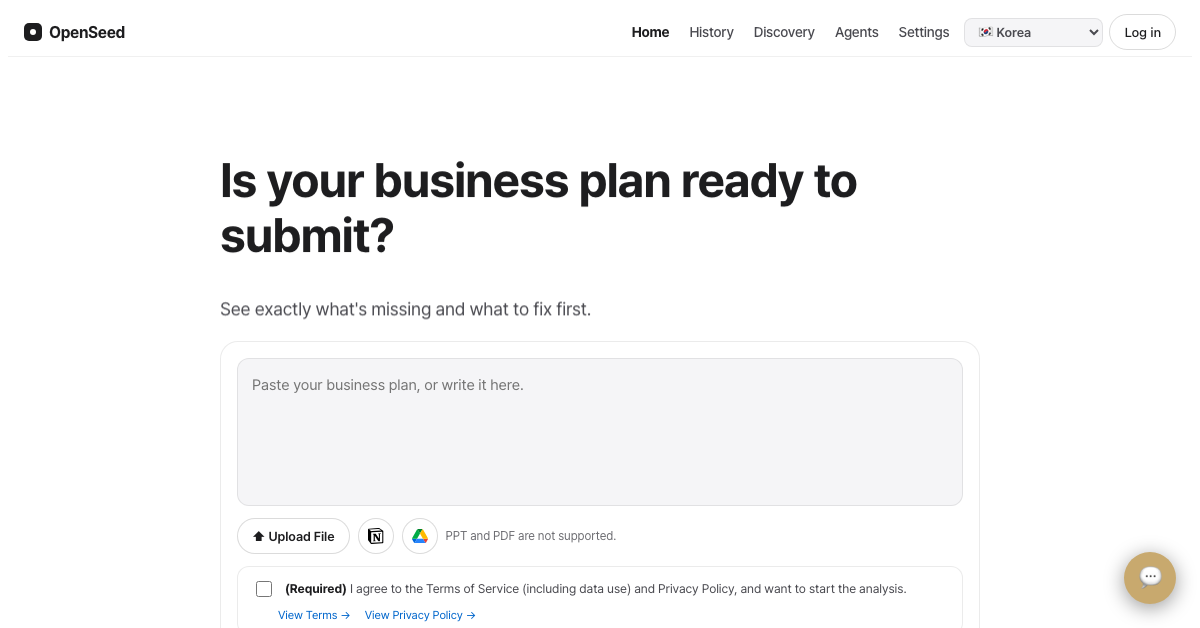
OpenSeed is an AI review board for startup business plans. Instead of one chatbot opinion, 15 specialized AI reviewers — market, product, team, CFO, risk, legal, IP, tax, credit, and a YC-style reviewer — analyze your plan in parallel, and a chief agent merges their findings into a single evidence-first report: scores, red flags, and concrete fixes.
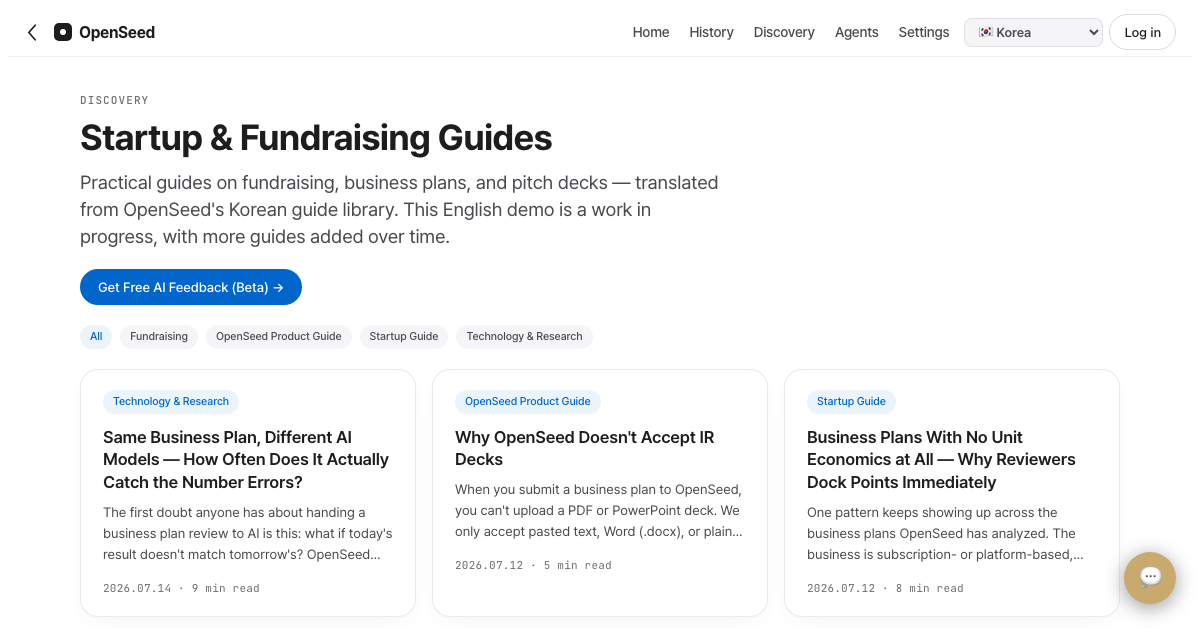
Claims are checked, not praised: the arithmetic in your plan (units × price = totals) is re-computed by code, not guessed by the model. We published our own cross-model benchmark (4 LLMs, 16 runs) showing the checks stay consistent when models change.
Built by a KAIST-backed team, with 2 patents filed on the multi-reviewer architecture. Free during beta — paste your plan, no login required, and your text is deleted right after analysis.

Features
15 specialized AI reviewers run in parallel: market, product, team, CFO, risk, legal, IP, tax, credit, and a YC-style reviewer
Chief agent merges all findings into one evidence-first report with scores, red flags, and concrete fixes
Arithmetic verification — numbers in your plan are re-computed by code, not guessed by an LLM
Published cross-model benchmark (4 LLMs, 16 runs) for consistency across models
No login required — paste your plan and get the report
Privacy-first: your plan text is deleted right after analysis
Free during beta
Use Cases
Founders pressure-testing a business plan before submitting to accelerators or grant programs
Solo founders getting a VC-style review without a warm intro
Startup teams finding weak numbers and missing evidence before investor meetings
Mentors and advisors triaging business plans with a structured, evidence-based report

Comments


Hey Fazier 👋 I'm Charlie, the maker of OpenSeed. I'm a solo founder from Korea. OpenSeed started from a simple frustration: when you ask one AI chatbot to review your business plan, it mostly praises you. Real review boards don't work that way — different specialists attack your plan from different angles. So OpenSeed runs 15 specialized AI reviewers in parallel (market, CFO, legal, IP, tax, credit, a YC-style reviewer, and more), and a chief agent merges their findings into one evidence-first report. The part I'm most proud of: the numbers in your plan are re-computed by code, not guessed by the model — and we published a cross-model benchmark (4 LLMs, 16 runs) to show the checks stay consistent when models change. It's been used by Korean founders preparing government grant submissions, and this launch is the English version. Free during beta, no login required, and your plan text is deleted right after analysis. I'd love your feedback — especially on what a US founder would need before trusting an AI review. I'm here all day!

I like the idea of having multiple specialized reviewers instead of relying on a single AI response. One feature I'd find valuable is the ability to compare two versions of the same business plan side by side, so founders can immediately see whether their revisions improved the overall score and addressed previous concerns.


The arithmetic verification is the strongest part here because it tackles a real weakness of AI plan reviews: they often sound confident while missing broken numbers. I would highlight one before/after example in the report so founders can quickly see how a red flag becomes a concrete fix before an investor meeting.

Charlie — on your question of what a US founder needs before trusting an AI review: the make-or-break is confidentiality, and "text deleted right after analysis" is the right instinct but it needs to be verifiable. Founders hand plans to accelerators under NDA; before pasting one here they'll want it explicit that the text isn't retained or used to train any model, ideally with the deletion provable rather than just stated. The other thing that would build trust is surfacing reviewer disagreement instead of only the merged verdict — if the CFO reviewer and the YC-style reviewer score the same plan very differently, seeing that split is more useful than a smoothed-over consensus, because it tells the founder where the plan is genuinely contested.
The "claims are checked, not praised" framing is the real differentiator - most AI plan reviewers just reflect your own optimism back at you. Re-computing the arithmetic in code instead of trusting the model to do the math is exactly right; that's the quiet failure mode of single-LLM reviewers. Splitting it across CFO / legal / IP / YC-style reviewers mirrors how actual diligence works, and publishing a cross-model benchmark to show the checks survive a model swap is a strong trust signal. Curious whether the 15 reviewers ever disagree hard enough that the chief agent has to arbitrate - and whether that disagreement surfaces in the report, since that tension is often where the useful signal is.

One of the biggest barriers for solo founders is the asymmetry of feedback. You spend weeks building a business plan and pitch deck, then you either get rubber-stamped approval from people who want to be supportive, or you get vague feedback like "the market size seems small" with no actionable path forward. Having an AI that can simultaneously play the role of a hardened product person, financial analyst, regulatory expert, and VC is incredibly powerful because these specialists actually disagree on what matters. A VC cares about TAM and defensibility. A CFO cares about unit economics. The product expert cares about workflow friction. Getting all of them to attack your plan from different angles in one structured report removes so much of the blind-spot friction that haunts early-stage planning. The fact that it requires no login and handles this in beta for free makes it genuinely accessible to the exact people who need it most - bootstrapped founders who can't afford a fractional CFO or advisor network.





OpenSeed has great potential! A few improvements could make it even better. I'd love to share my feedback and suggestions. WhatsApp: https://wa.me/447307349530 Telegram: t.me/rforrank



The sycophancy problem is exactly the right thing to attack — a single model reviewing your own plan almost always defaults to encouragement. Two details stand out: recomputing the numbers in code instead of trusting the model's arithmetic is the correct call (LLMs are genuinely bad at that), and running a cross-model benchmark to prove consistency is more rigor than most tools bother with. My genuine question: when the 15 reviewers disagree — say the CFO and the risk reviewer pull in opposite directions — does the merged report surface that tension, or does the admin smooth it into a consensus? The disagreement feels like where the real signal lives.
Recomputing the arithmetic in code instead of relying on the LLM to guess the math is smart. That tackles a huge failure mode in typical AI plan reviews. The 15-reviewer setup and no-signup flow make it really easy to try out. One useful addition would be a simple visual breakdown showing reviewer disagreement, like highlighting areas where the CFO and VC reviewers scored the plan differently. That split is usually where the most actionable insights live.

Premium Products




































Sponsors
Buy

Awards
View all
Awards
View allComments
Hey Fazier 👋 I'm Charlie, the maker of OpenSeed. I'm a solo founder from Korea. OpenSeed started from a simple frustration: when you ask one AI chatbot to review your business plan, it mostly praises you. Real review boards don't work that way — different specialists attack your plan from different angles. So OpenSeed runs 15 specialized AI reviewers in parallel (market, CFO, legal, IP, tax, credit, a YC-style reviewer, and more), and a chief agent merges their findings into one evidence-first report. The part I'm most proud of: the numbers in your plan are re-computed by code, not guessed by the model — and we published a cross-model benchmark (4 LLMs, 16 runs) to show the checks stay consistent when models change. It's been used by Korean founders preparing government grant submissions, and this launch is the English version. Free during beta, no login required, and your plan text is deleted right after analysis. I'd love your feedback — especially on what a US founder would need before trusting an AI review. I'm here all day!
I like the idea of having multiple specialized reviewers instead of relying on a single AI response. One feature I'd find valuable is the ability to compare two versions of the same business plan side by side, so founders can immediately see whether their revisions improved the overall score and addressed previous concerns.
The arithmetic verification is the strongest part here because it tackles a real weakness of AI plan reviews: they often sound confident while missing broken numbers. I would highlight one before/after example in the report so founders can quickly see how a red flag becomes a concrete fix before an investor meeting.
Charlie — on your question of what a US founder needs before trusting an AI review: the make-or-break is confidentiality, and "text deleted right after analysis" is the right instinct but it needs to be verifiable. Founders hand plans to accelerators under NDA; before pasting one here they'll want it explicit that the text isn't retained or used to train any model, ideally with the deletion provable rather than just stated. The other thing that would build trust is surfacing reviewer disagreement instead of only the merged verdict — if the CFO reviewer and the YC-style reviewer score the same plan very differently, seeing that split is more useful than a smoothed-over consensus, because it tells the founder where the plan is genuinely contested.
The "claims are checked, not praised" framing is the real differentiator - most AI plan reviewers just reflect your own optimism back at you. Re-computing the arithmetic in code instead of trusting the model to do the math is exactly right; that's the quiet failure mode of single-LLM reviewers. Splitting it across CFO / legal / IP / YC-style reviewers mirrors how actual diligence works, and publishing a cross-model benchmark to show the checks survive a model swap is a strong trust signal. Curious whether the 15 reviewers ever disagree hard enough that the chief agent has to arbitrate - and whether that disagreement surfaces in the report, since that tension is often where the useful signal is.
One of the biggest barriers for solo founders is the asymmetry of feedback. You spend weeks building a business plan and pitch deck, then you either get rubber-stamped approval from people who want to be supportive, or you get vague feedback like "the market size seems small" with no actionable path forward. Having an AI that can simultaneously play the role of a hardened product person, financial analyst, regulatory expert, and VC is incredibly powerful because these specialists actually disagree on what matters. A VC cares about TAM and defensibility. A CFO cares about unit economics. The product expert cares about workflow friction. Getting all of them to attack your plan from different angles in one structured report removes so much of the blind-spot friction that haunts early-stage planning. The fact that it requires no login and handles this in beta for free makes it genuinely accessible to the exact people who need it most - bootstrapped founders who can't afford a fractional CFO or advisor network.
OpenSeed has great potential! A few improvements could make it even better. I'd love to share my feedback and suggestions. WhatsApp: https://wa.me/447307349530 Telegram: t.me/rforrank
The sycophancy problem is exactly the right thing to attack — a single model reviewing your own plan almost always defaults to encouragement. Two details stand out: recomputing the numbers in code instead of trusting the model's arithmetic is the correct call (LLMs are genuinely bad at that), and running a cross-model benchmark to prove consistency is more rigor than most tools bother with. My genuine question: when the 15 reviewers disagree — say the CFO and the risk reviewer pull in opposite directions — does the merged report surface that tension, or does the admin smooth it into a consensus? The disagreement feels like where the real signal lives.
Recomputing the arithmetic in code instead of relying on the LLM to guess the math is smart. That tackles a huge failure mode in typical AI plan reviews. The 15-reviewer setup and no-signup flow make it really easy to try out. One useful addition would be a simple visual breakdown showing reviewer disagreement, like highlighting areas where the CFO and VC reviewers scored the plan differently. That split is usually where the most actionable insights live.
Premium Products
New to Fazier?

Find your next favorite product or submit your own. Made by @FalakDigital.
Copyright ©2026. All Rights Reserved