MyIntelBrief
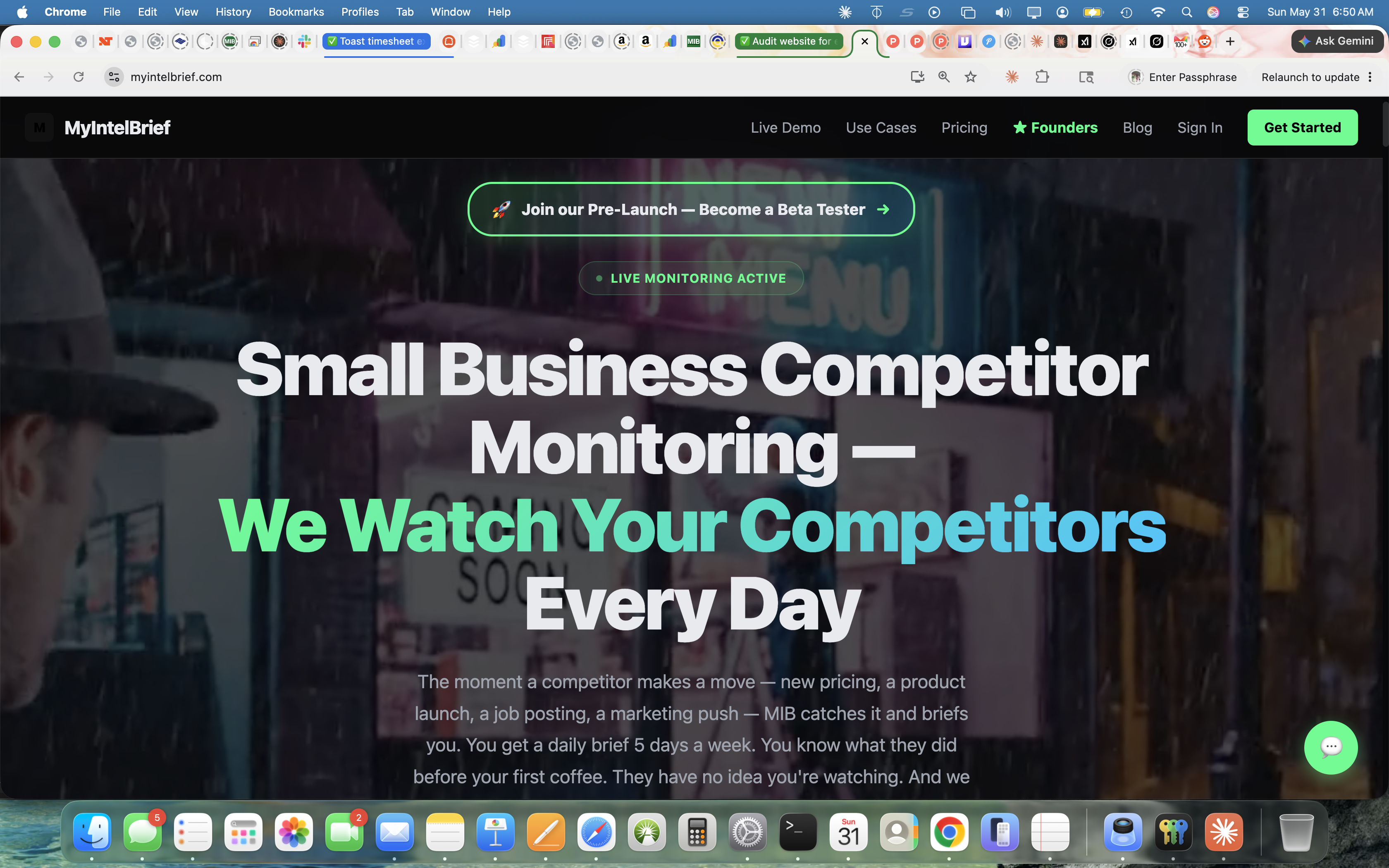
Watch competitors daily in a easy to use email brief.
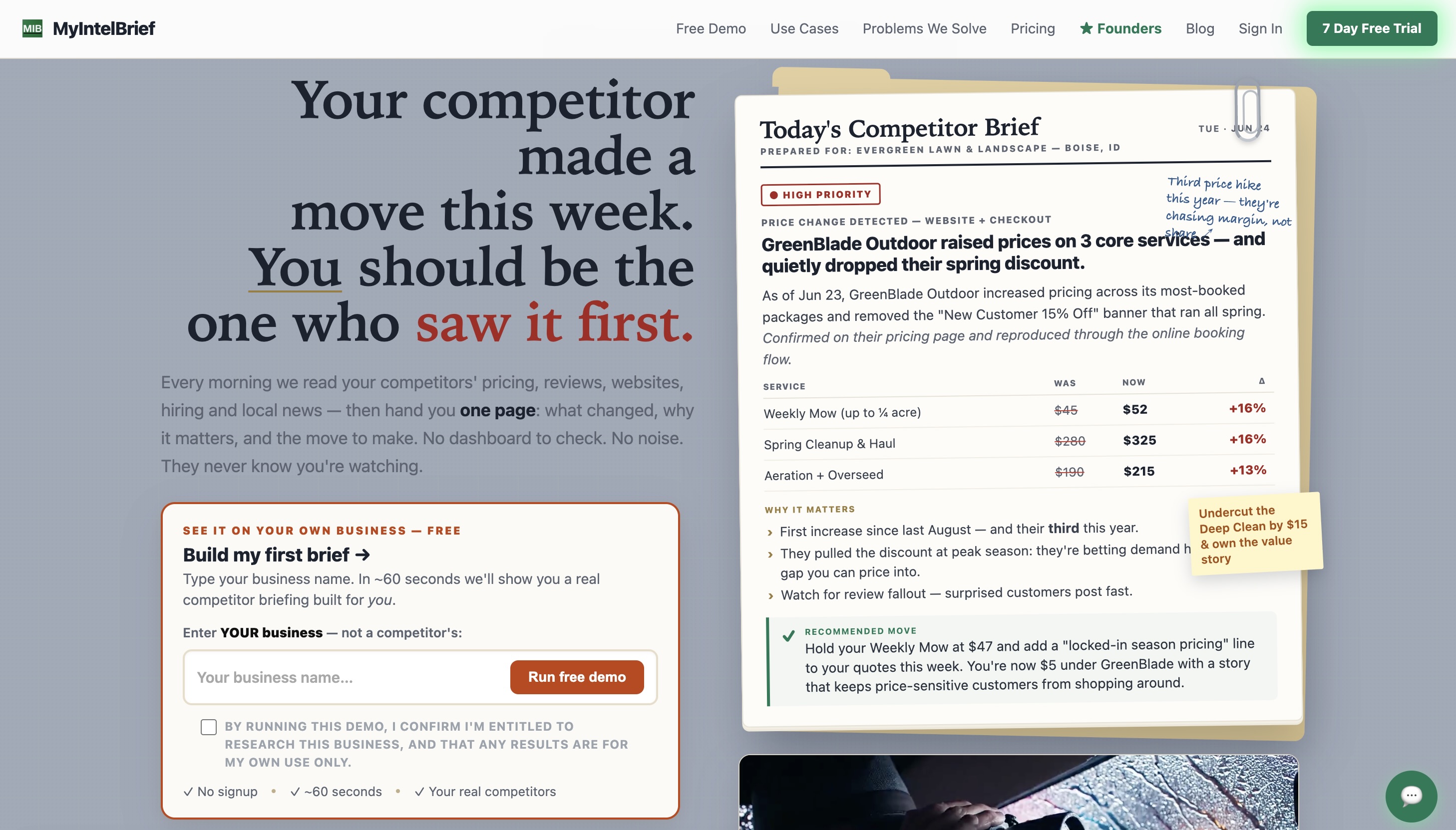
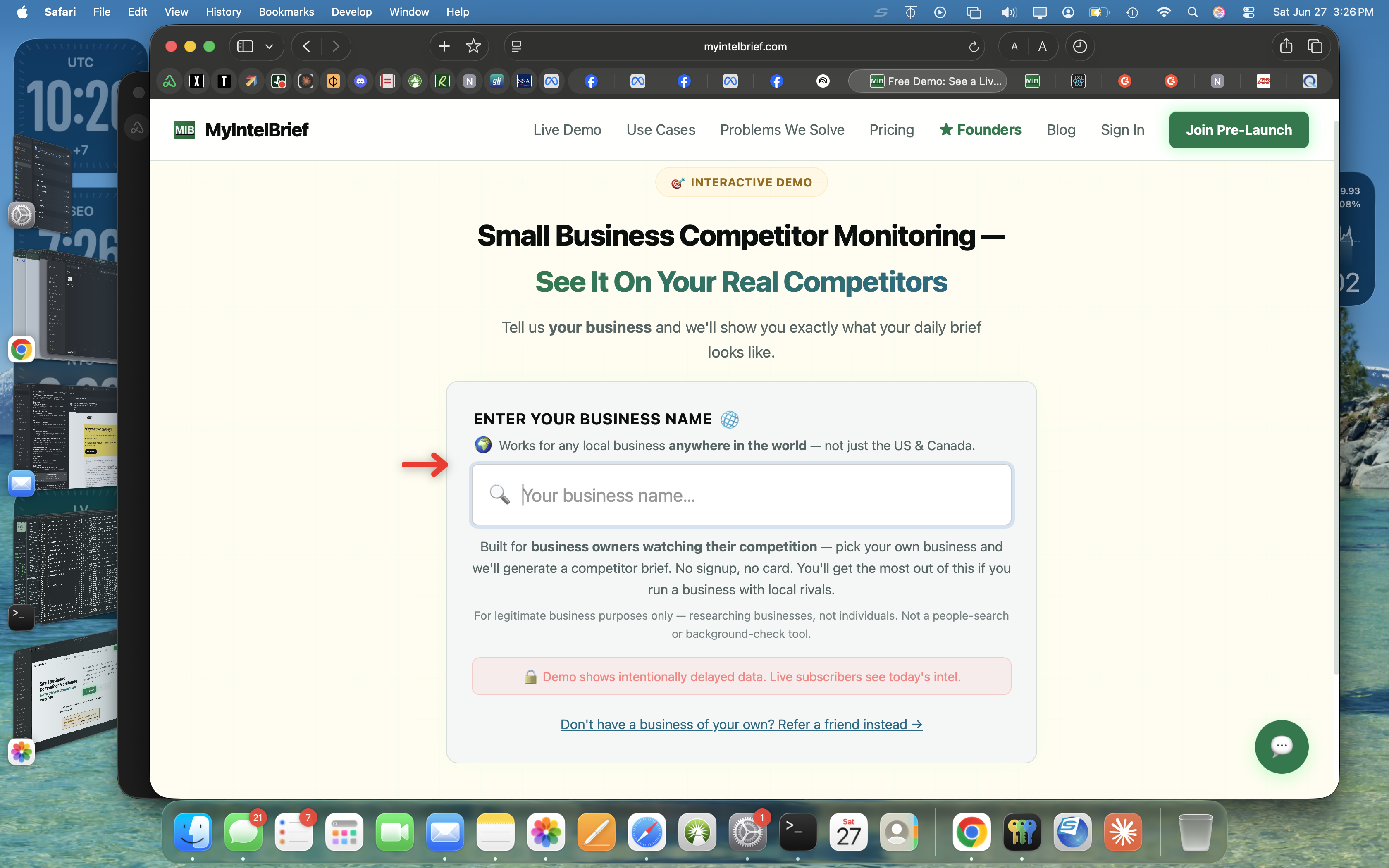
We give you a easy to read daily briefing of what your cometitors were up to every day around breakfast. Did they expand? Change pricing? add a service? Free Demo . 7 day free trial.
Agencies can resell the product with their branding, making your clients think 'how does he/she always know this stuff so quickly?'
Features
- monitor pricing
- watch ratings -google reviews BBB reviews
- learn about neighborhood traffic disruptions/festivals near your location
- Watch your supply chain pricing trend shifts
- Know if your product has been recalled
- Competitor Sentiment
- Job expansions
- new business openings around your location
- much more
Use Cases
Every small business needs to monitor the competition but few have the time. MIB solves it with a quick email consuming 5 min a day instead of hours of deep web crawling.
Fazier Deal

Comments


Hi. Its Chuck from MyIntelBrief. Im glad you are checking the site out. You either have a small or medium business or you know someone who does, and this will be something that will really help. Love to hear comments from you if you discover any bugs that need tweeking. Try the demo of your business and you'll get a really good glimpse of what MIB can do. And if you're a agency, a business consultant or a SEO agency, take a deep look at https://myintelbrief.com/consultant - there you can explore ways to take our briefing product and resell to your clients at your markup - and always look like the smartest business consultant they've ever seen. Whitelabel branding means the clients are presented with a brief that has your logo and name right on the top.

Competitive intelligence collection friction real - monitoring pricing across 5-10 competitors, checking reviews, tracking job openings, all scattered across different sources. Hours per week lost to manual tracking. MIB removes friction entirely by consolidating competitor signals into one daily email. Gets to breakfast brief format, gives startups and agencies the always-on competitive edge without hiring a dedicated market research person. Agencies get white-label resale with client branding. Real win is early warning system - know about pricing moves, new hires, service changes before they impact your business.

The breadth is what I'd stress-test here — pricing, reviews, job posts, recalls AND local festivals are very different data sources, and each has its own false-positive mode. I run keyword monitoring for my own space and the killer was never collection, it was precision: a brief that's 80% noise gets archived unread by week two. Two questions: (1) how do you verify a signal before it lands in the brief — if a competitor A/B tests their pricing page, does that get reported as a "price change"? (2) is there a per-signal mute so I can kill the categories I don't care about and keep it to the 5-minute promise? The white-label resale angle for agencies is genuinely smart, but it also raises the stakes on precision — a consultant forwarding one wrong competitor claim to a client burns trust fast.


Competitive intelligence collection friction real - monitoring pricing across 5-10 competitors, checking reviews, tracking job openings, all scattered across different sources. Hours per week lost to manual tracking. MIB removes friction entirely by consolidating competitor signals into one daily email. Gets to breakfast brief format, gives startups and agencies the always-on competitive edge without hiring a dedicated market research person. Agencies get white-label resale with client branding. Real win is early warning system - know about pricing moves, new hires, service cha

Daily cadence is the interesting bet. Most competitor monitoring I've tried dies because it emails you whether or not anything happened, and by week three you stop opening it. Do you suppress the brief on quiet days, or still send it with a "nothing material" line? The agency white-label angle is the part I'd actually pay for.


The thing I'd want to know before subscribing: what happens on a day when nothing changed? If a competitor raises a price on Monday and just holds it, does that land in Tuesday's brief? And Wednesday's? Every daily digest I've built or subscribed to died the same way, and it wasn't from missing signals. It was from repeating them until people stopped opening the email. I run a content pipeline with the same failure mode. The fix that actually worked wasn't smarter detection, it was two boring things: a rolling window of what we already reported, and a similarity check on meaning rather than wording. "Competitor X expands to Denver" and "X opens a Denver location" are one event, and word overlap won't catch that. With sources as heterogeneous as yours (Google reviews, job posts, recalls, local news), the same real-world event will reach you through three of them on different days, which makes this worse, not better. So the direct question: is there a "we already told you this" layer, and what's the window on it? I saw pedro's point about A/B tests reading as price changes and Samuli's about quiet days. Those look like the same family of problem to me. A materiality threshold plus dedup against recent history covers a surprising amount of it. One more, because of the whitelabel angle: does the brief show a source per signal? A consultant forwarding this to a client is putting their own name on every claim in it, and "where did this come from" is the first thing they'll be asked. Multi-source confirmation before a claim ships is the only thing that ever saved me there.
Premium Products






































Fazier Deal
Sponsors
Buy

Awards
View all
Awards
View allMakers
Makers
Comments
Hi. Its Chuck from MyIntelBrief. Im glad you are checking the site out. You either have a small or medium business or you know someone who does, and this will be something that will really help. Love to hear comments from you if you discover any bugs that need tweeking. Try the demo of your business and you'll get a really good glimpse of what MIB can do. And if you're a agency, a business consultant or a SEO agency, take a deep look at https://myintelbrief.com/consultant - there you can explore ways to take our briefing product and resell to your clients at your markup - and always look like the smartest business consultant they've ever seen. Whitelabel branding means the clients are presented with a brief that has your logo and name right on the top.
Competitive intelligence collection friction real - monitoring pricing across 5-10 competitors, checking reviews, tracking job openings, all scattered across different sources. Hours per week lost to manual tracking. MIB removes friction entirely by consolidating competitor signals into one daily email. Gets to breakfast brief format, gives startups and agencies the always-on competitive edge without hiring a dedicated market research person. Agencies get white-label resale with client branding. Real win is early warning system - know about pricing moves, new hires, service changes before they impact your business.
The breadth is what I'd stress-test here — pricing, reviews, job posts, recalls AND local festivals are very different data sources, and each has its own false-positive mode. I run keyword monitoring for my own space and the killer was never collection, it was precision: a brief that's 80% noise gets archived unread by week two. Two questions: (1) how do you verify a signal before it lands in the brief — if a competitor A/B tests their pricing page, does that get reported as a "price change"? (2) is there a per-signal mute so I can kill the categories I don't care about and keep it to the 5-minute promise? The white-label resale angle for agencies is genuinely smart, but it also raises the stakes on precision — a consultant forwarding one wrong competitor claim to a client burns trust fast.
Competitive intelligence collection friction real - monitoring pricing across 5-10 competitors, checking reviews, tracking job openings, all scattered across different sources. Hours per week lost to manual tracking. MIB removes friction entirely by consolidating competitor signals into one daily email. Gets to breakfast brief format, gives startups and agencies the always-on competitive edge without hiring a dedicated market research person. Agencies get white-label resale with client branding. Real win is early warning system - know about pricing moves, new hires, service cha
Daily cadence is the interesting bet. Most competitor monitoring I've tried dies because it emails you whether or not anything happened, and by week three you stop opening it. Do you suppress the brief on quiet days, or still send it with a "nothing material" line? The agency white-label angle is the part I'd actually pay for.
The thing I'd want to know before subscribing: what happens on a day when nothing changed? If a competitor raises a price on Monday and just holds it, does that land in Tuesday's brief? And Wednesday's? Every daily digest I've built or subscribed to died the same way, and it wasn't from missing signals. It was from repeating them until people stopped opening the email. I run a content pipeline with the same failure mode. The fix that actually worked wasn't smarter detection, it was two boring things: a rolling window of what we already reported, and a similarity check on meaning rather than wording. "Competitor X expands to Denver" and "X opens a Denver location" are one event, and word overlap won't catch that. With sources as heterogeneous as yours (Google reviews, job posts, recalls, local news), the same real-world event will reach you through three of them on different days, which makes this worse, not better. So the direct question: is there a "we already told you this" layer, and what's the window on it? I saw pedro's point about A/B tests reading as price changes and Samuli's about quiet days. Those look like the same family of problem to me. A materiality threshold plus dedup against recent history covers a surprising amount of it. One more, because of the whitelabel angle: does the brief show a source per signal? A consultant forwarding this to a client is putting their own name on every claim in it, and "where did this come from" is the first thing they'll be asked. Multi-source confirmation before a claim ships is the only thing that ever saved me there.
Premium Products
New to Fazier?

Find your next favorite product or submit your own. Made by @FalakDigital.
Copyright ©2026. All Rights Reserved