
ListingLoom
Free Etsy listing generator that follows Etsy's actual rules
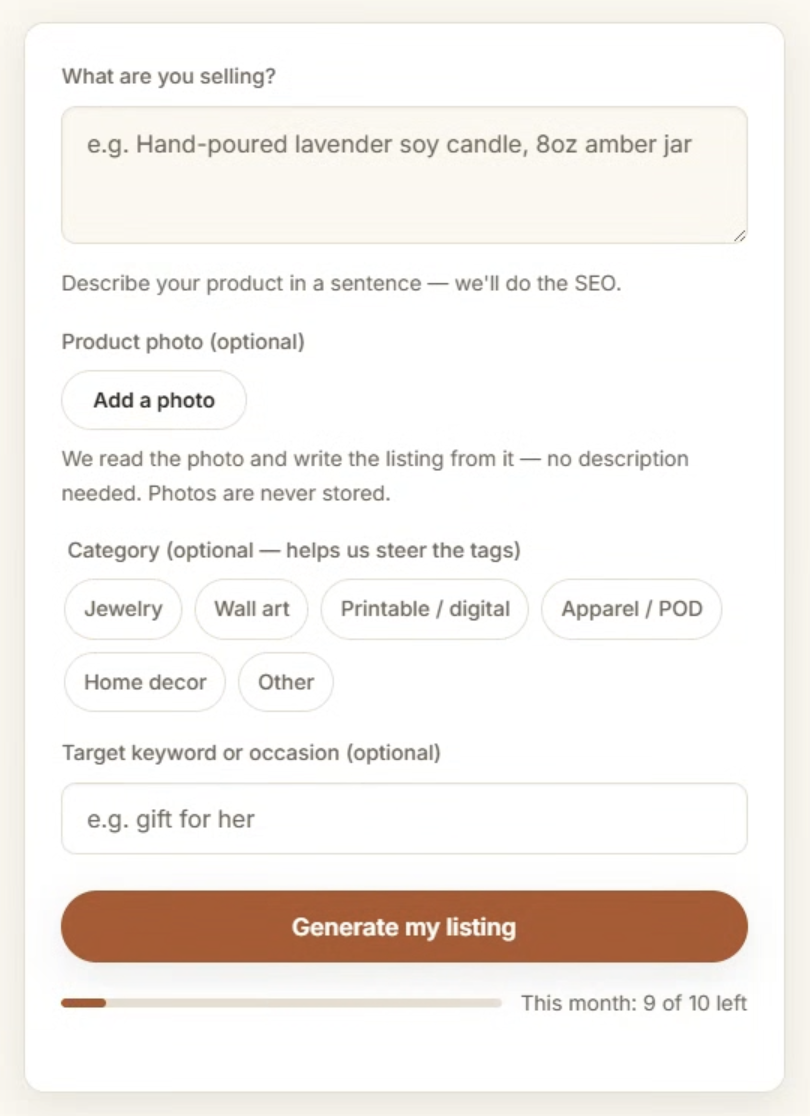
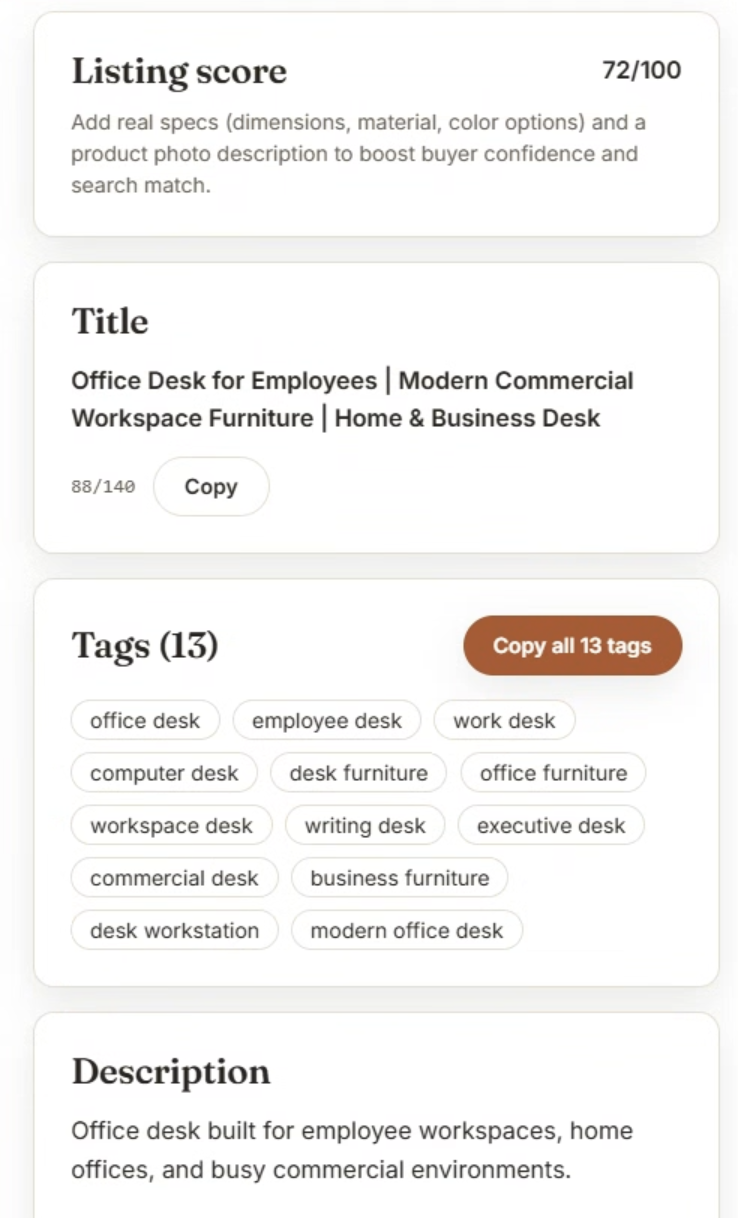
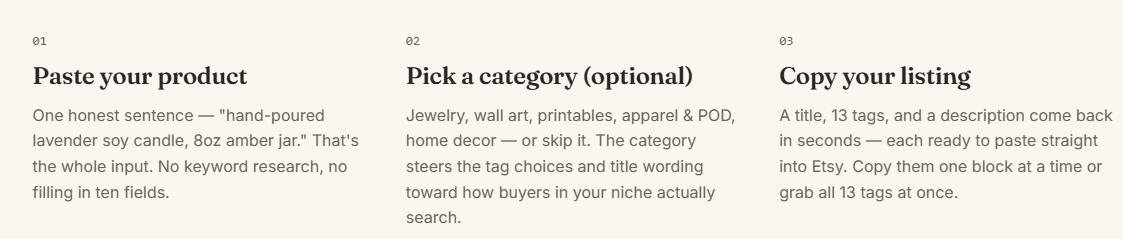
ChatGPT can write you an Etsy listing, but it doesn't know Etsy's rules unless you prompt-engineer them yourself — exactly 13 tags, each ≤20 characters, a title that front-loads your keyword in the first 40 characters. ListingLoom bakes those constraints in: paste one sentence about your product, get a compliant title, 13 valid tags, and a description back. Free to try, no signup. Solo-built, very early — 0 paying customers so far.
Features
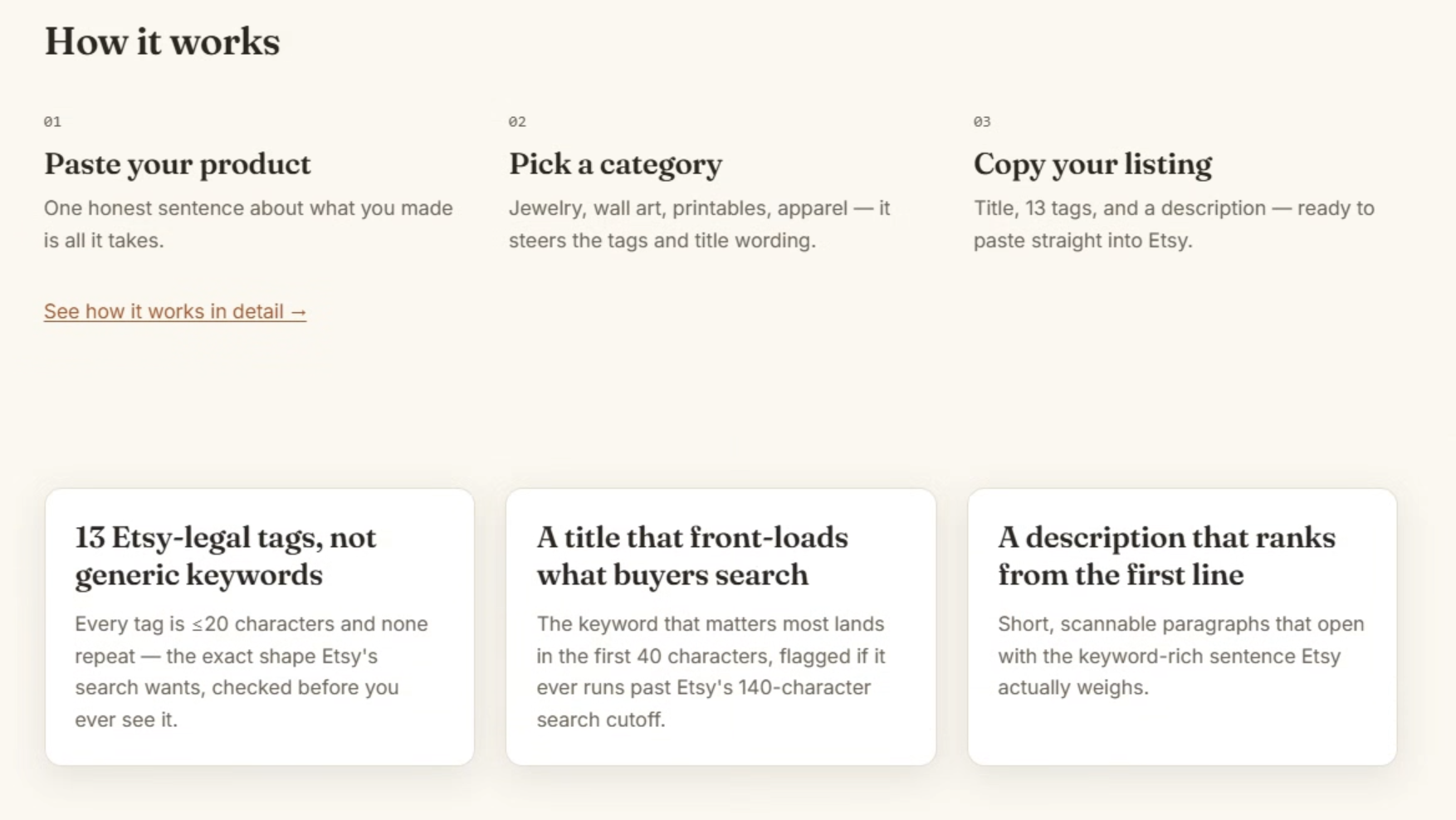
- Generates exactly 13 Etsy-valid tags, each ≤20 characters, no duplicates
- Title front-loads your best keyword within the first 40 characters
- Flags titles that exceed Etsy's 140-character search cutoff
- No signup required for the free tier
- Category-aware tag vocabulary (jewelry, wall art, printables, apparel/POD, home decor)
Use Cases
- Etsy sellers who don't know Etsy's tag/title rules and are guessing
- POD sellers listing many similar variants quickly
- Anyone who tried prompting ChatGPT and got generic, rule-breaking copy back

Comments


Etsy sellers face constant friction with tag/title compliance. ChatGPT gives you generic copy that violates Etsy's actual rules - you still spend hours editing to get it right. ListingLoom eliminates that entirely by enforcing the exact constraints from day one. The category-aware vocabulary and keyword front-loading take guesswork out of discoverability. For sellers managing multiple listings or POD variants, this becomes a force multiplier on listing quality and launch speed. Huge time save.

Built this after Etsy silently truncated a listing title I thought was fine — turns out the real search cutoff and the tag rules (13 max, 20 chars each) aren't documented anywhere obvious. ListingLoom just enforces them from the start instead of you finding out the hard way. Free to try, no signup. Would love feedback from anyone who's hit the same wall.

ListingLoom has great potential! A few improvements could make it even better. I'd love to share my feedback and suggestions. Email: [email protected]

ice work on baking Etsy's actual rules into the generator — most people don't know about the 13-tag limit or the 20-char cap per tag until their listing gets rejected. The category-aware vocabulary is a smart touch too. One thought: have you considered adding an "Amazon Handmade" mode? Their listing rules are slightly different from Etsy's but the core concept (auto-generating compliant copy) would translate well. Good luck with the early traction!
ice work on baking Etsy's actual rules into the generator — most people don't know about the 13-tag limit or the 20-char cap per tag until their listing gets rejected. The category-aware vocabulary is a smart touch too. One thought: have you considered adding an "Amazon Handmade" mode? Their listing rules are slightly different from Etsy's but the core concept (auto-generating compliant copy) would translate well. Good luck with the early traction!
Baking exact Etsy constraints into generation is a stronger wedge than generic AI copy. The category-aware vocabulary and no-signup trial lower friction for solo sellers. One useful next step would be a pre-publish checklist that flags repeated tags and shows which keyword appears in the first 40 title characters, so sellers can understand why an output is compliant instead of treating it as a black box.

Baking the constraints into the tool instead of expecting users to prompt-engineer them is the right call - 'exactly 13 tags, each under 20 chars' is exactly the kind of rule people get wrong when they freestyle it with ChatGPT. The no-signup free tier is a good funnel too. One suggestion: a small 'why these tags' explanation next to the output would build trust with sellers who are skeptical of generated content.
Baking Etsy's strict rules right into the tool is smart. Most sellers only realize their tags are too long or cut off after posting. The category-aware copy and no-signup setup make it super easy to test out. One nice addition would be a simple visual counter next to the generated copy, like showing 11 out of 13 tags used or highlighting the first 40 characters in the title. That way, sellers can quickly tweak things without breaking Etsy's limits. Really solid tool so far!


The real pain point for Etsy sellers has always been balancing optimization with compliance. You want better SEO and visibility, but Etsy's algorithm rules are opaque and violations can tank your shop. Having a tool that follows Etsy's actual documented rules removes that guesswork. Most listing assistants claim to optimize, but end up breaking platform rules or creating keyword-stuffed garbage. ListingLoom's approach of building on actual Etsy constraints rather than generic SEO theory is smarter - it means sellers can scale without learning the hard way what gets shadowbanned.


This solves a surprisingly specific but real problem. Baking Etsy’s title and tag rules directly into the generator makes it much more useful than a generic AI writer, especially for sellers who don’t want to memorize every constraint. The free, no-signup trial is a nice touch too. I’d be interested to see whether it can generate alternative keyword sets for different buyer intents.
ice work on baking Etsy's actual rules into the generator — most people don't know about the 13-tag limit or the 20-char cap per tag until their listing gets rejected. The category-aware vocabulary is a smart touch too. One thought: have you considered adding an "Amazon Handmade" mode? Their listing rules are slightly different from Etsy's but the core concept (auto-generating compliant copy) would translate well. Good luck with the early traction!


Premium Products




































Sponsors
Buy

Awards
View all
Awards
View allMakers
Makers
Comments
Etsy sellers face constant friction with tag/title compliance. ChatGPT gives you generic copy that violates Etsy's actual rules - you still spend hours editing to get it right. ListingLoom eliminates that entirely by enforcing the exact constraints from day one. The category-aware vocabulary and keyword front-loading take guesswork out of discoverability. For sellers managing multiple listings or POD variants, this becomes a force multiplier on listing quality and launch speed. Huge time save.
Built this after Etsy silently truncated a listing title I thought was fine — turns out the real search cutoff and the tag rules (13 max, 20 chars each) aren't documented anywhere obvious. ListingLoom just enforces them from the start instead of you finding out the hard way. Free to try, no signup. Would love feedback from anyone who's hit the same wall.
ListingLoom has great potential! A few improvements could make it even better. I'd love to share my feedback and suggestions. Email: [email protected]
ice work on baking Etsy's actual rules into the generator — most people don't know about the 13-tag limit or the 20-char cap per tag until their listing gets rejected. The category-aware vocabulary is a smart touch too. One thought: have you considered adding an "Amazon Handmade" mode? Their listing rules are slightly different from Etsy's but the core concept (auto-generating compliant copy) would translate well. Good luck with the early traction!
ice work on baking Etsy's actual rules into the generator — most people don't know about the 13-tag limit or the 20-char cap per tag until their listing gets rejected. The category-aware vocabulary is a smart touch too. One thought: have you considered adding an "Amazon Handmade" mode? Their listing rules are slightly different from Etsy's but the core concept (auto-generating compliant copy) would translate well. Good luck with the early traction!
Baking exact Etsy constraints into generation is a stronger wedge than generic AI copy. The category-aware vocabulary and no-signup trial lower friction for solo sellers. One useful next step would be a pre-publish checklist that flags repeated tags and shows which keyword appears in the first 40 title characters, so sellers can understand why an output is compliant instead of treating it as a black box.
Baking the constraints into the tool instead of expecting users to prompt-engineer them is the right call - 'exactly 13 tags, each under 20 chars' is exactly the kind of rule people get wrong when they freestyle it with ChatGPT. The no-signup free tier is a good funnel too. One suggestion: a small 'why these tags' explanation next to the output would build trust with sellers who are skeptical of generated content.
Baking Etsy's strict rules right into the tool is smart. Most sellers only realize their tags are too long or cut off after posting. The category-aware copy and no-signup setup make it super easy to test out. One nice addition would be a simple visual counter next to the generated copy, like showing 11 out of 13 tags used or highlighting the first 40 characters in the title. That way, sellers can quickly tweak things without breaking Etsy's limits. Really solid tool so far!
The real pain point for Etsy sellers has always been balancing optimization with compliance. You want better SEO and visibility, but Etsy's algorithm rules are opaque and violations can tank your shop. Having a tool that follows Etsy's actual documented rules removes that guesswork. Most listing assistants claim to optimize, but end up breaking platform rules or creating keyword-stuffed garbage. ListingLoom's approach of building on actual Etsy constraints rather than generic SEO theory is smarter - it means sellers can scale without learning the hard way what gets shadowbanned.
This solves a surprisingly specific but real problem. Baking Etsy’s title and tag rules directly into the generator makes it much more useful than a generic AI writer, especially for sellers who don’t want to memorize every constraint. The free, no-signup trial is a nice touch too. I’d be interested to see whether it can generate alternative keyword sets for different buyer intents.
ice work on baking Etsy's actual rules into the generator — most people don't know about the 13-tag limit or the 20-char cap per tag until their listing gets rejected. The category-aware vocabulary is a smart touch too. One thought: have you considered adding an "Amazon Handmade" mode? Their listing rules are slightly different from Etsy's but the core concept (auto-generating compliant copy) would translate well. Good luck with the early traction!
Premium Products
New to Fazier?

Find your next favorite product or submit your own. Made by @FalakDigital.
Copyright ©2026. All Rights Reserved