IndexMyURL
Backlink indexer & AI search discovery for Google and ChatGP
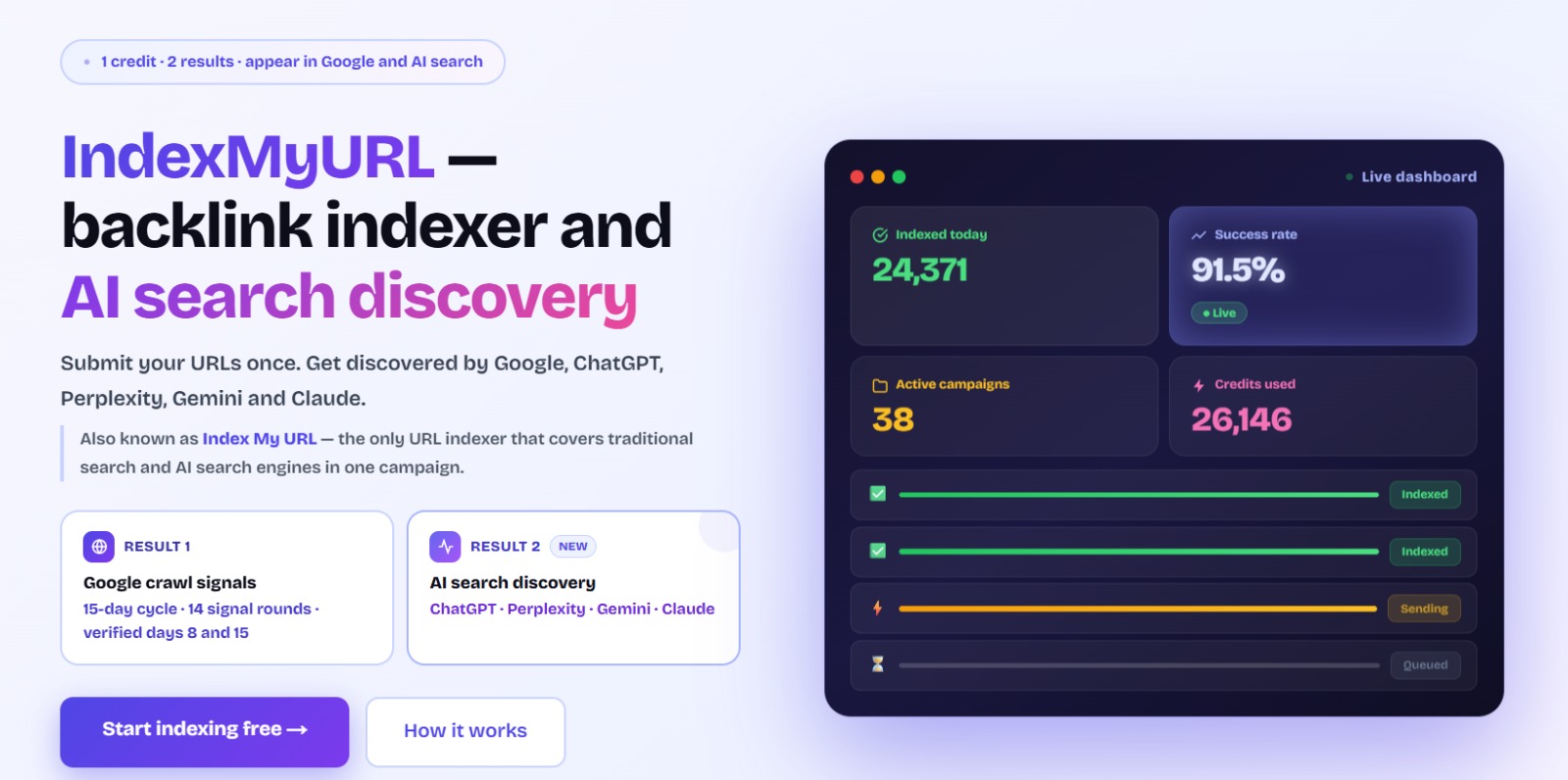
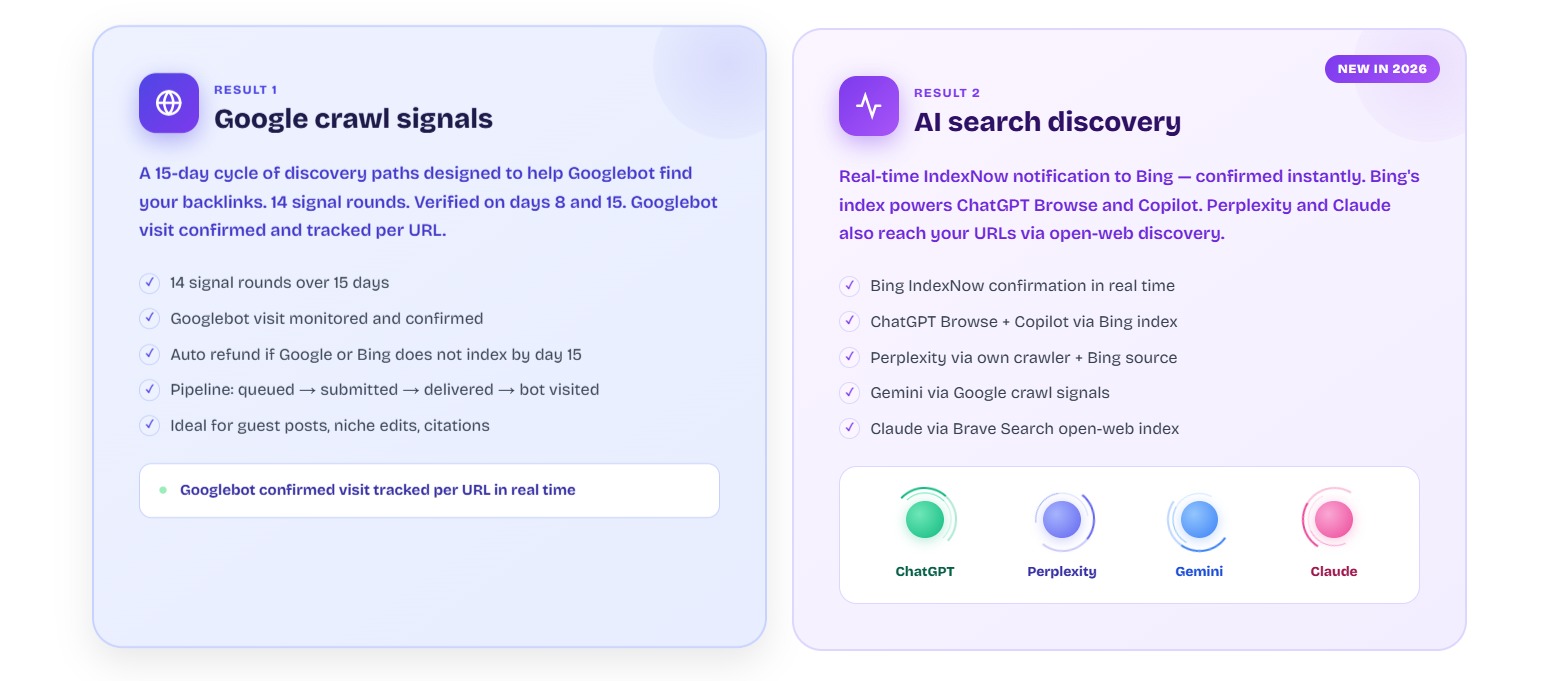
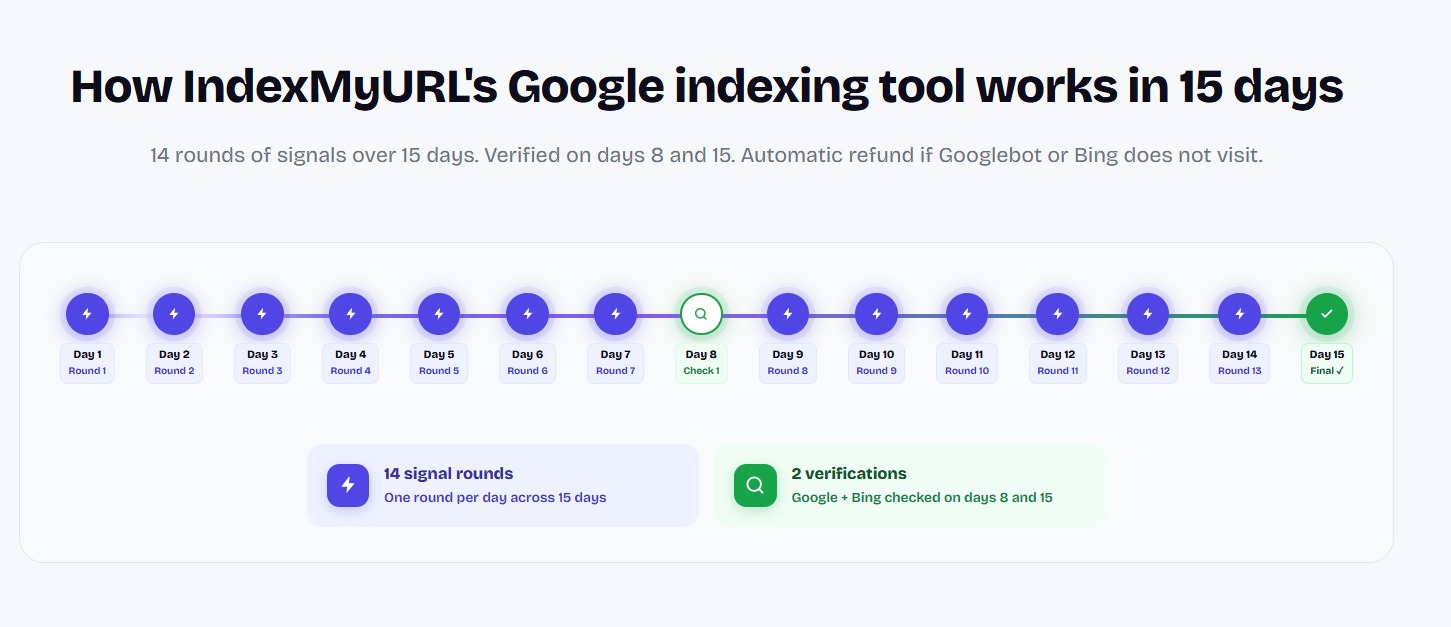
IndexMyURL is a backlink indexer and AI search discovery tool for SEOs, agencies and developers. Submit your URLs once and get crawl signals for Google plus real-time IndexNow notification to Bing — reaching ChatGPT, Copilot, Perplexity and Gemini simultaneously. One credit, two results, auto refund if Googlebot does not visit in 15 days. Credits never expire, no subscription.
Features
15-day crawl signal cycle with 14 signal rounds for Google
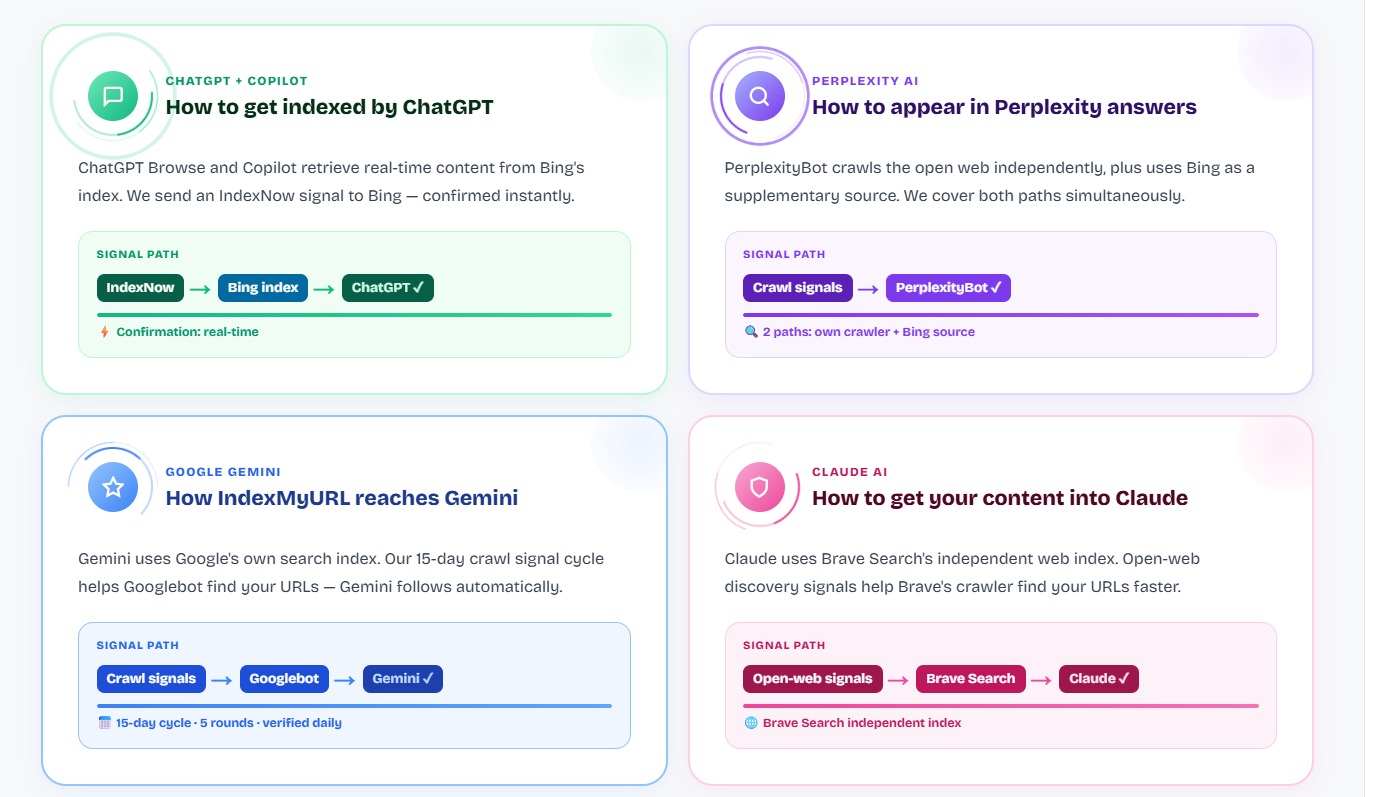
Real-time IndexNow notification to Bing — ChatGPT, Copilot and Perplexity
AI search discovery for Claude via Brave Search
Pre-check system — 404s and redirects validated free before spending credits
CSV, sitemap and RSS import — up to 10,000 URLs per campaign
Auto refund on day 15 if Googlebot does not visit
Full API access and real-time dashboard
Use Cases
Index guest posts and niche edits after link building
Bulk submit backlinks from agency campaigns
Get new content discovered by ChatGPT and Perplexity faster
Submit sitemaps to accelerate Google crawl of new pages

Comments



I built IndexMyURL after spending months doing link building and watching backlinks sit unindexed for weeks. Google just wasn't finding them fast enough, and by the time Googlebot visited, the SEO value was already delayed. The real breakthrough was realizing the problem wasn't just Google — AI search engines like ChatGPT, Perplexity and Claude also need to discover your URLs, and they each use completely different paths. So I built one tool that fires all of them at once: Google crawl signals + IndexNow to Bing for ChatGPT and Perplexity + Brave Search signals for Claude. One credit, two results. Auto refund if Googlebot doesn't visit in 15 days. No subscription. Happy to answer any questions about how the crawl signal engine works or the AI search discovery piece — it's more technical than it looks 🙂

This addresses a common SEO bottleneck: getting new pages and backlinks discovered quickly. I like that it combines Google crawl signals with IndexNow for Bing in a single workflow instead of treating them separately. The auto-refund policy if Googlebot doesn't visit within 15 days is also a practical touch, since users aren't paying for unsuccessful submissions. For agencies handling large link-building campaigns, the bulk import options and API access could save a significant amount of manual work.

This solves the multi-engine crawl friction. SEOs manually submitting to Google Search Console, Bing Webmaster Tools, ChatGPT, Perplexity separately — now one submission fires all of them. The auto-refund if Googlebot doesn't visit in 15 days removes risk entirely. Real-time dashboard plus API access means agencies can integrate this into workflows effortlessly. The bulk import up to 10k URLs per campaign is huge for campaign launches.


Hi, I just discovered your project on Fazier and I really like the direction you’re taking. I noticed a strong growth opportunity that could help you reach more targeted users, especially through Reddit community marketing, citation building, and strategic email outreach. Many brands are missing thousands of potential customers because their audience is already discussing their problems, looking for recommendations, and searching for solutions inside niche communities. I help businesses turn those conversations into brand visibility, trust, traffic, and qualified leads through authentic Reddit engagement and conversion-focused email strategies. I’d love to share a few growth ideas tailored specifically to your project. Best Regards, Olayinka Adeoye +1 479 739 7382 (WHATSAPP)



Indexing is one of those SEO problems where the delay is hard to see, but it quietly weakens the whole link-building workflow. The multi-engine angle is the useful part here, especially with Googlebot, IndexNow for Bing, and Brave Search signals all handled from one submission. Curious how you measure success beyond the Googlebot visit. Do you track whether a submitted URL later appears in Google or AI search surfaces, or is the refund logic mainly based on crawl discovery within the 15 days?

The auto-refund mechanism is interesting — how do you actually verify a Googlebot visit within the 15 days? Log parsing the user's server, GSC API integration, or something on your end? Asking because I've been sitting on ~88 "Discovered — currently not indexed" URLs for a while, and a signal more actionable than URL Inspection retries would be valuable.

The IndexNow → Bing route as a way to surface URLs in ChatGPT and Perplexity is a smart shortcut most indexers skip entirely. One question on the credit model: if a URL is crawled by Googlebot but later drops out of the index, does re-submitting it cost a fresh credit, or is there a window to re-fire the same URL? For agencies re-indexing refreshed content, that distinction is where the real cost adds up.

The per-engine breakdown in your comment (IndexNow to Bing for ChatGPT/Perplexity, Brave signals for Claude) is clearer than the landing copy, and honestly it's what I'd lead with — it shows you understand the plumbing rather than just claiming "AI visibility." One gap I'd close: the description also lists Gemini, but Gemini reads Google's index, so is that just riding the Googlebot crawl signal, or is there a separate path? That's the first thing a skeptical SEO will poke at. The auto-refund if Googlebot doesn't visit in 15 days is what made me take the rest seriously — that's a real trust mechanic, not a marketing line.

The "credits never expire, no subscription" model is a nice change from the usual SEO tool pricing trap. Auto-refund if Googlebot doesn't visit within 15 days is a good trust signal too — most indexing tools don't put their money where their mouth is like that. The AI search discovery angle (Perplexity, ChatGPT, Copilot) is timely given how much traffic is shifting toward those surfaces now.

The dual indexing approach (Google + AI search engines) is exactly where things are heading. I've been submitting content to GSC manually and the crawl delays are brutal. One thing I'm curious about: when you say "AI search discovery" for Claude and Perplexity — is that through Brave Search indexing, or a separate pipeline? The distinction matters a lot for content sites trying to get cited in AI answers.

Indexing issues can be the biggest bottleneck for independent projects, so seeing a tool designed specifically to tackle this is a huge win. The focus on speed and reliability is exactly what most indie builders need to get their content visible without the usual SEO headaches. I’ve been exploring how to streamline the content-to-indexing pipeline for my own projects as well, particularly by using Seedance 2.5 to generate high-quality, engaging visuals that help keep traffic on-site once indexed. It’s a great complement to tools like yours that focus on the discovery side. Great to see more solutions coming to the market—looking forward to seeing how this grows!


The auto-refund-if-not-indexed-in-15-days model is a nice trust signal, but I'm curious about the failure mode on the other side: for a brand new domain with zero backlink history (which is basically every early-stage indie site), does IndexMyURL's crawl signal actually help Google discover the site faster, or does it mainly help already-known URLs get recrawled? Asking because that's the exact gap I'm dealing with on a tool I just launched — plenty of backlinks now, but DR/indexing still catching up.




This looks very useful for SEOs and agencies. I like the idea of submitting URLs once and getting both Google crawl signals and IndexNow notifications for Bing, while also helping discovery across AI search platforms like ChatGPT, Copilot, Perplexity, and Gemini. The auto-refund if Googlebot does not visit in 15 days is a nice trust-building detail. Curious how you measure or confirm Googlebot visits — server logs, crawl data, or another verification method? Great launch!



The "one credit, two results" approach with Bing/IndexNow alongside Google signal triggering is a super practical model—especially now that AI search engines rely heavily on IndexNow networks for real-time citations. The 15-day auto-refund guarantee on unvisited URLs also builds instant trust in a space that’s usually pretty opaque. A couple of quick questions as I look at this: AI Discovery: Beyond pushing via IndexNow, are you triggering explicit search engine API pings or third-party crawler networks to speed up Perplexity and Gemini indexing? Bulk Workflow: Is there a public API or a simple webhook setup for agencies running automated post-publish indexing workflows?
Premium Products






















Sponsors
Buy



Comments
I built IndexMyURL after spending months doing link building and watching backlinks sit unindexed for weeks. Google just wasn't finding them fast enough, and by the time Googlebot visited, the SEO value was already delayed. The real breakthrough was realizing the problem wasn't just Google — AI search engines like ChatGPT, Perplexity and Claude also need to discover your URLs, and they each use completely different paths. So I built one tool that fires all of them at once: Google crawl signals + IndexNow to Bing for ChatGPT and Perplexity + Brave Search signals for Claude. One credit, two results. Auto refund if Googlebot doesn't visit in 15 days. No subscription. Happy to answer any questions about how the crawl signal engine works or the AI search discovery piece — it's more technical than it looks 🙂
This addresses a common SEO bottleneck: getting new pages and backlinks discovered quickly. I like that it combines Google crawl signals with IndexNow for Bing in a single workflow instead of treating them separately. The auto-refund policy if Googlebot doesn't visit within 15 days is also a practical touch, since users aren't paying for unsuccessful submissions. For agencies handling large link-building campaigns, the bulk import options and API access could save a significant amount of manual work.
This solves the multi-engine crawl friction. SEOs manually submitting to Google Search Console, Bing Webmaster Tools, ChatGPT, Perplexity separately — now one submission fires all of them. The auto-refund if Googlebot doesn't visit in 15 days removes risk entirely. Real-time dashboard plus API access means agencies can integrate this into workflows effortlessly. The bulk import up to 10k URLs per campaign is huge for campaign launches.
Hi, I just discovered your project on Fazier and I really like the direction you’re taking. I noticed a strong growth opportunity that could help you reach more targeted users, especially through Reddit community marketing, citation building, and strategic email outreach. Many brands are missing thousands of potential customers because their audience is already discussing their problems, looking for recommendations, and searching for solutions inside niche communities. I help businesses turn those conversations into brand visibility, trust, traffic, and qualified leads through authentic Reddit engagement and conversion-focused email strategies. I’d love to share a few growth ideas tailored specifically to your project. Best Regards, Olayinka Adeoye +1 479 739 7382 (WHATSAPP)
Indexing is one of those SEO problems where the delay is hard to see, but it quietly weakens the whole link-building workflow. The multi-engine angle is the useful part here, especially with Googlebot, IndexNow for Bing, and Brave Search signals all handled from one submission. Curious how you measure success beyond the Googlebot visit. Do you track whether a submitted URL later appears in Google or AI search surfaces, or is the refund logic mainly based on crawl discovery within the 15 days?
The auto-refund mechanism is interesting — how do you actually verify a Googlebot visit within the 15 days? Log parsing the user's server, GSC API integration, or something on your end? Asking because I've been sitting on ~88 "Discovered — currently not indexed" URLs for a while, and a signal more actionable than URL Inspection retries would be valuable.
The IndexNow → Bing route as a way to surface URLs in ChatGPT and Perplexity is a smart shortcut most indexers skip entirely. One question on the credit model: if a URL is crawled by Googlebot but later drops out of the index, does re-submitting it cost a fresh credit, or is there a window to re-fire the same URL? For agencies re-indexing refreshed content, that distinction is where the real cost adds up.
The per-engine breakdown in your comment (IndexNow to Bing for ChatGPT/Perplexity, Brave signals for Claude) is clearer than the landing copy, and honestly it's what I'd lead with — it shows you understand the plumbing rather than just claiming "AI visibility." One gap I'd close: the description also lists Gemini, but Gemini reads Google's index, so is that just riding the Googlebot crawl signal, or is there a separate path? That's the first thing a skeptical SEO will poke at. The auto-refund if Googlebot doesn't visit in 15 days is what made me take the rest seriously — that's a real trust mechanic, not a marketing line.
The "credits never expire, no subscription" model is a nice change from the usual SEO tool pricing trap. Auto-refund if Googlebot doesn't visit within 15 days is a good trust signal too — most indexing tools don't put their money where their mouth is like that. The AI search discovery angle (Perplexity, ChatGPT, Copilot) is timely given how much traffic is shifting toward those surfaces now.
The dual indexing approach (Google + AI search engines) is exactly where things are heading. I've been submitting content to GSC manually and the crawl delays are brutal. One thing I'm curious about: when you say "AI search discovery" for Claude and Perplexity — is that through Brave Search indexing, or a separate pipeline? The distinction matters a lot for content sites trying to get cited in AI answers.
Indexing issues can be the biggest bottleneck for independent projects, so seeing a tool designed specifically to tackle this is a huge win. The focus on speed and reliability is exactly what most indie builders need to get their content visible without the usual SEO headaches. I’ve been exploring how to streamline the content-to-indexing pipeline for my own projects as well, particularly by using Seedance 2.5 to generate high-quality, engaging visuals that help keep traffic on-site once indexed. It’s a great complement to tools like yours that focus on the discovery side. Great to see more solutions coming to the market—looking forward to seeing how this grows!
The auto-refund-if-not-indexed-in-15-days model is a nice trust signal, but I'm curious about the failure mode on the other side: for a brand new domain with zero backlink history (which is basically every early-stage indie site), does IndexMyURL's crawl signal actually help Google discover the site faster, or does it mainly help already-known URLs get recrawled? Asking because that's the exact gap I'm dealing with on a tool I just launched — plenty of backlinks now, but DR/indexing still catching up.
This looks very useful for SEOs and agencies. I like the idea of submitting URLs once and getting both Google crawl signals and IndexNow notifications for Bing, while also helping discovery across AI search platforms like ChatGPT, Copilot, Perplexity, and Gemini. The auto-refund if Googlebot does not visit in 15 days is a nice trust-building detail. Curious how you measure or confirm Googlebot visits — server logs, crawl data, or another verification method? Great launch!
The "one credit, two results" approach with Bing/IndexNow alongside Google signal triggering is a super practical model—especially now that AI search engines rely heavily on IndexNow networks for real-time citations. The 15-day auto-refund guarantee on unvisited URLs also builds instant trust in a space that’s usually pretty opaque. A couple of quick questions as I look at this: AI Discovery: Beyond pushing via IndexNow, are you triggering explicit search engine API pings or third-party crawler networks to speed up Perplexity and Gemini indexing? Bulk Workflow: Is there a public API or a simple webhook setup for agencies running automated post-publish indexing workflows?
Premium Products
New to Fazier?
Find your next favorite product or submit your own. Made by @FalakDigital.
Copyright ©2026. All Rights Reserved