
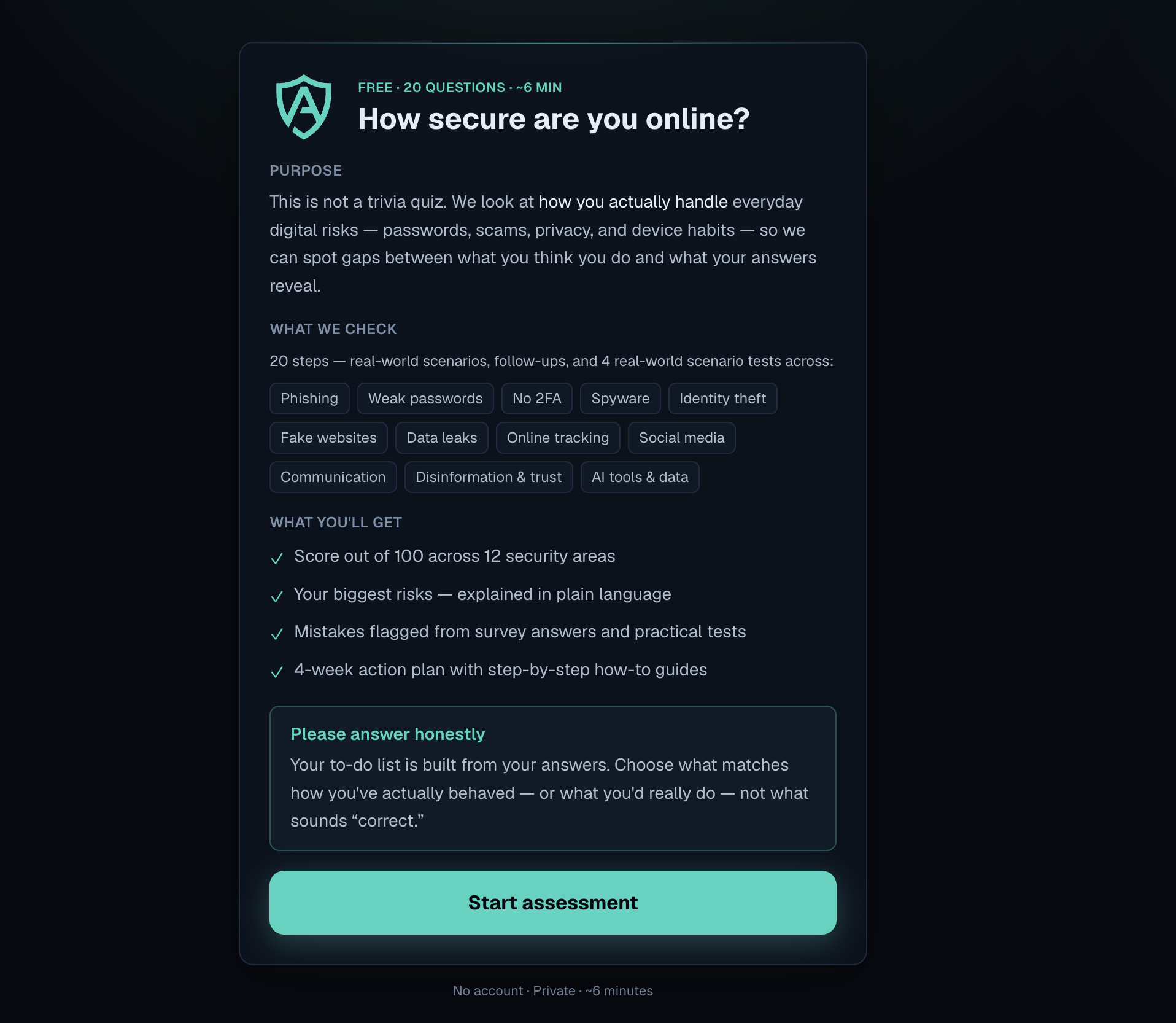
You answer 20 scenario-based questions: four fixed opening steps, then adaptive follow-ups and practical “what would you do?” tests across 12 areas (phishing, passwords, 2FA, malware, identity theft, fake sites, data leaks, tracking, social media, secure communication, disinformation, and AI tool safety).
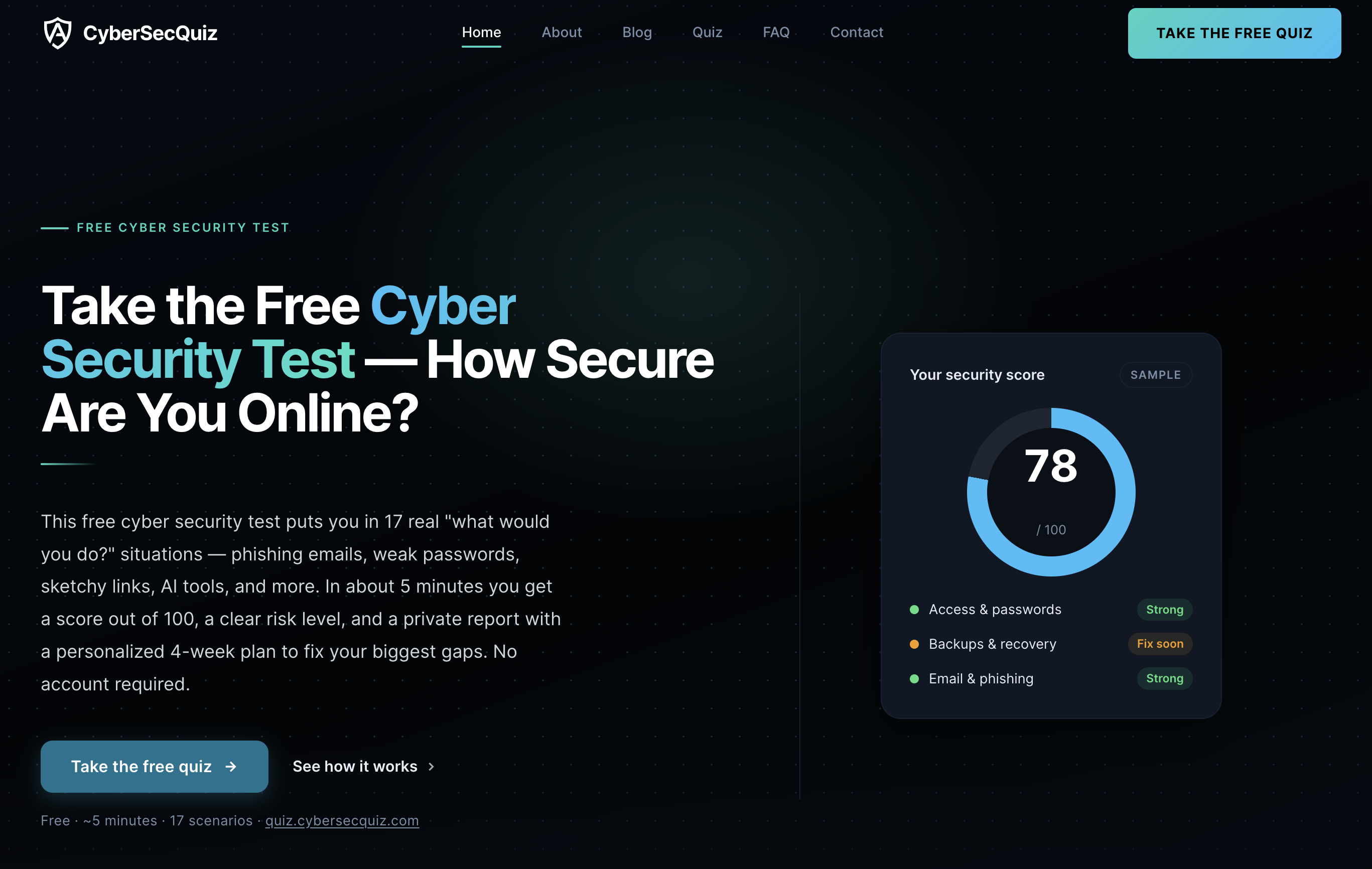
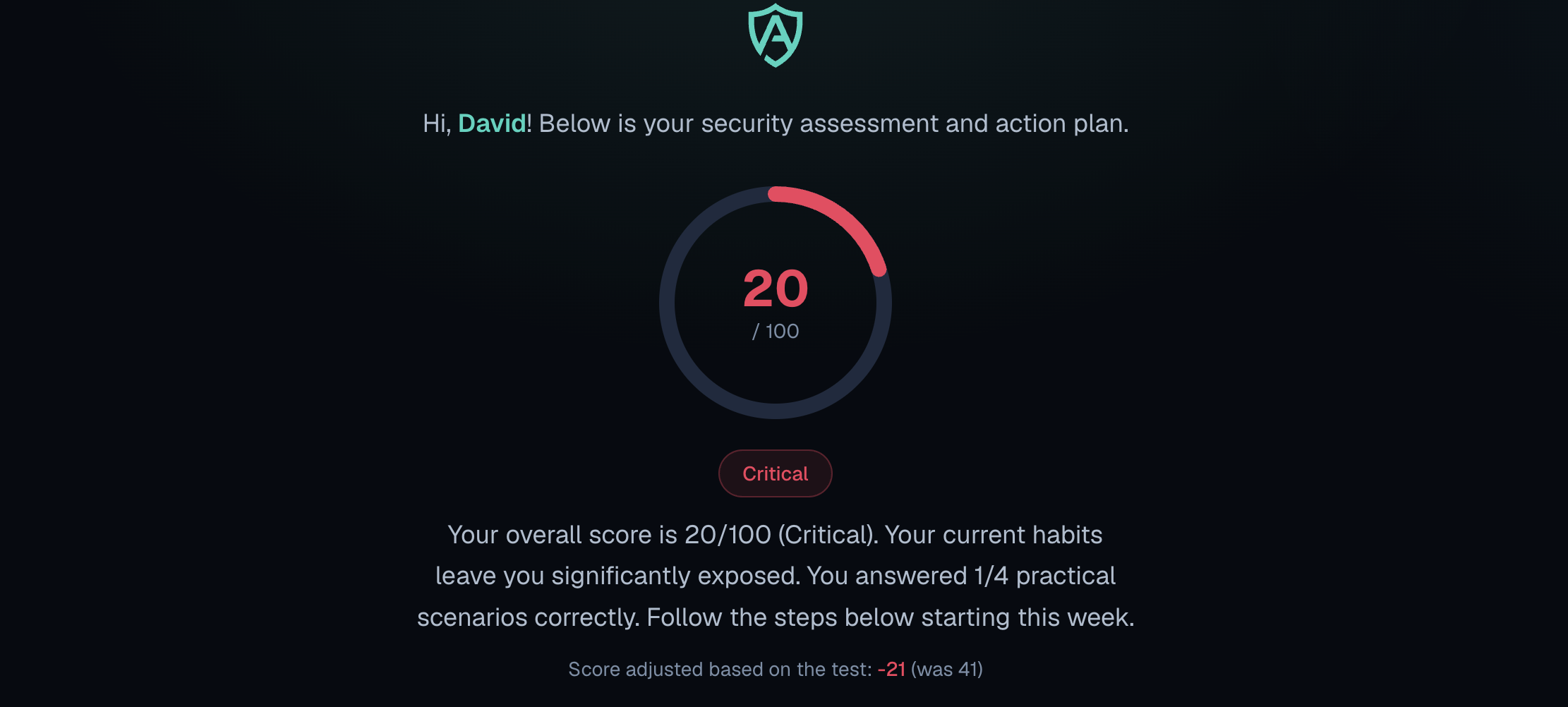
After you finish, you get a score out of 100, a risk level, and a breakdown of where you’re strong vs. exposed, including gaps between what you say you’d do and what the practical tests reveal.
You will receive a private report link (no account required) with plain-language explanations of your biggest risks and mistakes from the survey and tests.
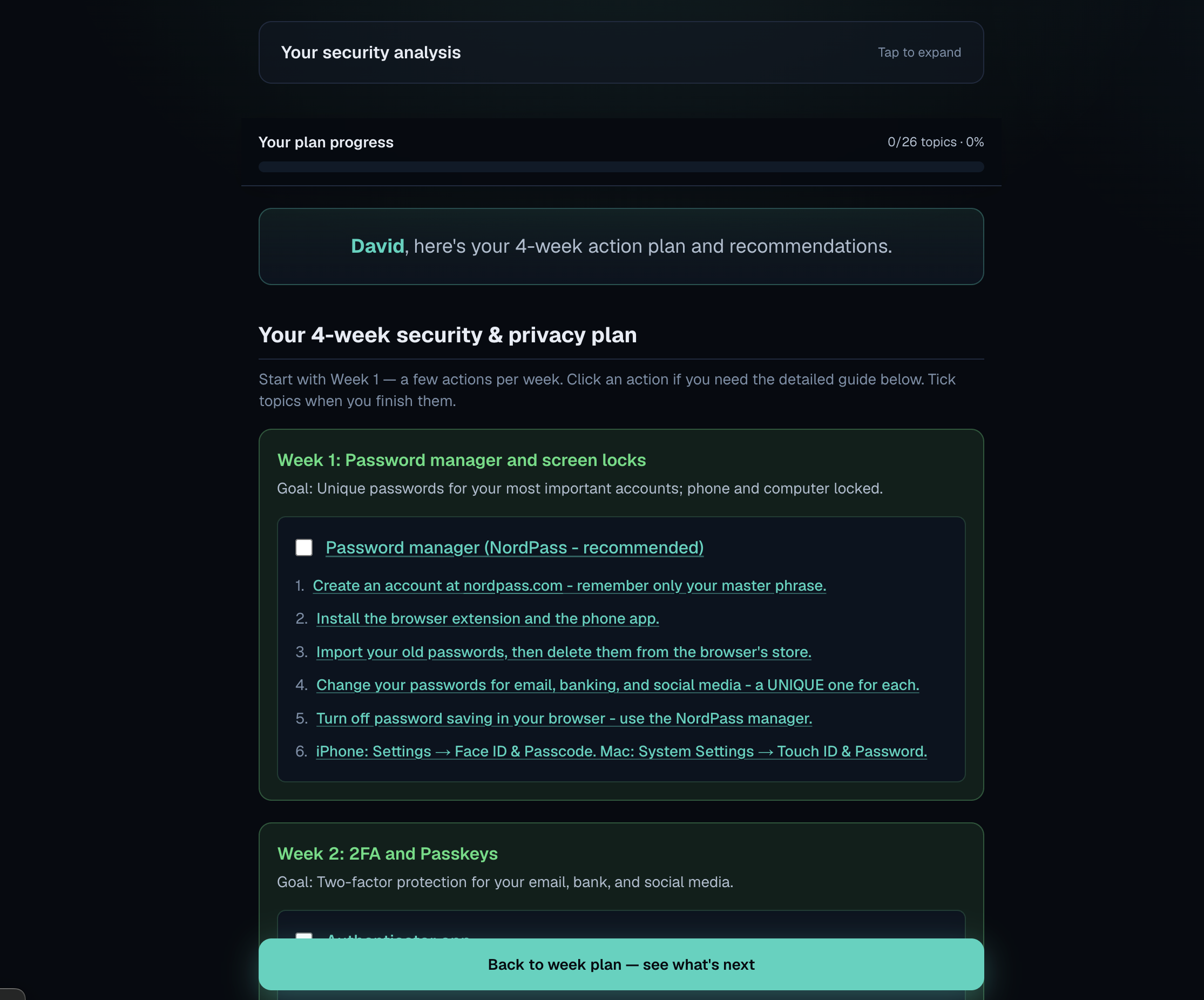
The full report includes a personalized 4-week action plan with step-by-step guides - password managers, 2FA, browser privacy, phishing habits, platform settings, and increasingly AI hygiene (what not to paste, how to turn off training, how to verify AI output).
It turns vague “I should be more careful online” into a prioritized to-do list based on your answers - you see your weak spots, understand why they matter, and know what to fix first this week.
Features
- 4-week action plan — prioritized steps you can tick off as you go
- Step-by-step how-to guides — passwords, 2FA, passkeys, browser privacy, and more
- Platform-specific setup help — iPhone, Android, Firefox, email, and social accounts
- 30-day deep-dive plan in the full report — 1–2 concrete actions per day
- Context guides — at home, at work, and when sharing information online
Use Cases
Individuals & everyday users
- Check whether your online habits match how risky the real world actually is
- Find weak spots before a scam, leak, or account takeover happens
- Get a simple score and a clear “fix this first” list without reading security blogs
- See if you’d really act safely under pressure — not just what you think you’d do
- Learn what to change on your phone, browser, email, and social accounts
- Test how you’d handle phishing texts, fake callers, and suspicious links
- Understand where you’re too trusting with websites, messages, and “urgent” requests
- Build better reflexes: pause, verify, don’t click, don’t share
Privacy-conscious users
- See how exposed you are to tracking, oversharing, and weak account settings
- Get practical steps to reduce what apps, sites, and advertisers can collect
- Review messaging, social media, and sign-up habits in one place
Anyone using AI tools (ChatGPT, Copilot, etc.)
- Check whether you’d paste work or personal data into consumer AI tools
- Learn to verify AI answers, citations, and “helpful” install links before trusting them
- Reduce the risk of leaking customer, company, or family information into AI chats\
Employees & remote workers
- Quick self-check before handling company email, customer data, or work accounts
- Identify gaps between “I’m careful at work” and actual behavior in realistic scenarios
- Useful as a personal refresher — not a replacement for employer security training
People who want a plan, not just a score
- Move from “I should be more secure” to a 4-week action plan with checkboxes
- Follow step-by-step guides for passwords, 2FA, browser privacy, and device settings
- Track progress on a 30-day plan in the full report
Before or after a security incident
- Reassess habits after a phishing attempt, password leak, or suspicious message
- See which areas still need work once the immediate panic has passed
- Re-test later to measure improvement over time

Comments


This is exactly what people need before something goes wrong. Most of us overestimate how careful we actually are online, especially when distracted or under pressure. The scenario-based approach is genius because it forces you to face realistic situations instead of just reading security tips. Love that it breaks down your risk across 12 specific areas rather than just a single score. The 4-week action plan with concrete steps makes it actually doable instead of overwhelming. Plus the private report format is smart for workplace sharing.


As an ethical hacker, I spend my time finding weaknesses before bad actors do. What I see again and again isn’t that people don’t care about security — it’s that they don’t know where they’re vulnerable, or what to fix first. I built CyberSecQuiz to change that. It’s a free, practical assessment based on everyday situations: scams, passwords, privacy, devices, and now AI tools. No jargon, no fear-mongering — just honest feedback and steps you can actually follow. My goal is simple: help people build real awareness, protect their privacy, and close the gap between “I think I’m careful” and how they’d act when it matters.
The scenario-based approach is brilliant because it surfaces the gap between what people think they'd do and what they actually do under pressure. Most security training is theoretical, but this tests real judgment calls across 12 different threat types. The personalized 4-week action plan turns a score into something actionable instead of leaving you thinking "well, I guess I should be more careful online." Free with no account required removes the friction entirely.
Premium Products






















Sponsors
Buy
Makers
Makers
Comments
This is exactly what people need before something goes wrong. Most of us overestimate how careful we actually are online, especially when distracted or under pressure. The scenario-based approach is genius because it forces you to face realistic situations instead of just reading security tips. Love that it breaks down your risk across 12 specific areas rather than just a single score. The 4-week action plan with concrete steps makes it actually doable instead of overwhelming. Plus the private report format is smart for workplace sharing.
As an ethical hacker, I spend my time finding weaknesses before bad actors do. What I see again and again isn’t that people don’t care about security — it’s that they don’t know where they’re vulnerable, or what to fix first. I built CyberSecQuiz to change that. It’s a free, practical assessment based on everyday situations: scams, passwords, privacy, devices, and now AI tools. No jargon, no fear-mongering — just honest feedback and steps you can actually follow. My goal is simple: help people build real awareness, protect their privacy, and close the gap between “I think I’m careful” and how they’d act when it matters.
The scenario-based approach is brilliant because it surfaces the gap between what people think they'd do and what they actually do under pressure. Most security training is theoretical, but this tests real judgment calls across 12 different threat types. The personalized 4-week action plan turns a score into something actionable instead of leaving you thinking "well, I guess I should be more careful online." Free with no account required removes the friction entirely.
Premium Products
New to Fazier?
Find your next favorite product or submit your own. Made by @FalakDigital.
Copyright ©2026. All Rights Reserved