
Zorin
Pricing Intelligence for e-commerce sellers
Most merchants price by gut feel or by copying competitors — but their customers aren't your customers, and their costs aren't your costs. Zorin fits a statistical demand model per SKU from your Shopify or WooCommerce sales history (or a plain CSV upload) and returns a clear raise, lower, or hold recommendation with a confidence score and estimated profit lift. Beyond individual recommendations, Zorin lets you roll pricing changes out at scale through scheduled campaigns, track real profit and loss over time, benchmark against competitor prices, and even price brand-new products with no sales history yet using a Van Westendorp price-sensitivity survey. Built for DTC brands and Shopify/WooCommerce sellers who want data-driven pricing without hiring a data analyst.
Features
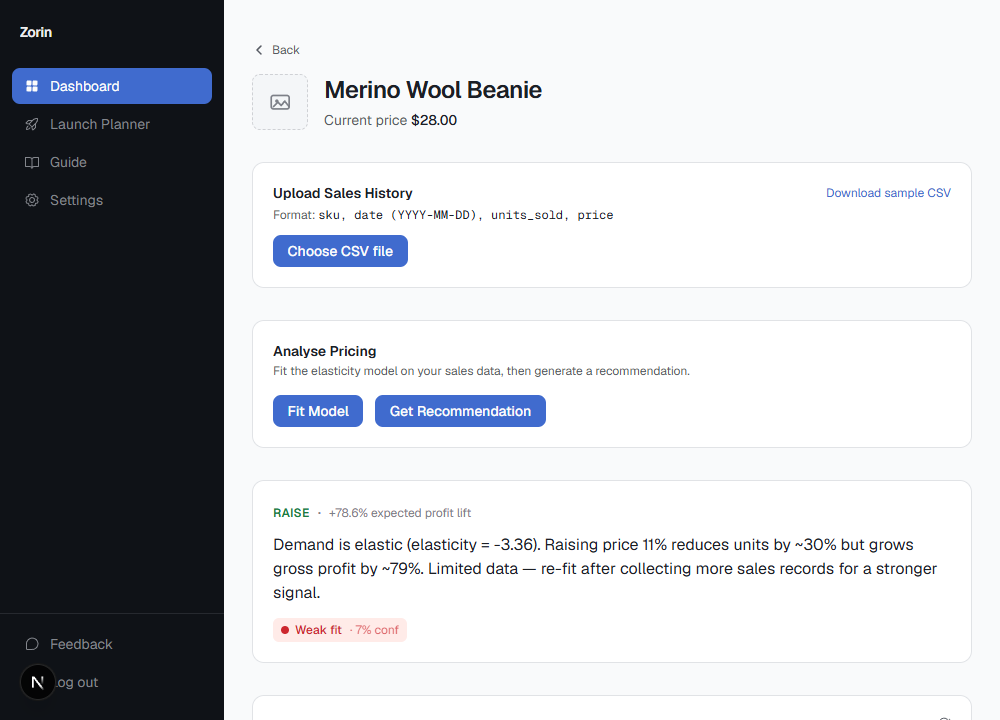
- Elasticity modeling — fits a demand model per SKU, returning raise/lower/hold recommendations with an elasticity coefficient and R² fit score
- Confidence scoring — every recommendation is labeled by data density and model fit, so you know when to trust it
- Promotion detection — automatically flags and excludes promotional sales spikes so they don't distort the model
- Van Westendorp price sensitivity survey — a 4-question customer survey for pricing new products with zero sales history
- Competitor price tracking — log and monitor competitor prices per product, feeding into Launch Planner
- Launch Planner — a defensible starting price for new SKUs based on cost, margin target, and competitor data, no sales history needed
- Pricing campaigns — schedule bulk price changes across many products at once (percentage, ML recommendation, or competitor-match rules) with automatic revert and conflict detection
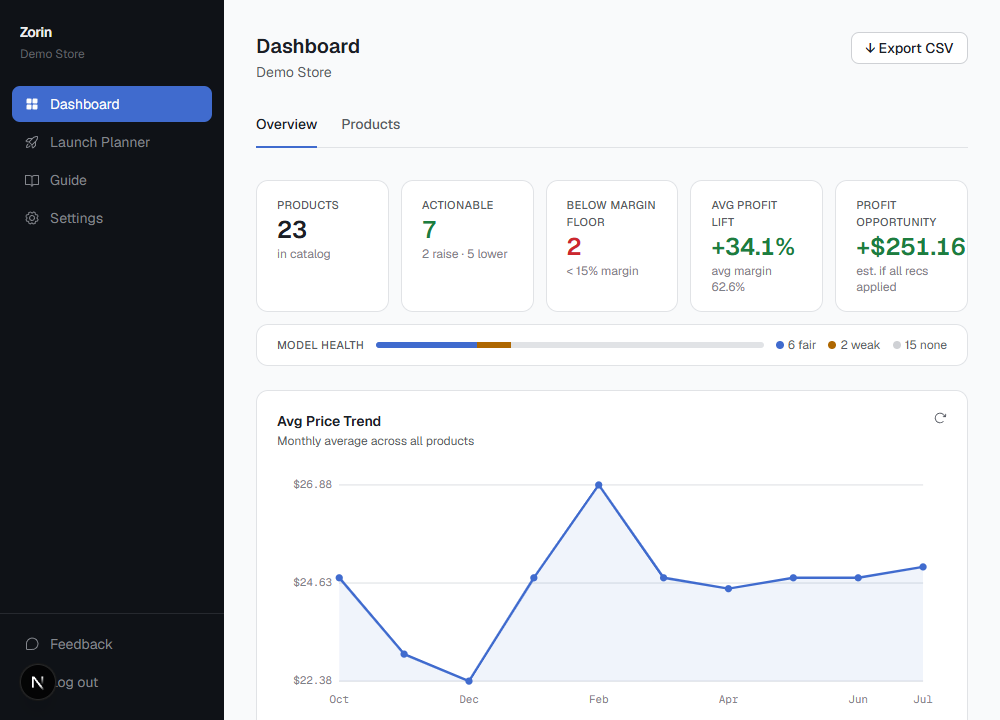
- Profit tracking dashboard — real P&L over time, a top-earner/margin-bleeder leaderboard, and before/after campaign performance
- Shopify & WooCommerce sync — connect once, products and orders stay synced automatically, price changes push live
- Multi-user teams — invite teammates with Owner/Member roles; Owner controls billing, Members get full pricing access
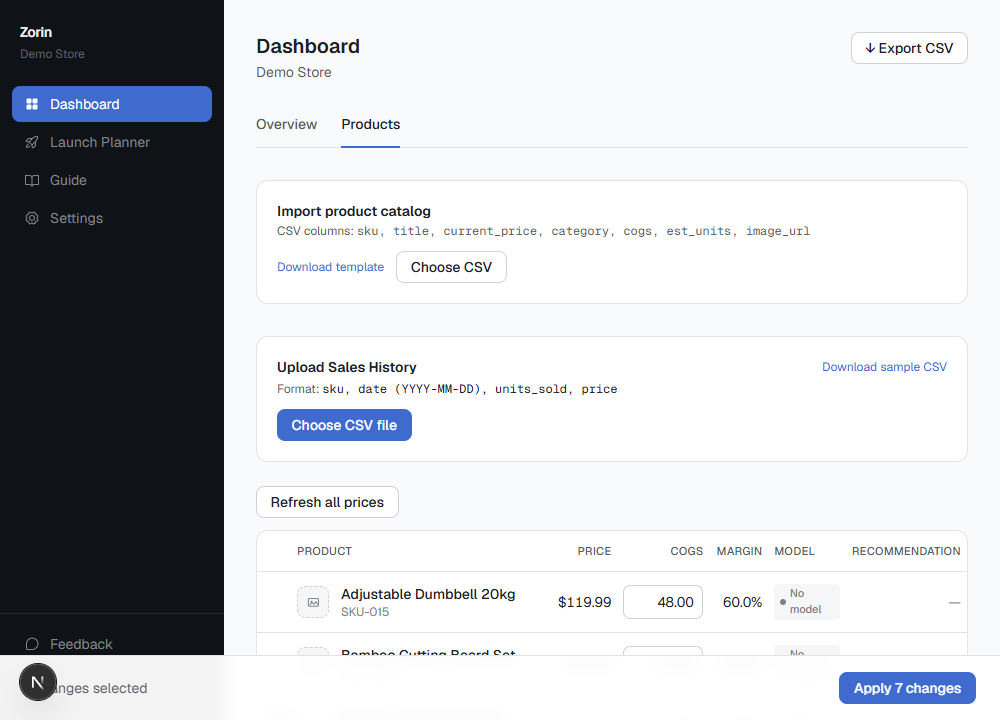
- No integration required to start — CSV upload gets your first recommendation in about 5 minutes
Use Cases
- E-commerce store owners replacing gut-feel pricing with data-driven recommendations
- DTC brands and Shopify/WooCommerce sellers automating price optimization without a data scientist
- Merchants with seasonal sales who need a model that accounts for promotions and demand shifts

Comments


The data-driven pricing angle is compelling - most sellers either underprice (leaving money on the table) or copypasta competitor rates without understanding their own margin structure. Using actual sales velocity data from Shopify/WooCommerce and providing confidence scores makes this actionable rather than theoretical. The detail about scheduled campaigns and SKU-level optimization is what separates this from basic competitor monitoring tools.
Turning Shopify or WooCommerce sales history into SKU-level price recommendations is a practical way to replace guesswork with evidence. The scheduled campaign rollouts and profit/loss tracking look particularly valuable for DTC teams; surfacing confidence ranges and the assumptions behind each recommendation could make the insights even easier to act on.

Elasticity estimation needs price variation, and that's exactly what most DTC catalogues don't have — plenty of SKUs have sold at a single price for their entire history, with the only variation coming from the promos you're deliberately excluding. What's the minimum number of distinct price points before the model produces anything meaningful, and does Zorin ever tell a merchant "I can't price this yet, run a deliberate test at ±10% for two weeks first"? The confidence score suggests it might already do something like that, and honestly that would be the most valuable feature in the whole product.
Elasticity estimation needs price variation, and that's exactly what most DTC catalogues don't have - plenty of SKUs have sold at a single price for their entire history, with the only variation coming from the promos you're deliberately excluding. What's the minimum number of distinct price points before the model produces anything meaningful, and does Zorin ever tell a merchant "I can't price this yet, run a deliberate test at plus/minus 10% for two weeks first"? The confidence score suggests it might already do something like that, and that would arguably be the most valuable feature in the whole product.


The scheduled pricing campaigns with automatic revert is what I'd actually use day-to-day — most sellers hesitate to test a price change because rolling back 50 SKUs manually is painful. Pairing that with conflict detection before changes go live feels like it was built by someone who has broken a store with a bulk edit before. Does the profit dashboard break down margin bleeders separately from top earners after a campaign ends?

The per-SKU demand model and confidence-scored raise/lower/hold recommendations feel more actionable than competitor price scraping alone. The CSV path plus Shopify/WooCommerce focus should also reduce setup friction. Can merchants see which inputs most influence a recommendation, so they can sanity-check unusual products before rolling out a scheduled change?

The distinction between raise, lower, or hold recommendations and confidence scores seems useful for avoiding knee-jerk price changes. Scheduled campaigns plus profit and loss tracking could give DTC teams a clearer feedback loop. I like that plain CSV upload lowers the barrier to testing historical data.

The SKU-level demand model and scheduled campaigns seem especially valuable for smaller DTC teams that cannot afford a dedicated pricing analyst. I like that it supports both Shopify/WooCommerce history and a plain CSV—does the recommendation explain which factors drove a raise versus hold decision?


The data-driven pricing angle is compelling - most sellers either underprice (leaving money on the table) or copypasta competitor rates without understanding their own margin structure. Using actual sales velocity data from Shopify/WooCommerce and providing confidence scores makes this actionable rather than theoretical. The detail about scheduled campaigns and SKU-level optimization is what separates this from basic competitor monitoring tools.


The SKU-level demand model and scheduled campaigns seem especially valuable for smaller DTC teams that cannot afford a dedicated pricing analyst. I like that it supports both Shopify/WooCommerce history and a plain CSV—does the recommendation explain which factors drove a raise versus hold decision?

Premium Products






























Sponsors
Buy

Awards
View all
Awards
View allMakers

Makers
Comments
The data-driven pricing angle is compelling - most sellers either underprice (leaving money on the table) or copypasta competitor rates without understanding their own margin structure. Using actual sales velocity data from Shopify/WooCommerce and providing confidence scores makes this actionable rather than theoretical. The detail about scheduled campaigns and SKU-level optimization is what separates this from basic competitor monitoring tools.
Turning Shopify or WooCommerce sales history into SKU-level price recommendations is a practical way to replace guesswork with evidence. The scheduled campaign rollouts and profit/loss tracking look particularly valuable for DTC teams; surfacing confidence ranges and the assumptions behind each recommendation could make the insights even easier to act on.
Elasticity estimation needs price variation, and that's exactly what most DTC catalogues don't have — plenty of SKUs have sold at a single price for their entire history, with the only variation coming from the promos you're deliberately excluding. What's the minimum number of distinct price points before the model produces anything meaningful, and does Zorin ever tell a merchant "I can't price this yet, run a deliberate test at ±10% for two weeks first"? The confidence score suggests it might already do something like that, and honestly that would be the most valuable feature in the whole product.
Elasticity estimation needs price variation, and that's exactly what most DTC catalogues don't have - plenty of SKUs have sold at a single price for their entire history, with the only variation coming from the promos you're deliberately excluding. What's the minimum number of distinct price points before the model produces anything meaningful, and does Zorin ever tell a merchant "I can't price this yet, run a deliberate test at plus/minus 10% for two weeks first"? The confidence score suggests it might already do something like that, and that would arguably be the most valuable feature in the whole product.
The scheduled pricing campaigns with automatic revert is what I'd actually use day-to-day — most sellers hesitate to test a price change because rolling back 50 SKUs manually is painful. Pairing that with conflict detection before changes go live feels like it was built by someone who has broken a store with a bulk edit before. Does the profit dashboard break down margin bleeders separately from top earners after a campaign ends?
The per-SKU demand model and confidence-scored raise/lower/hold recommendations feel more actionable than competitor price scraping alone. The CSV path plus Shopify/WooCommerce focus should also reduce setup friction. Can merchants see which inputs most influence a recommendation, so they can sanity-check unusual products before rolling out a scheduled change?
The distinction between raise, lower, or hold recommendations and confidence scores seems useful for avoiding knee-jerk price changes. Scheduled campaigns plus profit and loss tracking could give DTC teams a clearer feedback loop. I like that plain CSV upload lowers the barrier to testing historical data.
The SKU-level demand model and scheduled campaigns seem especially valuable for smaller DTC teams that cannot afford a dedicated pricing analyst. I like that it supports both Shopify/WooCommerce history and a plain CSV—does the recommendation explain which factors drove a raise versus hold decision?
The data-driven pricing angle is compelling - most sellers either underprice (leaving money on the table) or copypasta competitor rates without understanding their own margin structure. Using actual sales velocity data from Shopify/WooCommerce and providing confidence scores makes this actionable rather than theoretical. The detail about scheduled campaigns and SKU-level optimization is what separates this from basic competitor monitoring tools.
The SKU-level demand model and scheduled campaigns seem especially valuable for smaller DTC teams that cannot afford a dedicated pricing analyst. I like that it supports both Shopify/WooCommerce history and a plain CSV—does the recommendation explain which factors drove a raise versus hold decision?
Premium Products
New to Fazier?

Find your next favorite product or submit your own. Made by @FalakDigital.
Copyright ©2026. All Rights Reserved