
Yubook
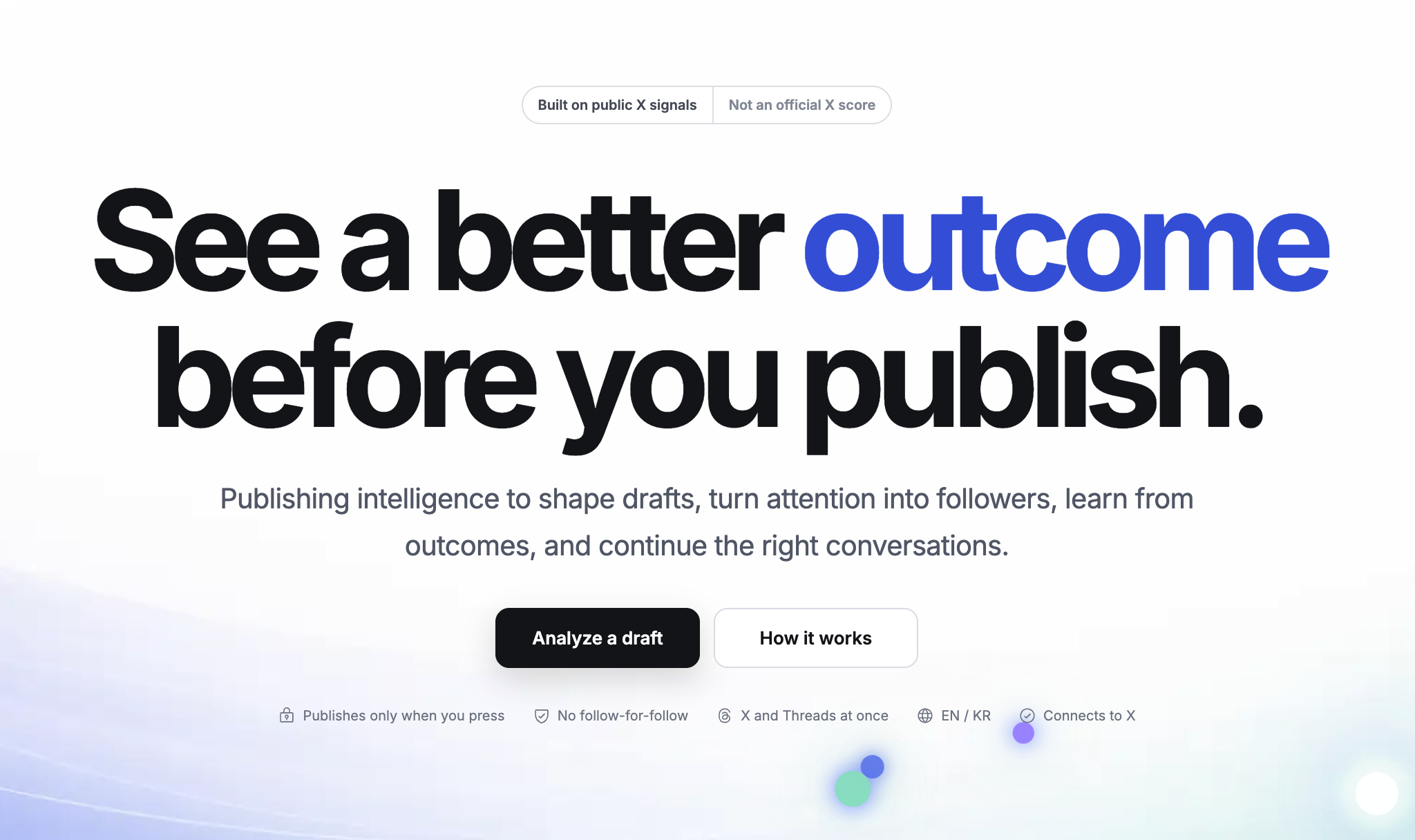
See how a draft will land before you post.
Yubook is a publishing coach for people who post on X. It scores a draft against X's published ranking signals before anything goes out, and it finds the posts where a reply would put you in front of someone else's readers. It does not trade follows, and it does not post to X for you.
The problem
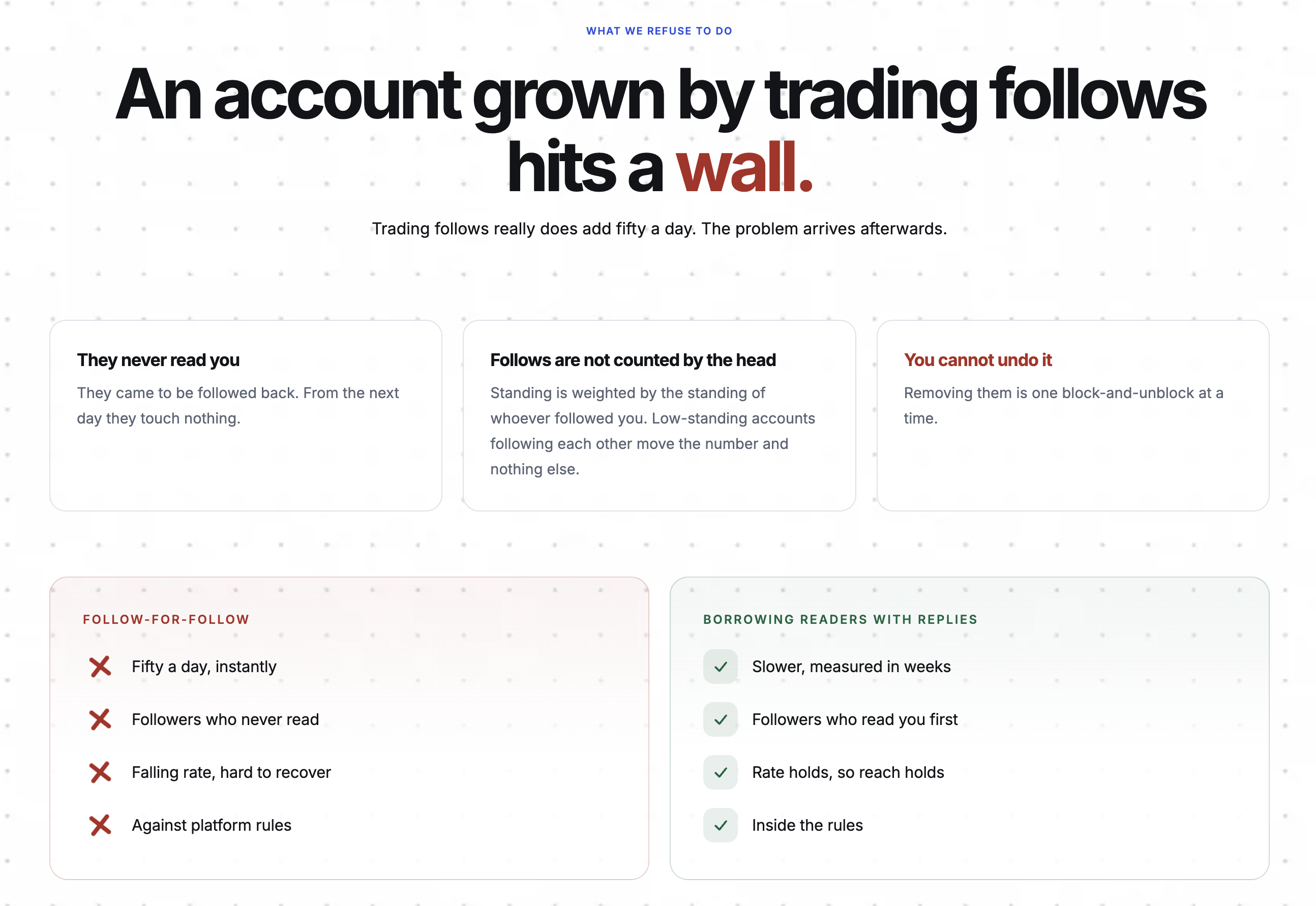
A small account can publish every day and still not get seen. The usual advice is to post more, or to swap follows until the number goes up. Follow-for-follow is fast for a week. Those people never read you, and you cannot get rid of them.
Most “algorithm scores” are a black box. They give you a number and no sentence to change. Yubook uses the ranking weights X has published, splits a draft into signals, and tells you what the writing is asking people to do — reply, share, click, or mute.
How it works
- Sign in with X or an email magic link. Connecting X is how Yubook reads your account. It does not ask for posting permission on X.
- Paste or write a draft. Yubook breaks it into signals and shows a forecast as a range, not a promised view count.
- Open the reply queue. It ranks fresh posts from accounts you already follow, by freshness, audience, and competition, while the window is still open.
- Run a seven-day plan. Replies and posts are split across the week to fit the size of the account and the time you actually have.
You keep the sentence. Threads can go out from Yubook when you press publish. X stays in your own composer.
Features
Draft signal analysis
Score a draft before it is posted. The result is not one opaque number. You see which lines pull for a reply, a share, a click, or negative feedback, and you can rewrite the sentence and watch the reasoning update.
Forecast range
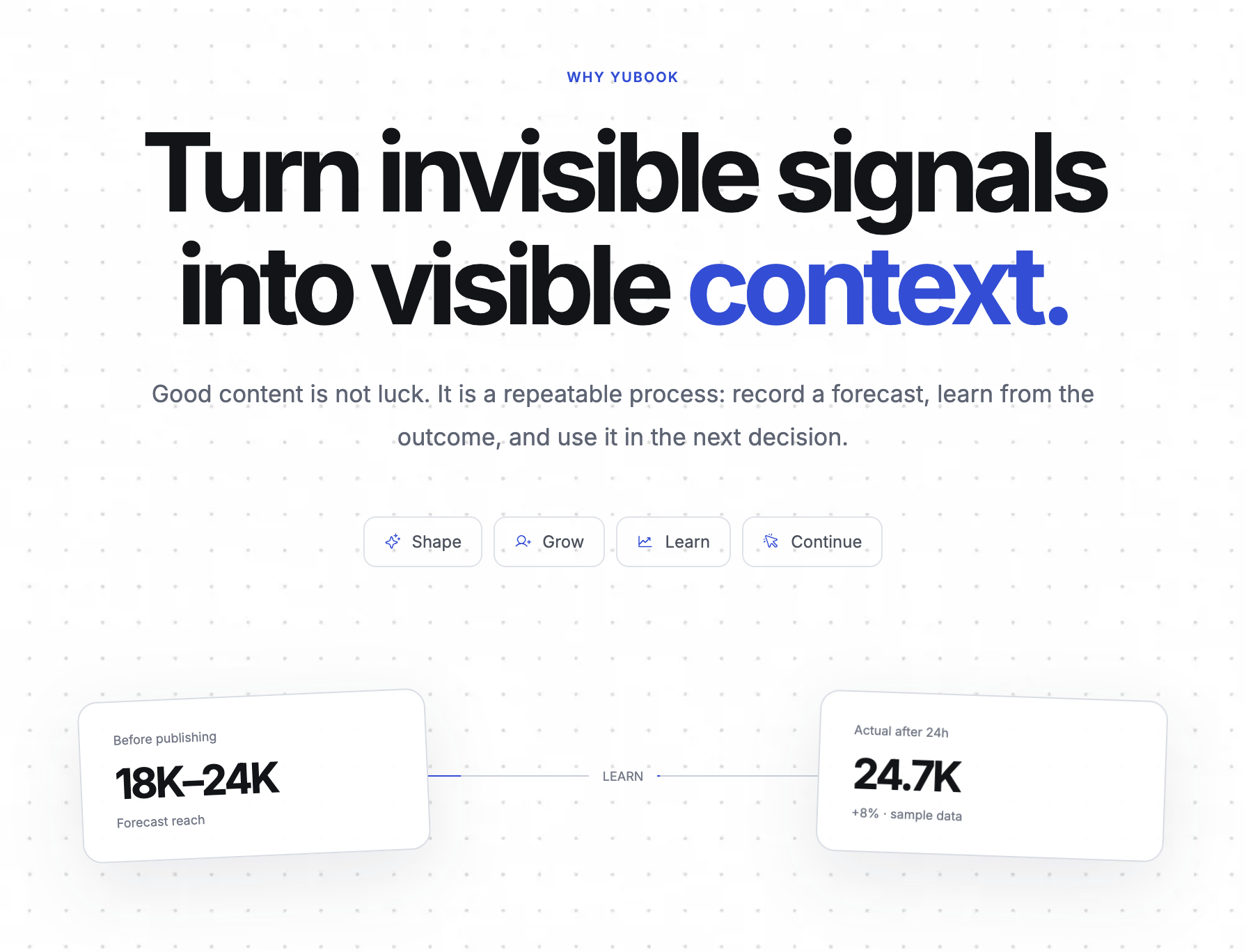
Predicted reach is a calibrated interval. It is not an official X score and it does not guarantee views or followers.
Reply target queue
When you open the app, Yubook polls recent posts (10-minute cooldown, last 60 minutes) and ranks where a reply would still land in front of someone else's readers.
Watched accounts
The main pool comes from your following list. A secondary pass finds accounts by category. News and broadcast accounts are excluded. You can add more watch slots if you need them.
Seven-day growth plan and calendar
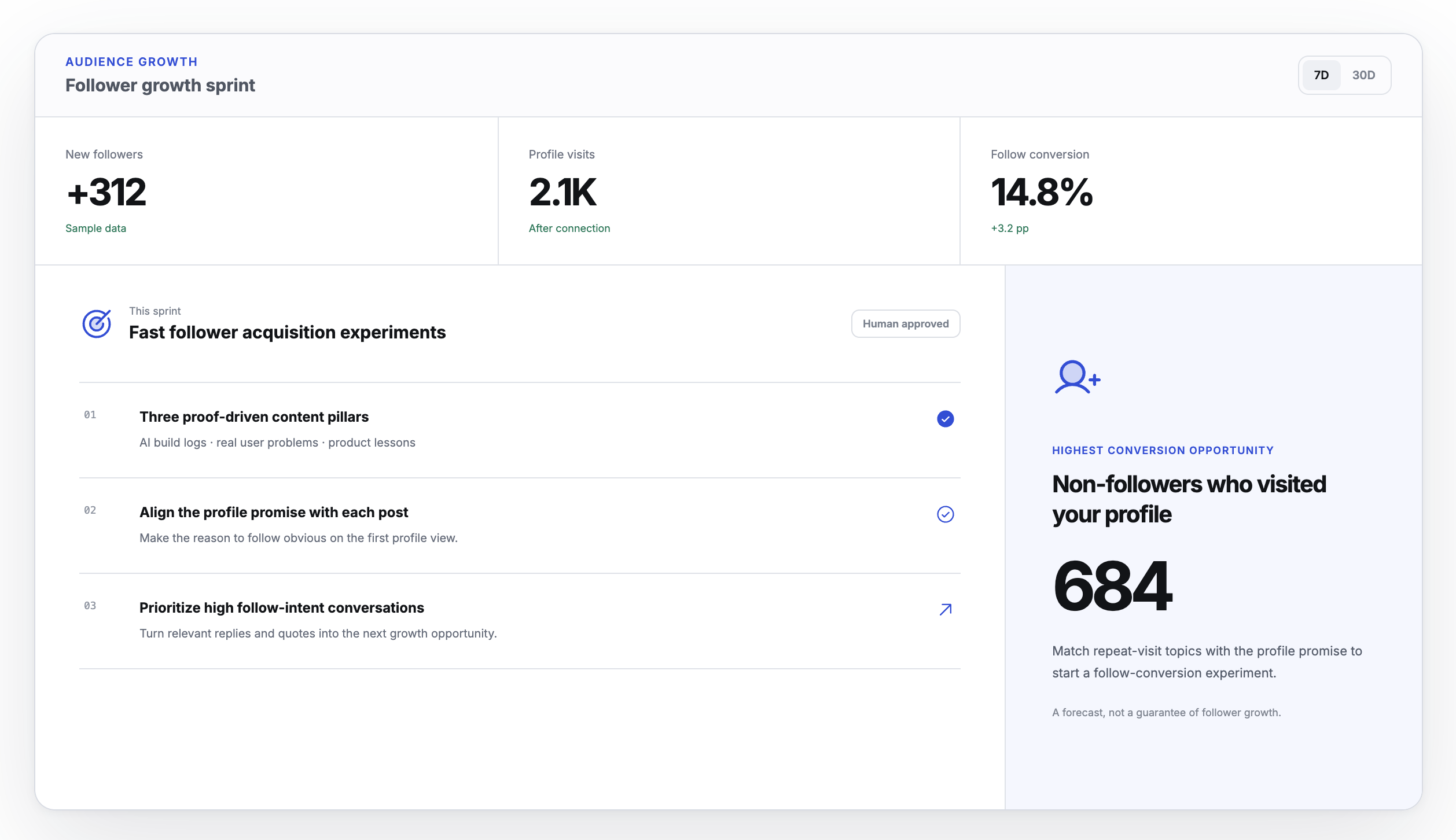
A click-through onboarding (7 steps) builds a week of reply and post targets. You confirm days. The calendar follows that plan.
Follower tracking
Your own follower count is collected once a day. Looking up your own account is unmetered, so this stays free.
AI drafts, replies, and rewrites
When you want a starting sentence or a reply, Yubook writes in the language you chose. You edit before anything is published.
X + Threads
Connect Threads and publish there when you choose. Yubook does not auto-post to X.
Free tools (no account)
X account status check — yubook.app/x-check
See whether search is still showing an account's posts. Official X API only. What it can see and what it cannot are listed separately. It will not invent a “no ghost ban” all-clear.
Best posting hours — yubook.app/best-time
Not a generic “post at 9am.” Median views from that account's own posts, in your timezone.
Use Cases
What Yubook will not do
- Follow-for-follow lists
- Post to X on your behalf
- Promise follower counts
- Pretend a heuristic is X's internal score

Comments


Splitting the score into per-sentence signals instead of one opaque number is the right call - 'this line pulls for a mute' is something you can actually act on. The reply queue ranking by freshness + audience + competition is a smart constraint too. Does the forecast range calibrate differently for small accounts, where published ranking weights behave differently?


Showing the forecast as a range and breaking a draft into reply/share/click/mute signals is much more honest than the single 'virality score' most tools give. The line-level feedback is what makes it actionable - we run a small brand account and the usual failure is that a post asks for nothing, so nobody replies. Two questions: since X's open-sourced ranking weights are from 2023, how do you keep the model from drifting as the real algorithm changes - do you calibrate against actual outcomes of users' posts? And does the reply queue let you filter by topic/keyword, so a niche account (say ecommerce ads) only sees threads where a reply is on-topic rather than just fresh?

The fact that Yubook won't post to X for you is what stands out most here — most "growth" tools in this space quietly turn into automation the moment you connect your account. Scoring a draft against the actual published ranking signals (reply/share/click/mute) instead of one opaque virality number is genuinely more useful feedback for a writer. Curious how the reply queue handles accounts that post in bursts vs. steadily — does freshness ranking favor the steady posters, or does a burst temporarily crowd out the queue?


Scoring a draft before it goes out is the step most writing tools skip: they help you write, then leave distribution to luck. One thing I'd want to see is how the score treats replies differently from root posts — the signals that get a reply seen inside someone else's thread feel different from the ones that rank a standalone post. Keeping it a coach instead of auto-posting is the right scope call.





The "no sentence to change" line nails why most algorithm scores are useless — a number without a fix is just anxiety. Scoring the draft into what it's actually asking people to do (reply/share/click/mute) is the part that's genuinely actionable. And refusing follow-swaps is the right call; borrowed followers never read you anyway.


The decision to display a forecast range instead of a single promised view count is a refreshing way to handle the unpredictability of social algorithms. The reply target queue seems particularly useful for smaller accounts trying to find high-impact conversations without spending all day scrolling. How does the system determine the negative feedback or mute signals within a specific draft?
The forecast-as-range framing is the right call - a single "virality score" number always feels made up, but an interval you can watch move as you rewrite a sentence is actually actionable. The reply queue ranked by freshness + competition is smart too; the first hour of a post is exactly when a reply from a small account has any chance of being seen. Curious how you handle X's ranking weights changing - do you re-calibrate against your users' actual outcomes?

I like that Yubook focuses on actionable feedback instead of just giving users a mysterious score. Showing which parts of a draft may encourage replies, shares, clicks, or negative feedback seems especially useful. I also appreciate that the forecast is presented as a range rather than promising results.
Premium Products


































Sponsors
Buy

Makers

Makers
Comments
Splitting the score into per-sentence signals instead of one opaque number is the right call - 'this line pulls for a mute' is something you can actually act on. The reply queue ranking by freshness + audience + competition is a smart constraint too. Does the forecast range calibrate differently for small accounts, where published ranking weights behave differently?
Showing the forecast as a range and breaking a draft into reply/share/click/mute signals is much more honest than the single 'virality score' most tools give. The line-level feedback is what makes it actionable - we run a small brand account and the usual failure is that a post asks for nothing, so nobody replies. Two questions: since X's open-sourced ranking weights are from 2023, how do you keep the model from drifting as the real algorithm changes - do you calibrate against actual outcomes of users' posts? And does the reply queue let you filter by topic/keyword, so a niche account (say ecommerce ads) only sees threads where a reply is on-topic rather than just fresh?
The fact that Yubook won't post to X for you is what stands out most here — most "growth" tools in this space quietly turn into automation the moment you connect your account. Scoring a draft against the actual published ranking signals (reply/share/click/mute) instead of one opaque virality number is genuinely more useful feedback for a writer. Curious how the reply queue handles accounts that post in bursts vs. steadily — does freshness ranking favor the steady posters, or does a burst temporarily crowd out the queue?
Scoring a draft before it goes out is the step most writing tools skip: they help you write, then leave distribution to luck. One thing I'd want to see is how the score treats replies differently from root posts — the signals that get a reply seen inside someone else's thread feel different from the ones that rank a standalone post. Keeping it a coach instead of auto-posting is the right scope call.
The "no sentence to change" line nails why most algorithm scores are useless — a number without a fix is just anxiety. Scoring the draft into what it's actually asking people to do (reply/share/click/mute) is the part that's genuinely actionable. And refusing follow-swaps is the right call; borrowed followers never read you anyway.
The decision to display a forecast range instead of a single promised view count is a refreshing way to handle the unpredictability of social algorithms. The reply target queue seems particularly useful for smaller accounts trying to find high-impact conversations without spending all day scrolling. How does the system determine the negative feedback or mute signals within a specific draft?
The forecast-as-range framing is the right call - a single "virality score" number always feels made up, but an interval you can watch move as you rewrite a sentence is actually actionable. The reply queue ranked by freshness + competition is smart too; the first hour of a post is exactly when a reply from a small account has any chance of being seen. Curious how you handle X's ranking weights changing - do you re-calibrate against your users' actual outcomes?
I like that Yubook focuses on actionable feedback instead of just giving users a mysterious score. Showing which parts of a draft may encourage replies, shares, clicks, or negative feedback seems especially useful. I also appreciate that the forecast is presented as a range rather than promising results.
Premium Products
New to Fazier?

Find your next favorite product or submit your own. Made by @FalakDigital.
Copyright ©2026. All Rights Reserved