
Words Gallery
Browse words by letter position, not search boxes
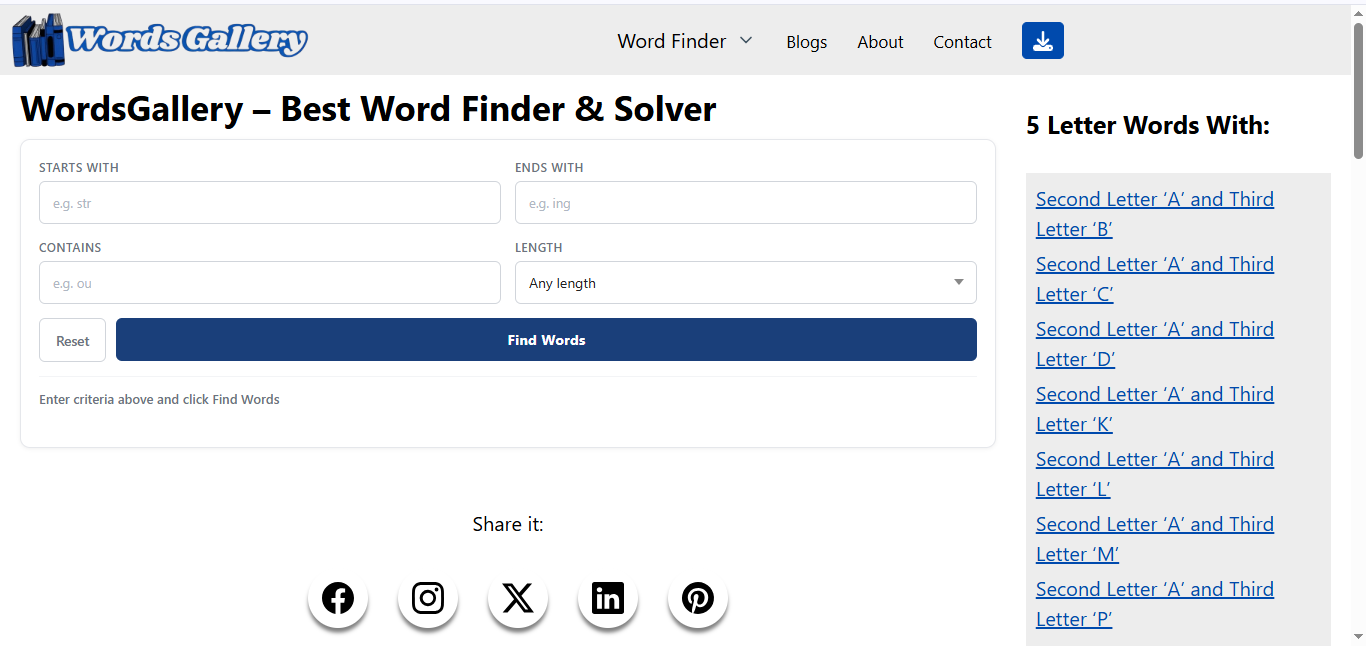
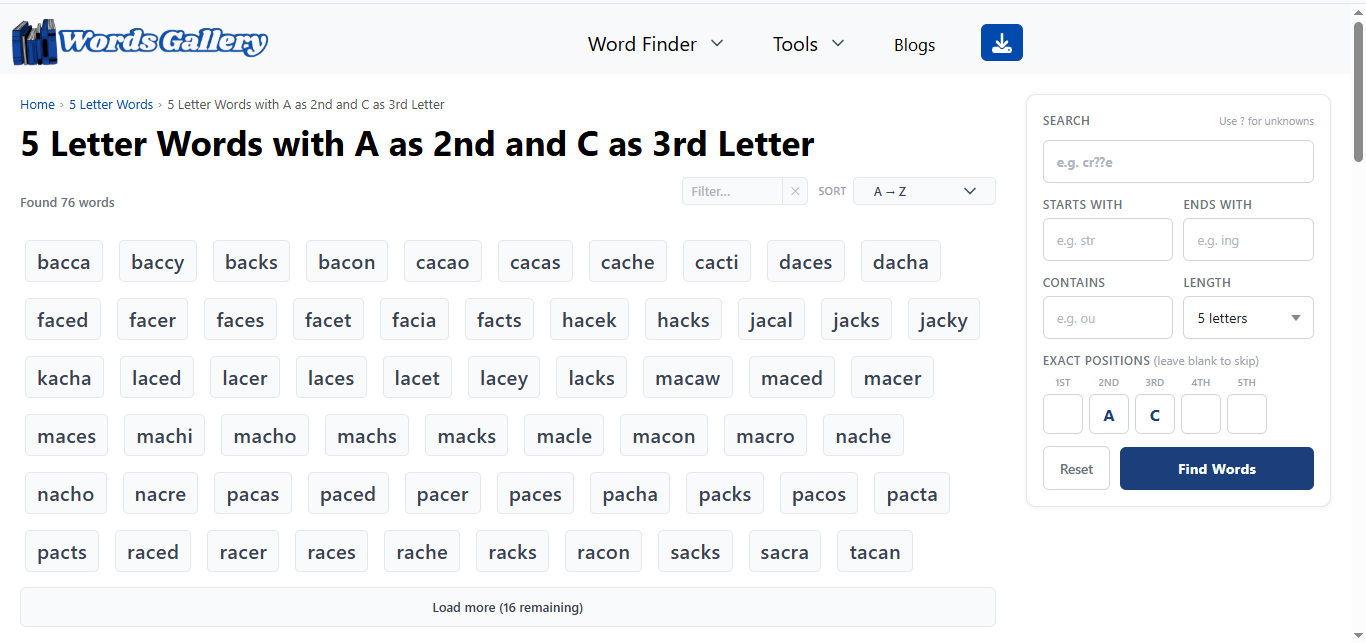
WordsGallery is a word finder for people who play Wordle, Scrabble, Words With Friends and crosswords. Instead of typing patterns into a search box, you open the page that matches what you already know. Know the second letter is E and the third is O? There's a page with every word that fits. The site also has lists by starting letters, a Spanish words section, and guides on things like banned Wordle words and Scrabble bingos.
Features
- Separate pages for every letter position combo
- Word lists by starting letters and word length
- Spanish words section for learners
- Guides for Wordle, Scrabble and word game players
- Works in the browser on phone and desktop
Use Cases
- Finding the right word when stuck on Wordle
- Checking valid words during a Scrabble or Words With Friends game
- Filling in missing letters on a crossword
- Building Spanish vocabulary lists for practice or class
- Picking better starting words for daily puzzles

Comments


Hi Fazier community, The idea for WordsGallery came from a pretty common moment. You're on your fourth Wordle guess, two letters are green, and your brain just stops giving you words. Most word finders want you to type something like "?e?o?" into a box, which never feels natural in the middle of a game. So the site works the other way around. Each letter position combo already has its own page, and you just open the one that matches your board. It started with 5 letter words and slowly grew into starting letter lists, a Spanish section and guides for Scrabble and Wordle players. Behind the scenes it's a fairly simple setup, mostly word data turned into pages people can scan quickly on a phone. Would love to hear what you think. If there's a word game or a type of list you'd like to see, drop it in the comments.

Separate pages for each letter-position combo is a clever way to skip the pattern syntax most word finders make you learn. Do the lists mark which words Wordle accepts versus the Scrabble dictionary? That difference trips people up. A way to exclude letters already ruled out would cover the other half of a Wordle guess.


Browsing by letter position instead of typing a pattern is a genuinely better fit for how people get stuck mid-game — especially on a phone during Scrabble, where typing ?e?o? syntax is fiddly. Giving every position combination its own page is also a smart structure for discovery. I am curious how you handle repeated letters and words with a known letter in multiple spots, since that is where position-based browsing can get tricky. The Spanish section is a nice touch for learners too. Congrats on the launch!


Browsing by letter position instead of typing a pattern is a clever twist: it matches how you actually think mid-Wordle ("second letter E, third O"). Static pages per combination should also rank well in search. Would a filter for excluded letters (the grey tiles) fit the page model, or would that explode the number of pages?
Opening a page for a known letter position instead of typing a pattern like ?e?o? fits how Wordle actually feels on guess four. Do those position pages let me filter by word length, or is length only on the starting-letter lists? For crosswords I often know the length before I know the second and third letters.

Pre-building a static page per letter-position combo is a neat architectural choice — no pattern syntax to learn mid-game, and each page loads instantly on a phone. I'm curious about the scale side: with thousands of possible position combinations, did you generate pages for every combo or only the ones that map to real word sets? Pruning the empty ones would keep the site easy to crawl. The Spanish section is a smart addition too — Spanish Scrabble has its own letter distribution, so those lists should feel genuinely different rather than just translated.
Premium Products

















































Sponsors
Buy

Makers
Makers
Comments
Hi Fazier community, The idea for WordsGallery came from a pretty common moment. You're on your fourth Wordle guess, two letters are green, and your brain just stops giving you words. Most word finders want you to type something like "?e?o?" into a box, which never feels natural in the middle of a game. So the site works the other way around. Each letter position combo already has its own page, and you just open the one that matches your board. It started with 5 letter words and slowly grew into starting letter lists, a Spanish section and guides for Scrabble and Wordle players. Behind the scenes it's a fairly simple setup, mostly word data turned into pages people can scan quickly on a phone. Would love to hear what you think. If there's a word game or a type of list you'd like to see, drop it in the comments.
Separate pages for each letter-position combo is a clever way to skip the pattern syntax most word finders make you learn. Do the lists mark which words Wordle accepts versus the Scrabble dictionary? That difference trips people up. A way to exclude letters already ruled out would cover the other half of a Wordle guess.
Browsing by letter position instead of typing a pattern is a genuinely better fit for how people get stuck mid-game — especially on a phone during Scrabble, where typing ?e?o? syntax is fiddly. Giving every position combination its own page is also a smart structure for discovery. I am curious how you handle repeated letters and words with a known letter in multiple spots, since that is where position-based browsing can get tricky. The Spanish section is a nice touch for learners too. Congrats on the launch!
Browsing by letter position instead of typing a pattern is a clever twist: it matches how you actually think mid-Wordle ("second letter E, third O"). Static pages per combination should also rank well in search. Would a filter for excluded letters (the grey tiles) fit the page model, or would that explode the number of pages?
Opening a page for a known letter position instead of typing a pattern like ?e?o? fits how Wordle actually feels on guess four. Do those position pages let me filter by word length, or is length only on the starting-letter lists? For crosswords I often know the length before I know the second and third letters.
Pre-building a static page per letter-position combo is a neat architectural choice — no pattern syntax to learn mid-game, and each page loads instantly on a phone. I'm curious about the scale side: with thousands of possible position combinations, did you generate pages for every combo or only the ones that map to real word sets? Pruning the empty ones would keep the site easy to crawl. The Spanish section is a smart addition too — Spanish Scrabble has its own letter distribution, so those lists should feel genuinely different rather than just translated.
Premium Products
New to Fazier?

Find your next favorite product or submit your own. Made by @FalakDigital.
Copyright ©2026. All Rights Reserved