WHY.™
Score your SaaS emails for decision friction, not wording
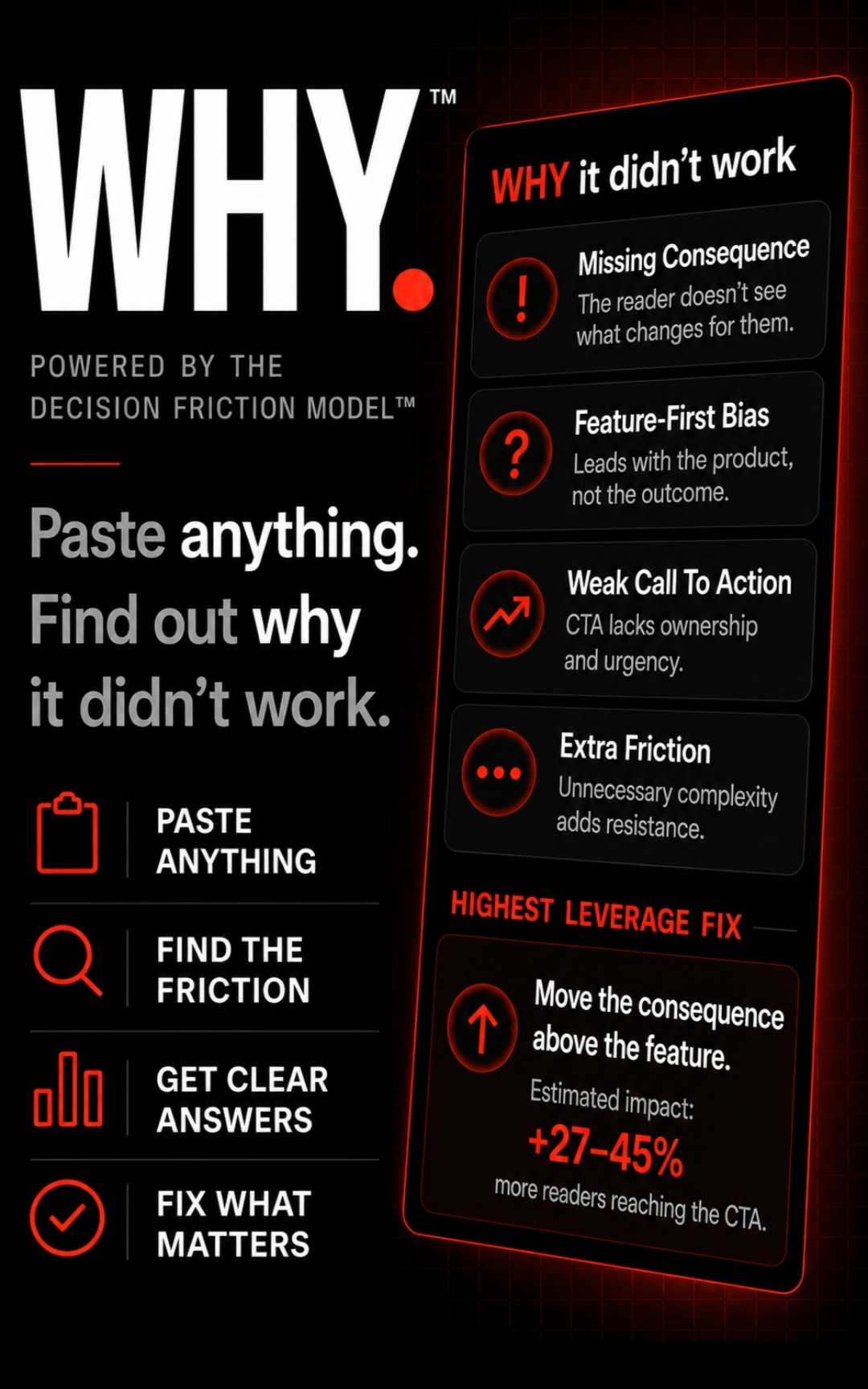
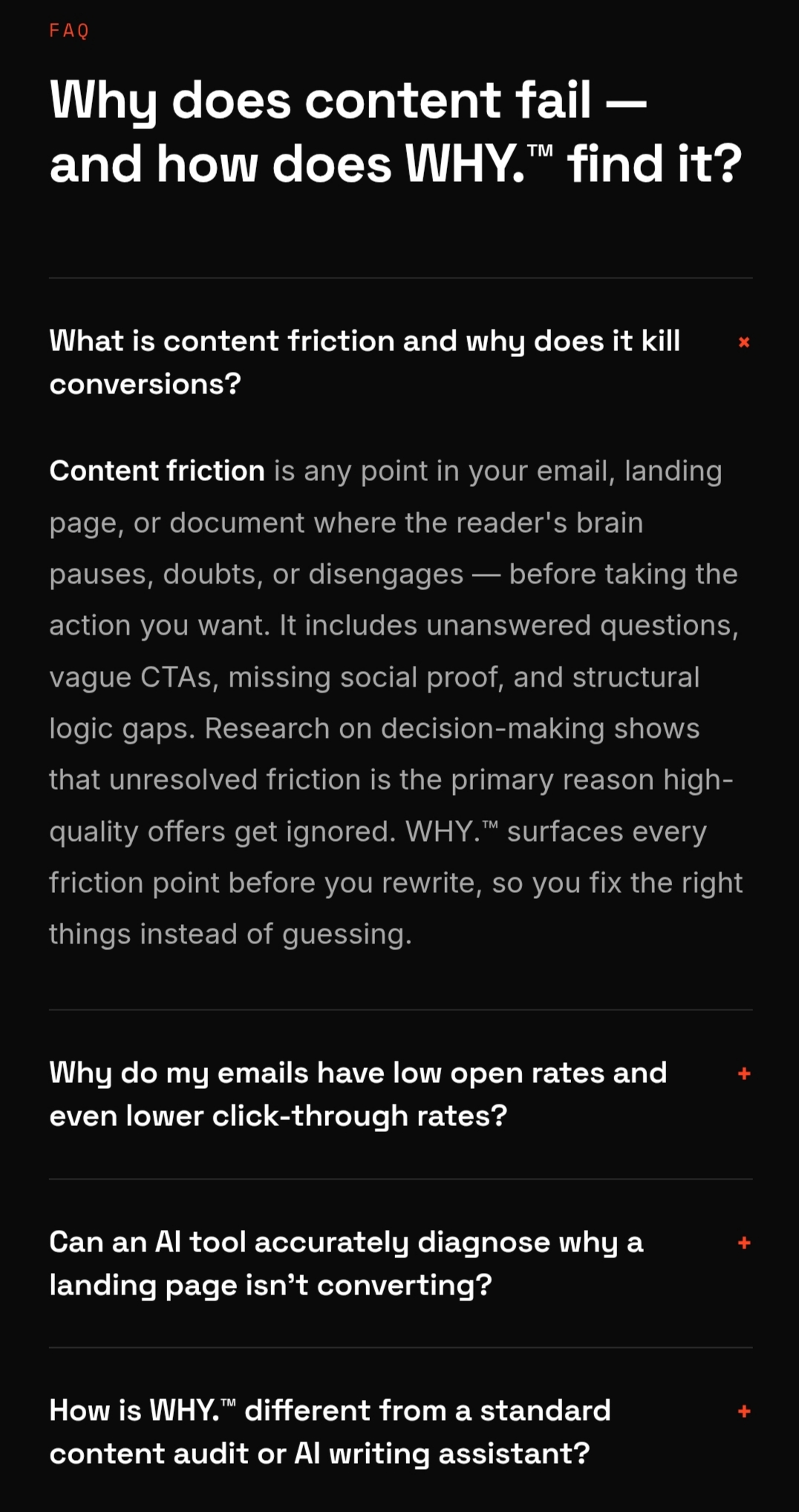
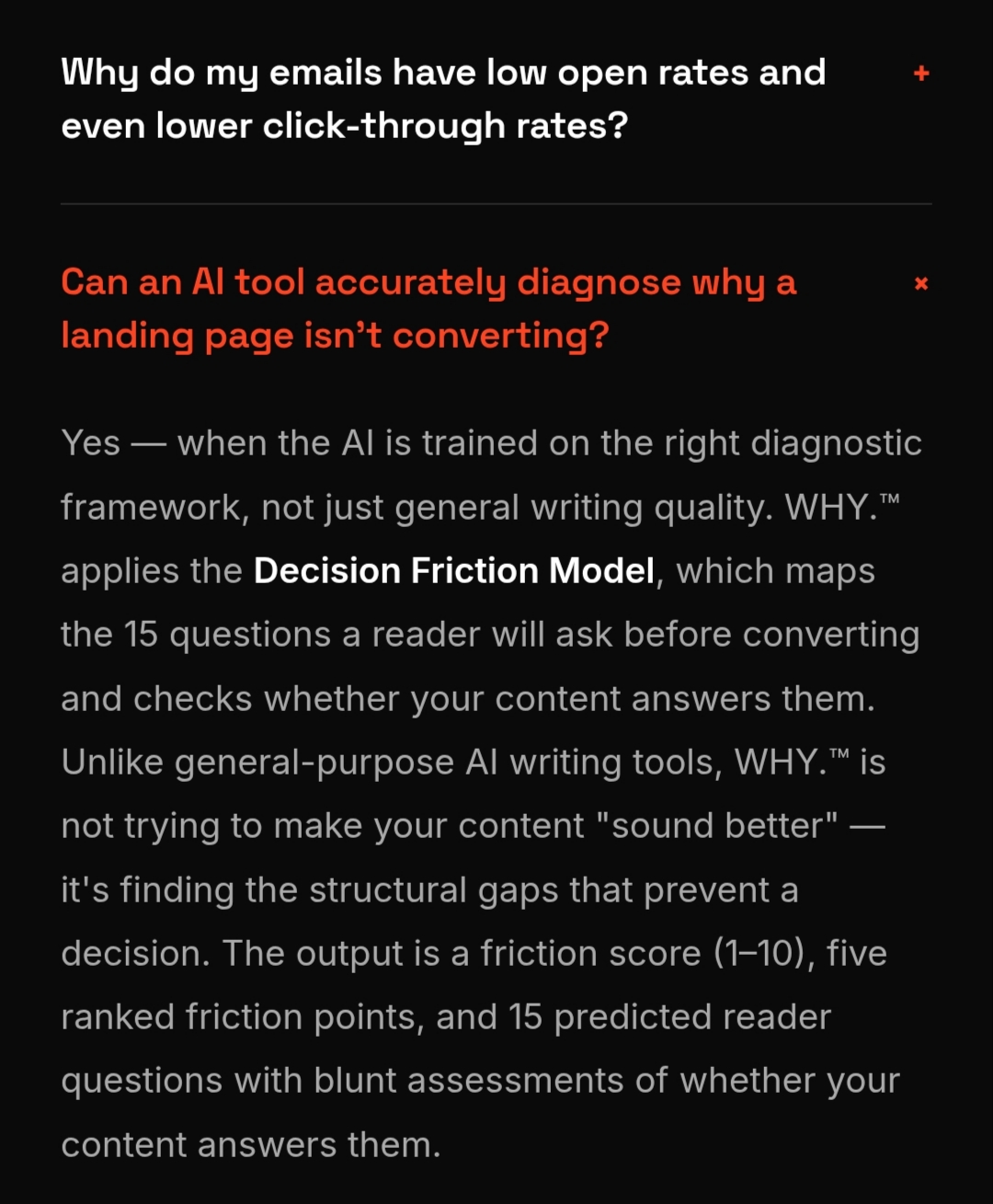
WHY. is a diagnostic tool that scores SaaS emails, onboarding sequences, changelogs, and product updates against the Decision Friction Model, a 7 point structural framework built from 59 real teardowns of SaaS sends.
It does not rewrite your copy and it does not check deliverability. Those are different problems. WHY. looks at the layer underneath the words: does the email give the reader a clear decision to make, or does it bury the point behind vague subject lines, guest language CTAs, and a feature list that arrives before any reason to care.
Across the teardowns analyzed so far, the average original score is 3.4 out of 10. After a structural rebuild using the same framework, the average score reaches 9 out of 10. The most common failures: guest language CTAs, feature first bias, filing label subject lines, and consequences buried after the caveat instead of stated before it.
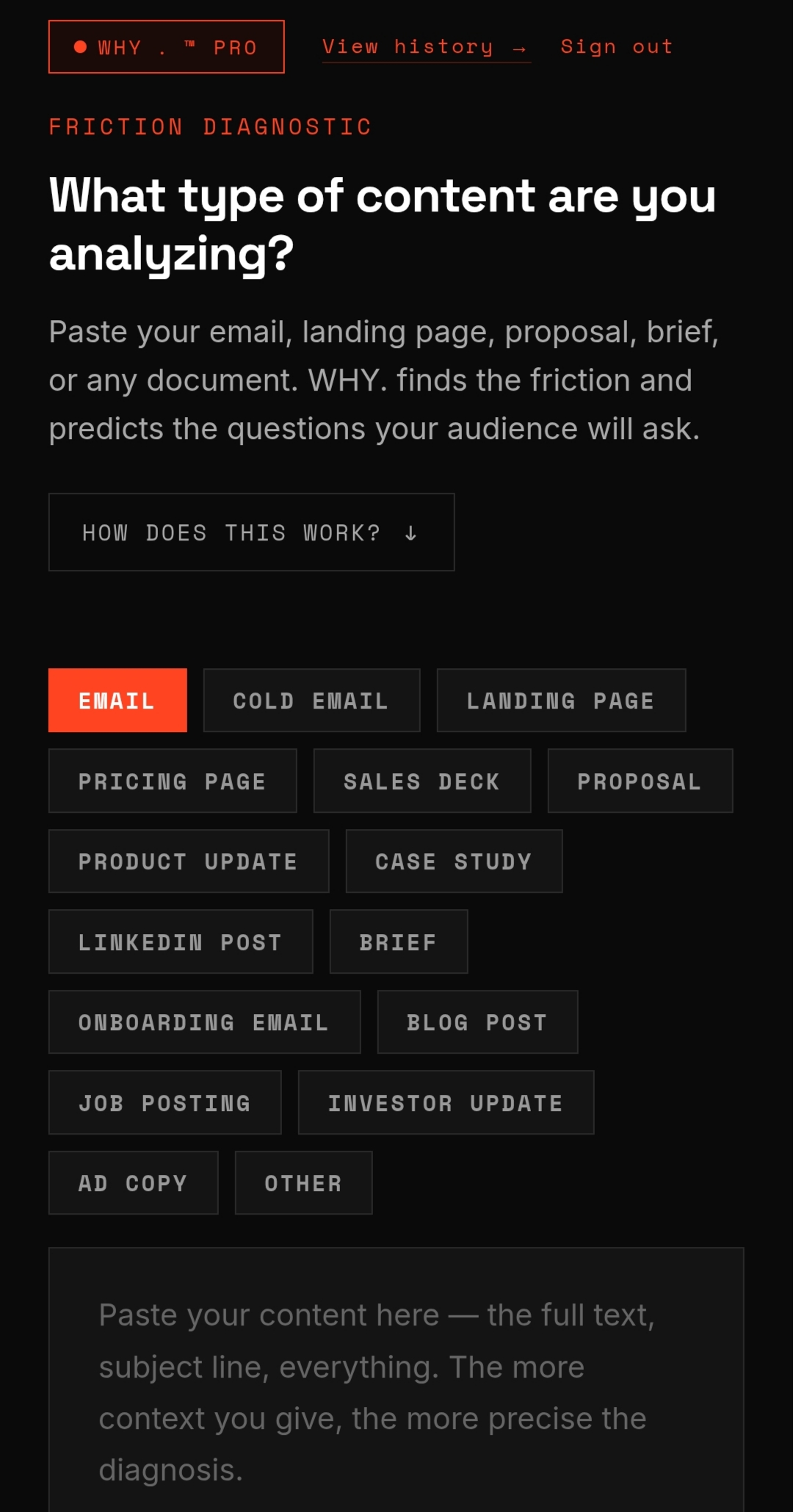
Paste an email, sequence, or changelog and get a score plus the exact friction points behind it. Three free analyses, no signup required.
Built solo by Alex Iliescu as part of Strategic Flow, a behavioral email architecture practice for B2B SaaS teams.
Features
- Scores emails, sequences, and changelogs against a 7 point Decision Friction Model
- Built from 59 published teardowns with real before/after scores
- Flags guest language CTAs, feature first bias, buried subject lines
- Average score jumps from 3.4/10 to 9/10 after rebuild
- 3 free analyses, no signup required
Use Cases
- SaaS founders auditing their own product update emails before sending
- Marketing managers checking onboarding sequences for drop-off points
- Newsletter writers scoring subject lines before scheduling a send
- Growth teams comparing before/after versions of a rewritten email
- Founders preparing a cold outreach email and want an outside diagnostic first
- Teams reviewing a changelog before it goes out to reduce reader confusion

Comments


Built this after doing 59 manual teardowns of real SaaS emails and noticing the same structural failures over and over. Most tools check wording or deliverability. This one checks whether the email actually gives the reader a decision to make. Happy to answer anything about the framework or the scoring logic.




Get Now Best Streaming Option from https://flash4kiptv.com/whmcs/aff.php?aff=42


Really like the idea behind this. Instead of focusing on grammar or deliverability, it evaluates whether an email actually helps the reader make a decision. The feedback feels practical, and the friction points are easy to understand. The free analyses without requiring signup are a nice touch. It seems especially useful for SaaS teams looking to improve onboarding and product emails.


The 'founders preparing a cold outreach email' use case is exactly me this month - I've been sending partner emails for my app and guessing at why replies don't come. Wording checkers never told me anything useful. Scoring whether the reader actually has a decision to make is a smarter frame. Trying it on my next batch before I hit send.

I like the approach of focusing on decision friction rather than just improving the wording. It’s interesting to see how factors like vague CTAs and feature-first messaging can affect whether someone actually takes action. This could be especially useful for SaaS teams looking to understand why their emails aren't converting, beyond just checking grammar or readability.

This is a sharp wedge. Most email tools grade wording or deliverability, and "does the reader actually have a decision to make" is the part everyone skips. The guest-language CTA and feature-first bias callouts hit close to home. Question on the scoring: when it flags a friction point, does it explain the structural fix or just mark the deduction? The teardown before/after numbers (3.4 to 9) are a strong proof point, would be great to see one full example in the gallery.

WHY has great potential! A few improvements could make it even better. I'd love to share my feedback and suggestions. WhatsApp: https://wa.me/447307349530 Telegram: t.me/rforrank


WHY. sounds useful because it focuses on the decision structure behind an email rather than simply changing the wording. I’d be interested to see how the framework performs for product updates and onboarding emails from browser-based tools like especially when the goal is to explain a technical feature clearly and guide users toward one simple next step.


Premium Products

































Sponsors
Buy

Awards
View all
Awards
View allMakers
Makers
Comments
Built this after doing 59 manual teardowns of real SaaS emails and noticing the same structural failures over and over. Most tools check wording or deliverability. This one checks whether the email actually gives the reader a decision to make. Happy to answer anything about the framework or the scoring logic.
Get Now Best Streaming Option from https://flash4kiptv.com/whmcs/aff.php?aff=42
Really like the idea behind this. Instead of focusing on grammar or deliverability, it evaluates whether an email actually helps the reader make a decision. The feedback feels practical, and the friction points are easy to understand. The free analyses without requiring signup are a nice touch. It seems especially useful for SaaS teams looking to improve onboarding and product emails.
The 'founders preparing a cold outreach email' use case is exactly me this month - I've been sending partner emails for my app and guessing at why replies don't come. Wording checkers never told me anything useful. Scoring whether the reader actually has a decision to make is a smarter frame. Trying it on my next batch before I hit send.
I like the approach of focusing on decision friction rather than just improving the wording. It’s interesting to see how factors like vague CTAs and feature-first messaging can affect whether someone actually takes action. This could be especially useful for SaaS teams looking to understand why their emails aren't converting, beyond just checking grammar or readability.
This is a sharp wedge. Most email tools grade wording or deliverability, and "does the reader actually have a decision to make" is the part everyone skips. The guest-language CTA and feature-first bias callouts hit close to home. Question on the scoring: when it flags a friction point, does it explain the structural fix or just mark the deduction? The teardown before/after numbers (3.4 to 9) are a strong proof point, would be great to see one full example in the gallery.
WHY has great potential! A few improvements could make it even better. I'd love to share my feedback and suggestions. WhatsApp: https://wa.me/447307349530 Telegram: t.me/rforrank
WHY. sounds useful because it focuses on the decision structure behind an email rather than simply changing the wording. I’d be interested to see how the framework performs for product updates and onboarding emails from browser-based tools like especially when the goal is to explain a technical feature clearly and guide users toward one simple next step.
Premium Products
New to Fazier?

Find your next favorite product or submit your own. Made by @FalakDigital.
Copyright ©2026. All Rights Reserved