
WhittleOS
Decide which startup idea is worth building
Most idea validators are feel-good machines: paste an idea, get a "promising" score, then build for months on a vibe.
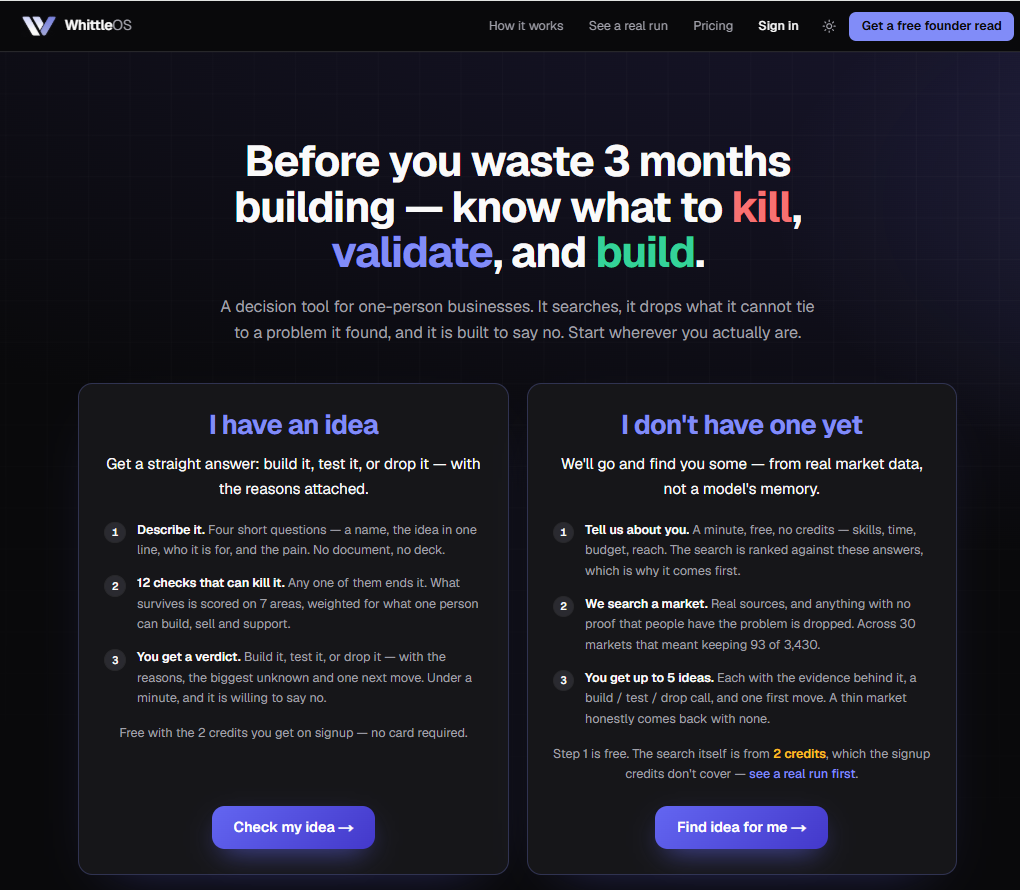
WhittleOS is the opposite — deliberately kill-biased. Ask it about an idea you already have and it returns build / test-first / drop, with the reasons. Or let Discovery source real candidates for you across a market and rank them against your founder profile.
What makes the verdict checkable rather than flattering:
- It links the problems it cites to the page each was read on, or labels them as its own estimate. The published run documents 56 problems, 32 of them with a link you can open.
- The 0–100 score is computed in code from a fixed weighted rubric across seven categories, not asked of a model.
- When a market is genuinely weak it hands back nothing rather than a score. That published run took 69 candidates, killed 36 on deal-breakers, and its best surviving idea scored 52 — "test it first", not "build it".
Validation is no-call and async by design: a landing page and a real CTA, never "go book 20 discovery calls".
Seventeen analysis modes in total, with Discovery as the flagship. Prepaid credits, pay per decision, no subscription — two free credits on signup, three calculators at whittleos.com/tools with no signup at all, and the full published run readable at whittleos.com/sample-discovery.
Features
- Discovery — autonomous sourcing: splits a market into sub-markets, runs the searches, reads the pages, and returns a ranked shortlist with an idea card per finalist
- Single Idea Check — a build / test-first / drop verdict against twelve deal-breaker filters, each with its reason attached
- Kill My Idea — an adversarial pass that argues only the case against, ranked by severity
- Evidence base — each problem cited links to the page it was read on, or is labelled as our own estimate; nothing is quietly presented as sourced
- Scoring in code — the 0–100 score comes from a fixed weighted rubric over seven categories, not from a number a model invented
- No-Call Validation — an async validation plan: landing promise, CTA, pricing test, success criteria and a stop-loss
- Founder Fit — ranks ideas against your real constraints: time budget, capital, skills, support tolerance, sales preference
- Focused checks — Pricing Power, Support Burden, Platform Risk, MVP Scope, Pivot Wedge, Competitor Teardown, Pain Mining, Compare Ideas, First-Customer Leads, Landing Page, Idea Graveyard
- Prepaid credits — $19 / $49 / $99 / $149 for 2 / 6 / 15 / 30 credits, no subscription
Use Cases
- You have an idea and want a blunt verdict before spending three months building it
- You have no idea yet and want candidates sourced from real markets, ranked against your own profile
- You have five ideas and need them ranked against each other rather than praised one at a time
- You want to kill an idea cheaply — or find the narrow wedge that would save it
- You want an async validation plan (landing page plus a real CTA) instead of booking discovery calls
- You want to know before building whether it can charge enough, whether support will eat your week, and which platform can switch you off

Comments


Hi Fazier 👋 I built WhittleOS after running my own idea through the tools that were supposed to check it. One came back 72/100, "promising", "among the top ideas we've seen". So I built the thing I actually wanted and pointed it at the same idea: KILL, 15/100, ten reasons — including the one that stung, which was essentially "strip the LLM out and what is left?". Both verdicts are still published on the site. So this one is deliberately kill-biased. Problems it cites link to the page they were read on, or are labelled as its own estimate. The 0–100 score comes from a fixed weighted rubric in code, not from a model picking a number. And when a market is weak it hands back nothing rather than a verdict. The Discovery run I published tops out at 52 — "test it first", not "build it" — and I left that one up instead of staging a prettier one: whittleos.com/sample-discovery Two free credits on signup, no card. What I'd most like from this launch: tell me where it is too harsh. That is the failure mode I cannot see from inside.



Premium Products






































Sponsors
Buy

Makers
Makers
Comments
Hi Fazier 👋 I built WhittleOS after running my own idea through the tools that were supposed to check it. One came back 72/100, "promising", "among the top ideas we've seen". So I built the thing I actually wanted and pointed it at the same idea: KILL, 15/100, ten reasons — including the one that stung, which was essentially "strip the LLM out and what is left?". Both verdicts are still published on the site. So this one is deliberately kill-biased. Problems it cites link to the page they were read on, or are labelled as its own estimate. The 0–100 score comes from a fixed weighted rubric in code, not from a model picking a number. And when a market is weak it hands back nothing rather than a verdict. The Discovery run I published tops out at 52 — "test it first", not "build it" — and I left that one up instead of staging a prettier one: whittleos.com/sample-discovery Two free credits on signup, no card. What I'd most like from this launch: tell me where it is too harsh. That is the failure mode I cannot see from inside.
Premium Products
New to Fazier?

Find your next favorite product or submit your own. Made by @FalakDigital.
Copyright ©2026. All Rights Reserved