
what movie is this
What Movie Is This — Identify a Film from Memory
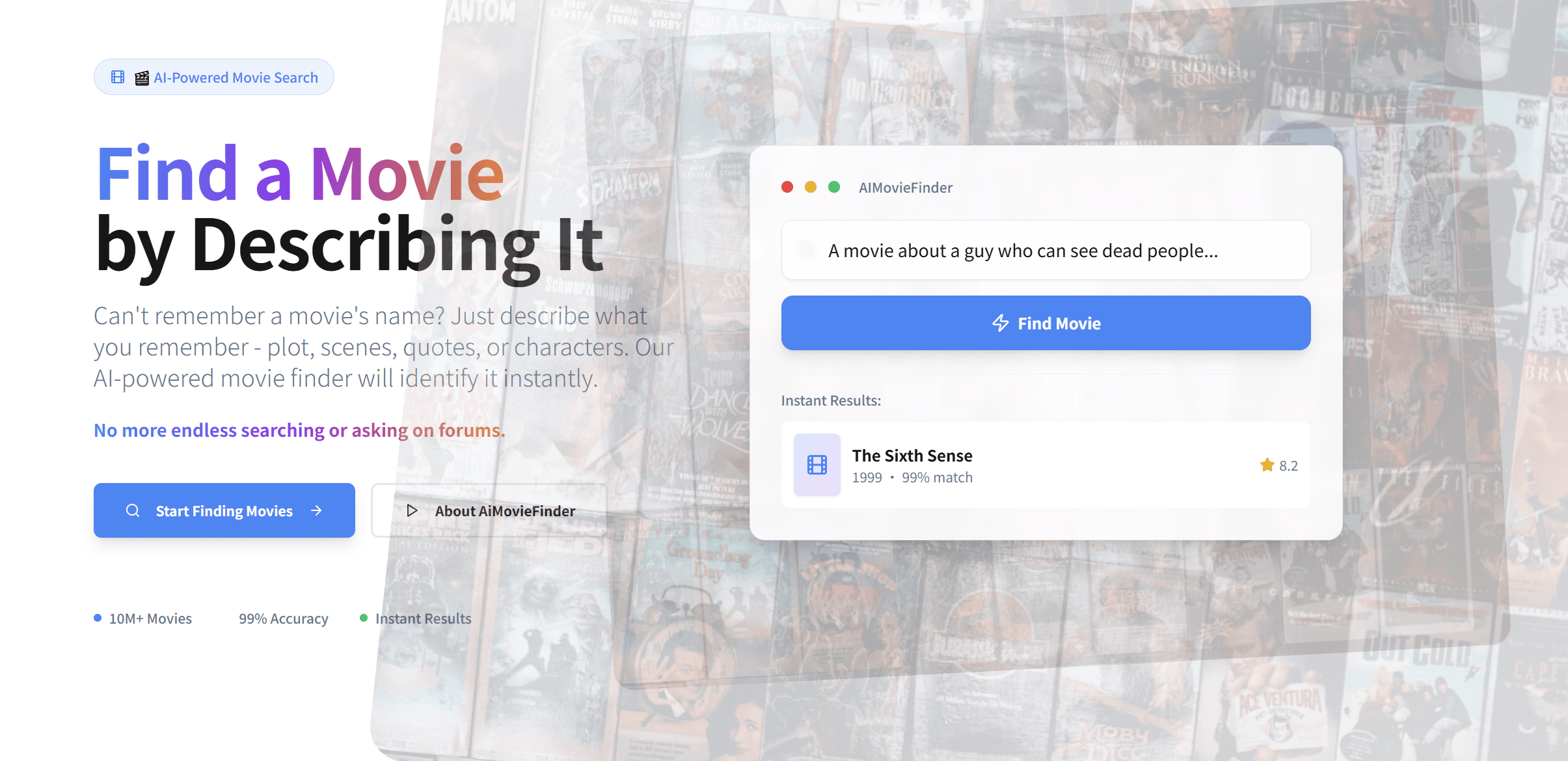
[what movie is this from](https://www.aimoviefinder.com/) lets you search with whatever evidence survived: part of the plot, one unusual scene, a line of dialogue, a performer, or an image. AiMovieFinder returns likely candidates with useful metadata and verification links, helping you compare possibilities before deciding which title matches your memory.
Features
- Find a movie by describing the plot, a scene, or a mood
- Identify a film from an exact quote or line of dialogue
- Upload a screenshot, still, or poster to identify the movie
- Narrow the search by actor, clip frame, or song clue
- Guess the Movie by Emoji — a new daily movie puzzle every day
- Guess the Movie by Famous Quotes — three quote clues per film
Use Cases
- Upload a screenshot from social media to identify the film
- Recover a childhood movie from one half-remembered scene
- Find the movie behind a quote stuck in your head
- Identify a film from a song heard in its soundtrack
- Play today's emoji movie puzzle and replay past days from the calendar
- Challenge friends to name a classic film from its famous quotes

Comments


[what movie is this](https://www.aimoviefinder.com/) is the question AiMovieFinder helps answer when a film title disappears but part of the viewing experience remains. A user may remember a strange room, a particular costume, the ending of a chase, one line of dialogue, the relationship between two characters, an actor’s face, a soundtrack cue, or a screenshot saved without context. Instead of requiring an exact title or a perfectly remembered quotation, the finder accepts the incomplete clues people naturally have and turns them into a focused list of possible films. The main search works with ordinary language. Users can describe a plot fragment, scene, character, setting, ending, genre, mood, approximate era, country, or language. Optional filters help separate films that share a broad premise. Someone who remembers only “a child makes a wish at a fortune-telling machine and wakes up as an adult” can enter that sequence directly. Someone with a less reliable memory can say which details may be wrong. The purpose is not to force the user into database syntax; it is to preserve the clues in the way they are actually remembered. AiMovieFinder returns up to five likely candidates rather than presenting one unexplained answer as certain. When movie metadata is available, candidates can include a poster, release year, plot overview, match reason, rating information, and an IMDb link. This makes the result useful even when several films share similar scenes or story structures. The user can compare the shortlist with the original memory, verify cast and plot details, reject weak candidates, and refine the description with one more distinctive clue. Text is not the only input. A picture search is available for screenshots, stills, and posters. Visual clues such as faces, costumes, locations, props, signs, lighting, color, and composition can help identify the source. Dedicated tools also let users focus on a description, plot, scene, quotation, actor or director, song or soundtrack clue, poster, picture, or a representative frame extracted from an MP4 clip. The clip workflow keeps the original video in the browser and sends only a compressed still for analysis. The specialized scene finder is useful when the user remembers one moment more clearly than the overall story. It encourages details about the sequence of actions, environment, weather, camera movement, costume, unusual objects, and what happens immediately before or after the shot. The quote finder is designed for partial dialogue, catchphrases, translated wording, and common misquotes. Context such as the speaker, scene, genre, or approximate year can strengthen a quotation search. The actor and director tool combines a person clue with a role, co-star, location, or story detail so a long filmography becomes easier to narrow. AiMovieFinder also includes a separate movie quote discovery tool. This page serves a different purpose from identifying a film by a remembered line. Users can search within a known movie or explore dialogue by a theme such as courage, friendship, regret, family, ambition, or second chances. It offers a flexible alternative to static “best quotes” lists for movie fans, writers, educators, presenters, and trivia hosts. Search is free and does not require registration. Finder queries, uploaded images, extracted clip frames, and search history are not retained in an application database, although the external services used for AI processing, analytics, advertising, and movie metadata may handle limited data under their own policies. Results are suggestions, not guarantees, and the product consistently gives users ways to verify the strongest candidates. AiMovieFinder is most useful for the familiar tip-of-the-tongue situation: the viewer knows they have seen the film, can picture part of it, but cannot recover the name. It brings description, scene, quote, image, cast, music, and clip-frame clues into one browser-based destination. By returning several reasoned possibilities instead of demanding perfect input, the site helps turn a vague movie memory into a title the user can check and recognize. Good searches are built from independent clues. A broad prompt such as “a scary movie in a house” can match hundreds of titles, while “a family moves into an isolated house, a child speaks to someone unseen, and the wallpaper contains a distinctive pattern” gives the finder several signals to compare. Users do not need to write a complete synopsis. Two or three details that would be unusual together are often more useful than a long retelling of common events. The system also supports an iterative search process. The first shortlist can reveal which clue was too broad or which remembered detail may be incorrect. A user can then add a decade, remove a mistaken genre, describe the ending, identify the country, or explain that the actors looked older than initially remembered. This feedback loop makes AiMovieFinder useful even when the answer is not obvious from the first prompt. For directories, the most accurate category is an AI movie identification or entertainment search tool. It is not primarily a streaming guide, recommendation engine, review database, or general chatbot. Its central job is recovering a specific title from memory. That narrow problem statement, combined with several clue-specific workflows, distinguishes AiMovieFinder from sites that only recommend similar movies after the user already knows what they watched.
Premium Products






















Sponsors
Buy
Makers
Makers
Comments
[what movie is this](https://www.aimoviefinder.com/) is the question AiMovieFinder helps answer when a film title disappears but part of the viewing experience remains. A user may remember a strange room, a particular costume, the ending of a chase, one line of dialogue, the relationship between two characters, an actor’s face, a soundtrack cue, or a screenshot saved without context. Instead of requiring an exact title or a perfectly remembered quotation, the finder accepts the incomplete clues people naturally have and turns them into a focused list of possible films. The main search works with ordinary language. Users can describe a plot fragment, scene, character, setting, ending, genre, mood, approximate era, country, or language. Optional filters help separate films that share a broad premise. Someone who remembers only “a child makes a wish at a fortune-telling machine and wakes up as an adult” can enter that sequence directly. Someone with a less reliable memory can say which details may be wrong. The purpose is not to force the user into database syntax; it is to preserve the clues in the way they are actually remembered. AiMovieFinder returns up to five likely candidates rather than presenting one unexplained answer as certain. When movie metadata is available, candidates can include a poster, release year, plot overview, match reason, rating information, and an IMDb link. This makes the result useful even when several films share similar scenes or story structures. The user can compare the shortlist with the original memory, verify cast and plot details, reject weak candidates, and refine the description with one more distinctive clue. Text is not the only input. A picture search is available for screenshots, stills, and posters. Visual clues such as faces, costumes, locations, props, signs, lighting, color, and composition can help identify the source. Dedicated tools also let users focus on a description, plot, scene, quotation, actor or director, song or soundtrack clue, poster, picture, or a representative frame extracted from an MP4 clip. The clip workflow keeps the original video in the browser and sends only a compressed still for analysis. The specialized scene finder is useful when the user remembers one moment more clearly than the overall story. It encourages details about the sequence of actions, environment, weather, camera movement, costume, unusual objects, and what happens immediately before or after the shot. The quote finder is designed for partial dialogue, catchphrases, translated wording, and common misquotes. Context such as the speaker, scene, genre, or approximate year can strengthen a quotation search. The actor and director tool combines a person clue with a role, co-star, location, or story detail so a long filmography becomes easier to narrow. AiMovieFinder also includes a separate movie quote discovery tool. This page serves a different purpose from identifying a film by a remembered line. Users can search within a known movie or explore dialogue by a theme such as courage, friendship, regret, family, ambition, or second chances. It offers a flexible alternative to static “best quotes” lists for movie fans, writers, educators, presenters, and trivia hosts. Search is free and does not require registration. Finder queries, uploaded images, extracted clip frames, and search history are not retained in an application database, although the external services used for AI processing, analytics, advertising, and movie metadata may handle limited data under their own policies. Results are suggestions, not guarantees, and the product consistently gives users ways to verify the strongest candidates. AiMovieFinder is most useful for the familiar tip-of-the-tongue situation: the viewer knows they have seen the film, can picture part of it, but cannot recover the name. It brings description, scene, quote, image, cast, music, and clip-frame clues into one browser-based destination. By returning several reasoned possibilities instead of demanding perfect input, the site helps turn a vague movie memory into a title the user can check and recognize. Good searches are built from independent clues. A broad prompt such as “a scary movie in a house” can match hundreds of titles, while “a family moves into an isolated house, a child speaks to someone unseen, and the wallpaper contains a distinctive pattern” gives the finder several signals to compare. Users do not need to write a complete synopsis. Two or three details that would be unusual together are often more useful than a long retelling of common events. The system also supports an iterative search process. The first shortlist can reveal which clue was too broad or which remembered detail may be incorrect. A user can then add a decade, remove a mistaken genre, describe the ending, identify the country, or explain that the actors looked older than initially remembered. This feedback loop makes AiMovieFinder useful even when the answer is not obvious from the first prompt. For directories, the most accurate category is an AI movie identification or entertainment search tool. It is not primarily a streaming guide, recommendation engine, review database, or general chatbot. Its central job is recovering a specific title from memory. That narrow problem statement, combined with several clue-specific workflows, distinguishes AiMovieFinder from sites that only recommend similar movies after the user already knows what they watched.
Premium Products
New to Fazier?

Find your next favorite product or submit your own. Made by @FalakDigital.
Copyright ©2025. All Rights Reserved