
Voiden API Client
Modern, fast and extensible API Client with Git integration
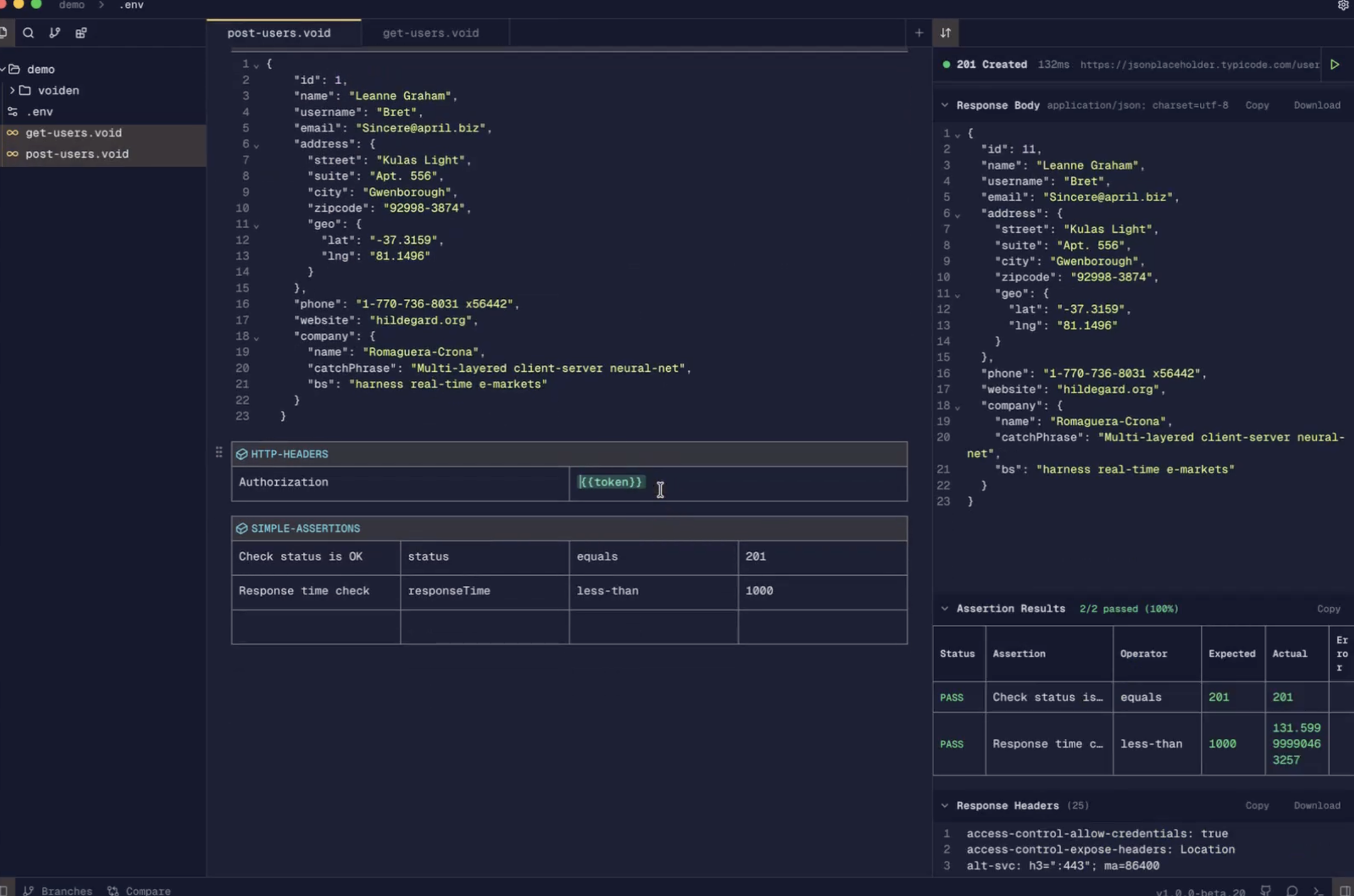
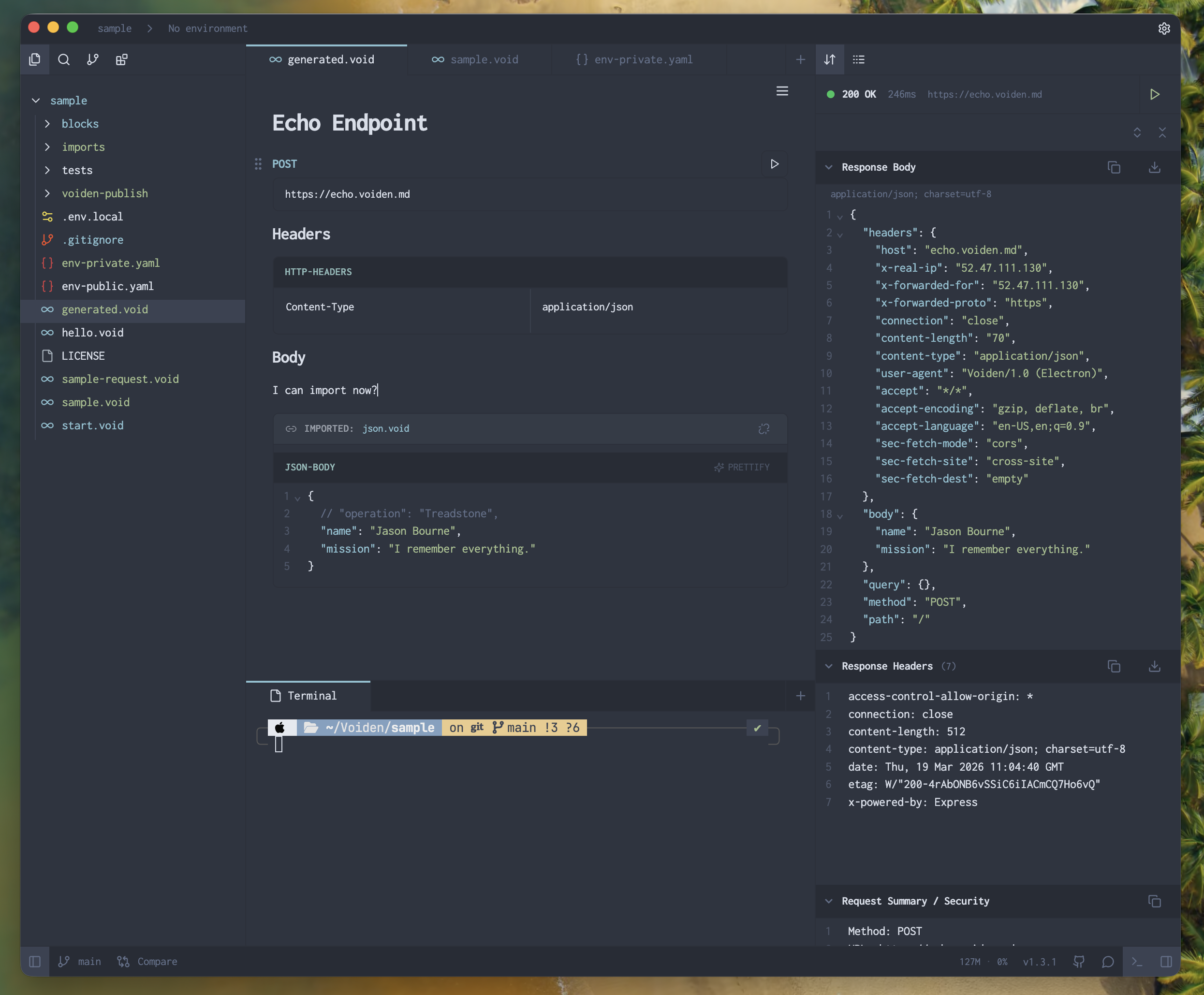
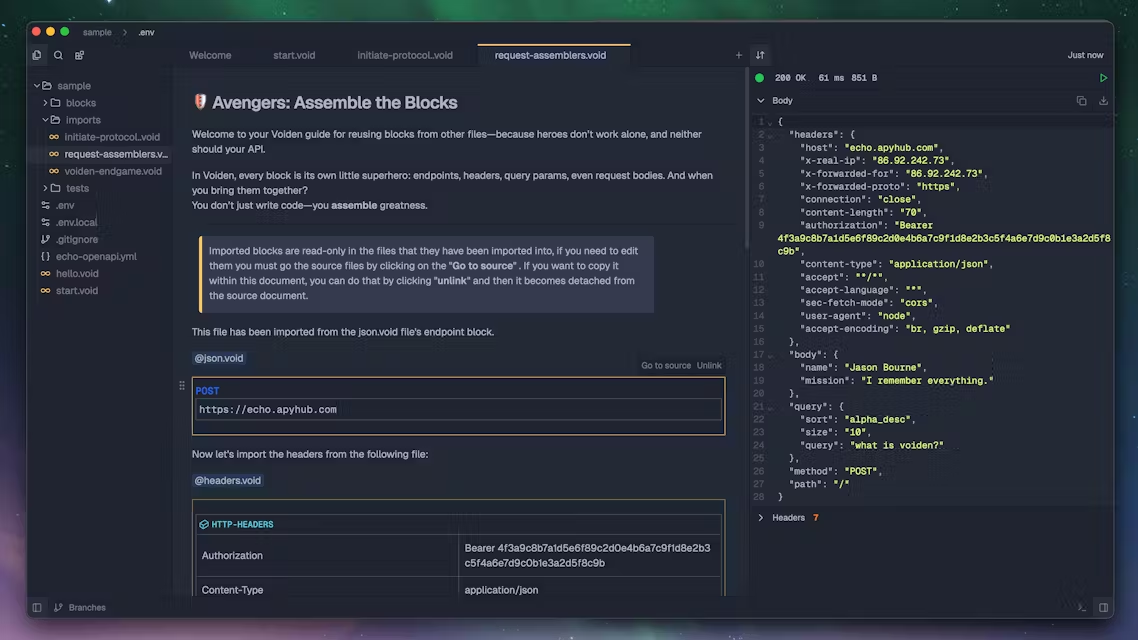
Voiden is a modern API Client that adapts to how devs and QA folks already work. It works with reusable components, just like Notion, or like Lego. You can decompose requests into blocks (endpoint, headers, auth, params) and reuse across files, just like functions.
Define, test, and document APIs like a developer, not a SaaS user. No accounts. No lock-in. No telemetry. Just Markdown, Git, hotkeys, and your damn specs.
Features
- Programmable Interface with slash commands
- Specs, Tests and Docs all in plain text (markdown)
- REST, gRPC, Web-sockets, Graph QL in one place
- Scripting in JS, Python, Shell and more
- Multi Request support
- Collection Runner
- Community Extensions
- Keyboard first
- Offline, no signup required
- Open Source
Use Cases
- Design APIs
- Test APIs
- Create API documentation
- Test Automation
- API Management

Comments

The offline-first approach is exactly right for an API client. Postman's cloud-required shift broke workflows for anyone with strict security requirements or airgapped environments. An open source, keyboard-first client that stores files locally is a genuinely different value proposition. Will watch how the extensibility story develops.

Nikolas here, building Voiden. API tools were supposed to make developers faster. Somewhere along the way, they turned into platforms: logins for localhost, cloud-first workflows, proprietary formats, per-seat pricing and things breaking the moment you go offline. That never sat right with us. We didn’t want to build another Postman clone or a “faster version” of what’s already out there. Instead, we took the longer (and harder) path: rethinking assumptions, stripping away noise, and building an API tool that actually respects how developers think and work. A few principles we have been (a bit) stubborn about: - API testing should work locally, by default - Your files and workflows should stay yours - Tools should not hold your work hostage - If you claim to “free developers”, the tool itself should stay free How Voiden is different: First of all, the key idea: every part of a request is a reusable block: endpoints, headers, auth, query params, body, tests… Everything is modular. Think LEGO, but for API components. Why blocks matter: - Blocks live in slash commands, so they appear only when you need them - Requests and tests are composed by assembling blocks, not by filling “forms” And it gets better: - Blocks can be reused across different files, APIs, and projects. You only need to update once and it updates everywhere to all other docs that share the same block/component. - Everything is versioned in Git, fully offline, and fully transparent The idea behind this was to have API work treated like in code : when we add an extra logic to an imported method. (In other API clients you mainly have to duplicate stuff or just use environment variables to substitute.) Other things we love and we want you to love as well: - Specs, tests, and docs all live together in executable plain text (Markdown). - Pre- and post-request scripting supports JavaScript, Python, Shell, etc. Unlike other clients, this isn’t a tiny JS sandbox, your scripts run fully locally, integrated with the request blocks. - Core and Community Plugins: gRPC, GraphQL, WebSockets, custom runtimes, etc. - Multi-request flows: Run groups of requests like scripts from multiple documents (similar to the collection runner) or within the same file! -Voiden Skills for Claude & Codex Agents: AI agents can now understand Voiden blocks, files, and plugins. If you are tired of heavyweight API platforms pretending to be tools, this might resonate. Try it, break it, question it, shape it. Genuinely want the feedback 🚀
Premium Products


































Sponsors
Buy

Comments
The offline-first approach is exactly right for an API client. Postman's cloud-required shift broke workflows for anyone with strict security requirements or airgapped environments. An open source, keyboard-first client that stores files locally is a genuinely different value proposition. Will watch how the extensibility story develops.
Nikolas here, building Voiden. API tools were supposed to make developers faster. Somewhere along the way, they turned into platforms: logins for localhost, cloud-first workflows, proprietary formats, per-seat pricing and things breaking the moment you go offline. That never sat right with us. We didn’t want to build another Postman clone or a “faster version” of what’s already out there. Instead, we took the longer (and harder) path: rethinking assumptions, stripping away noise, and building an API tool that actually respects how developers think and work. A few principles we have been (a bit) stubborn about: - API testing should work locally, by default - Your files and workflows should stay yours - Tools should not hold your work hostage - If you claim to “free developers”, the tool itself should stay free How Voiden is different: First of all, the key idea: every part of a request is a reusable block: endpoints, headers, auth, query params, body, tests… Everything is modular. Think LEGO, but for API components. Why blocks matter: - Blocks live in slash commands, so they appear only when you need them - Requests and tests are composed by assembling blocks, not by filling “forms” And it gets better: - Blocks can be reused across different files, APIs, and projects. You only need to update once and it updates everywhere to all other docs that share the same block/component. - Everything is versioned in Git, fully offline, and fully transparent The idea behind this was to have API work treated like in code : when we add an extra logic to an imported method. (In other API clients you mainly have to duplicate stuff or just use environment variables to substitute.) Other things we love and we want you to love as well: - Specs, tests, and docs all live together in executable plain text (Markdown). - Pre- and post-request scripting supports JavaScript, Python, Shell, etc. Unlike other clients, this isn’t a tiny JS sandbox, your scripts run fully locally, integrated with the request blocks. - Core and Community Plugins: gRPC, GraphQL, WebSockets, custom runtimes, etc. - Multi-request flows: Run groups of requests like scripts from multiple documents (similar to the collection runner) or within the same file! -Voiden Skills for Claude & Codex Agents: AI agents can now understand Voiden blocks, files, and plugins. If you are tired of heavyweight API platforms pretending to be tools, this might resonate. Try it, break it, question it, shape it. Genuinely want the feedback 🚀
Premium Products
New to Fazier?

Find your next favorite product or submit your own. Made by @FalakDigital.
Copyright ©2026. All Rights Reserved