
Most women who stop singing don't decide to stop. Kids arrive, a job gets loud, a choir folds, and one day it's been eleven years since you sang anything that wasn't in the car.
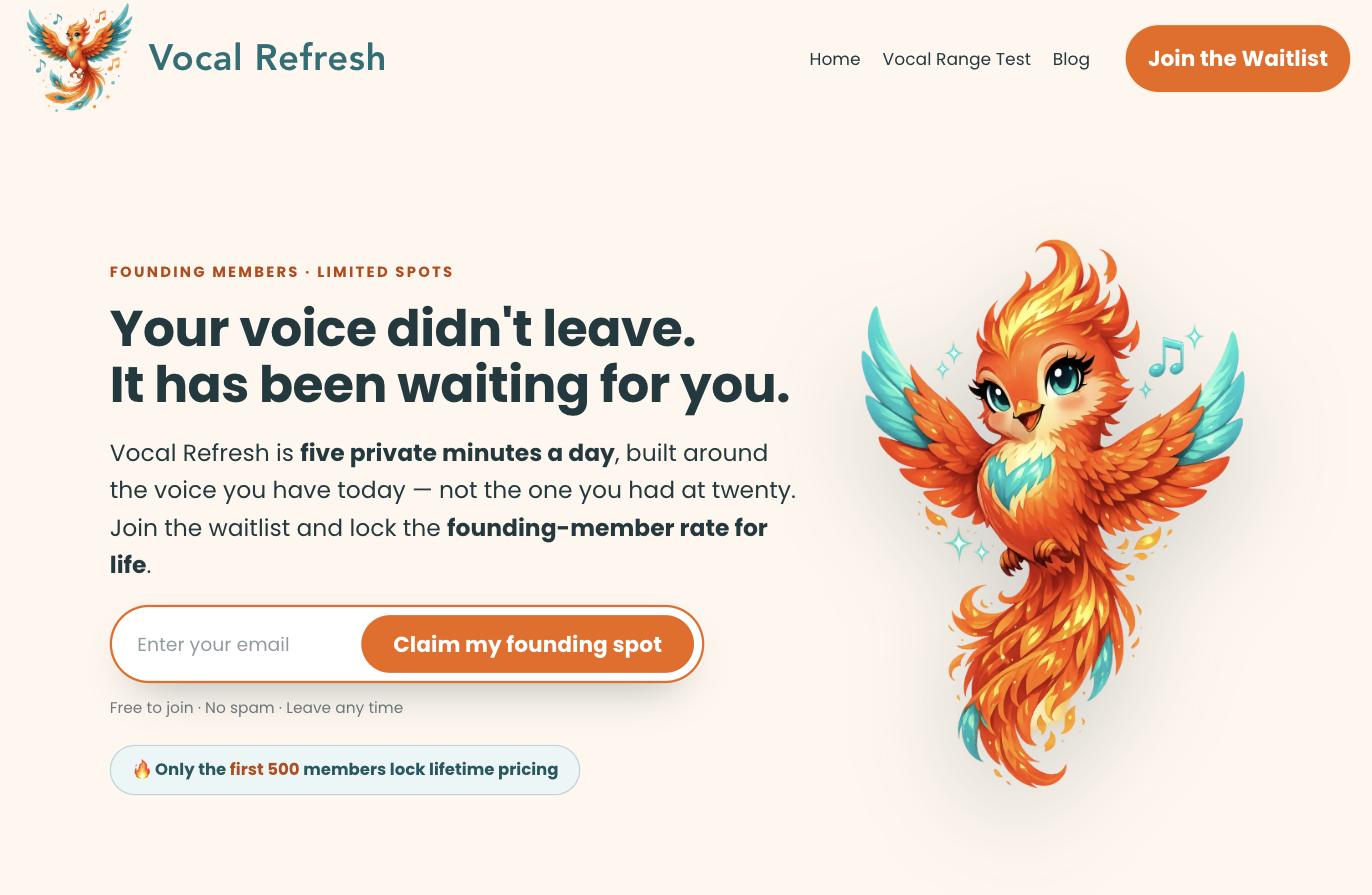
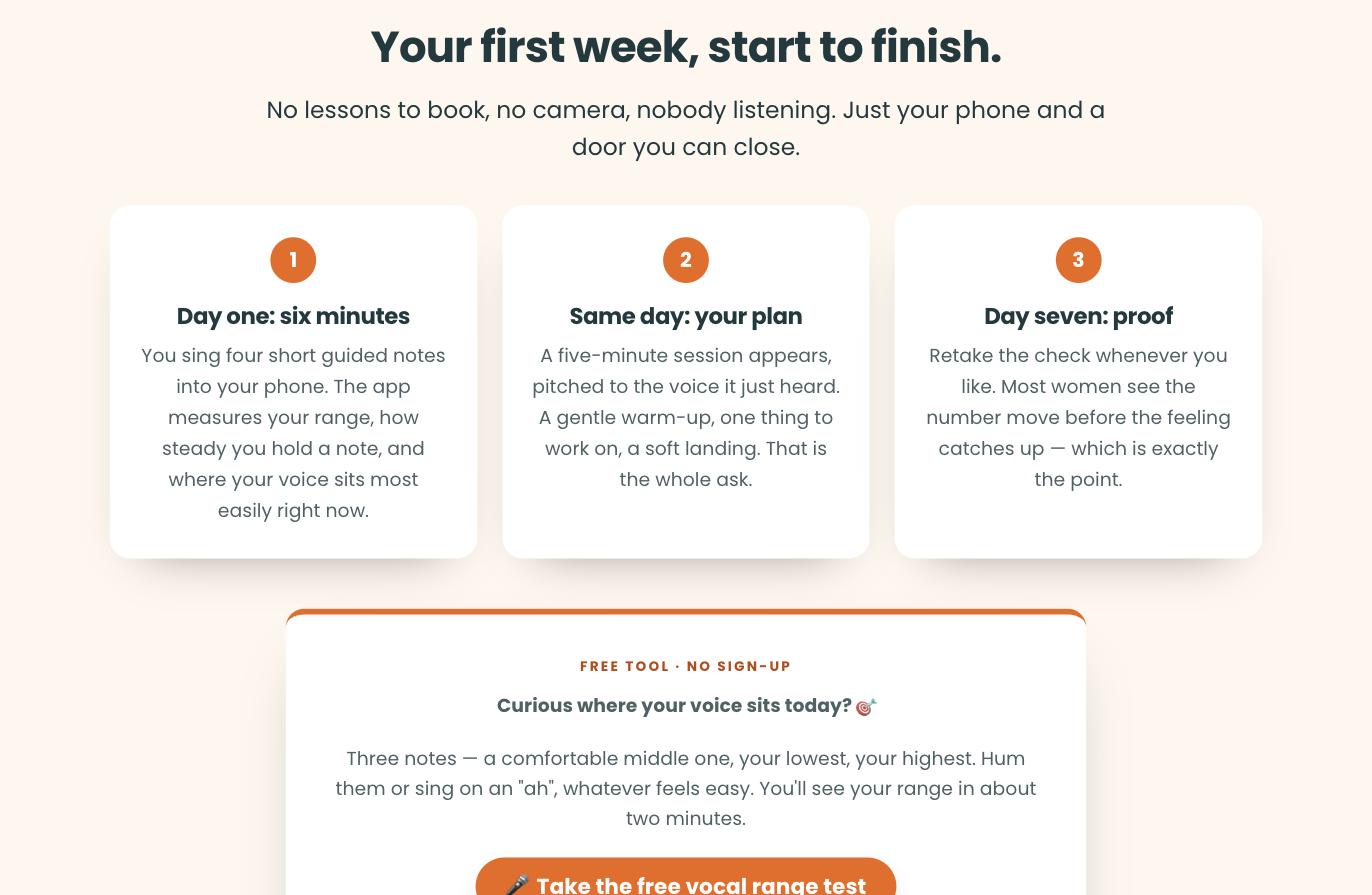
Vocal Refresh is built for that person. It's an iOS app that starts by listening: a short vocal snapshot that measures the range you actually have right now, not the one you had at twenty-two. From there it builds warm-ups and practice around your voice, adjusts as it changes, and keeps sessions short enough to survive a real week.
The adult voice is not a lapsed teenage voice. Most singing apps are built for beginners learning from scratch or for trained singers drilling technique. Neither fits a woman who already knows what her voice used to do and wants to find out what it can do now.
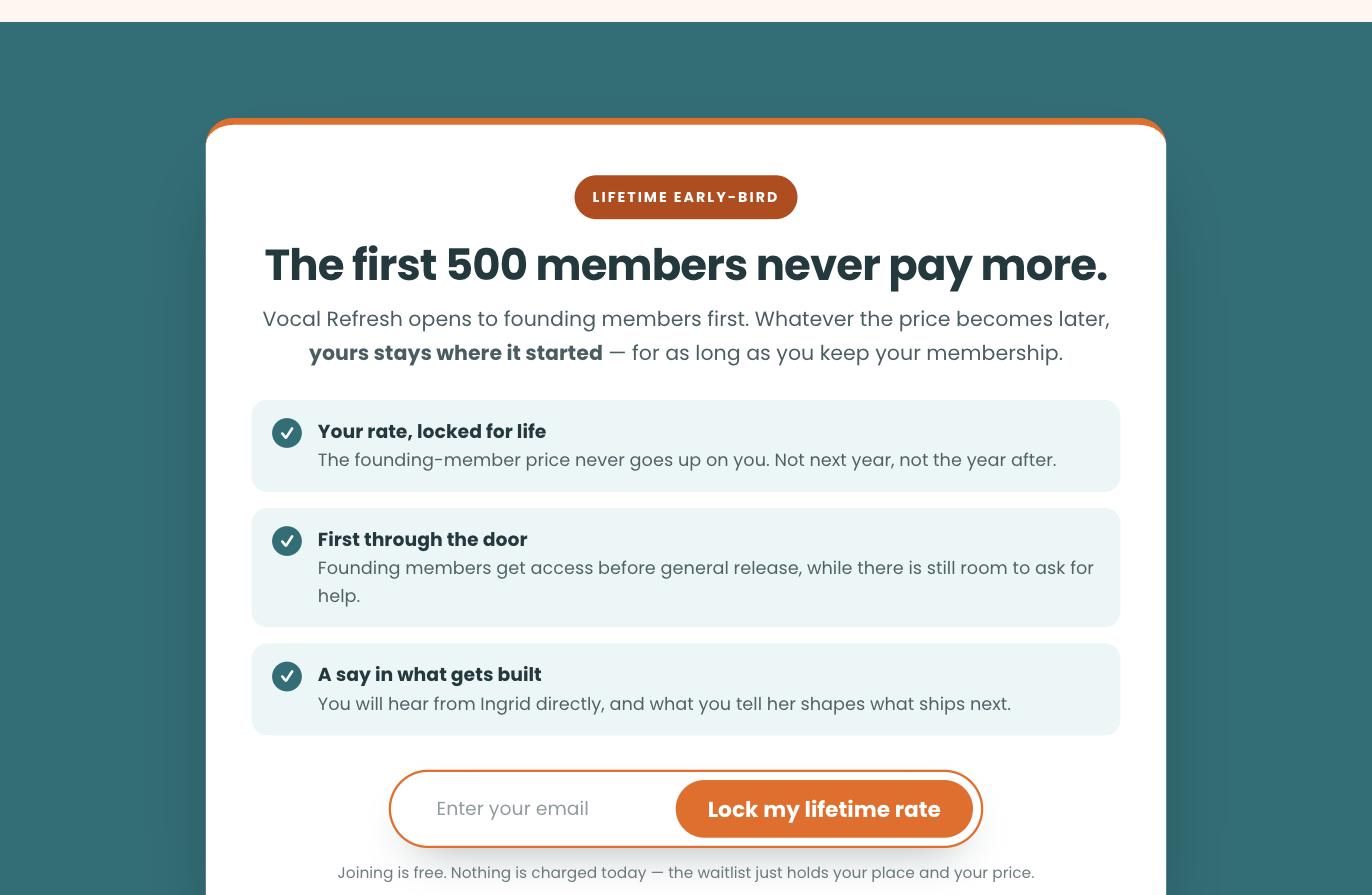
Founded by Ingrid Moss, a vocal coach of more than 25 years who studied Music and Music Theory at the University of Wisconsin-Eau Claire. In development for a 2026 release - join the waitlist for early access.

Features
Vocal snapshot that measures the range you have today, not the one you had at twenty-two
Warm-ups and practice built around your voice, adjusting as it changes
Sessions short enough to survive a real week
Audio processed on your device and never uploaded to our servers
Built by a vocal coach of more than 25 years, not a general-purpose music app
Use Cases
You sang in choir or a band years ago and have not sung properly since
You want to know what your range actually is now, before committing to lessons
You are thinking about joining a choir again and want to prepare privately first
Your voice has changed and you want practice built for the voice you have now

Comments


Hi Fazier. Vocal Refresh came out of a pattern our founder, Ingrid Moss, kept running into after 25+ years of coaching voice: an adult woman books a lesson, apologises for her voice before she has sung a note, and assumes what she had at twenty-two is gone. It usually isn't. It has changed, and nobody taught her the new one. Most singing apps are built for absolute beginners or for trained singers drilling technique, and neither fits her. So we built the thing that happens in the first ten minutes of those lessons: a short vocal snapshot that measures the range you actually have today, then warm-ups and practice built around it, short enough to survive a real week. Audio is processed on device and never uploaded to our servers. We're pre-launch on iOS with the waitlist open, and the honest open question we'd love feedback on is how much structure to impose versus how much to let people wander.vey good



Hi Fazier. Vocal Refresh came out of a pattern our founder, Ingrid Moss, kept running into after 25+ years of coaching voice: an adult woman books a lesson, apologises for her voice before she has sung a note, and assumes what she had at twenty-two is gone. It usually isn't. It has changed, and nobody taught her the new one. Most singing apps are built for absolute beginners or for trained singers drilling technique, and neither fits her. So we built the thing that happens in the first ten minutes of those lessons: a short vocal snapshot that measures the range you actually have today, then warm-ups and practice built around it, short enough to survive a real week. Audio is processed on device and never uploaded to our servers. We're pre-launch on iOS with the waitlist open, and the honest open question we'd love feedback on is how much structure to impose versus how much to let people wander. Happy to answer anything.

Vocal Refresh Your product has strong potential, but I found a few key improvements that could make it even better. I'd love to share my feedback and suggestions—please contact me at [email protected].

Designing for returning singers rather than beginners is a thoughtful distinction, and keeping the vocal snapshot on-device lowers the barrier to trying it privately. I’d love to see the app separate normal day-to-day range variation from genuine progress so users don’t feel they are regressing after a tired session. Will the practice plan account for fatigue and confidence?


The psychological barrier here is the actual product. Most women who stop singing don't decide to stop - life happens, confidence drops, and restarting feels impossible. Everyone else's app is built for beginners discovering singing or trained singers refining technique. Neither fits a person who already knows her voice and just needs to rebuild what's still there. Measuring current vocal range instead of assuming atrophy is the right design call. A woman whose range used to be A3-C6 doesn't need drill sequences for C-G. She needs short, targeted rebuilding that fits into actual life. Sessions short enough to survive a real week is the constraint most tools miss - they're built for dedicated practice, not for someone carving out 10 minutes between work and kids. The fact that audio is processed on-device and never uploaded to servers changes the psychological safety too. Women are less likely to practice voice work with strangers listening. That's not a bug in your implementation - it's actually addressing why people abandon vocal training. Ingrid's 25 years of coaching shines through in the design. This understands the actual problem, not just the feature list.
Premium Products





























Sponsors
Buy

Awards
View all
Awards
View allMakers
Makers
Comments
Hi Fazier. Vocal Refresh came out of a pattern our founder, Ingrid Moss, kept running into after 25+ years of coaching voice: an adult woman books a lesson, apologises for her voice before she has sung a note, and assumes what she had at twenty-two is gone. It usually isn't. It has changed, and nobody taught her the new one. Most singing apps are built for absolute beginners or for trained singers drilling technique, and neither fits her. So we built the thing that happens in the first ten minutes of those lessons: a short vocal snapshot that measures the range you actually have today, then warm-ups and practice built around it, short enough to survive a real week. Audio is processed on device and never uploaded to our servers. We're pre-launch on iOS with the waitlist open, and the honest open question we'd love feedback on is how much structure to impose versus how much to let people wander.vey good
Hi Fazier. Vocal Refresh came out of a pattern our founder, Ingrid Moss, kept running into after 25+ years of coaching voice: an adult woman books a lesson, apologises for her voice before she has sung a note, and assumes what she had at twenty-two is gone. It usually isn't. It has changed, and nobody taught her the new one. Most singing apps are built for absolute beginners or for trained singers drilling technique, and neither fits her. So we built the thing that happens in the first ten minutes of those lessons: a short vocal snapshot that measures the range you actually have today, then warm-ups and practice built around it, short enough to survive a real week. Audio is processed on device and never uploaded to our servers. We're pre-launch on iOS with the waitlist open, and the honest open question we'd love feedback on is how much structure to impose versus how much to let people wander. Happy to answer anything.
Vocal Refresh Your product has strong potential, but I found a few key improvements that could make it even better. I'd love to share my feedback and suggestions—please contact me at [email protected].
Designing for returning singers rather than beginners is a thoughtful distinction, and keeping the vocal snapshot on-device lowers the barrier to trying it privately. I’d love to see the app separate normal day-to-day range variation from genuine progress so users don’t feel they are regressing after a tired session. Will the practice plan account for fatigue and confidence?
The psychological barrier here is the actual product. Most women who stop singing don't decide to stop - life happens, confidence drops, and restarting feels impossible. Everyone else's app is built for beginners discovering singing or trained singers refining technique. Neither fits a person who already knows her voice and just needs to rebuild what's still there. Measuring current vocal range instead of assuming atrophy is the right design call. A woman whose range used to be A3-C6 doesn't need drill sequences for C-G. She needs short, targeted rebuilding that fits into actual life. Sessions short enough to survive a real week is the constraint most tools miss - they're built for dedicated practice, not for someone carving out 10 minutes between work and kids. The fact that audio is processed on-device and never uploaded to servers changes the psychological safety too. Women are less likely to practice voice work with strangers listening. That's not a bug in your implementation - it's actually addressing why people abandon vocal training. Ingrid's 25 years of coaching shines through in the design. This understands the actual problem, not just the feature list.
Premium Products
New to Fazier?

Find your next favorite product or submit your own. Made by @FalakDigital.
Copyright ©2026. All Rights Reserved