TrustGrowth brings a site's current SEO evidence into one inspectable workflow. We connect to a verified site through read-only Google Search Console, audit technical health, performance, content, E-E-A-T, keywords, and strategy, and show the evidence behind one current TrustGrowth Score.
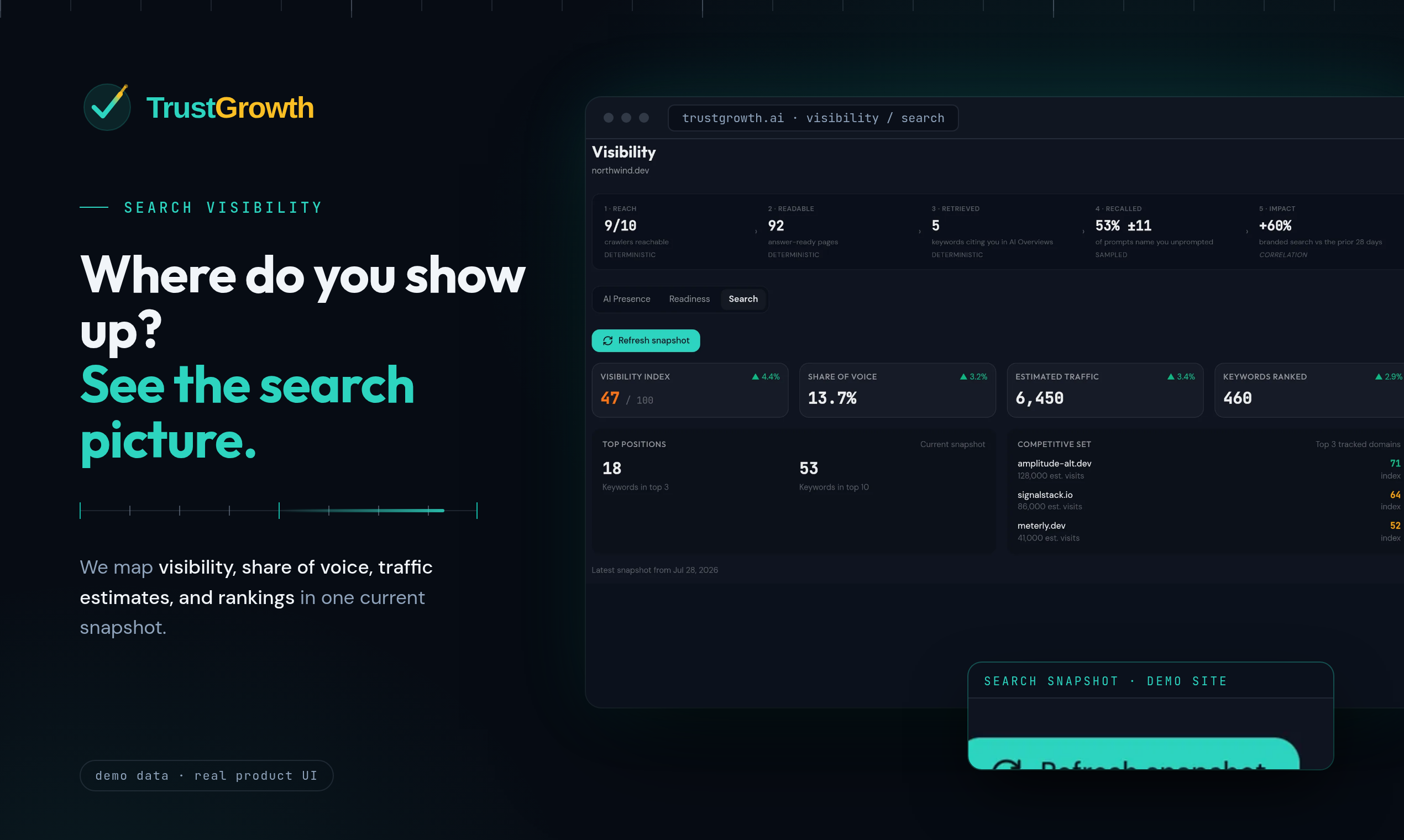
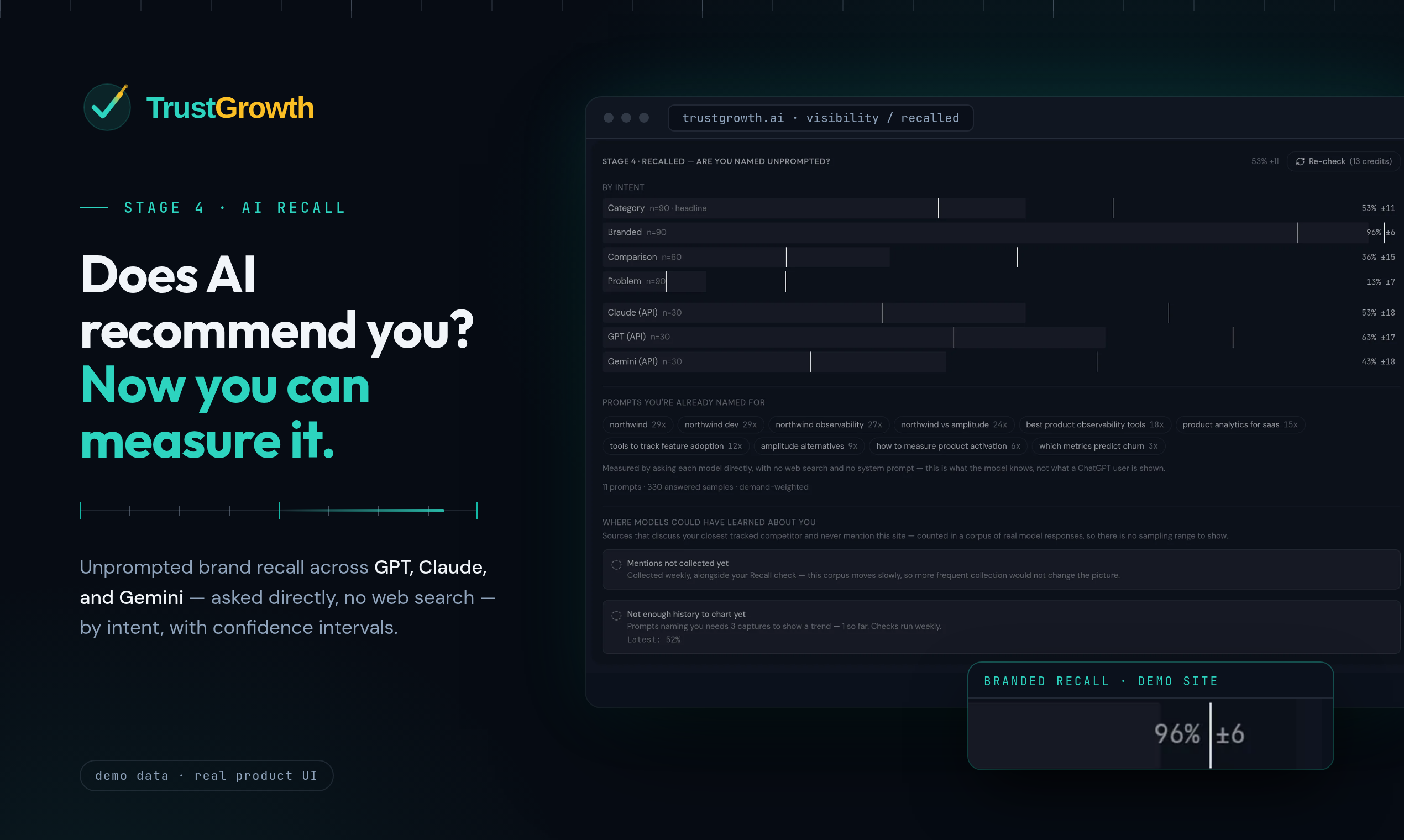
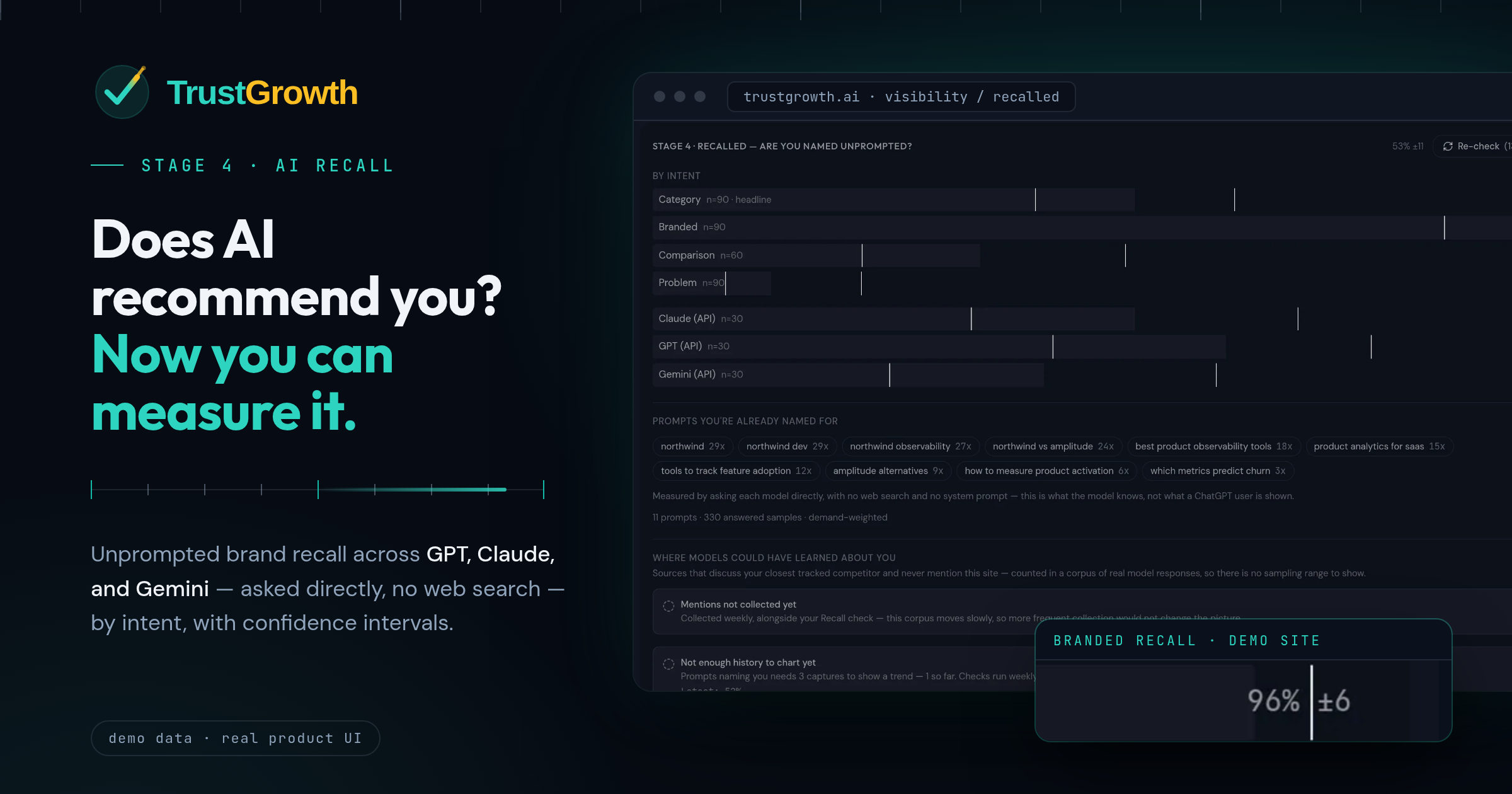
We also measure AI visibility in five stages, from whether AI crawlers can reach and read your site to whether Claude, GPT and Gemini name it when asked about its category.
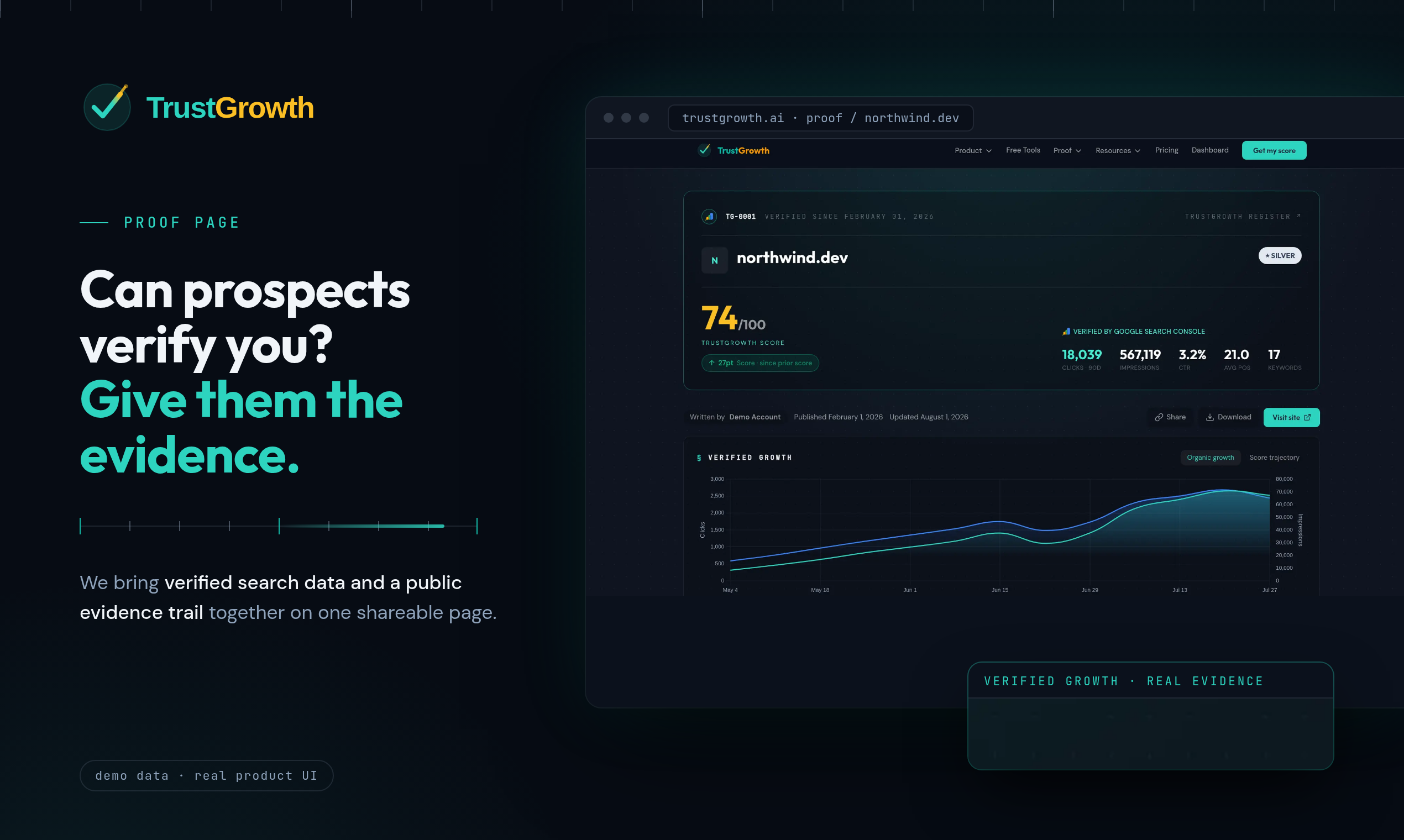
Each site can have a public proof page with its timestamp, source context, weak signals, scorecard, and leaderboard position visible. Users approve what changes. The Groundcrew playbook behind the workflow is open source, so your own coding agent can fix what we find, and our MCP server lets it work from your live data. Content workflows are coming; the current product is available with a free plan.
Features
- Scheduled audit verified against your own Google Search Console: 80+ checks across technical, performance and content (Free)
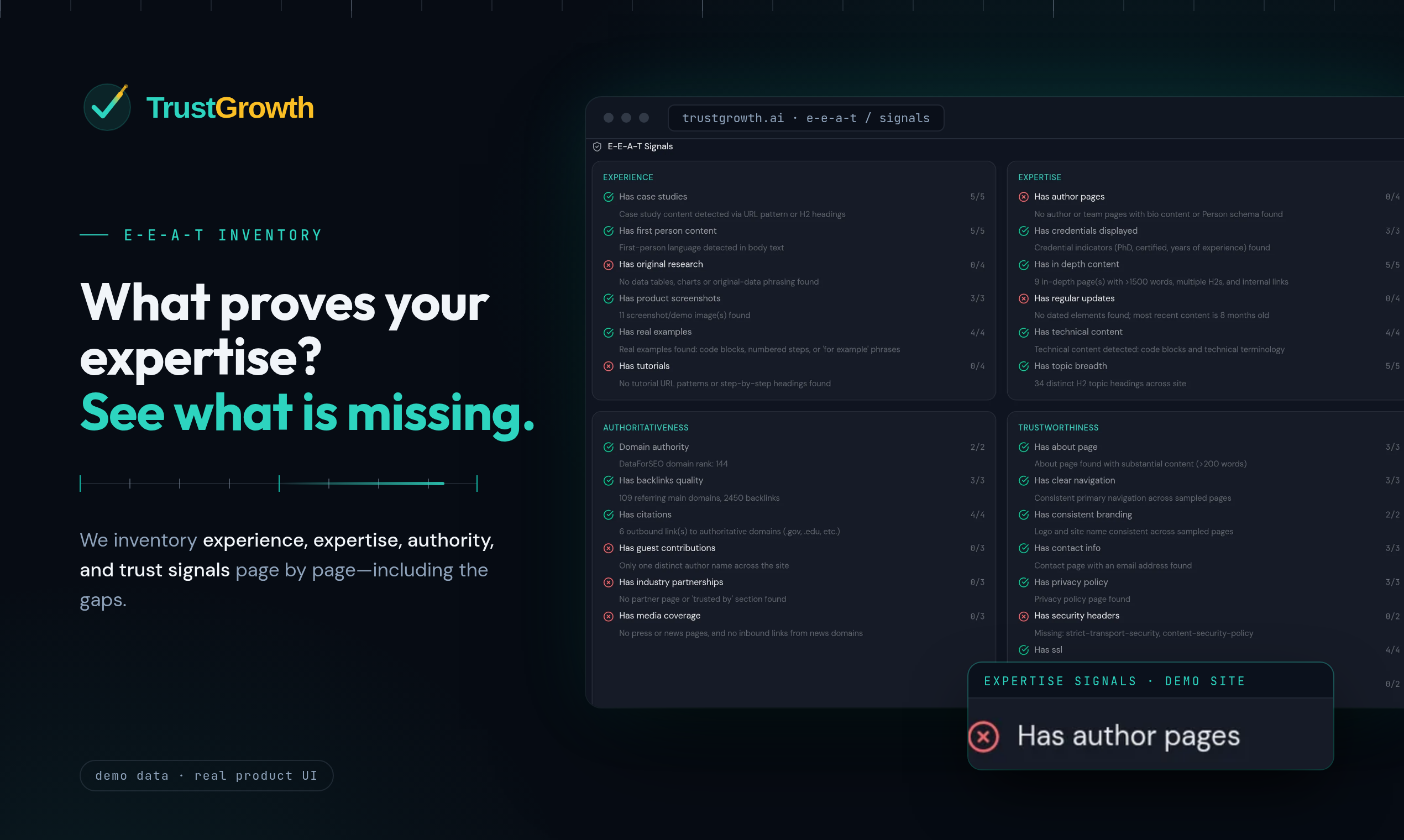
- E-E-A-T check across 27 trust signals (Free)
- One TrustGrowth Score with a breakdown and the evidence behind it (Free)
- Public, dated proof page with a share link, JSON and an embeddable badge, ranked on a daily public leaderboard (Free)
- Groundcrew: 20 open-source (MIT) skills so your own coding agent can fix findings (Free)
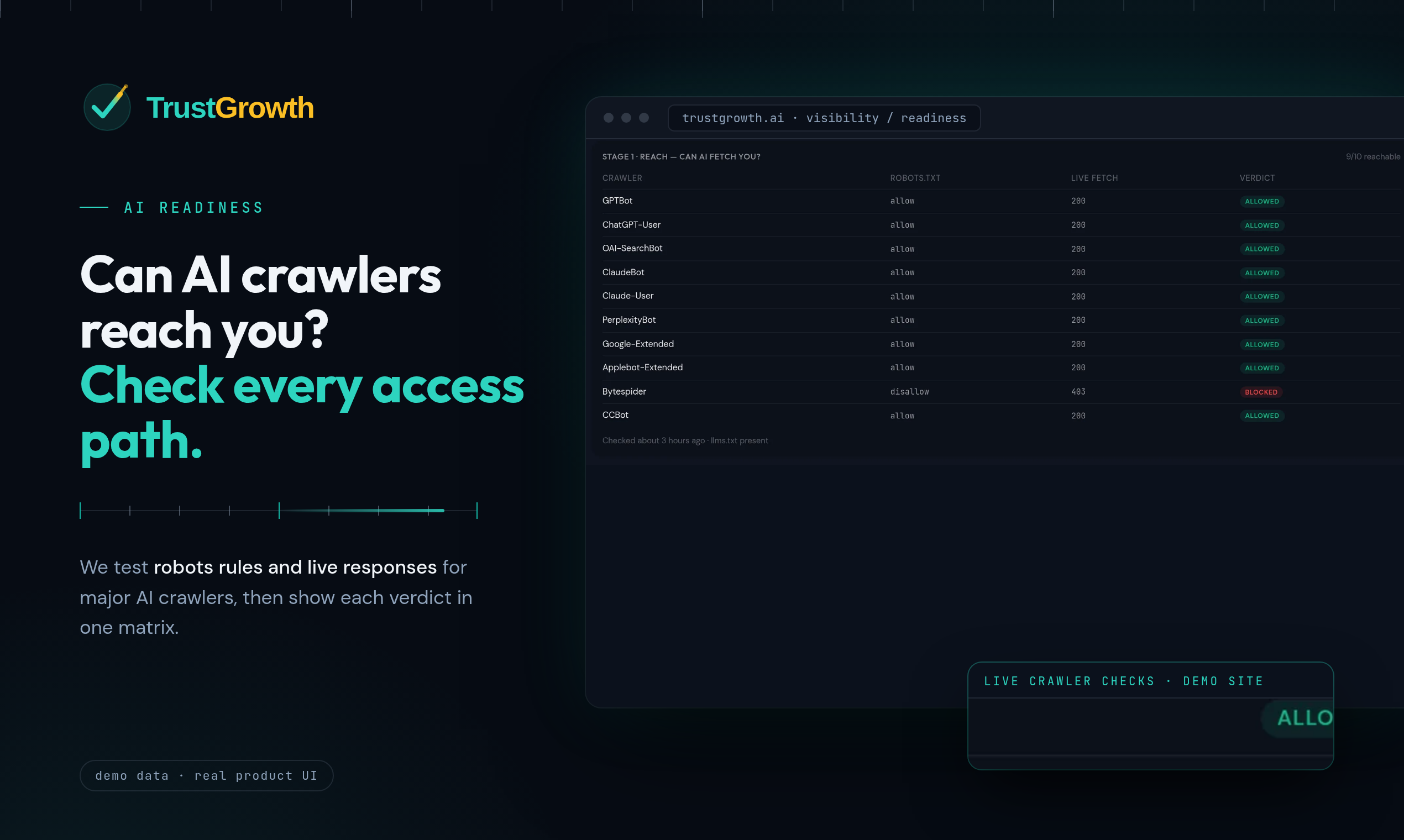
- Free tools with no account: AI crawler access check, schema check, page speed, canonical inspector, llms.txt creator (Free)
- Keyword opportunities, competitor gaps and a monthly strategy you approve or send back (Starter)
- MCP server and API so Claude, Cursor, VS Code or Codex work from your live findings (Starter)
- AI visibility in five stages, from crawler reach to whether Claude, GPT and Gemini name you (Pro; first stages from Starter)
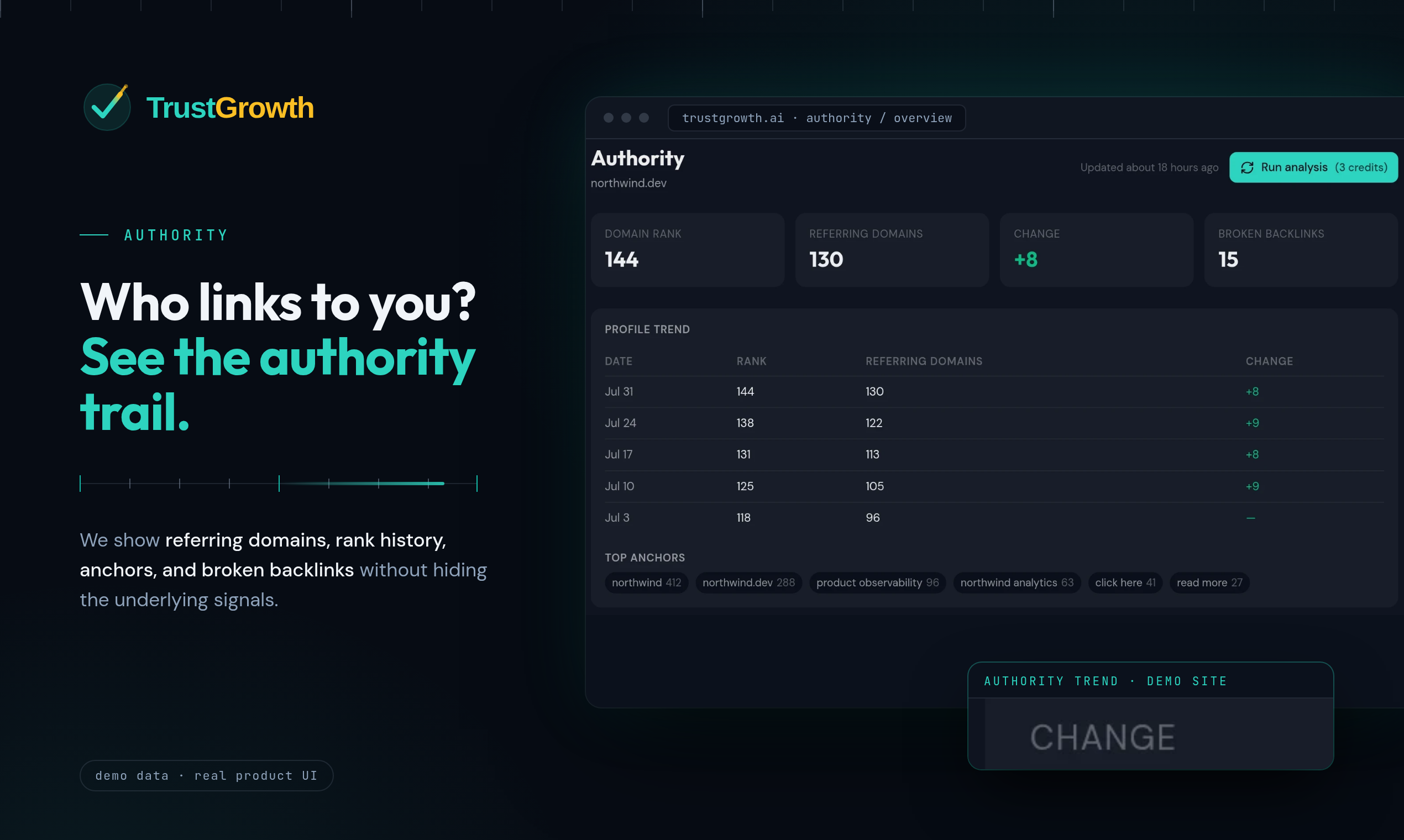
- Backlink profile, link gap and reclamation, SERP landscape and share of voice (Pro)
3. Use Cases
Use Cases
- See which AI crawlers your robots.txt or CDN blocks. A live fetch tests each crawler.
- Get one current audit from your own Search Console data, not from third-party estimates.
- Publish a dated proof page that clients or buyers can check, weak signals included.
- Let your coding agent fix an audit finding and open a pull request. The next audit shows if the finding is closed.
- Agencies: track many client sites. Paid plans have no site limit.
- Founders: get a strategy and a keyword gap list that you can review before you spend money on content.
Fazier Deal

Comments


Verifying claims against the user's own Search Console data instead of third-party estimates is the right direction — it removes the black-box problem most SEO audits have, where you get a score with no way to check the reasoning. The public, dated proof page is a genuinely useful artifact for agencies and anyone selling a site: including weak signals makes it more credible, not less, because buyers can see what's being hedged. Two questions: for the five-stage AI visibility measurement, how do you verify whether Claude, GPT and Gemini actually 'name' a site — sampled prompts with known answers, and how is that kept reproducible as models change? And for Groundcrew: do the open-source skills map to specific fix recipes per finding, or are they general remediation guidance? If each audit finding shipped with an agent-executable fix, the loop from audit to PR would be genuinely compelling.

The 'show the evidence behind the score' framing is what separates this from every SEO tool that hands you a number and a generic checklist. Verifying against the site's own Search Console instead of third-party estimates is exactly the right call — estimates are where SEO tools usually lose credibility. Two questions: (1) the public proof page includes weak signals too, which is refreshingly honest — do clients actually approve publishing those, or does that need convincing? (2) for the five-stage AI visibility measurement, how do you handle answer variance over time — is the score a point-in-time snapshot or a rolling window? The open-source Groundcrew playbook is also a smart move: every coding agent that uses it becomes a distribution channel.


Hi Fazier, I'm Ravi, the maker of TrustGrowth. I built it because most SEO tools gave me a report I could not check. A number, a list of issues, and no way to see where any of it came from. TrustGrowth works from your own Google Search Console data (read-only). It runs a scheduled audit across technical health, performance, content, E-E-A-T and AI visibility, and shows the evidence behind every point of the score. We hold ourselves to the same rule. In August we changed our scoring model, and our own site dropped from 73 to 32. We published that, because a score that only flatters you is not worth much. A few things I'd love you to try: 1. The free plan: one site, full audit, and a public proof page you can share. 2. The free AI crawler check: it shows which AI bots your robots.txt or CDN blocks, no account needed. 3. Groundcrew: our open-source playbook, so your own coding agent can fix what the audit finds. I'm here all day. Tell me what is confusing, what is missing, or where the score looks wrong for your site. I read every comment.
Showing the evidence behind an SEO score, not just a number and a list of issues. The public proof page is a strong tool for agencies that need to show clients what's improved over time. How do you help users distinguish between an actual improvement or decline in SEO performance and a change caused by the scoring?
Premium Products
















































Fazier Deal
Sponsors
Buy

Makers
Makers
Comments
Verifying claims against the user's own Search Console data instead of third-party estimates is the right direction — it removes the black-box problem most SEO audits have, where you get a score with no way to check the reasoning. The public, dated proof page is a genuinely useful artifact for agencies and anyone selling a site: including weak signals makes it more credible, not less, because buyers can see what's being hedged. Two questions: for the five-stage AI visibility measurement, how do you verify whether Claude, GPT and Gemini actually 'name' a site — sampled prompts with known answers, and how is that kept reproducible as models change? And for Groundcrew: do the open-source skills map to specific fix recipes per finding, or are they general remediation guidance? If each audit finding shipped with an agent-executable fix, the loop from audit to PR would be genuinely compelling.
The 'show the evidence behind the score' framing is what separates this from every SEO tool that hands you a number and a generic checklist. Verifying against the site's own Search Console instead of third-party estimates is exactly the right call — estimates are where SEO tools usually lose credibility. Two questions: (1) the public proof page includes weak signals too, which is refreshingly honest — do clients actually approve publishing those, or does that need convincing? (2) for the five-stage AI visibility measurement, how do you handle answer variance over time — is the score a point-in-time snapshot or a rolling window? The open-source Groundcrew playbook is also a smart move: every coding agent that uses it becomes a distribution channel.
Hi Fazier, I'm Ravi, the maker of TrustGrowth. I built it because most SEO tools gave me a report I could not check. A number, a list of issues, and no way to see where any of it came from. TrustGrowth works from your own Google Search Console data (read-only). It runs a scheduled audit across technical health, performance, content, E-E-A-T and AI visibility, and shows the evidence behind every point of the score. We hold ourselves to the same rule. In August we changed our scoring model, and our own site dropped from 73 to 32. We published that, because a score that only flatters you is not worth much. A few things I'd love you to try: 1. The free plan: one site, full audit, and a public proof page you can share. 2. The free AI crawler check: it shows which AI bots your robots.txt or CDN blocks, no account needed. 3. Groundcrew: our open-source playbook, so your own coding agent can fix what the audit finds. I'm here all day. Tell me what is confusing, what is missing, or where the score looks wrong for your site. I read every comment.
Showing the evidence behind an SEO score, not just a number and a list of issues. The public proof page is a strong tool for agencies that need to show clients what's improved over time. How do you help users distinguish between an actual improvement or decline in SEO performance and a change caused by the scoring?
Premium Products
New to Fazier?

Find your next favorite product or submit your own. Made by @FalakDigital.
Copyright ©2026. All Rights Reserved