
trendJack
Agentic AI signal-to-publish intelligence
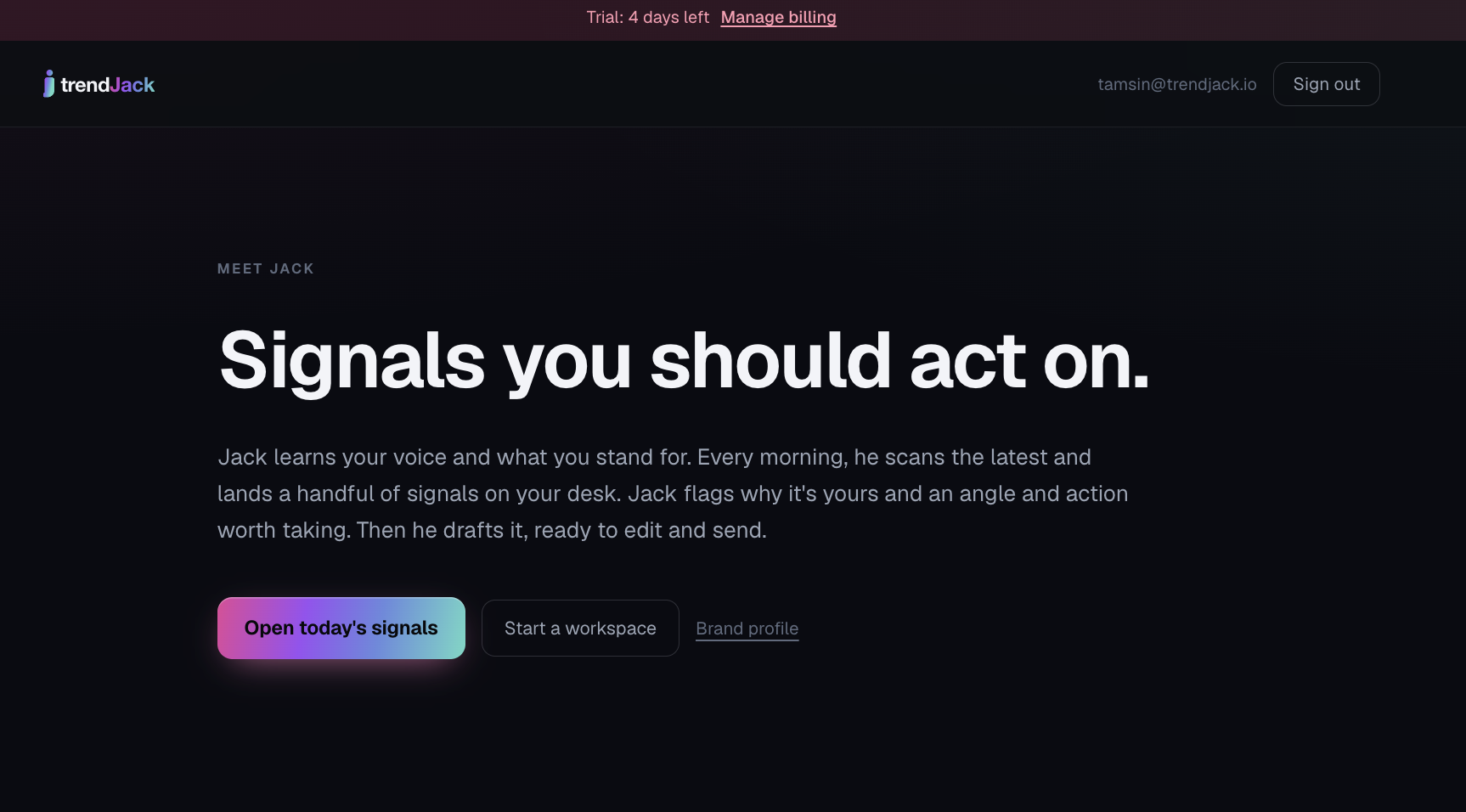
trendJack is an agentic content assistant and media intelligence platform designed for lean teams. It automates trend monitoring, provides real-time competitor intelligence, and generates on-brand content daily. Jack, the AI assistant, watches industry trends, tracks competitor activity, and drafts content, delivering a morning briefing to keep your brand relevant and your sanity intact.
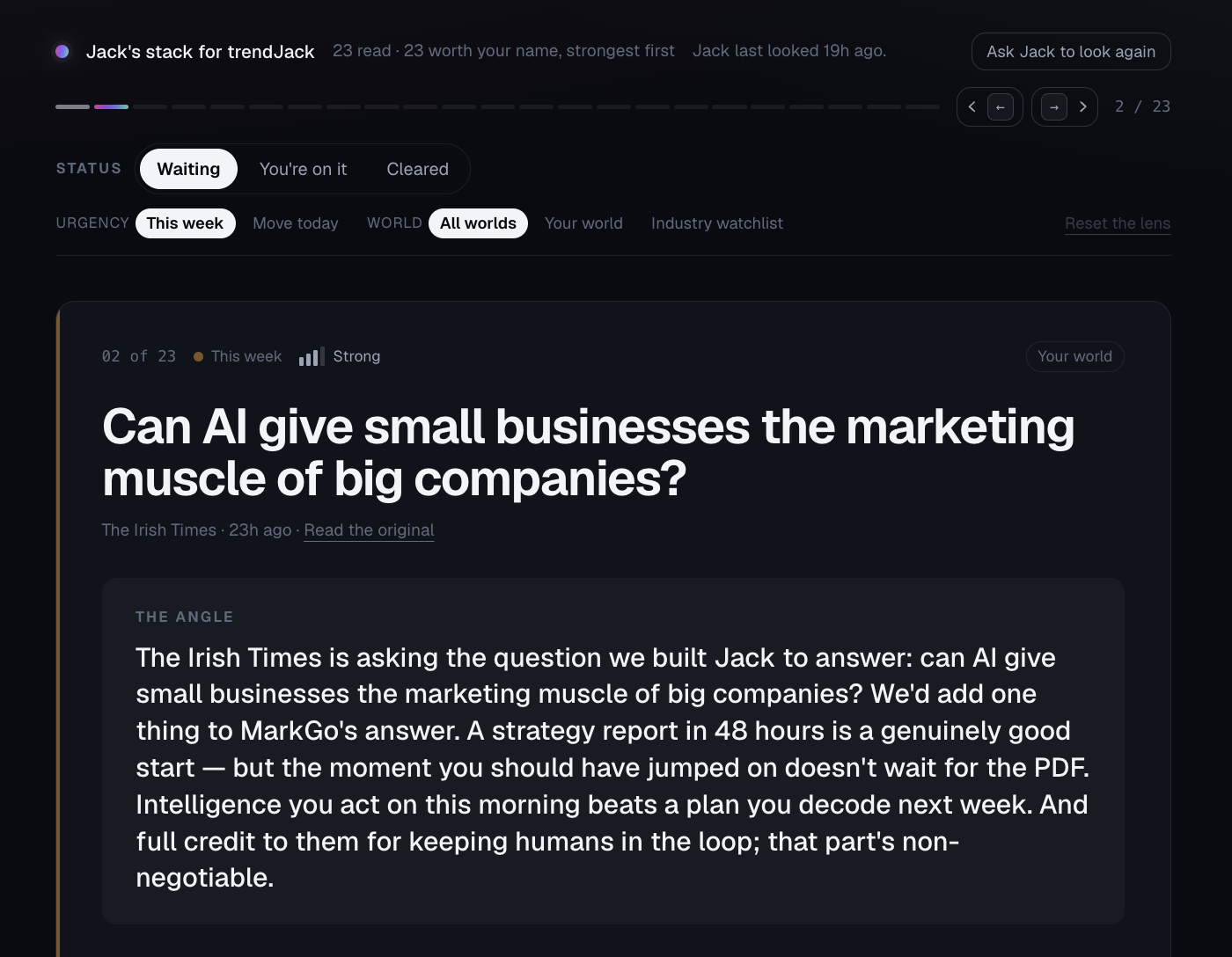
- Automated Briefings: Receive daily briefings with top trending articles, topics, and competitor activity before you start your workday.
- Real-time Alerts & Content: React to market signals with immediate trend alerts and AI-powered content generation in your brand's voice, complete with recommended calls-to-action.
- Brand Voice Consistency: Jack maintains separate brand voice profiles for each brand, ensuring all content aligns with specific guidelines, whether you manage one or multiple brands.
- Industry & Competitor Monitoring: Stay informed about competitor posts, communications, and reactions to industry developments.
- Seamless Workflow Integration: trendJack integrates with existing tools like ChatGPT, Claude, Slack, email, Google Drive, and Microsoft 365, fitting into your current workflow without requiring a new platform.
- Actionable Intelligence: Unlike traditional dashboards, trendJack provides plain-language context on why signals matter and suggests the next best action, turning data into momentum.
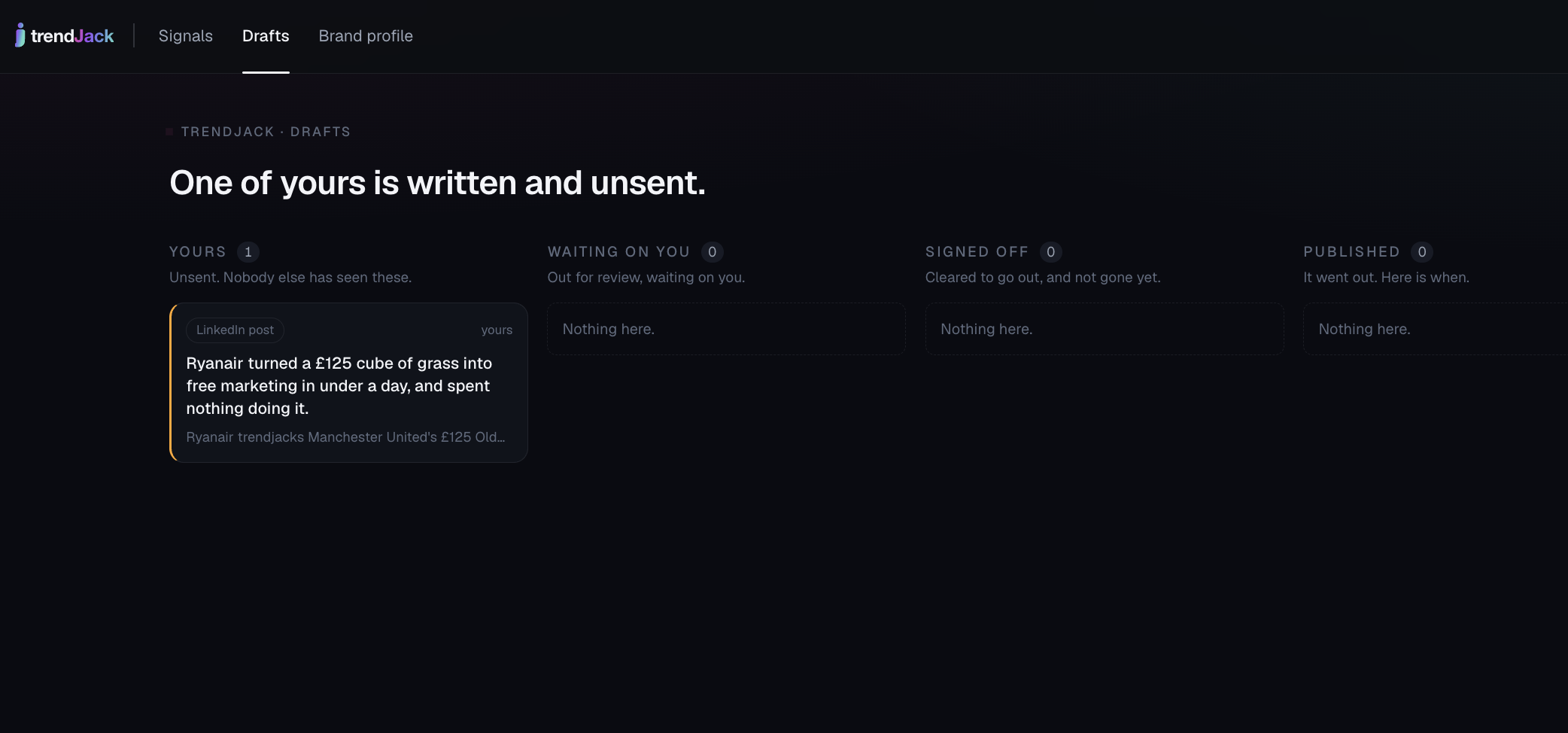
- Signal to Action: Jack monitors the web, identifies relevant signals, drafts content in your brand's voice, routes it for approval, and handles publishing, streamlining the entire process.
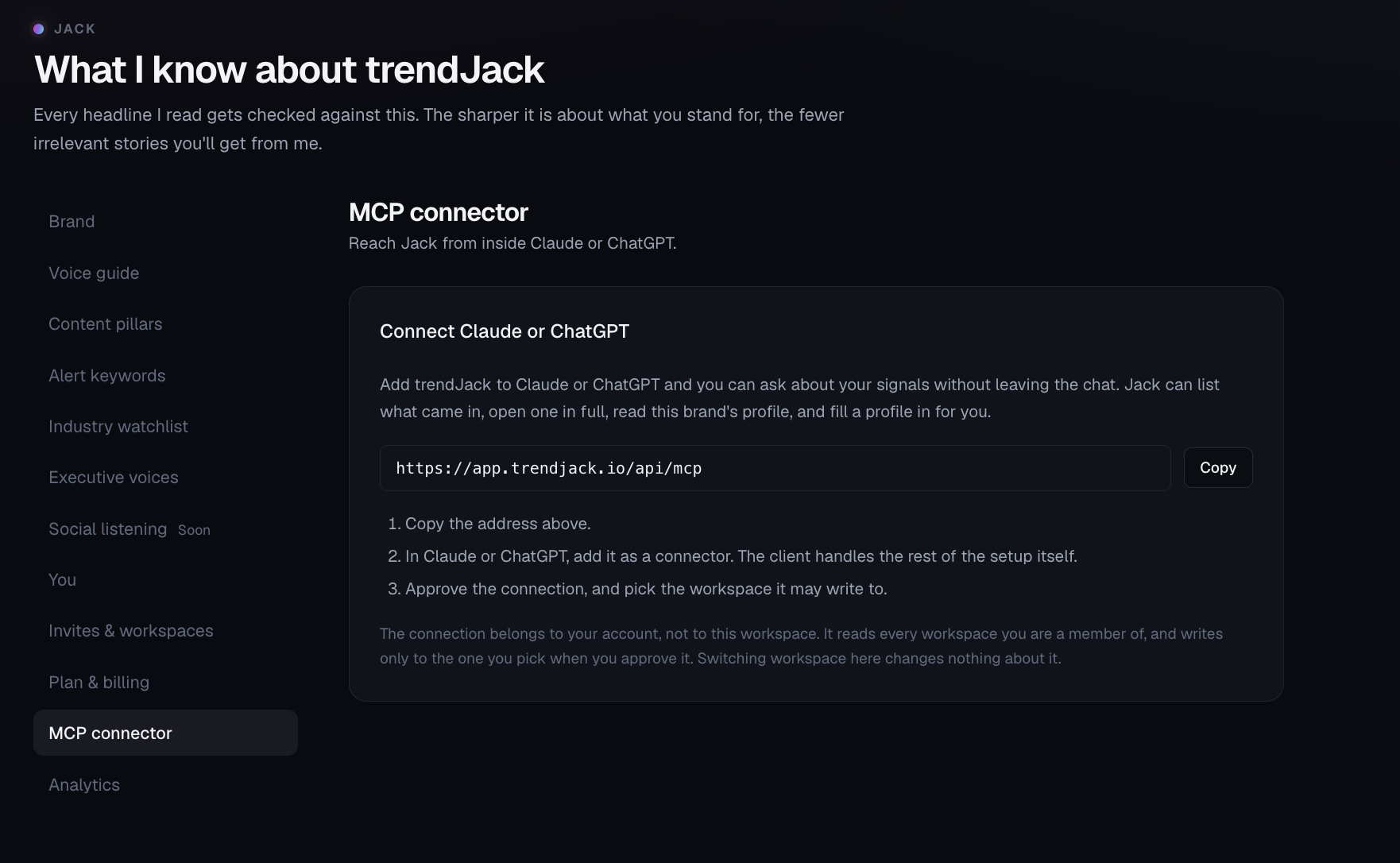
- MCP-Ready: Compatible with Model Context Protocol (MCP), allowing Jack to work within AI assistants like ChatGPT and Claude, enabling you to pull live signals and draft content without switching applications.
The platform offers intelligence and content firepower comparable to a large agency, making it ideal for lean marketing and communications teams, in-house leads, and B2B scale-ups. trendJack focuses on delivering actionable insights and ready-to-publish content, helping you spot and use moments while they are still live.
Features
- Real-time trend/media monitoring — social listening and media intelligence to catch signals worth acting on
- Content drafting from social posts — tailorable output based on trending topics
- Executive media comments — drafted commentary for spokespeople
- Outreach emails — drafted messages to prospects and journalists
- Competitor content monitoring — tracking what competitors are publishing
- Agentic AI workflow (positioned as "agentic AI" rather than an assistant) — designed to work agent-style rather than just generating suggestions
- Guides resource hub — trendjack.io/guides, covering topics like what a "trendjack" is, AI agents for marketing teams, and social listening vs. media intelligence
- Sales use case — also positioned for sales teams under the "dealjack" angle, not just marketing
- 7-day free trial — no payment taken upfront, cancel anytime during the trial
Use Cases
Marketing teams
- Spotting trends in real time and turning them into timely, on-brand content ("signal to publish")
- Drafting social posts tailored to a trending moment before it passes
- Monitoring competitors' content and messaging without dedicating headcount to it
- Ideal for lean or one-person marketing departments that can't manage 24/7 monitoring manually
Social media strategists
- Juggling content calendars and trend-spotting across several brand accounts without losing track of what's relevant to each
- Drafting on-brand content fast enough to catch a trend while it's still live, even when split across accounts
- Keeping tabs on competitor activity per brand without manually monitoring each one separately
- Useful for agencies or in-house strategists managing more brands than they have time to watch closely
PR / executive communications
- Drafting executive media comments quickly when a relevant story breaks
- Reaching out to journalists with timely, relevant pitches tied to a live news moment
Sales teams ("dealjack" angle)
- Tracking prospect and market signals relevant to deals in progress
- Drafting outreach emails to prospects informed by real-time context rather than generic templates
General competitive intelligence
- Always-on competitor tracking so teams know what rivals are publishing and reacting to
- Media/social listening as an alternative to traditional, heavier listening tools
Fazier Deal

Comments


This was built out of my own frustration and experiences as a content marketer, PR person and social media strategist (in one) on a lean marketing team. It's been a few months building BTS, but now we're building in public since this launch! We are still very much open to feedback and want to continue shaping the platform, so please do get involved.



Turning raw signals into a publish-ready draft is the part that usually takes days for a small team. If the AI can surface the angle plus first draft in one flow, that's a real time-save for bootstrapped marketers. Curious how it handles brand-voice consistency across posts - a tone preset or style guide input would make this production-ready.


The signal-to-publish angle is what stands out here: most monitoring tools stop at alerts, but routing a draft through an approval step in the brand's own voice is where the real time saving is for a lean team. I am curious how you handle false positives — can users set a relevance threshold or train Jack on which signals are worth acting on, so the morning briefing does not become another noisy feed? The separate brand voice profiles also seem useful for agencies managing several clients at once.
Separate brand-voice profiles plus an approval step before publish is the piece that keeps an agent from posting the wrong tone. A morning briefing is easy to ignore if every signal looks equally urgent. Does Jack rank the briefing by how closely a signal matches a specific brand profile, or is the ranking the same for every brand on the account?

The most useful distinction here is signal-to-publish rather than just signal-to-alert, since most monitoring tools leave the drafting work to the team. Separate brand voice profiles plus an approval step before publishing also seem essential for agencies handling several brands. How is a signal scored for urgency — is it based on volume, velocity, competitor reaction, or a mix — and can a team tune that threshold per brand so the morning briefing does not become noisy?



Signal-to-publish latency is exactly where editorial teams bleed hours. One question that decides the product: how do you weight source credibility when a signal first appears? Surfacing a trend early is only a win if the tool can also flag that it is still single-source, otherwise teams either over-commit or learn to ignore the feed.

Premium Products













































Fazier Deal
Sponsors
Buy

Makers
Makers
Comments
This was built out of my own frustration and experiences as a content marketer, PR person and social media strategist (in one) on a lean marketing team. It's been a few months building BTS, but now we're building in public since this launch! We are still very much open to feedback and want to continue shaping the platform, so please do get involved.
Turning raw signals into a publish-ready draft is the part that usually takes days for a small team. If the AI can surface the angle plus first draft in one flow, that's a real time-save for bootstrapped marketers. Curious how it handles brand-voice consistency across posts - a tone preset or style guide input would make this production-ready.
The signal-to-publish angle is what stands out here: most monitoring tools stop at alerts, but routing a draft through an approval step in the brand's own voice is where the real time saving is for a lean team. I am curious how you handle false positives — can users set a relevance threshold or train Jack on which signals are worth acting on, so the morning briefing does not become another noisy feed? The separate brand voice profiles also seem useful for agencies managing several clients at once.
Separate brand-voice profiles plus an approval step before publish is the piece that keeps an agent from posting the wrong tone. A morning briefing is easy to ignore if every signal looks equally urgent. Does Jack rank the briefing by how closely a signal matches a specific brand profile, or is the ranking the same for every brand on the account?
The most useful distinction here is signal-to-publish rather than just signal-to-alert, since most monitoring tools leave the drafting work to the team. Separate brand voice profiles plus an approval step before publishing also seem essential for agencies handling several brands. How is a signal scored for urgency — is it based on volume, velocity, competitor reaction, or a mix — and can a team tune that threshold per brand so the morning briefing does not become noisy?
Signal-to-publish latency is exactly where editorial teams bleed hours. One question that decides the product: how do you weight source credibility when a signal first appears? Surfacing a trend early is only a win if the tool can also flag that it is still single-source, otherwise teams either over-commit or learn to ignore the feed.
Premium Products
New to Fazier?

Find your next favorite product or submit your own. Made by @FalakDigital.
Copyright ©2026. All Rights Reserved