
Tokenhot LLM API Gateway
OpenAI-compatible LLM API gateway for 100+ models.
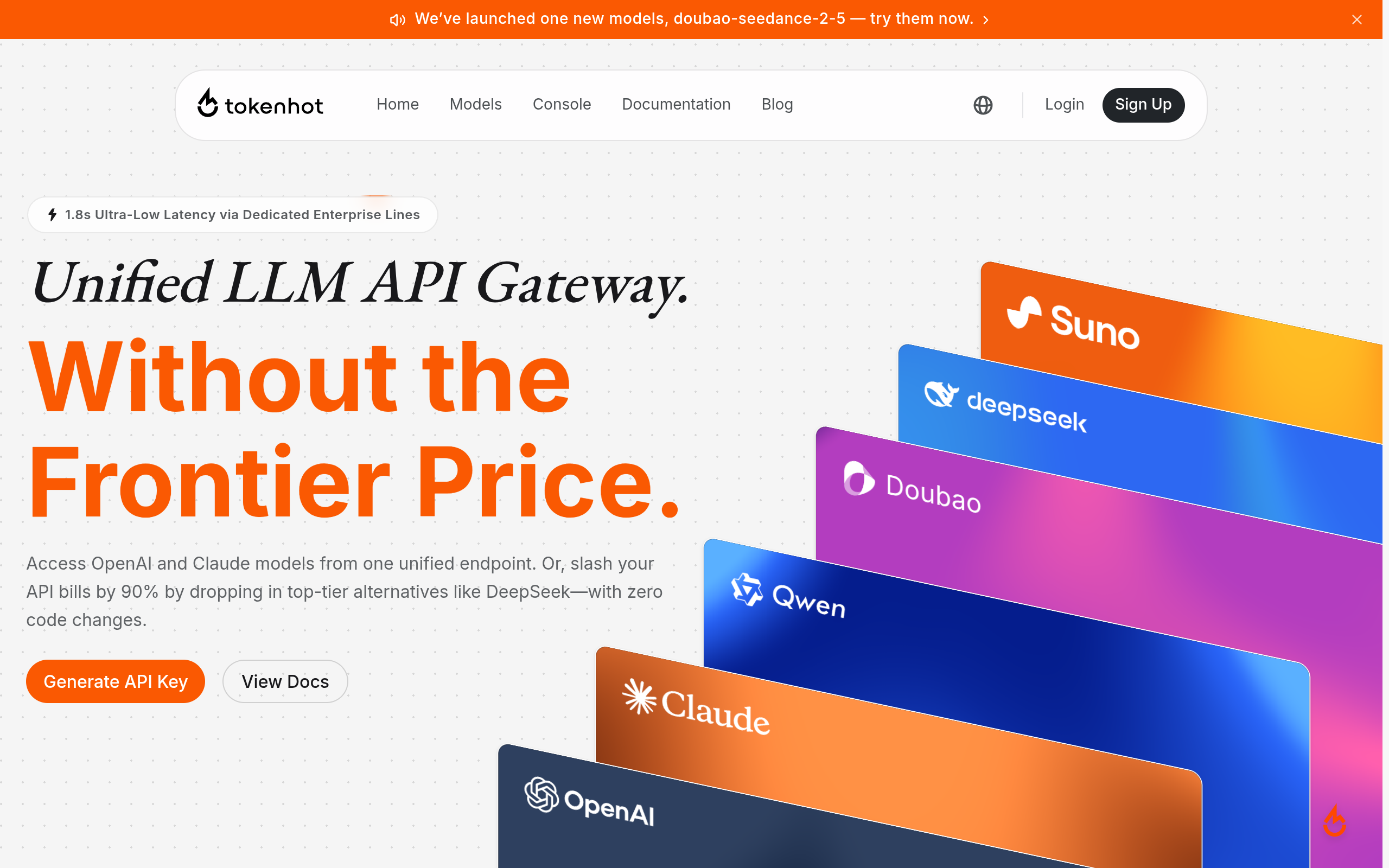
Tokenhot is an OpenAI-compatible unified LLM API gateway that gives developers instant access to 100+ AI models from 30+ providers through a single endpoint. No new SDKs to learn—just change your base URL to https://api.tokenhot.ai/v1 and start calling models from OpenAI, Claude, Gemini, DeepSeek, and more.
Features
Why Developers Choose Tokenhot
One-Line Migration: Fully compatible with OpenAI SDKs. Zero code rewrites.
100+ Models, 30+ Providers: From lightweight Haiku to advanced O3 and Claude Opus. Exclusive early access to Seedance 2.0 API.
Up to 90% Cost Savings: Intelligent routing and aggregated purchasing automatically find the best price-performance ratio.
Multi-Modal Ready: Text, vision, video generation, and TTS—all through one API.
Zero KYC, Instant Start: No identity verification. Get your API key and go live in seconds.
Enterprise Reliability: Multi-channel redundancy with automatic failover. Dedicated enterprise lines for high-concurrency workloads.
Tooling Ecosystem: Native integrations with Cursor, VS Code, Dify, FastGPT, and Cherry Studio.
Use Cases
Best For
AI Application Builders shipping multi-model products without managing 30+ API keys.
Cost-Conscious Teams optimizing LLM spend without sacrificing model quality.
Rapid Prototyping—test GPT-4o, Claude Sonnet, and DeepSeek V3 side-by-side from one dashboard.
AI Agents & Automation platforms (Dify, FastGPT) needing stable, high-throughput model access.

Comments


Tokenhot looks useful for developers who want one API layer instead of integrating with multiple model providers separately. The OpenAI-compatible interface is probably the biggest advantage because it lowers the migration cost for existing applications. Being able to access models from OpenAI, Claude, Gemini, DeepSeek, and other providers through a single endpoint can make experimentation and provider switching much easier. I also like that it avoids introducing another SDK and keeps the setup close to the standard OpenAI API pattern. That makes it easier to test different models without rewriting a lot of application code. I’d be interested to see more detail around routing, rate limits, latency, pricing transparency, and fallback behavior between providers, since those are important when using an API gateway in production. Overall, Tokenhot has a clear value proposition for developers building multi-model AI applications and wanting to reduce integration complexity.

"Zero KYC, instant start" plus OpenAI-SDK compatibility is a strong combo for prototyping, but the part I'd want documented up front is the failover behavior - when a provider has an outage, does Tokenhot silently reroute to an equivalent model, or does the request just fail? That distinction matters a lot for anyone routing production traffic through a single endpoint.


The one-endpoint approach sounds really practical, especially for developers testing different models without juggling separate integrations and API keys. The cost optimization and multi-modal support make it even more interesting for AI builders. I’m also working on CountVerse, an online tally counter for simple digital counting: https://countverseapp.com/

This solves a real fragmentation problem. Right now if you want to support multiple models, you're managing 5+ different APIs, each with their own parameters and quirks. OpenAI-compatible interface means you can drop this in as a middleware layer and swap models without touching application code. That's the kind of infrastructure play that enables better experimentation and cost optimization for teams already using LLMs. The bigger the model surface you support (100+), the more valuable the gateway becomes. Developer experience here is what makes or breaks adoption, so curious how you're handling edge cases across different model architectures.

I ship an Android app where four models from different providers answer the same question in parallel, so I care a lot about failover behaviour. When a provider goes down mid-request, does the automatic failover reroute to another provider silently, or does the client get an error first? And does the swap keep the same model, or can it land on a different one?


"One-endpoint access to 100+ models is appealing, but the question I'd want answered before routing production traffic through it is the failover behavior other commenters already raised — does a provider outage silently reroute to an equivalent model, or does the caller see the error first and have to retry? That distinction changes how much retry logic I'd need to build on my end."

The idea of using one API gateway to access multiple LLM providers is useful, especially for avoiding provider lock-in. One thing I'd want to know before using it in production is how failover works: when a provider or model becomes unavailable, can requests automatically switch to another compatible model, or does the client need to handle retries and routing manually?

Tokenhot LLM API Gateway Your product has strong potential, but I found a few key improvements that could make it even better. I'd love to share my feedback and suggestions—please contact me at [email protected].
Generate additional sections, such as a "Getting Started" guide, code snippets using the OpenAI SDK, or architectural diagrams for failover routing. https://www.pike-pass.com

The OpenAI-compatible approach is what makes this especially interesting. Being able to switch between 100+ models and 30+ providers without rebuilding the integration could make experimenting with different models much less painful. I also like the cost-optimization angle — having routing and provider aggregation handled at the gateway level is a pretty compelling proposition for developers running AI features at scale. Definitely something I’d want to test in a real project. 🚀

The multi-modal claim is the part I would want pinned down before routing anything through it. Text completions fit inside a normal request, but video generation and TTS do not: a long render regularly outlives the timeout of a serverless function. Do those endpoints return a job handle to poll, or does the gateway hold the connection open until the provider answers? And if a retry lands on a second provider after the first one has already started billing, whose meter counts? For anyone shipping video, those two answers matter more than the price list.
Premium Products




































Sponsors
Buy

Awards
View all
Awards
View allMakers

Makers
Comments
Tokenhot looks useful for developers who want one API layer instead of integrating with multiple model providers separately. The OpenAI-compatible interface is probably the biggest advantage because it lowers the migration cost for existing applications. Being able to access models from OpenAI, Claude, Gemini, DeepSeek, and other providers through a single endpoint can make experimentation and provider switching much easier. I also like that it avoids introducing another SDK and keeps the setup close to the standard OpenAI API pattern. That makes it easier to test different models without rewriting a lot of application code. I’d be interested to see more detail around routing, rate limits, latency, pricing transparency, and fallback behavior between providers, since those are important when using an API gateway in production. Overall, Tokenhot has a clear value proposition for developers building multi-model AI applications and wanting to reduce integration complexity.
"Zero KYC, instant start" plus OpenAI-SDK compatibility is a strong combo for prototyping, but the part I'd want documented up front is the failover behavior - when a provider has an outage, does Tokenhot silently reroute to an equivalent model, or does the request just fail? That distinction matters a lot for anyone routing production traffic through a single endpoint.
The one-endpoint approach sounds really practical, especially for developers testing different models without juggling separate integrations and API keys. The cost optimization and multi-modal support make it even more interesting for AI builders. I’m also working on CountVerse, an online tally counter for simple digital counting: https://countverseapp.com/
This solves a real fragmentation problem. Right now if you want to support multiple models, you're managing 5+ different APIs, each with their own parameters and quirks. OpenAI-compatible interface means you can drop this in as a middleware layer and swap models without touching application code. That's the kind of infrastructure play that enables better experimentation and cost optimization for teams already using LLMs. The bigger the model surface you support (100+), the more valuable the gateway becomes. Developer experience here is what makes or breaks adoption, so curious how you're handling edge cases across different model architectures.
I ship an Android app where four models from different providers answer the same question in parallel, so I care a lot about failover behaviour. When a provider goes down mid-request, does the automatic failover reroute to another provider silently, or does the client get an error first? And does the swap keep the same model, or can it land on a different one?
"One-endpoint access to 100+ models is appealing, but the question I'd want answered before routing production traffic through it is the failover behavior other commenters already raised — does a provider outage silently reroute to an equivalent model, or does the caller see the error first and have to retry? That distinction changes how much retry logic I'd need to build on my end."
The idea of using one API gateway to access multiple LLM providers is useful, especially for avoiding provider lock-in. One thing I'd want to know before using it in production is how failover works: when a provider or model becomes unavailable, can requests automatically switch to another compatible model, or does the client need to handle retries and routing manually?
Tokenhot LLM API Gateway Your product has strong potential, but I found a few key improvements that could make it even better. I'd love to share my feedback and suggestions—please contact me at [email protected].
Generate additional sections, such as a "Getting Started" guide, code snippets using the OpenAI SDK, or architectural diagrams for failover routing. https://www.pike-pass.com
The OpenAI-compatible approach is what makes this especially interesting. Being able to switch between 100+ models and 30+ providers without rebuilding the integration could make experimenting with different models much less painful. I also like the cost-optimization angle — having routing and provider aggregation handled at the gateway level is a pretty compelling proposition for developers running AI features at scale. Definitely something I’d want to test in a real project. 🚀
The multi-modal claim is the part I would want pinned down before routing anything through it. Text completions fit inside a normal request, but video generation and TTS do not: a long render regularly outlives the timeout of a serverless function. Do those endpoints return a job handle to poll, or does the gateway hold the connection open until the provider answers? And if a retry lands on a second provider after the first one has already started billing, whose meter counts? For anyone shipping video, those two answers matter more than the price list.
Premium Products
New to Fazier?
Find your next favorite product or submit your own. Made by @FalakDigital.
Copyright ©2026. All Rights Reserved