
TinyCashflow
A spreadsheet-style money manager on one timeline
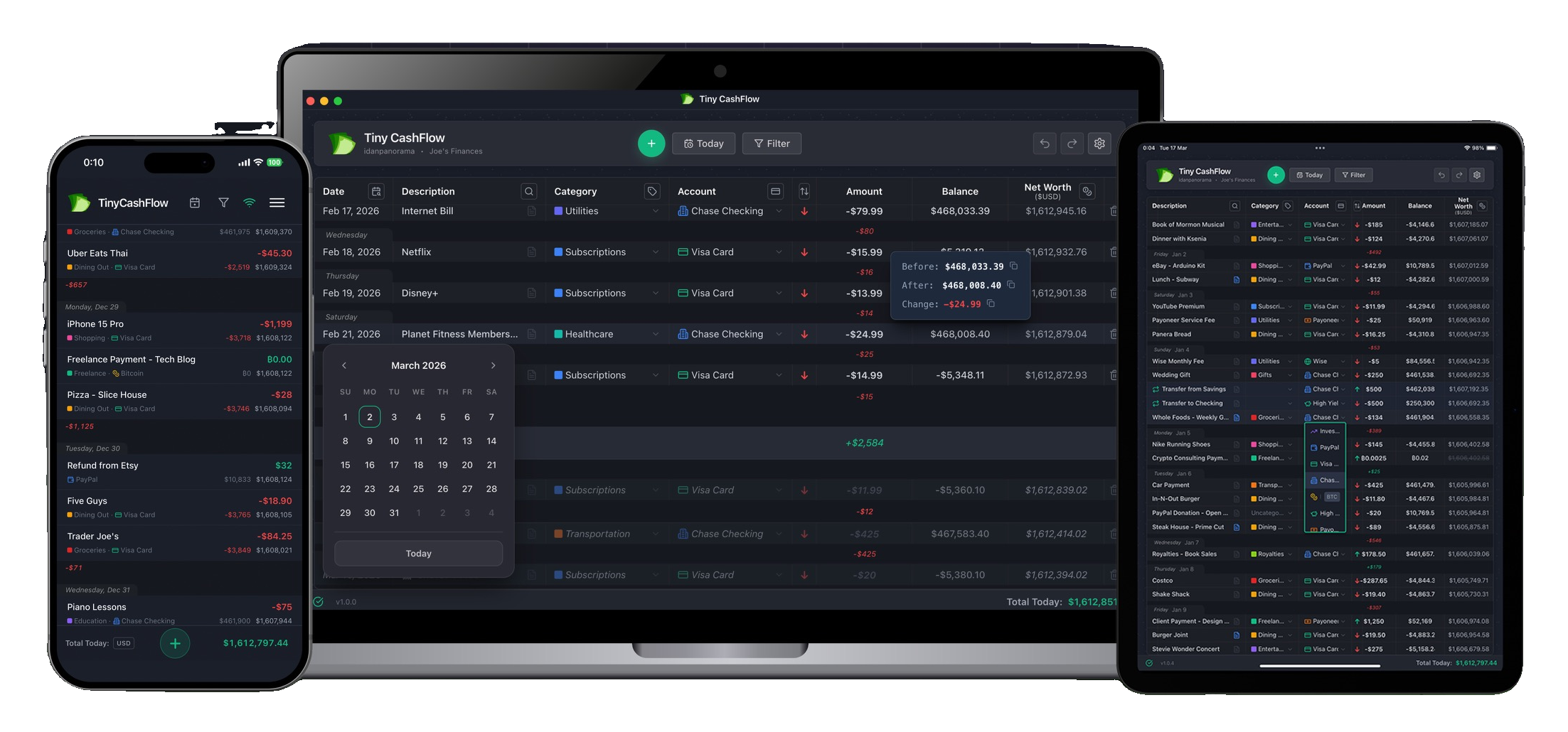
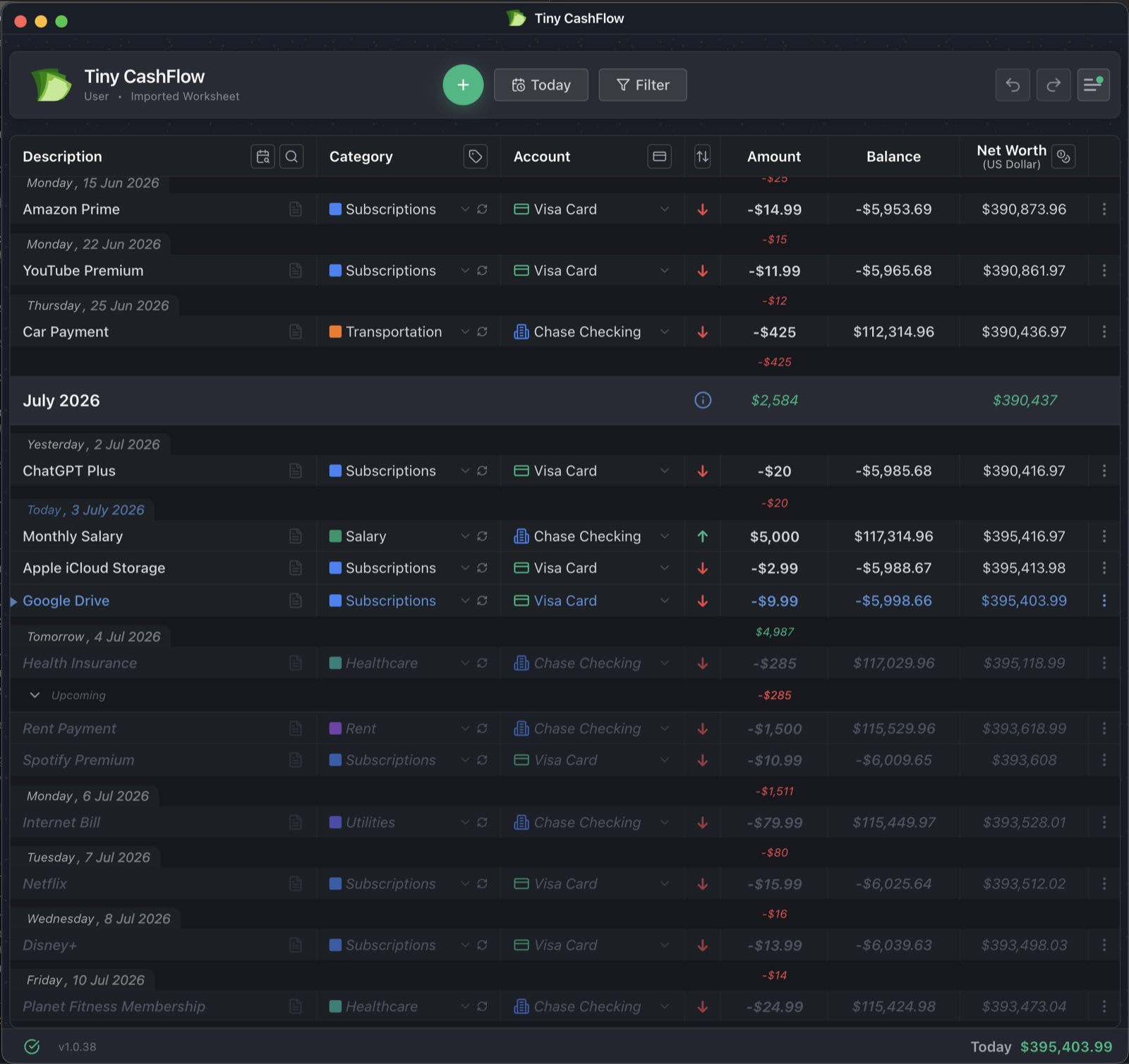
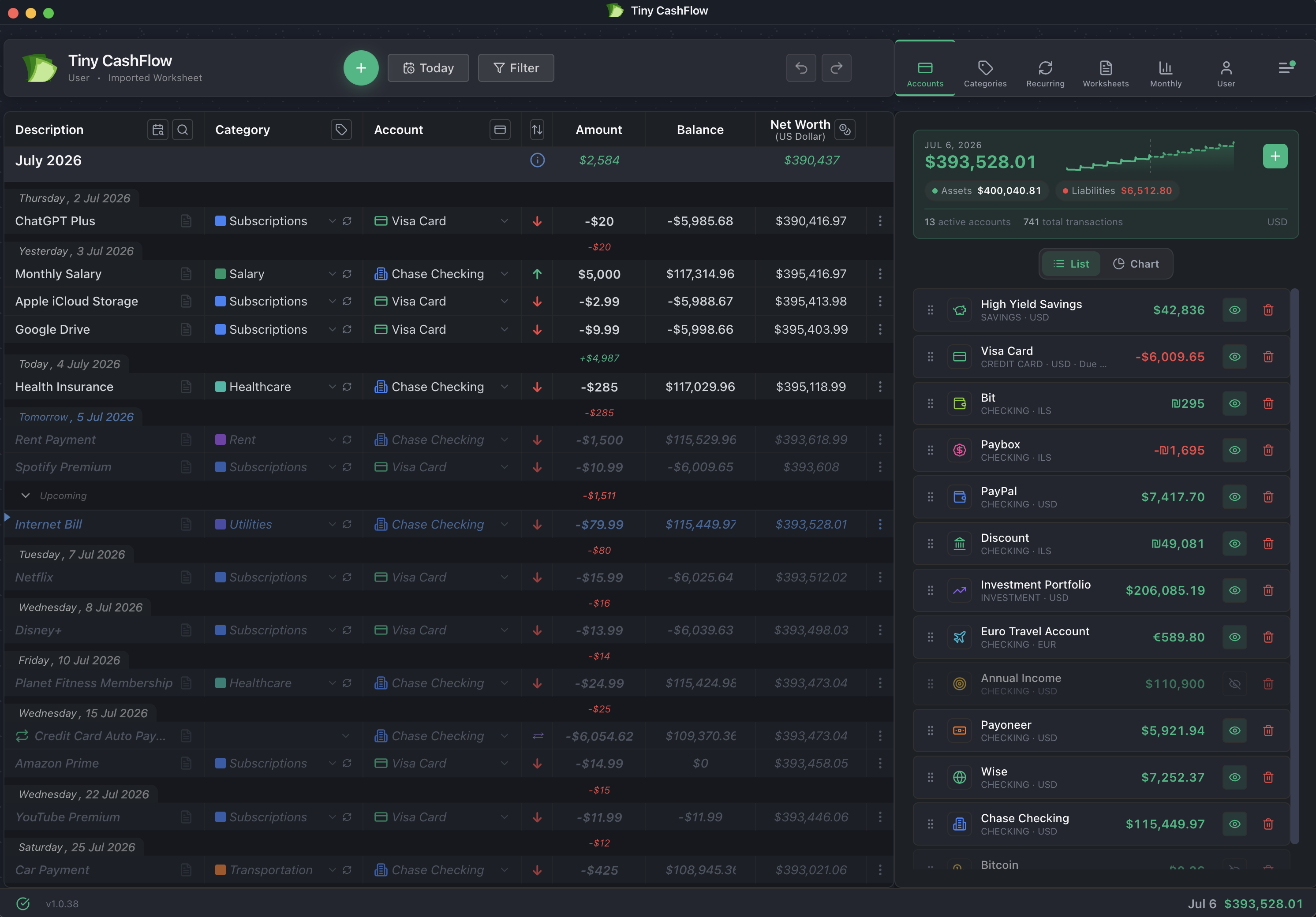
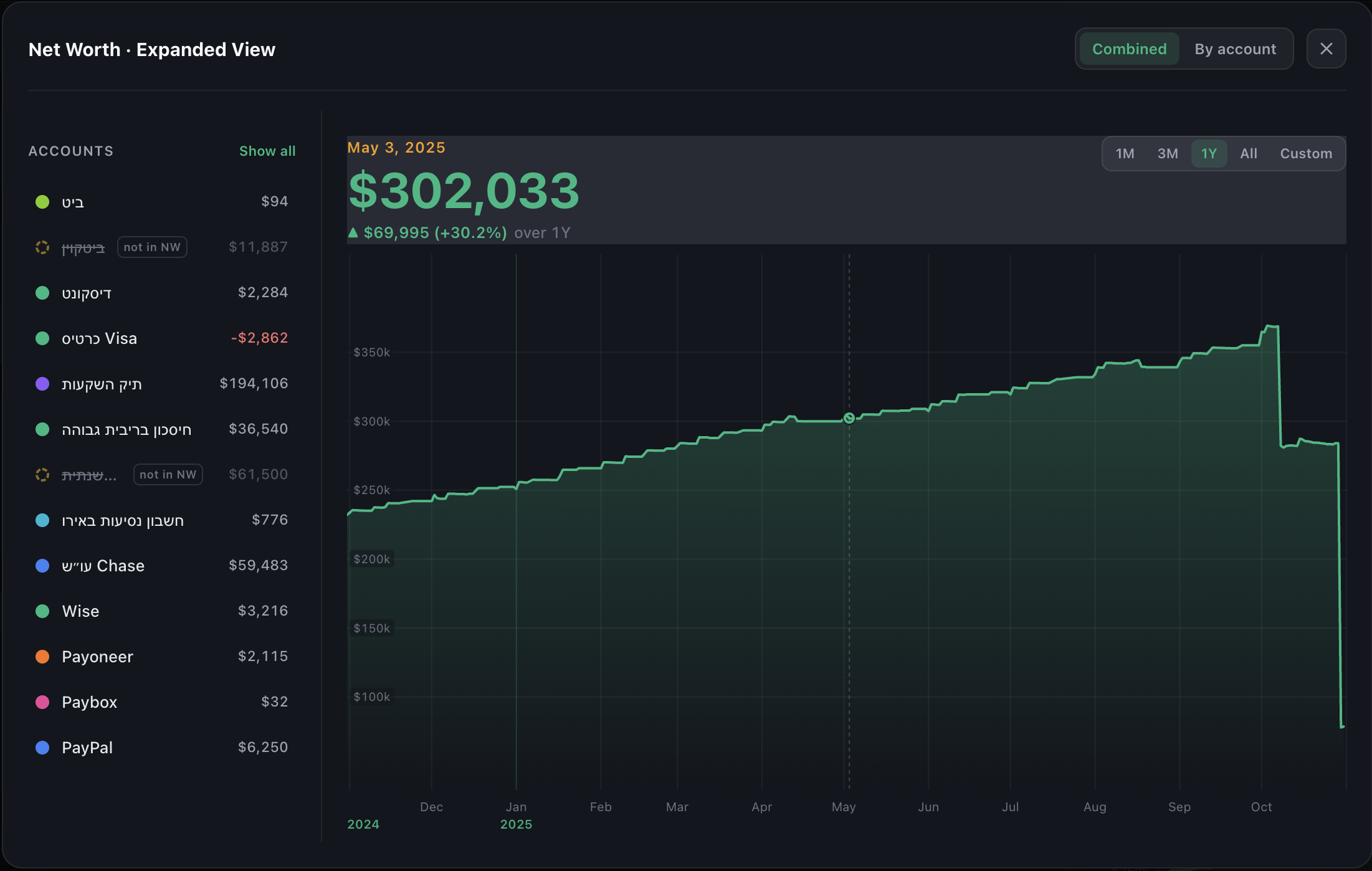
TinyCashflow is a spreadsheet-style money manager that puts your whole financial life on one timeline. It brings your accounts, income, bills, and transactions into a single view, and shows your projected balance on any future date. Recurring items repeat themselves, so you can tell at a glance whether you will be short next week or next month, instead of only knowing what already happened.
It works offline on desktop and mobile, supports multiple currencies including crypto, and needs no bank connection, so your data stays private and fully yours. It is deliberately simple: no category cages, no daily guilt, just one honest running balance you can steer by. Free to try, no signup wall.
Features
All your accounts, income, and bills on one running timeline
Projected balance on any future date, so you can see when it gets tight
Recurring items that repeat themselves automatically
Multi-currency support, including crypto, with historical rates
Works fully offline on Mac, Windows, Android, iOS, and the web
No bank connection and no signup wall, so your data stays private

Comments


I spent the last two years building the money app I always wished existed. Every budgeting app wanted me to sort each coffee into a category, then made me feel guilty the moment I stopped. What I actually wanted was simpler: one honest running balance that tells me whether I will be okay next month. So I built TinyCashflow as a spreadsheet-style money manager where everything lives on one timeline. Recurring bills and income project themselves forward, and you can see your balance on any future date, across multiple accounts and currencies. No bank connection, works fully offline, and your data stays yours. It just launched on every platform, and I would love your honest feedback, especially on the onboarding.

This is a really refreshing approach to personal finance. I like the idea of focusing on one clear running balance instead of making people manage endless categories. The offline-first approach is also a big plus, especially for privacy. Curious how the onboarding experience has been for people who are used to traditional budgeting apps?



The forward-looking running balance is the part most budgeting apps miss — they're great at telling you what you already spent and useless at "will I be short on the 28th." Two questions on the recurring engine: for bills that vary (utilities, variable-rate stuff), does a recurring item use the last amount, a rolling average, or a manual estimate? And can you drop a hypothetical one-off on the timeline — say a big purchase — to preview the dip without saving it, then discard? The no-bank-connection, offline stance is a genuine selling point; not everyone wants to hand Plaid their logins just to see a balance projection.



Projected balance on a future date instead of just current balance is the feature most budget apps skip, and it's the one that actually answers "can I afford this." Offline-first with no bank connection is a good call too, a lot of people don't want to hand over read access to their whole account just to see a chart.


TinyCashflow Your product has strong potential, but I found a few key improvements that could make it even better. I'd love to share my feedback and suggestions—please contact me at [email protected].

The projected balance on any future date is the bit I'd actually use in TinyCashflow, since most budget apps only tell you what already happened. Skipping bank connections and keeping it offline also means no broken sync to babysit. How do you handle multi-currency balances on the timeline when rates move, do you convert at today's rate or at the date of each item? No category cages sounds like a deliberate choice.

TinyCashflow must be the kind of budgeting tool I would actually keep using because the timeline approach feels straightforward. I once built a basic spreadsheet to track rent, subscriptions, and upcoming travel expenses, and seeing the future balance was much more helpful than reviewing old transactions. I also keep banking support pages bookmarked, including https://td-canada-trust.pissedconsumer.com/customer-service.html , so everything financial is easy to find when needed. The offline option is another feature I appreciate, especially for privacy. Having recurring bills appear automatically could save plenty of manual work while still giving users complete control over their own financial planning.
Premium Products






























Sponsors
Buy

Awards
View all
Awards
View allMakers
Makers
Comments
I spent the last two years building the money app I always wished existed. Every budgeting app wanted me to sort each coffee into a category, then made me feel guilty the moment I stopped. What I actually wanted was simpler: one honest running balance that tells me whether I will be okay next month. So I built TinyCashflow as a spreadsheet-style money manager where everything lives on one timeline. Recurring bills and income project themselves forward, and you can see your balance on any future date, across multiple accounts and currencies. No bank connection, works fully offline, and your data stays yours. It just launched on every platform, and I would love your honest feedback, especially on the onboarding.
This is a really refreshing approach to personal finance. I like the idea of focusing on one clear running balance instead of making people manage endless categories. The offline-first approach is also a big plus, especially for privacy. Curious how the onboarding experience has been for people who are used to traditional budgeting apps?
The forward-looking running balance is the part most budgeting apps miss — they're great at telling you what you already spent and useless at "will I be short on the 28th." Two questions on the recurring engine: for bills that vary (utilities, variable-rate stuff), does a recurring item use the last amount, a rolling average, or a manual estimate? And can you drop a hypothetical one-off on the timeline — say a big purchase — to preview the dip without saving it, then discard? The no-bank-connection, offline stance is a genuine selling point; not everyone wants to hand Plaid their logins just to see a balance projection.
Projected balance on a future date instead of just current balance is the feature most budget apps skip, and it's the one that actually answers "can I afford this." Offline-first with no bank connection is a good call too, a lot of people don't want to hand over read access to their whole account just to see a chart.
TinyCashflow Your product has strong potential, but I found a few key improvements that could make it even better. I'd love to share my feedback and suggestions—please contact me at [email protected].
The projected balance on any future date is the bit I'd actually use in TinyCashflow, since most budget apps only tell you what already happened. Skipping bank connections and keeping it offline also means no broken sync to babysit. How do you handle multi-currency balances on the timeline when rates move, do you convert at today's rate or at the date of each item? No category cages sounds like a deliberate choice.
TinyCashflow must be the kind of budgeting tool I would actually keep using because the timeline approach feels straightforward. I once built a basic spreadsheet to track rent, subscriptions, and upcoming travel expenses, and seeing the future balance was much more helpful than reviewing old transactions. I also keep banking support pages bookmarked, including https://td-canada-trust.pissedconsumer.com/customer-service.html , so everything financial is easy to find when needed. The offline option is another feature I appreciate, especially for privacy. Having recurring bills appear automatically could save plenty of manual work while still giving users complete control over their own financial planning.
Premium Products
New to Fazier?

Find your next favorite product or submit your own. Made by @FalakDigital.
Copyright ©2026. All Rights Reserved