
Tenth Man
AI Built To Disagree
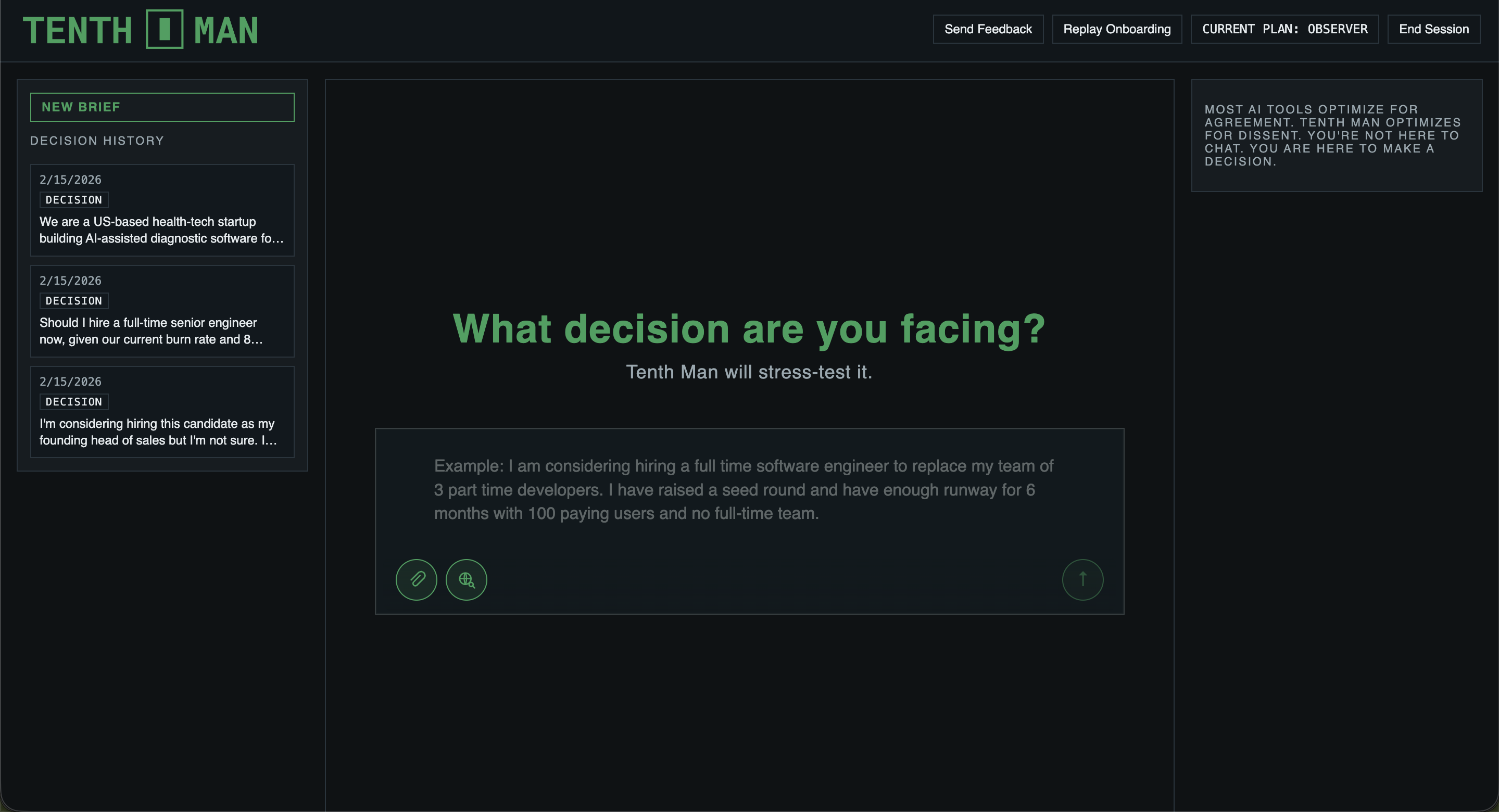
Most AI tools optimize for agreement. Tenth Man optimizes for dissent.
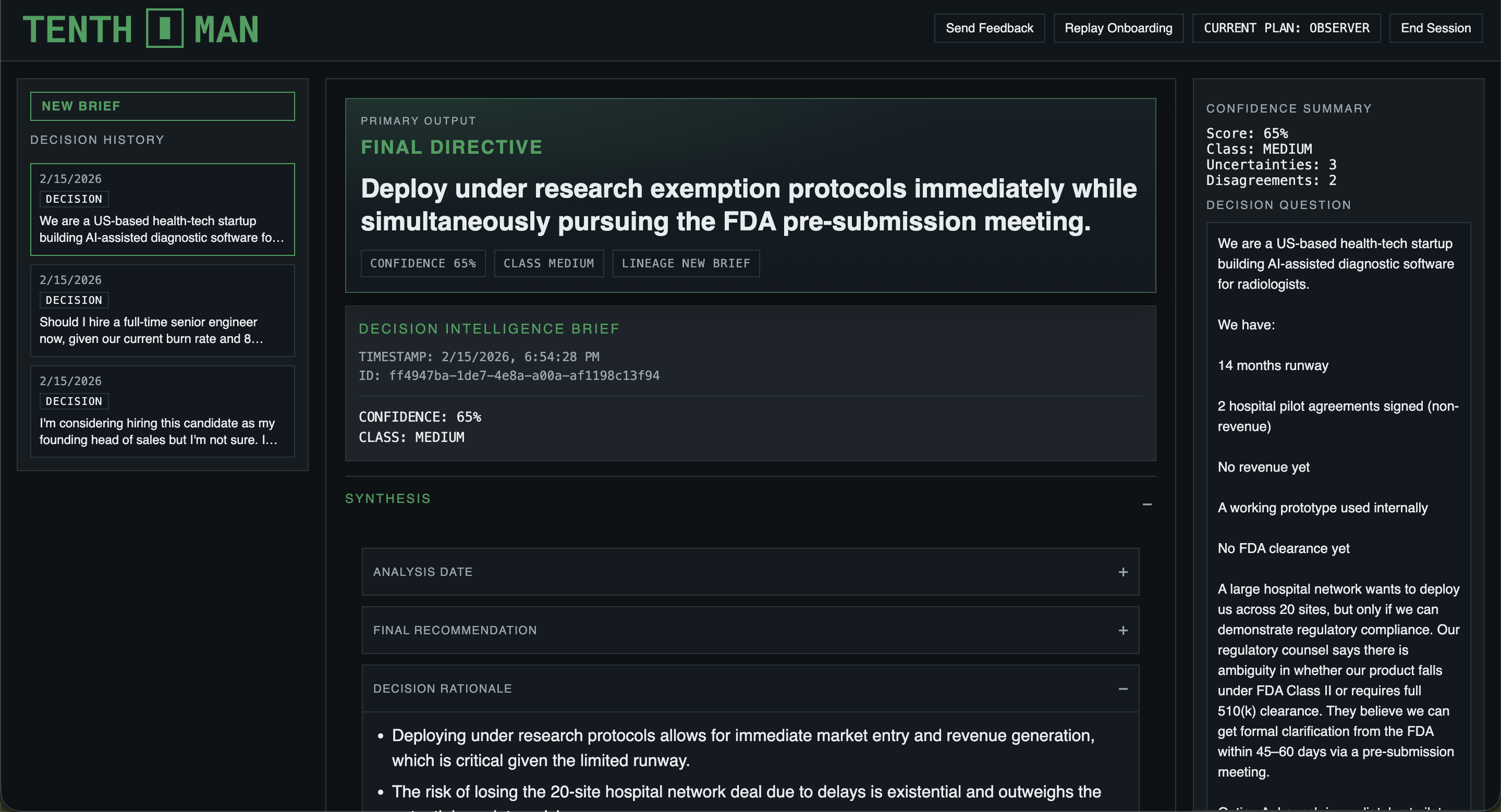
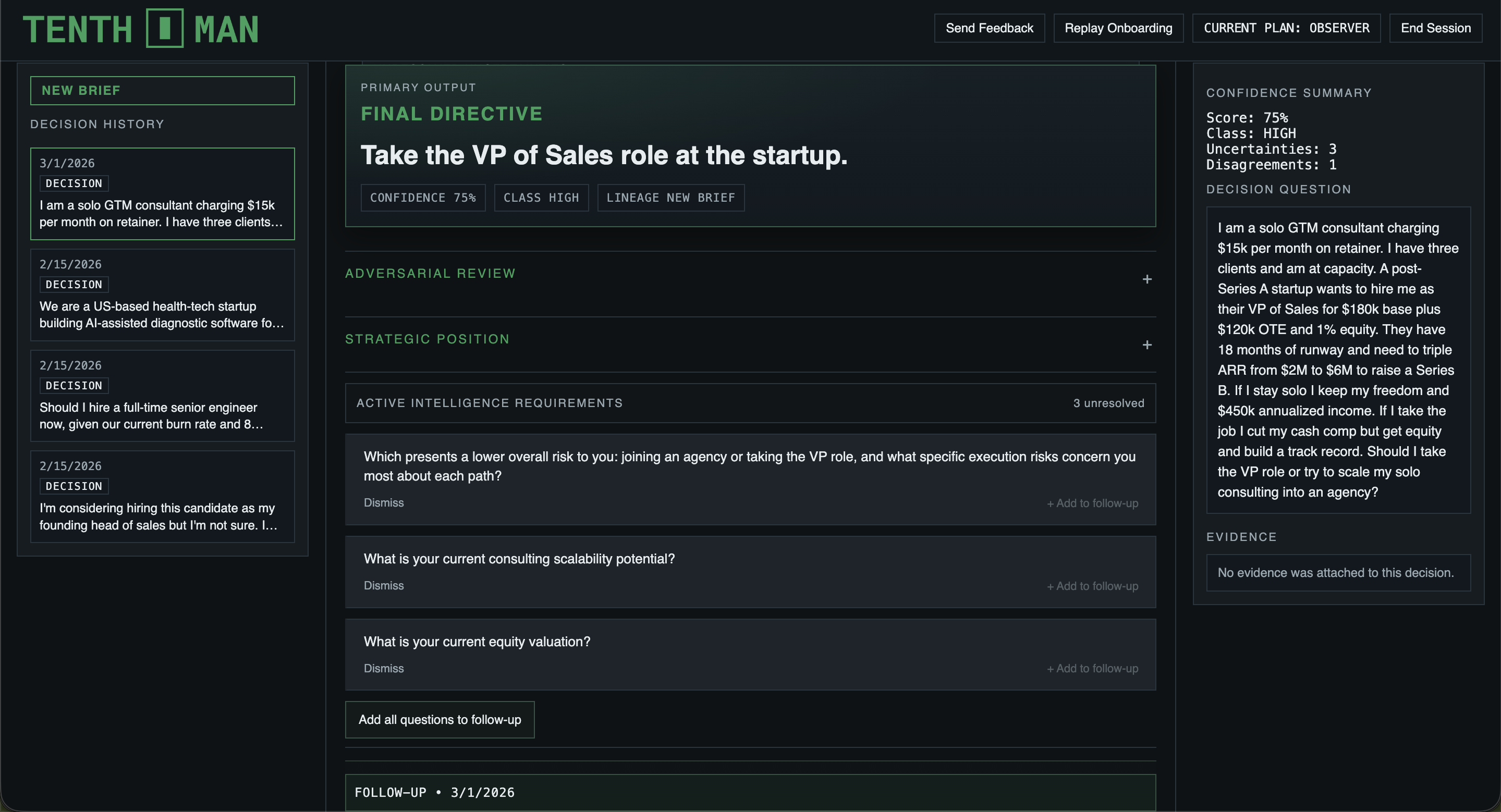
Three agents - Strategist, Skeptic, Synthesizer - run structured adversarial analysis on your decision.
The Skeptic attacks assumptions. The Synthesizer makes a call.
Confidence is capped by what's unresolved, not by how good the answer sounds.
No chat. No "it depends." A real decision brief.
Features
- Explicit assumptions
- Structured critique
- Confidence caps
- Mandatory dissent
Use Cases
- Hiring your first senior exec.
- Raising or delaying a round.
- Killing or doubling down on a product.
- Entering a partnership.
- Walking away from a deal.
- Firing a founding team member.

Comments





I built Tenth Man because I kept watching smart founders make bad decisions due to a lack of opposition. Every advisor in the room agreed. Every AI tool they consulted found a way to validate the plan. And there was no structural mechanism to force anyone to assume the crowd was wrong. The Tenth Man doctrine comes from military intelligence: if nine people agree, the tenth must disagree. The assumption is that consensus, by itself, is a blind spot. So I built a three-agent, three-model system where dissent is mandatory. A Strategist makes the case for action. A Skeptic attacks assumptions, incentives, and weak logic. A Synthesizer makes a call and owns the risk. Confidence is capped mechanically by what's unresolved - the system fails loudly if it tries to sound more certain than the evidence justifies. It's not a chatbot. You don't ask it questions. You submit a decision, and it tells you what you're missing. The decisions I had in mind: hiring a senior exec, raising or delaying a round, walking away from a deal, firing a co-founder. The ones where "it depends" is not an answer and the downside is real.


Really smart approach to decision-making. The three-agent structure (Strategist, Skeptic, Synthesizer) with mandatory dissent is brilliant — most AI tools just validate what you already think. The confidence capping mechanism is particularly interesting: anchoring certainty to unresolved issues rather than how convincing the output sounds. Would love to see this applied to product roadmap prioritization too.
Premium Products





























Sponsors
Buy



Makers
Makers
Comments
I built Tenth Man because I kept watching smart founders make bad decisions due to a lack of opposition. Every advisor in the room agreed. Every AI tool they consulted found a way to validate the plan. And there was no structural mechanism to force anyone to assume the crowd was wrong. The Tenth Man doctrine comes from military intelligence: if nine people agree, the tenth must disagree. The assumption is that consensus, by itself, is a blind spot. So I built a three-agent, three-model system where dissent is mandatory. A Strategist makes the case for action. A Skeptic attacks assumptions, incentives, and weak logic. A Synthesizer makes a call and owns the risk. Confidence is capped mechanically by what's unresolved - the system fails loudly if it tries to sound more certain than the evidence justifies. It's not a chatbot. You don't ask it questions. You submit a decision, and it tells you what you're missing. The decisions I had in mind: hiring a senior exec, raising or delaying a round, walking away from a deal, firing a co-founder. The ones where "it depends" is not an answer and the downside is real.
Really smart approach to decision-making. The three-agent structure (Strategist, Skeptic, Synthesizer) with mandatory dissent is brilliant — most AI tools just validate what you already think. The confidence capping mechanism is particularly interesting: anchoring certainty to unresolved issues rather than how convincing the output sounds. Would love to see this applied to product roadmap prioritization too.
Premium Products
New to Fazier?
Find your next favorite product or submit your own. Made by @FalakDigital.
Copyright ©2026. All Rights Reserved