
tastemaker
Real design taste for coding agents
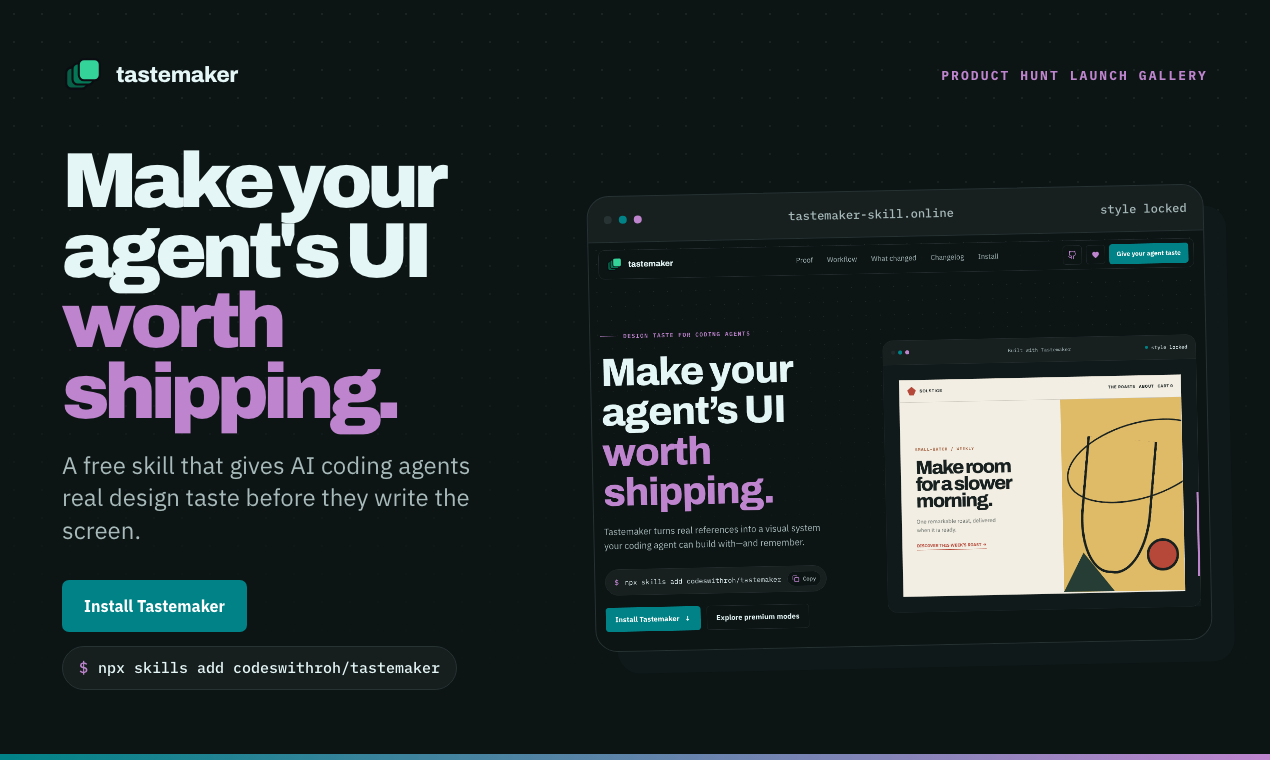
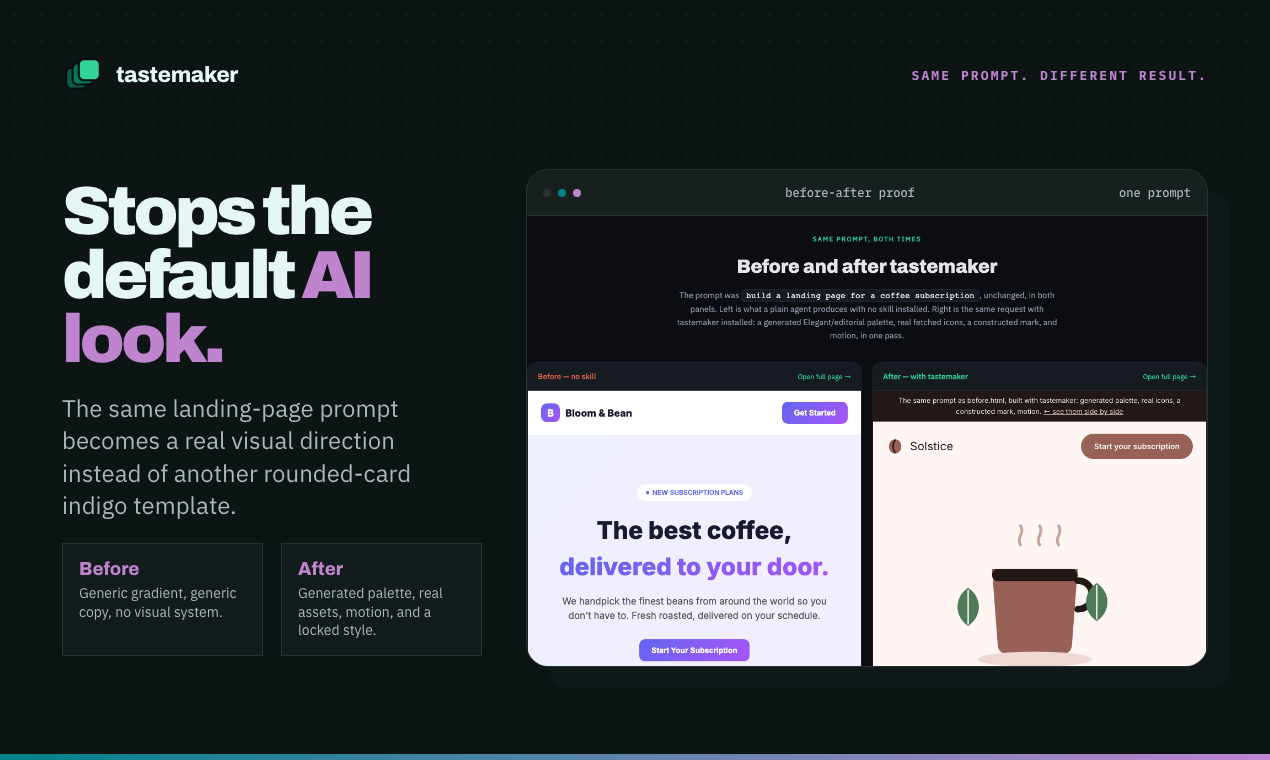
Coding agents are good at logic and bad at taste, and it shows the moment you ask one to design something: the same gradient, the same card shadow, the same hero every project. tastemaker is a free, open-source skill that gives Claude Code, Gemini CLI, and Windsurf an actual design system to build from instead of guessing. A fresh, contrast-checked palette every project. A page structure that varies build to build instead of repeating the same template. A memory of what you kept and rejected, so the next project starts warm. Plain Markdown and small Python scripts, no hosted backend, nothing to sign into.
Features
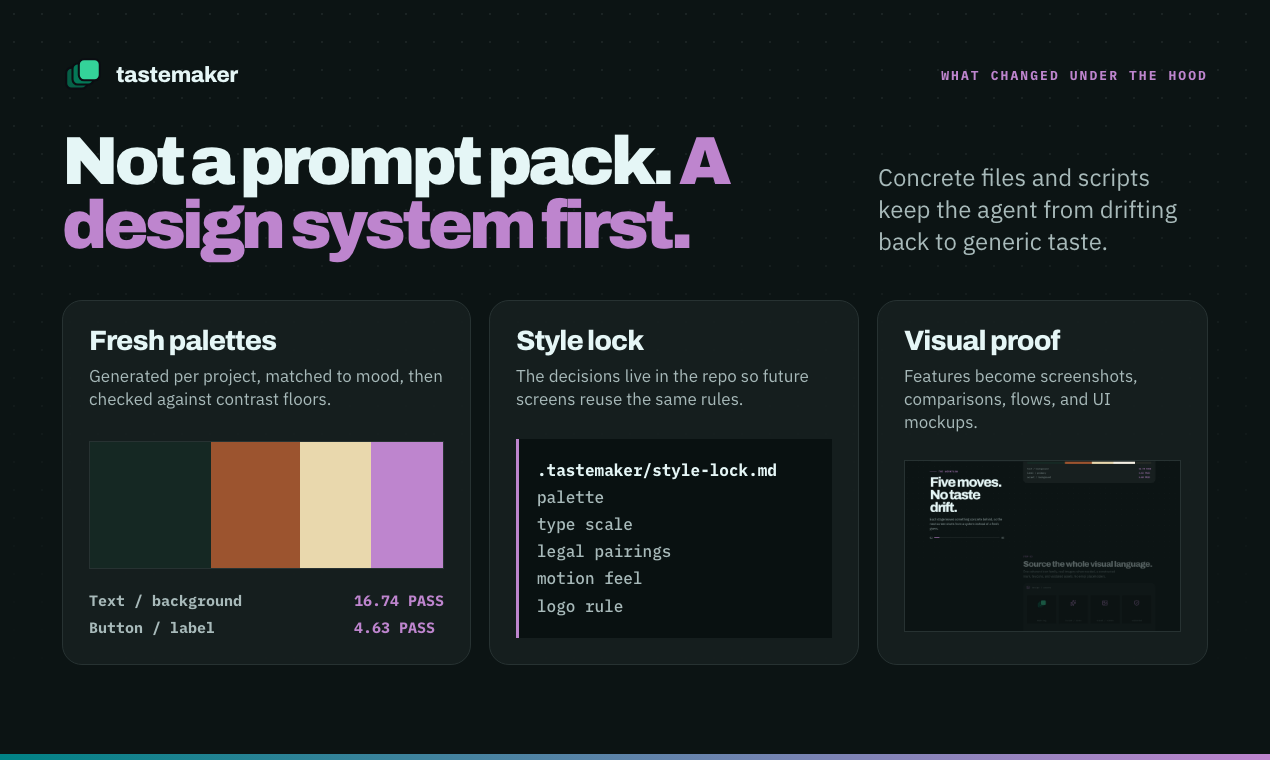
- Checks every text/background color pairing against real WCAG contrast math before it ships, not by eyeballing
- Reads actual pixel values from a reference image instead of summarizing it in words
- Locks your chosen style (tokens, palette, spacing) into the repo so it persists across sessions
- Reuses design tokens and legal pairings on every new screen instead of reinventing them
- Ships four built-in visual registers: Brutalist, Glassmorphic, Minimalist, Soft/Premium-Calm
- Works with Claude Code, Gemini CLI, and Windsurf
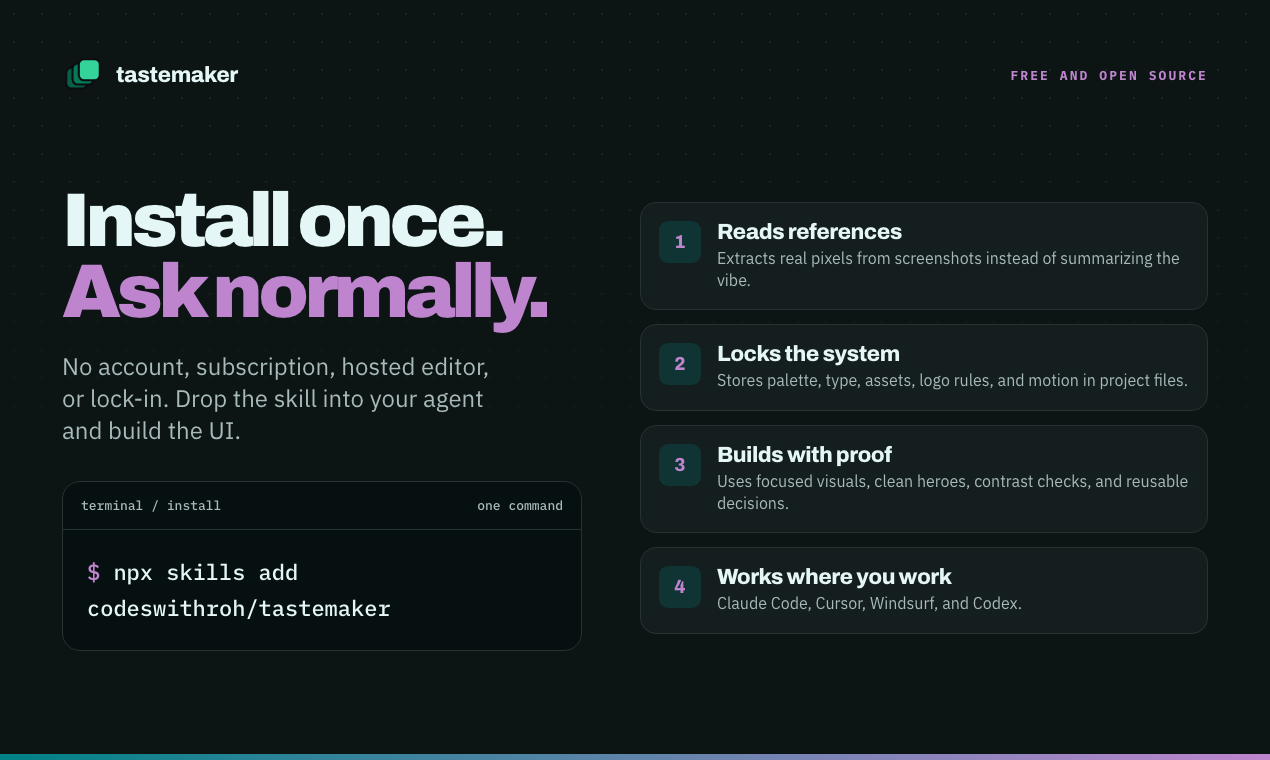
- Installs with one command: npx skills add codeswithroh/tastemaker (Claude Code also gets a plugin marketplace and manual install path)
- No magic phrase, account, or hosted API. Triggers automatically when you ask your agent to build, style, or improve a UI
Use Cases
- Building a landing page or product UI with an AI coding agent and wanting it to look intentional, not templated
- Catching accessibility contrast failures before a design ships instead of after a user reports them
- Handing your agent a reference screenshot and getting a real visual match, not a vague paraphrase
- Keeping a consistent design system across many pages or components an agent generates over multiple sessions
- Picking a specific visual register (brutalist, glassmorphic, minimalist, calm) for a project instead of the same default gradient and rounded card look every AI-built site gets

Comments


I kept asking Claude to build a UI and getting the same thing back: an indigo gradient, a rounded card with a soft shadow, a hero that looks like every other SaaS launch this year. That's not a prompting problem. A model has no way to invent taste from a text description alone, so it defaults to whatever's most common in its training data. tastemaker fixes the actual mechanism instead of writing a longer prompt. It generates a real palette every project and checks every color pairing against WCAG contrast with a script, not a guess. It picks a different page structure than your last build, so two projects don't come out as the same template in different colors. It remembers what you kept and rejected, so your tenth project starts from real preference instead of zero. It's free, MIT licensed, and runs as plain Markdown and small Python scripts. No account, no API key, no hosted backend. I'd love your feedback, especially anywhere the output still looks generic to you. That's the whole reason this exists.
Premium Products































Sponsors
Buy

Makers
Makers
Comments
I kept asking Claude to build a UI and getting the same thing back: an indigo gradient, a rounded card with a soft shadow, a hero that looks like every other SaaS launch this year. That's not a prompting problem. A model has no way to invent taste from a text description alone, so it defaults to whatever's most common in its training data. tastemaker fixes the actual mechanism instead of writing a longer prompt. It generates a real palette every project and checks every color pairing against WCAG contrast with a script, not a guess. It picks a different page structure than your last build, so two projects don't come out as the same template in different colors. It remembers what you kept and rejected, so your tenth project starts from real preference instead of zero. It's free, MIT licensed, and runs as plain Markdown and small Python scripts. No account, no API key, no hosted backend. I'd love your feedback, especially anywhere the output still looks generic to you. That's the whole reason this exists.
Premium Products
New to Fazier?

Find your next favorite product or submit your own. Made by @FalakDigital.
Copyright ©2025. All Rights Reserved