
Supsindex
Stop asking investors to believe in you. Give them a reason
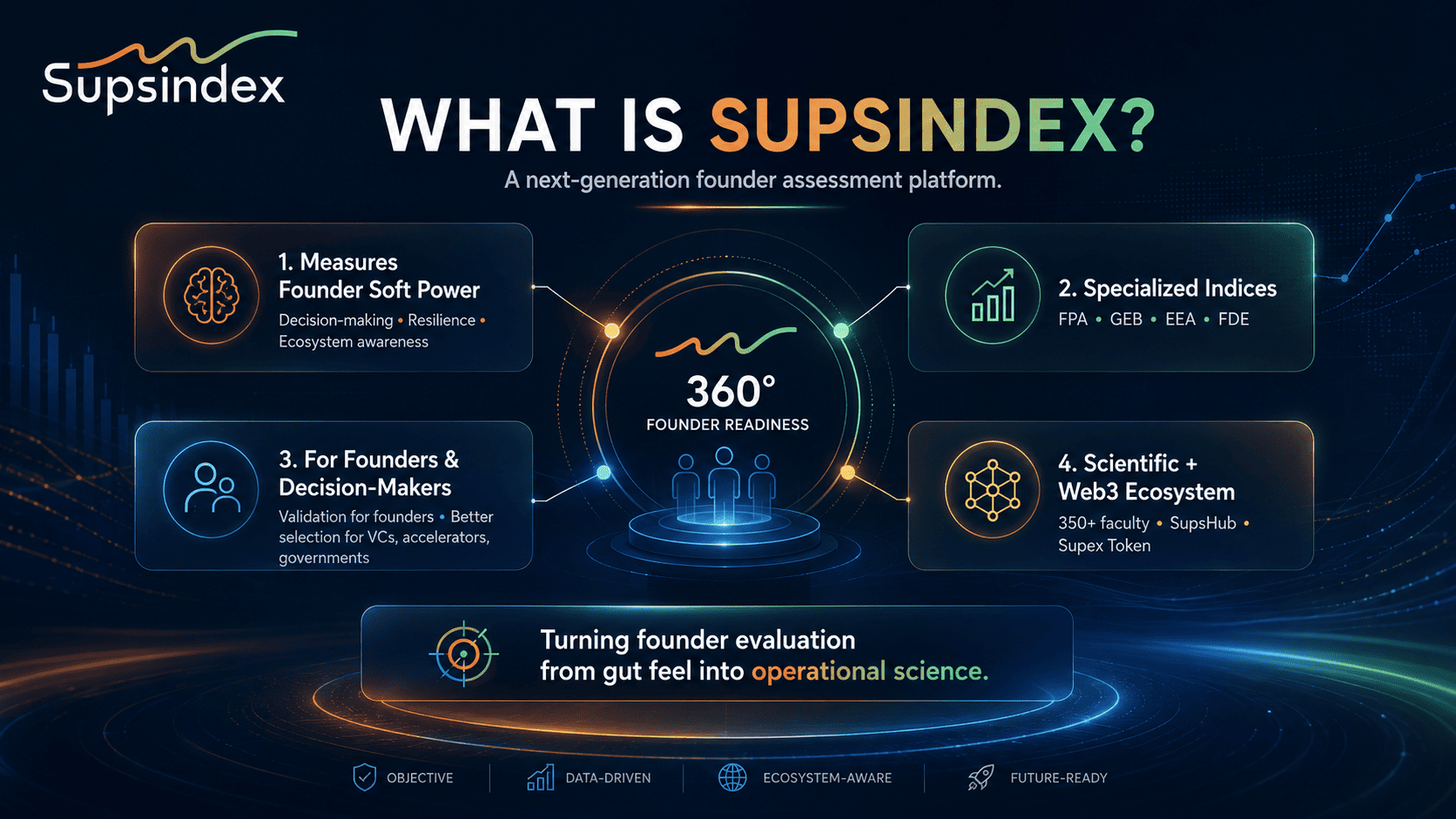
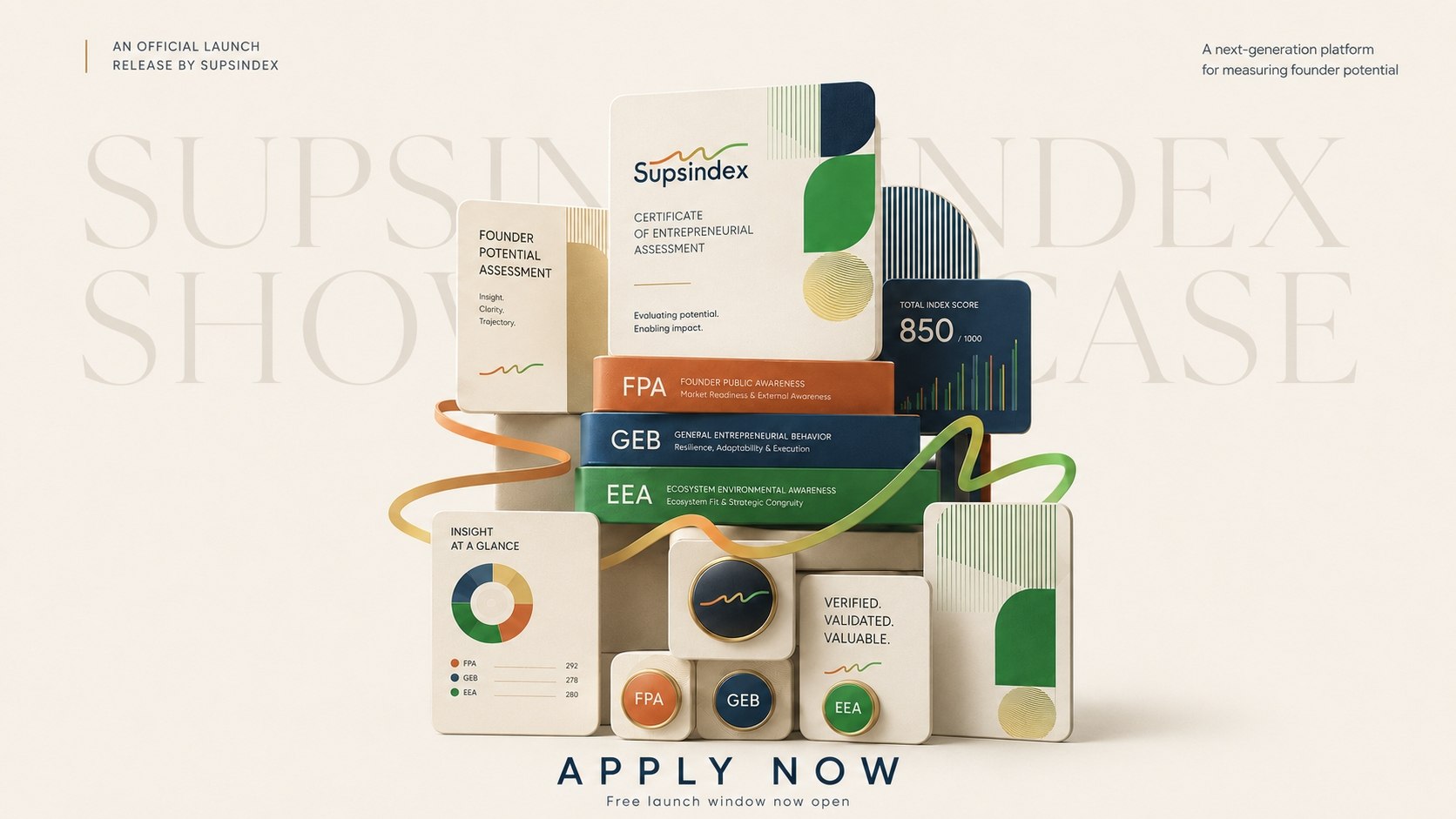
Supsindex evaluates the person behind the startup—not just the story inside the pitch deck. Through three structured assessments and more than 200 indicators, it examines your entrepreneurial knowledge, decision-making, behavior, mindset, strengths, blind spots, and compatibility with the ecosystem you are entering. The result is your Entrepreneurial Passport: a clear, data-backed profile of how prepared you are to build, lead, adapt, and survive as a founder. You receive detailed reports showing where you are strong, where you are exposed, and what needs improvement before an investor discovers those weaknesses for you.A pitch deck explains what you want to build. Supsindex shows whether you appear ready to build it.
Features
- Scientific founder assessment based on 200+ indicators
- Three structured assessments: FPA, GEB, and EEA
- Measures entrepreneurial knowledge, decision-making, behavior, mindset, strengths, and blind spots
- Verified founder identity for report validity
- Personalized, data-backed Entrepreneurial Passport
- Detailed insights into strengths, blind spots, and areas for improvement
- Industry-specific assessment based on the founder's selected sector
Use Cases
- Understand your entrepreneurial strengths and blind spots
- Identify areas that may affect your leadership and decision-making
- Benchmark your founder readiness with a structured assessment
- Prepare for investor conversations with a clearer understanding of your entrepreneurial profile
- Discover potential weaknesses before they become costly problems
- Build a data-backed profile of yourself as a founder
- Gain objective insight beyond what a pitch deck can show

Comments



The investor-conversation use case is the strongest part: a structured profile is more useful in that meeting than a self-written founder story. One suggestion: let founders export the assessment as a shareable PDF they control, since they will be asked for it repeatedly during a raise and will want to know who saw it.

I like the idea of evaluating founder readiness beyond the pitch deck. The Entrepreneurial Passport feels like a useful way to identify blind spots before fundraising. I'm curious whether founders can retake the assessments over time to measure improvement and track their progress as they build their startup.


We believe founders deserve to understand themselves before asking the world to believe in them. Supsindex was built to make that understanding measurable—not through another generic quiz, but through a scientific, verified assessment that turns your entrepreneurial profile into something you can actually learn from. If you're curious about what your Entrepreneurial Passport might reveal, this is a good time to find out.

This is such a smart angle — most founder tools focus on the pitch deck or the idea, but the founder's own blind spots are usually what actually sink things later. The three-assessment structure (FPA/GEB/EEA) is a nice touch too, feels more rigorous than a generic personality quiz. Curious how the industry-specific part works — does the assessment change meaningfully across sectors, or is it more like a weighting on top of the same core indicators? Also building something myself right now, so genuinely interested in how you're thinking about the verification step for report validity.

Proud to see Supsindex launch on Fazier! As an Industry Ambassador, I believe startup ecosystems need to assess not only the venture, but also the founder behind it. Supsindex brings structured, evidence-based insight into founder readiness, decision-making, resilience, and ecosystem awareness. Excited to see more founders and ecosystem professionals discover this new standard.



Interesting angle — most tools score the deck, not the founder. The 200+ indicator assessment sounds thorough, but as a founder I'd want to know how long the three assessments take end-to-end and whether the Entrepreneurial Passport can be shared with investors as a verified link rather than a PDF. Also curious how you handle sector fit for founders switching industries — does the EEA adapt, or is it fixed to the sector chosen at signup? The identity verification step is a smart touch for credibility.


Really like the "verified founder identity, report validity" angle here, that's the part that usually gets skipped in most founder-assessment tools. A lot of self-assessment products end up being whatever the founder wants to believe about themselves, so building in verification against that is a genuinely different approach. The blind-spot detection piece is probably the most valuable part in practice. Founders are usually decent at listing their strengths unprompted but need real structure to surface the stuff they're avoiding or don't see. Curious how the 200+ indicators handle something like decision-making under pressure, is that self-reported through the assessment, or does it also draw on any external behavioral signal?



For the Entrepreneurial Passport, can founders choose which sections an investor sees and revoke access later? Since the assessments cover behavioral blind spots as well as knowledge, a sample report showing the boundary between private coaching feedback and shareable results would make the workflow much clearer.


Assessing the founder instead of the deck is the right instinct. Most early-stage investment failures aren't a bad idea, they're a founder who couldn't adapt, and a structured profile is a far better signal than a self-written narrative. The 200+ indicators across knowledge, decision-making and behavior is where this gets interesting, because it can surface blind spots the founder themselves hasn't noticed. What I'd want to see before treating a score as decision-grade: how the indicators were derived and validated — whether they're benchmarked against actual outcomes or expert opinion, since a weighted checklist will always produce a confident number whether or not it predicts anything. And on the founder side, the real test is whether a low score changes behavior rather than just discouraging them. The investor-conversation use case is the strongest angle here. Worth watching how the evidence base holds up as more founders go through it.



The structured profile approach is exactly what investors need - moving beyond narrative bias toward measurable indicators. The 200+ assessment framework feels comprehensive without being overwhelming. Curious if the assessment results are static or if founders can retake them to show learning curves across funding rounds.





Premium Products









































Sponsors
Buy
Awards
View all
Awards
View allMakers
Makers
Comments
The investor-conversation use case is the strongest part: a structured profile is more useful in that meeting than a self-written founder story. One suggestion: let founders export the assessment as a shareable PDF they control, since they will be asked for it repeatedly during a raise and will want to know who saw it.
I like the idea of evaluating founder readiness beyond the pitch deck. The Entrepreneurial Passport feels like a useful way to identify blind spots before fundraising. I'm curious whether founders can retake the assessments over time to measure improvement and track their progress as they build their startup.
We believe founders deserve to understand themselves before asking the world to believe in them. Supsindex was built to make that understanding measurable—not through another generic quiz, but through a scientific, verified assessment that turns your entrepreneurial profile into something you can actually learn from. If you're curious about what your Entrepreneurial Passport might reveal, this is a good time to find out.
This is such a smart angle — most founder tools focus on the pitch deck or the idea, but the founder's own blind spots are usually what actually sink things later. The three-assessment structure (FPA/GEB/EEA) is a nice touch too, feels more rigorous than a generic personality quiz. Curious how the industry-specific part works — does the assessment change meaningfully across sectors, or is it more like a weighting on top of the same core indicators? Also building something myself right now, so genuinely interested in how you're thinking about the verification step for report validity.
Proud to see Supsindex launch on Fazier! As an Industry Ambassador, I believe startup ecosystems need to assess not only the venture, but also the founder behind it. Supsindex brings structured, evidence-based insight into founder readiness, decision-making, resilience, and ecosystem awareness. Excited to see more founders and ecosystem professionals discover this new standard.
Interesting angle — most tools score the deck, not the founder. The 200+ indicator assessment sounds thorough, but as a founder I'd want to know how long the three assessments take end-to-end and whether the Entrepreneurial Passport can be shared with investors as a verified link rather than a PDF. Also curious how you handle sector fit for founders switching industries — does the EEA adapt, or is it fixed to the sector chosen at signup? The identity verification step is a smart touch for credibility.
Really like the "verified founder identity, report validity" angle here, that's the part that usually gets skipped in most founder-assessment tools. A lot of self-assessment products end up being whatever the founder wants to believe about themselves, so building in verification against that is a genuinely different approach. The blind-spot detection piece is probably the most valuable part in practice. Founders are usually decent at listing their strengths unprompted but need real structure to surface the stuff they're avoiding or don't see. Curious how the 200+ indicators handle something like decision-making under pressure, is that self-reported through the assessment, or does it also draw on any external behavioral signal?
For the Entrepreneurial Passport, can founders choose which sections an investor sees and revoke access later? Since the assessments cover behavioral blind spots as well as knowledge, a sample report showing the boundary between private coaching feedback and shareable results would make the workflow much clearer.
Assessing the founder instead of the deck is the right instinct. Most early-stage investment failures aren't a bad idea, they're a founder who couldn't adapt, and a structured profile is a far better signal than a self-written narrative. The 200+ indicators across knowledge, decision-making and behavior is where this gets interesting, because it can surface blind spots the founder themselves hasn't noticed. What I'd want to see before treating a score as decision-grade: how the indicators were derived and validated — whether they're benchmarked against actual outcomes or expert opinion, since a weighted checklist will always produce a confident number whether or not it predicts anything. And on the founder side, the real test is whether a low score changes behavior rather than just discouraging them. The investor-conversation use case is the strongest angle here. Worth watching how the evidence base holds up as more founders go through it.
The structured profile approach is exactly what investors need - moving beyond narrative bias toward measurable indicators. The 200+ assessment framework feels comprehensive without being overwhelming. Curious if the assessment results are static or if founders can retake them to show learning curves across funding rounds.
Premium Products
New to Fazier?

Find your next favorite product or submit your own. Made by @FalakDigital.
Copyright ©2026. All Rights Reserved