
SubmitMap
Where to submit your product, and exactly how
Every launch guide says "submit to directories". None of them say which ones accept your kind of product, what the form will ask, or what happens after you hit submit.
SubmitMap is that missing map. Every platform is a typed record: who it accepts, what disqualifies you, the exact submission steps, expected approval time and whether the backlink is dofollow. A phased route of guides puts it in order, from getting launch-ready to the paid channels you should open last. Connect it to your AI over MCP and it works out what you qualify for and fills the forms in your own browser.
The directory, the guides and the qualification checks are free and need no account. No paid placement, ever.
Features
Eligibility rules and disqualifiers written per platform
The exact submission steps and form fields, before you open the form
Dofollow and approval time on every record
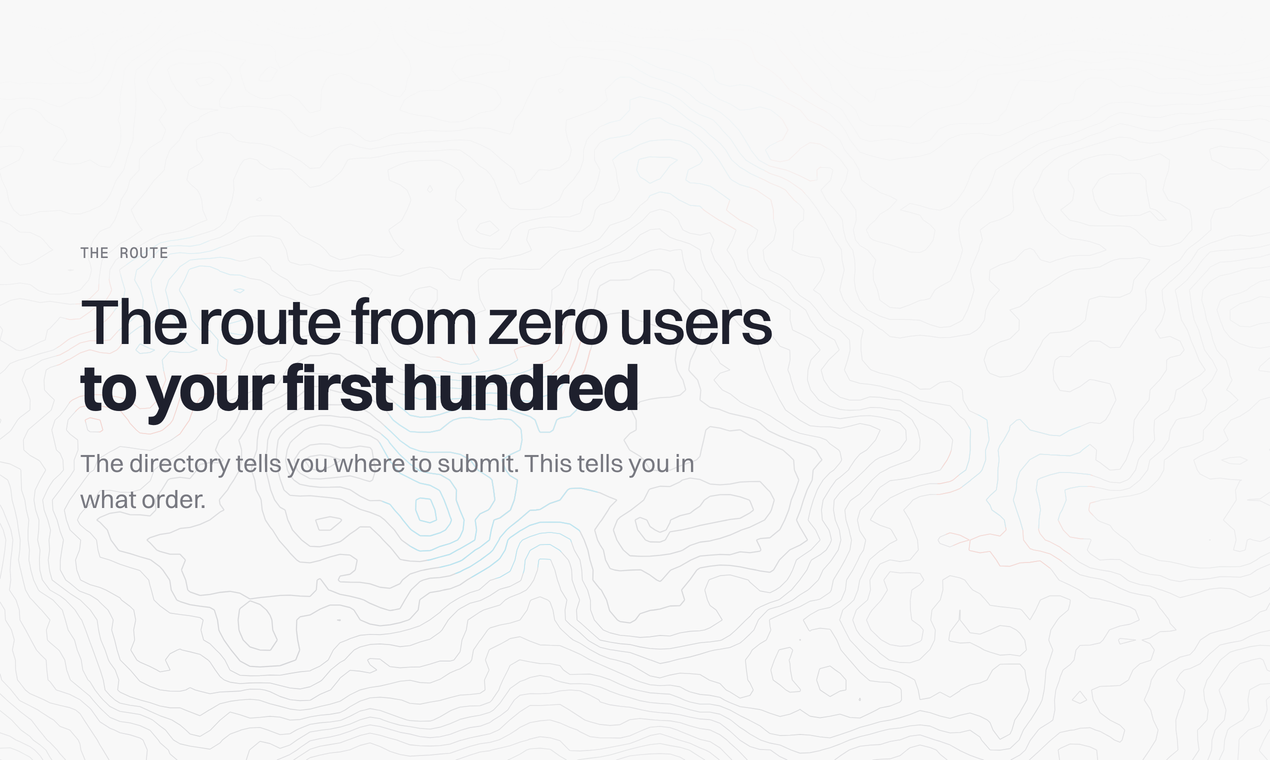
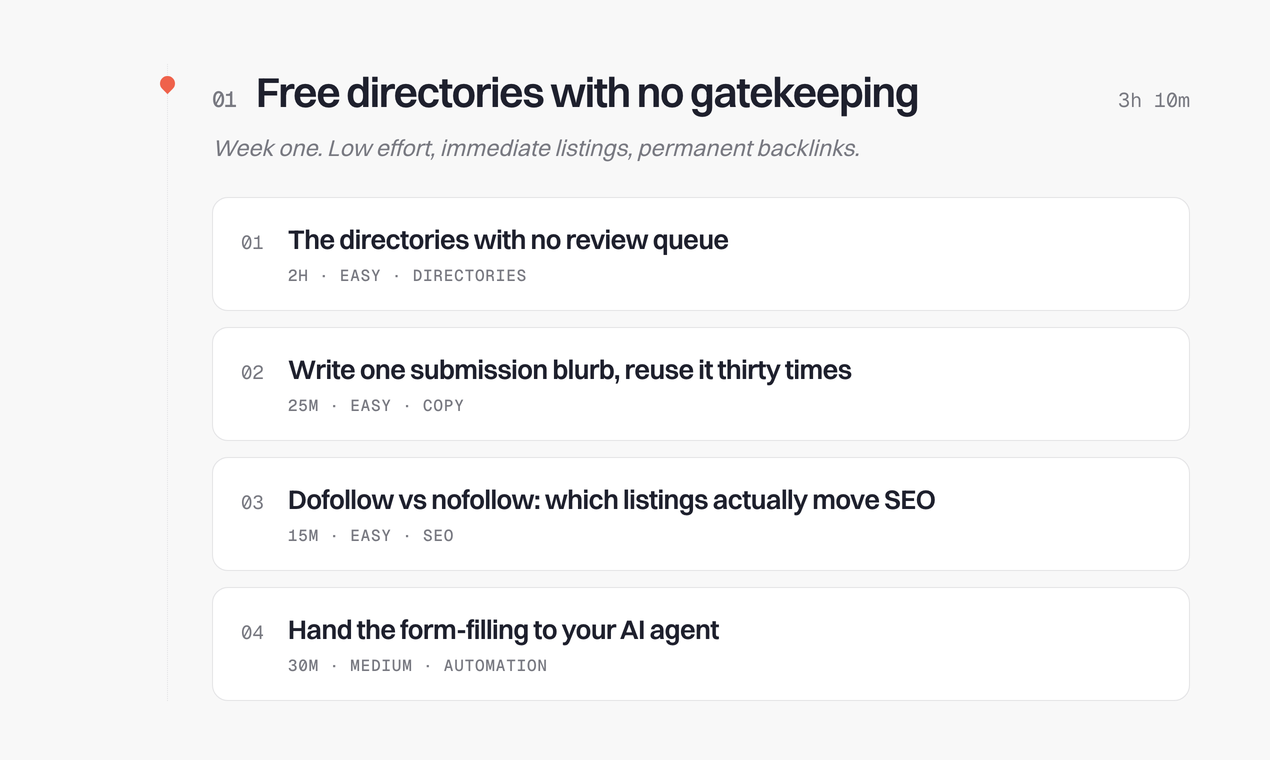
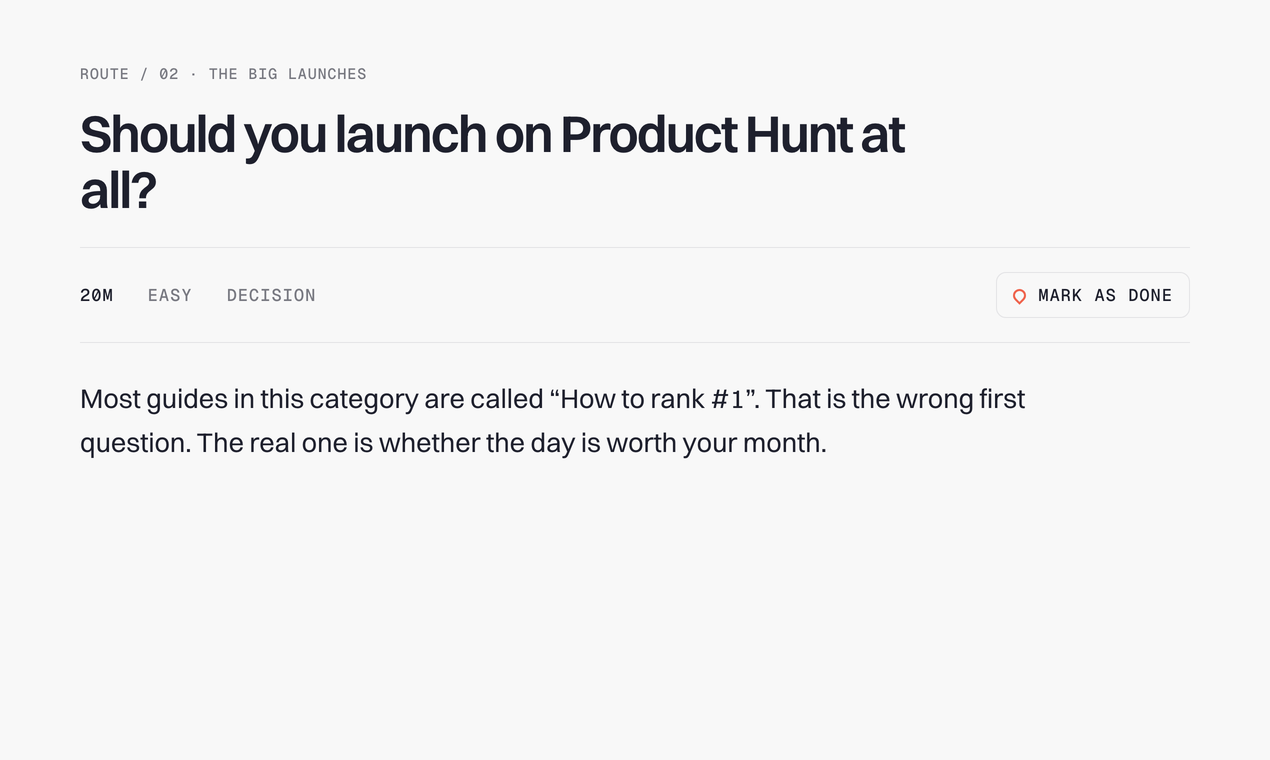
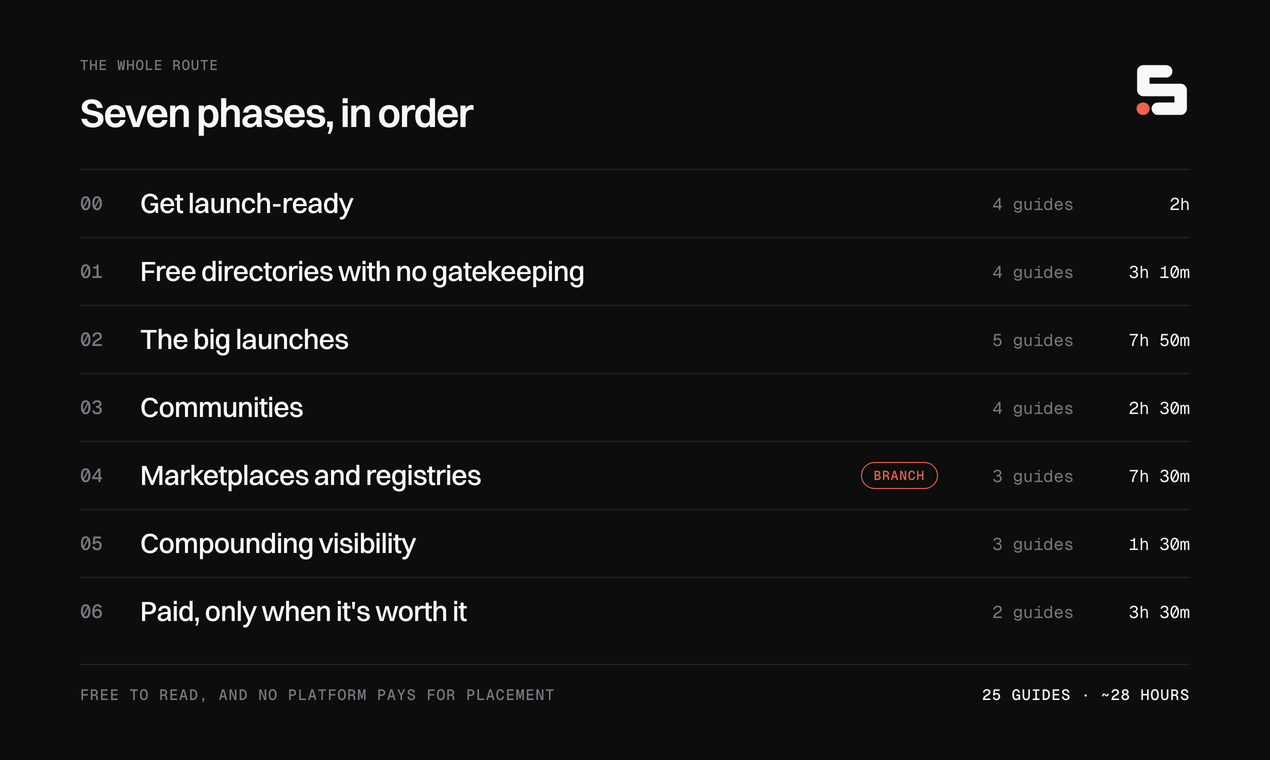
A phased route of guides from launch-ready to your first hundred users
An MCP server so your AI agent does the submitting in your own browser
Use Cases
Work out which directories your product actually qualifies for before writing a word
Plan a launch week in the right order instead of firing every channel at once
Check whether a platform's backlink is worth the form before filling it in
Hand the whole queue to an AI agent and have it submit for you

Comments



SubmitMap is a genuinely useful resource for startups and SaaS founders looking to improve their product launches. The organized directory, eligibility filters, detailed submission guidance, and AI-powered automation make discovering and submitting to relevant platforms much faster and more efficient.

This is the map I wished I had while listing a desktop app recently. One distinction mattered a lot for me: some directories link to your site, others host your installer on their own servers, sometimes wrapped in their own downloader. Do you record whether a platform links out or rehosts the file? And do you flag directories that only accept open source projects, or that have gone offline? Both came up for me.


Ha, this is exactly the rabbit hole I've been stuck in for the past couple weeks. So many of these "launch directories" turn out to be the same reciprocal-badge template with a different coat of paint and basically no real audience behind them. Would be so useful if there were a version of this that flagged which ones are actually worth your 10 minutes vs. which just want a link back. Great idea for a tool.




This is exactly the kind of problem that becomes painful once you're actually launching multiple products. The directory itself is useful, but I think the eligibility rules and the "what happens after submission" information are even more valuable. One thing I'd be curious to see is historical data on approval time and actual traffic generated by each directory. It would make it much easier to distinguish between "easy to submit to" and "actually worth submitting to."
Working through a directory submission pass myself right now, so this resonates — the "which ones accept your kind of product" framing is the part every other launch list skips. Two fields I'd add to the per-platform records: whether the directory page actually gets organic traffic (some are ghost towns), and the exact backlink/attribution placement, since a badge requirement can be a dealbreaker depending on your site. The MCP server for agent-led submitting is forward-thinking — delegation of the most repetitive founder task.

Hey everyone, maker here. SubmitMap started as my own launch spreadsheet. Every time I shipped a side project I re-researched the same question: where do I submit this, and in what order? So I turned the spreadsheet into a typed directory: every platform carries its eligibility rules, the exact form fields, the gotchas and the approval time. A phased route of guides puts it all in order, from launch-ready to your first hundred users. It also speaks MCP, so you can hand the whole thing to your AI agent and have it do the submitting in your browser. The directory, the guides and the checks are free and need no account. There's a paid plan for the dashboard and MCP if you want your projects and submissions tracked, and no platform pays for placement either way. I'd love to know which platform you'd add next.



This is useful because the hard part with directory submissions is usually not finding directories, but knowing which ones are still active, worth the effort, and what each one actually requires. I’d be curious how often the directory data is refreshed and whether you track approval rates over time.

SubmitMap Your product has strong potential, but I found a few key improvements that could make it even better. I'd love to share my feedback and suggestions—please contact me at [email protected].

The friction you're addressing is usually invisible because makers just accept it as part of launch. The real cost is not the form filling - it's the research: finding which directories exist, figuring out if you even qualify, then discovering mid-form that they don't accept your category. By organizing this upfront (eligibility + form fields + approval time), you remove the false-starts that kill momentum. The MCP integration is the smart part here - instead of manually copy-pasting between your app and a web form, an agent does the whole thing. The phased route makes sense too since not all directories are created equal. A backlink from a directory with 50 DAQ authority is different from a 2M site, so knowing this before you submit matters. If the data actually stays current (directories change their requirements constantly), this becomes the one place makers check before launch week instead of a random spreadsheet.


This is basically solving the exact problem I've been hand-doing across a dozen directory submissions the past few weeks — figuring out per-site eligibility, form fields, and whether a backlink is even dofollow before investing the time. The "approval time + dofollow" flag per platform is the detail that would've saved me the most guesswork. Would genuinely use this the next time I'm sequencing a launch campaign

This is useful because the hard part with directory submissions is usually not finding directories, but knowing which ones are still active, worth the effort, and what each one actually requires. I’d be curious how often the directory data is refreshed and whether you track approval rates over time.

The dofollow field is the one I wish I had two days ago. I have been submitting a tool across a dozen directories this week, and the thing that cost the most time is written nowhere: most verifiers fetch only the homepage you submit, they do not follow internal links. I built a proper partners page with every badge on it, and six listings sat unpublished because the crawler never saw it. I had to move a plain text link into the footer before anything passed. If you encode that per platform, badge on the homepage versus anywhere on the domain, and what the verifier actually fetches, that alone would justify the map.




Congrats on shipping SubmitMap — this is exactly the kind of thing I wish I’d had earlier. Turning a messy “where do I submit next?” spreadsheet into a typed directory with eligibility rules, form gotchas, and expected approval times is hugely useful. The guided launch → first-100-users path plus MCP so an agent can help in-browser is a really smart combo. Love that the core directory/guides stay free too. I’m currently launching Trilo3D (image → textured 3D online, GLB/FBX/OBJ/USDZ/STL): https://trilo3d.com — tools like yours make the directory grind way less painful.

This is a really useful idea because finding the right directories can be surprisingly time-consuming, especially when every platform has different eligibility rules and submission requirements. I like the focus on showing the actual approval process and whether a backlink is dofollow instead of simply providing a long list of directories. I'm currently working on https://dltaexecutorapk.com/ , so having a way to quickly identify which directories are suitable for a gaming/Android project would definitely be useful. The qualification checks and phased approach sound especially helpful for avoiding wasted submissions.

The MCP-agent piece is what caught my attention. I've been running my own directory submissions through Claude Code this week (Uneed, StartupBase, Fazier), and the actual blocker every time wasn't the copywriting, it was not knowing upfront which platforms had closed their free queue, which needed a comment-gate before you could even see the form, or which had a paid-only path disguised as a free one. Found all of that out the hard way, one platform at a time. Having that eligibility and disqualifier data typed per-platform before you start would've saved a real afternoon. And handing the actual form-filling to an agent once you know what you qualify for is the natural next step, most of the manual part isn't the writing, it's the tab-switching and re-reading each platform's fine print. Following this, curious how deep the eligibility rules go, do you flag things like required minimum traffic or team size, or just acceptance criteria on product type?



Using SubmitMap to plan Cookpress's directory launch right now. The part that actually saved me time is the per-platform disqualifier and backlink notes — most directory lists don't tell you which forms are dead or what they'll reject before you fill them. Would love to see approval-rate tracking over time, that's the one signal nobody publishes.



Listing the eligibility rules and disqualifiers per platform is the part most directory lists skip, and it's exactly where the time goes - half the submissions I've written got rejected for a rule that was never stated up front. Dofollow status plus typical approval time on every record makes it possible to prioritise instead of blasting all of them in one afternoon. How often are the records re-checked? Submission forms and approval times drift fast, and a stale map is worse than no map.
Recording eligibility rules and disqualifiers per directory is the detail that makes this more than another list — most of the wasted time in launch weeks comes from filling a form for a site that was never going to accept the product. Listing dofollow status and typical approval time next to each entry is exactly the pair of facts needed to prioritise. My question is freshness: how often are those records re-checked, since directories quietly change submission rules and nofollow their links? Showing a "last verified" date on each row would make the whole thing much easier to trust.


The framing is right — "which ones accept your kind of product" is the part every other launch guide skips. One thing I'd find genuinely useful if you don't already track it: whether the listing actually emits a crawlable link. I went through a list of fourteen directories this week and twelve were worthless, but only three of those were worthless for the obvious reason of being off-topic. The rest either rendered the site's URL as plain text with no anchor at all, nofollowed everything, or loaded listings client-side so nothing appears in the HTML. Acceptance and a usable link turned out to be almost unrelated. Do you distinguish those, or is the map about acceptance criteria only?

The per-platform eligibility rules and disqualifiers are what impressed me most. Most directory lists focus on quantity, but knowing whether a product actually qualifies and seeing approval time and backlink details upfront makes SubmitMap much more actionable. The MCP integration is also an interesting touch. How often do you re-verify platform requirements as directories change their submission rules?


The typed-record approach is what makes this useful. I have been working through a directory list for my own product this week and the real time sink is not finding directories, it is discovering after signup that the free tier closed or the platform only accepts open source. Encoding disqualifiers per platform solves the actual problem. The MCP angle is a nice touch too.
SubmitMap Your product has strong potential, but I found a few key improvements that could make it even better. I'd love to share my feedback and suggestions—please contact me at [email protected].


The hidden-requirements angle is the useful part. We just hit Fazier’s free lane: the pricing card only mentions the badge, then /launch reveals the 3-comment gate. Encoding “free tier is conditional (badge / comments / queue)” as first-class fields would have saved that round trip. Same for boards that reject personal email domains before the form even opens.


Two disqualifiers I hit this week that I have not seen on any launch list, including the ones in this thread. The first is the email domain. Startup Stash rejected my submission at the email step with "we only accept work/business emails" — a Gmail address is a hard stop before you ever see the form. That is not a product-category rule, it is an identity rule, and it silently rules out anyone who has not bought a domain yet. The second is the shape of the free tier. Several platforms have one, but it is conditional rather than free: Smol Launch wants their badge embedded and then puts you in a six-week queue, TinyLaunch was 33 days out, Uneed has closed its free queue to new products entirely. All genuinely free, but the cost is time or work rather than money — and you only find that out after creating an account. For scale: I checked nine directories off one list and exactly one was free, open and needed no account. So the disqualifier data is the whole value here, not the list itself. Do you encode either of those? Fields like "requires business email" and "free tier: conditional — badge / queue length / closed" would have saved me most of an afternoon.




I am submitting a product to Fazier right now. The Basic plan card mentions a required backlink, but after signing in it reveals another requirement: three helpful comments. This is exactly the kind of hidden condition I would want SubmitMap to surface. Do your records distinguish requirements visible before login from requirements revealed after account creation, with a last-checked date?

This would've saved me a lot of trial and error. I've been manually working through directory submissions for a new site over the past few weeks — Uneed, SaaSHub, BetaList, Product Hunt — and the biggest time sink wasn't the forms themselves, it was figuring out upfront which ones actually have a free tier vs. which paywall the "real" listing behind a $50-300 upgrade. Having that dofollow/approval-time/paid-vs-free info typed out per platform before I start would've cut a lot of wasted clicks. Does the MCP integration handle the "this platform requires 30-day account age" type gates too, or just the form-filling itself?

The thing I'd want this to tell me is which of the directories on the list actually have an audience of their own, versus which are backlink-only. I ranked 107 SaaS directories by their own monthly traffic recently and only about eleven free ones clear a million visits a month. The rest are still worth submitting to, but for the link, not for referral clicks, and going in expecting traffic is how people conclude the whole channel is worthless. If SubmitMap can label each entry that way, and flag which ones have quietly moved to paid placement, that's the part no listicle gets right.

Went through about 15 launch sites today for my own launch, so this hits home. Two fields I'd love per platform: (1) what the form does to your data. SaaSHub silently dropped the "&" from my product name, and the only fix was a moderated "suggest changes" form. (2) Gates before you can actually launch. Peerlist wants account verification first, HN restricts Show HN for new accounts, and some "free" queues are months long (one offered me a 2029 slot). Knowing that upfront would have saved me an evening.

Ran into exactly this today doing a submission pass for one of my apps: two directories listed as "freemium" turned out to gate the real listing behind a flat $49-99 fee once you're actually in the form, and a third (this one, actually) only reveals the comment + badge requirement after you log in. None of that shows up beforehand. A "requirements visible before login vs. revealed after signup" flag, like hamm37 asked about above, would be the single most useful field you could add here — it's the difference between a 5-minute submission and burning an afternoon on dead ends.

Two gates I hit today that I have not seen encoded anywhere, including this thread. Per-account submission caps. SaaSHub allows one pending submission at a time. I got two products in, and the third came back with "we need to approve one of your recent submissions before you can submit more". For anyone launching a portfolio rather than a single product, that turns one afternoon into three separate weeks, and nothing on the form says so until you are already three fields deep. A "one pending per account" field would be worth a lot. Stale submission URLs. Every guide I found cites alternativeto.net/manage/add-item/ for AlternativeTo. That 404s. The working path is /manage-item/. The old URL has been wrong long enough to have propagated through most listicles, which is a good argument for your last-verified date being on the URL itself and not just the record. One more that cost me a rejected submit: AlternativeTo's pricing selector is a combobox, not the radio buttons it looks like. Clicking the visible option does nothing and the form rejects with "Pricing is required" after you have filled everything else in. Form-field gotchas at that level of detail are exactly what would make an agent-driven pass work first time.



Having just spent a week submitting one product to a dozen launch platforms by hand, I can confirm the pain is real. What would make this genuinely valuable: flagging which directories give dofollow links on the free tier vs. paid-only, and which require a reciprocal badge — that's the information you only discover after wasting time on each site.



The disqualifier data being the whole value, not the list, matches what I found this week submitting one product by hand. Two field-tested additions you may not have encoded yet. First, a "free tier: how far out" number, not just free versus paid. Open Launch has a genuinely free launch, but the queue is booked into 2027, and the only thing that moves you sooner is a paid slot that also happens to carry the dofollow. So the honest label is not "free" or "paid", it is "free in fourteen months, or twelve dollars now". A queue-length field would catch that class of platform. Second, split the dofollow flag by tier. On several platforms the free listing is nofollow and the dofollow only shows up on a paid or top-ranked slot, so one dofollow flag per platform overstates what a free submission gets you. A "free tier link type" column kept separate from the paid one is the pair of facts that decides whether the form is worth opening. On the MCP piece: the form-filling is the right shape, but in practice the login and the anti-bot check stay the human step on most of these, so the real win is the map telling the agent what it qualifies for before it opens a single tab.

Congrats, this is exactly the spreadsheet I've been rebuilding by hand this week. Launching a language app across Product Hunt, Uneed, Fazier and AlternativeTo, and the two things that cost me the most time were finding out BetaList dropped free submissions only after opening the form, and that AlternativeTo has no Education category at the top level. Per-platform disqualifiers up front would have saved both. Question: how do you keep the eligibility rules current when platforms change their terms? Upvoted.






Congratulations on the launch! As an indie maker, finding the right places to submit and launch new projects is always a massive time-sink. A tool like SubmitMap is exactly what the founder community needs to streamline that process. Quick question: Does the platform also filter or show which directories provide the highest Domain Authority (DA) do-follow backlinks? Great job on solving a real pain point for creators. Upvoted and wishing you a successful launch!







Premium Products































Sponsors
Buy



Comments
SubmitMap is a genuinely useful resource for startups and SaaS founders looking to improve their product launches. The organized directory, eligibility filters, detailed submission guidance, and AI-powered automation make discovering and submitting to relevant platforms much faster and more efficient.
This is the map I wished I had while listing a desktop app recently. One distinction mattered a lot for me: some directories link to your site, others host your installer on their own servers, sometimes wrapped in their own downloader. Do you record whether a platform links out or rehosts the file? And do you flag directories that only accept open source projects, or that have gone offline? Both came up for me.
Ha, this is exactly the rabbit hole I've been stuck in for the past couple weeks. So many of these "launch directories" turn out to be the same reciprocal-badge template with a different coat of paint and basically no real audience behind them. Would be so useful if there were a version of this that flagged which ones are actually worth your 10 minutes vs. which just want a link back. Great idea for a tool.
This is exactly the kind of problem that becomes painful once you're actually launching multiple products. The directory itself is useful, but I think the eligibility rules and the "what happens after submission" information are even more valuable. One thing I'd be curious to see is historical data on approval time and actual traffic generated by each directory. It would make it much easier to distinguish between "easy to submit to" and "actually worth submitting to."
Working through a directory submission pass myself right now, so this resonates — the "which ones accept your kind of product" framing is the part every other launch list skips. Two fields I'd add to the per-platform records: whether the directory page actually gets organic traffic (some are ghost towns), and the exact backlink/attribution placement, since a badge requirement can be a dealbreaker depending on your site. The MCP server for agent-led submitting is forward-thinking — delegation of the most repetitive founder task.
Hey everyone, maker here. SubmitMap started as my own launch spreadsheet. Every time I shipped a side project I re-researched the same question: where do I submit this, and in what order? So I turned the spreadsheet into a typed directory: every platform carries its eligibility rules, the exact form fields, the gotchas and the approval time. A phased route of guides puts it all in order, from launch-ready to your first hundred users. It also speaks MCP, so you can hand the whole thing to your AI agent and have it do the submitting in your browser. The directory, the guides and the checks are free and need no account. There's a paid plan for the dashboard and MCP if you want your projects and submissions tracked, and no platform pays for placement either way. I'd love to know which platform you'd add next.
This is useful because the hard part with directory submissions is usually not finding directories, but knowing which ones are still active, worth the effort, and what each one actually requires. I’d be curious how often the directory data is refreshed and whether you track approval rates over time.
SubmitMap Your product has strong potential, but I found a few key improvements that could make it even better. I'd love to share my feedback and suggestions—please contact me at [email protected].
The friction you're addressing is usually invisible because makers just accept it as part of launch. The real cost is not the form filling - it's the research: finding which directories exist, figuring out if you even qualify, then discovering mid-form that they don't accept your category. By organizing this upfront (eligibility + form fields + approval time), you remove the false-starts that kill momentum. The MCP integration is the smart part here - instead of manually copy-pasting between your app and a web form, an agent does the whole thing. The phased route makes sense too since not all directories are created equal. A backlink from a directory with 50 DAQ authority is different from a 2M site, so knowing this before you submit matters. If the data actually stays current (directories change their requirements constantly), this becomes the one place makers check before launch week instead of a random spreadsheet.
This is basically solving the exact problem I've been hand-doing across a dozen directory submissions the past few weeks — figuring out per-site eligibility, form fields, and whether a backlink is even dofollow before investing the time. The "approval time + dofollow" flag per platform is the detail that would've saved me the most guesswork. Would genuinely use this the next time I'm sequencing a launch campaign
This is useful because the hard part with directory submissions is usually not finding directories, but knowing which ones are still active, worth the effort, and what each one actually requires. I’d be curious how often the directory data is refreshed and whether you track approval rates over time.
The dofollow field is the one I wish I had two days ago. I have been submitting a tool across a dozen directories this week, and the thing that cost the most time is written nowhere: most verifiers fetch only the homepage you submit, they do not follow internal links. I built a proper partners page with every badge on it, and six listings sat unpublished because the crawler never saw it. I had to move a plain text link into the footer before anything passed. If you encode that per platform, badge on the homepage versus anywhere on the domain, and what the verifier actually fetches, that alone would justify the map.
Congrats on shipping SubmitMap — this is exactly the kind of thing I wish I’d had earlier. Turning a messy “where do I submit next?” spreadsheet into a typed directory with eligibility rules, form gotchas, and expected approval times is hugely useful. The guided launch → first-100-users path plus MCP so an agent can help in-browser is a really smart combo. Love that the core directory/guides stay free too. I’m currently launching Trilo3D (image → textured 3D online, GLB/FBX/OBJ/USDZ/STL): https://trilo3d.com — tools like yours make the directory grind way less painful.
This is a really useful idea because finding the right directories can be surprisingly time-consuming, especially when every platform has different eligibility rules and submission requirements. I like the focus on showing the actual approval process and whether a backlink is dofollow instead of simply providing a long list of directories. I'm currently working on https://dltaexecutorapk.com/ , so having a way to quickly identify which directories are suitable for a gaming/Android project would definitely be useful. The qualification checks and phased approach sound especially helpful for avoiding wasted submissions.
The MCP-agent piece is what caught my attention. I've been running my own directory submissions through Claude Code this week (Uneed, StartupBase, Fazier), and the actual blocker every time wasn't the copywriting, it was not knowing upfront which platforms had closed their free queue, which needed a comment-gate before you could even see the form, or which had a paid-only path disguised as a free one. Found all of that out the hard way, one platform at a time. Having that eligibility and disqualifier data typed per-platform before you start would've saved a real afternoon. And handing the actual form-filling to an agent once you know what you qualify for is the natural next step, most of the manual part isn't the writing, it's the tab-switching and re-reading each platform's fine print. Following this, curious how deep the eligibility rules go, do you flag things like required minimum traffic or team size, or just acceptance criteria on product type?
Using SubmitMap to plan Cookpress's directory launch right now. The part that actually saved me time is the per-platform disqualifier and backlink notes — most directory lists don't tell you which forms are dead or what they'll reject before you fill them. Would love to see approval-rate tracking over time, that's the one signal nobody publishes.
Listing the eligibility rules and disqualifiers per platform is the part most directory lists skip, and it's exactly where the time goes - half the submissions I've written got rejected for a rule that was never stated up front. Dofollow status plus typical approval time on every record makes it possible to prioritise instead of blasting all of them in one afternoon. How often are the records re-checked? Submission forms and approval times drift fast, and a stale map is worse than no map.
Recording eligibility rules and disqualifiers per directory is the detail that makes this more than another list — most of the wasted time in launch weeks comes from filling a form for a site that was never going to accept the product. Listing dofollow status and typical approval time next to each entry is exactly the pair of facts needed to prioritise. My question is freshness: how often are those records re-checked, since directories quietly change submission rules and nofollow their links? Showing a "last verified" date on each row would make the whole thing much easier to trust.
The framing is right — "which ones accept your kind of product" is the part every other launch guide skips. One thing I'd find genuinely useful if you don't already track it: whether the listing actually emits a crawlable link. I went through a list of fourteen directories this week and twelve were worthless, but only three of those were worthless for the obvious reason of being off-topic. The rest either rendered the site's URL as plain text with no anchor at all, nofollowed everything, or loaded listings client-side so nothing appears in the HTML. Acceptance and a usable link turned out to be almost unrelated. Do you distinguish those, or is the map about acceptance criteria only?
The per-platform eligibility rules and disqualifiers are what impressed me most. Most directory lists focus on quantity, but knowing whether a product actually qualifies and seeing approval time and backlink details upfront makes SubmitMap much more actionable. The MCP integration is also an interesting touch. How often do you re-verify platform requirements as directories change their submission rules?
The typed-record approach is what makes this useful. I have been working through a directory list for my own product this week and the real time sink is not finding directories, it is discovering after signup that the free tier closed or the platform only accepts open source. Encoding disqualifiers per platform solves the actual problem. The MCP angle is a nice touch too.
SubmitMap Your product has strong potential, but I found a few key improvements that could make it even better. I'd love to share my feedback and suggestions—please contact me at [email protected].
The hidden-requirements angle is the useful part. We just hit Fazier’s free lane: the pricing card only mentions the badge, then /launch reveals the 3-comment gate. Encoding “free tier is conditional (badge / comments / queue)” as first-class fields would have saved that round trip. Same for boards that reject personal email domains before the form even opens.
Two disqualifiers I hit this week that I have not seen on any launch list, including the ones in this thread. The first is the email domain. Startup Stash rejected my submission at the email step with "we only accept work/business emails" — a Gmail address is a hard stop before you ever see the form. That is not a product-category rule, it is an identity rule, and it silently rules out anyone who has not bought a domain yet. The second is the shape of the free tier. Several platforms have one, but it is conditional rather than free: Smol Launch wants their badge embedded and then puts you in a six-week queue, TinyLaunch was 33 days out, Uneed has closed its free queue to new products entirely. All genuinely free, but the cost is time or work rather than money — and you only find that out after creating an account. For scale: I checked nine directories off one list and exactly one was free, open and needed no account. So the disqualifier data is the whole value here, not the list itself. Do you encode either of those? Fields like "requires business email" and "free tier: conditional — badge / queue length / closed" would have saved me most of an afternoon.
I am submitting a product to Fazier right now. The Basic plan card mentions a required backlink, but after signing in it reveals another requirement: three helpful comments. This is exactly the kind of hidden condition I would want SubmitMap to surface. Do your records distinguish requirements visible before login from requirements revealed after account creation, with a last-checked date?
This would've saved me a lot of trial and error. I've been manually working through directory submissions for a new site over the past few weeks — Uneed, SaaSHub, BetaList, Product Hunt — and the biggest time sink wasn't the forms themselves, it was figuring out upfront which ones actually have a free tier vs. which paywall the "real" listing behind a $50-300 upgrade. Having that dofollow/approval-time/paid-vs-free info typed out per platform before I start would've cut a lot of wasted clicks. Does the MCP integration handle the "this platform requires 30-day account age" type gates too, or just the form-filling itself?
The thing I'd want this to tell me is which of the directories on the list actually have an audience of their own, versus which are backlink-only. I ranked 107 SaaS directories by their own monthly traffic recently and only about eleven free ones clear a million visits a month. The rest are still worth submitting to, but for the link, not for referral clicks, and going in expecting traffic is how people conclude the whole channel is worthless. If SubmitMap can label each entry that way, and flag which ones have quietly moved to paid placement, that's the part no listicle gets right.
Went through about 15 launch sites today for my own launch, so this hits home. Two fields I'd love per platform: (1) what the form does to your data. SaaSHub silently dropped the "&" from my product name, and the only fix was a moderated "suggest changes" form. (2) Gates before you can actually launch. Peerlist wants account verification first, HN restricts Show HN for new accounts, and some "free" queues are months long (one offered me a 2029 slot). Knowing that upfront would have saved me an evening.
Ran into exactly this today doing a submission pass for one of my apps: two directories listed as "freemium" turned out to gate the real listing behind a flat $49-99 fee once you're actually in the form, and a third (this one, actually) only reveals the comment + badge requirement after you log in. None of that shows up beforehand. A "requirements visible before login vs. revealed after signup" flag, like hamm37 asked about above, would be the single most useful field you could add here — it's the difference between a 5-minute submission and burning an afternoon on dead ends.
Two gates I hit today that I have not seen encoded anywhere, including this thread. Per-account submission caps. SaaSHub allows one pending submission at a time. I got two products in, and the third came back with "we need to approve one of your recent submissions before you can submit more". For anyone launching a portfolio rather than a single product, that turns one afternoon into three separate weeks, and nothing on the form says so until you are already three fields deep. A "one pending per account" field would be worth a lot. Stale submission URLs. Every guide I found cites alternativeto.net/manage/add-item/ for AlternativeTo. That 404s. The working path is /manage-item/. The old URL has been wrong long enough to have propagated through most listicles, which is a good argument for your last-verified date being on the URL itself and not just the record. One more that cost me a rejected submit: AlternativeTo's pricing selector is a combobox, not the radio buttons it looks like. Clicking the visible option does nothing and the form rejects with "Pricing is required" after you have filled everything else in. Form-field gotchas at that level of detail are exactly what would make an agent-driven pass work first time.
Having just spent a week submitting one product to a dozen launch platforms by hand, I can confirm the pain is real. What would make this genuinely valuable: flagging which directories give dofollow links on the free tier vs. paid-only, and which require a reciprocal badge — that's the information you only discover after wasting time on each site.
The disqualifier data being the whole value, not the list, matches what I found this week submitting one product by hand. Two field-tested additions you may not have encoded yet. First, a "free tier: how far out" number, not just free versus paid. Open Launch has a genuinely free launch, but the queue is booked into 2027, and the only thing that moves you sooner is a paid slot that also happens to carry the dofollow. So the honest label is not "free" or "paid", it is "free in fourteen months, or twelve dollars now". A queue-length field would catch that class of platform. Second, split the dofollow flag by tier. On several platforms the free listing is nofollow and the dofollow only shows up on a paid or top-ranked slot, so one dofollow flag per platform overstates what a free submission gets you. A "free tier link type" column kept separate from the paid one is the pair of facts that decides whether the form is worth opening. On the MCP piece: the form-filling is the right shape, but in practice the login and the anti-bot check stay the human step on most of these, so the real win is the map telling the agent what it qualifies for before it opens a single tab.
Congrats, this is exactly the spreadsheet I've been rebuilding by hand this week. Launching a language app across Product Hunt, Uneed, Fazier and AlternativeTo, and the two things that cost me the most time were finding out BetaList dropped free submissions only after opening the form, and that AlternativeTo has no Education category at the top level. Per-platform disqualifiers up front would have saved both. Question: how do you keep the eligibility rules current when platforms change their terms? Upvoted.
Congratulations on the launch! As an indie maker, finding the right places to submit and launch new projects is always a massive time-sink. A tool like SubmitMap is exactly what the founder community needs to streamline that process. Quick question: Does the platform also filter or show which directories provide the highest Domain Authority (DA) do-follow backlinks? Great job on solving a real pain point for creators. Upvoted and wishing you a successful launch!
Premium Products
New to Fazier?

Find your next favorite product or submit your own. Made by @FalakDigital.
Copyright ©2026. All Rights Reserved