
StoreCanary
Know when Google stops seeing your Shopify products
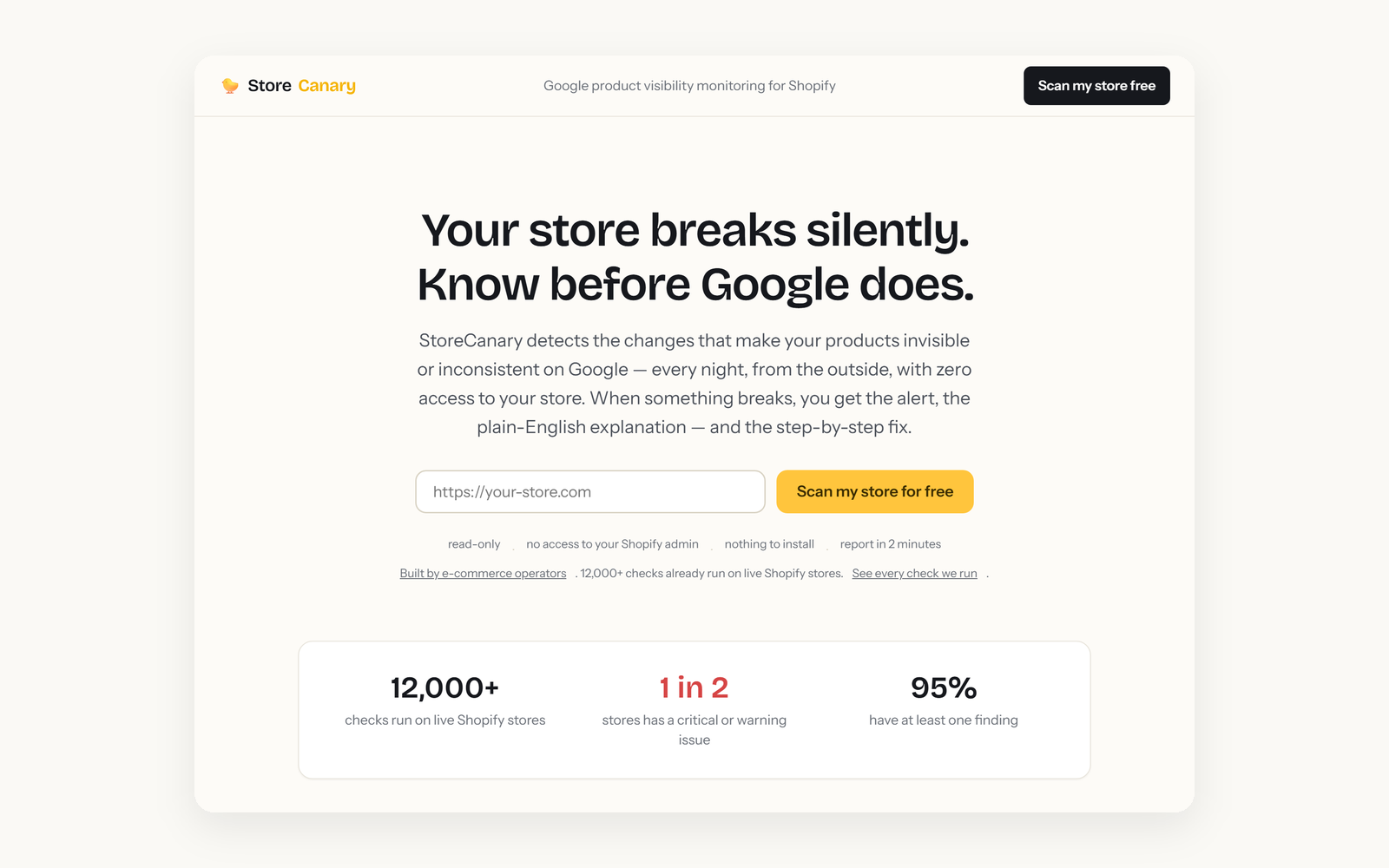
Most Shopify problems that cost you Google traffic are silent. A product page flips to noindex after a theme update. The price in your structured data stops matching the price on the page, and Google Shopping quietly disapproves the item. An app rewrites your JSON-LD and the review stars vanish from the results.
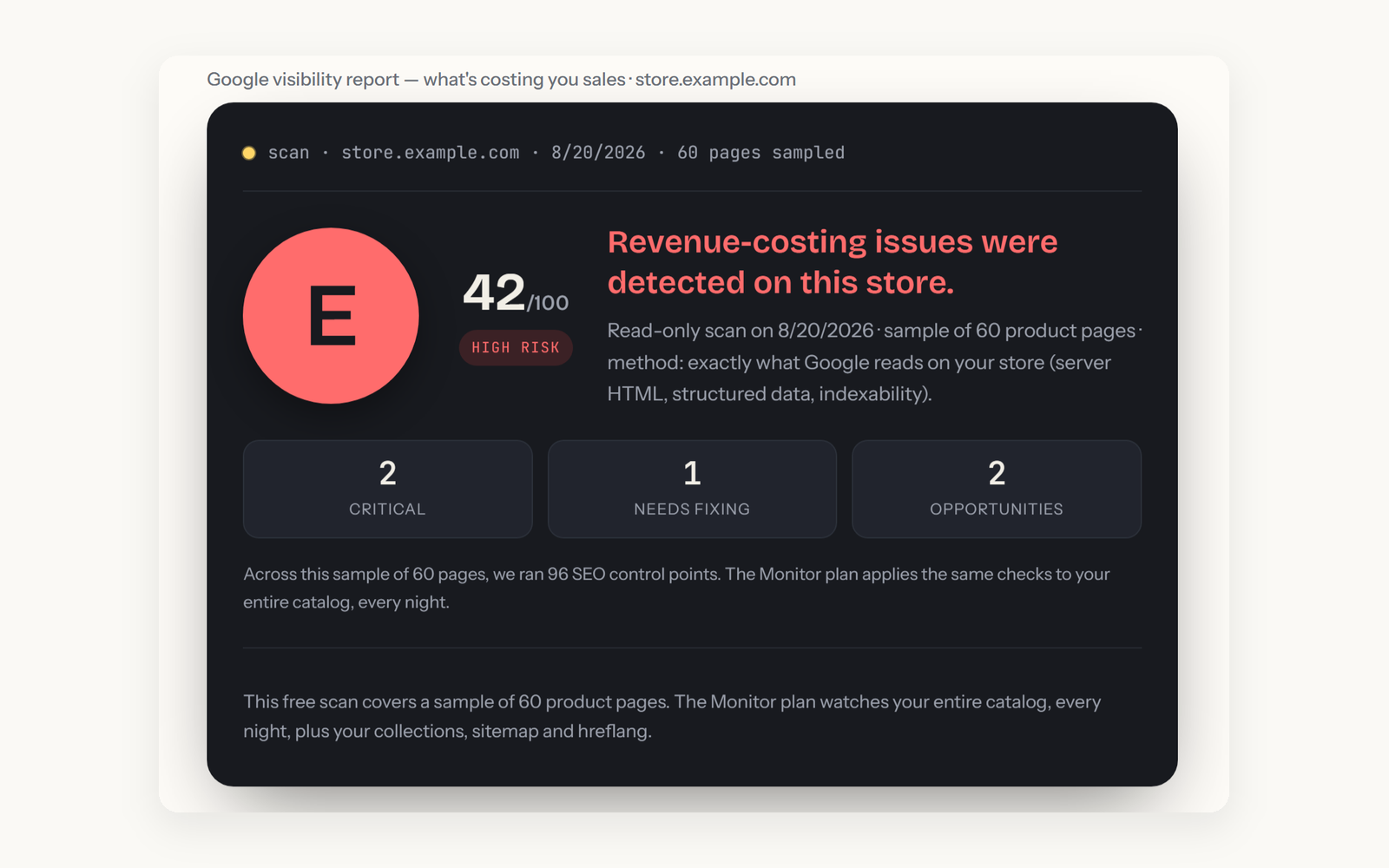
StoreCanary scans your full product catalog every night, not a three page sample, and compares it to yesterday. You only hear from it when something actually changed, with the exact fix for that store, step by step. Across more than 90,000 product pages scanned, more than 4 in 10 stores carried at least one critical issue and 73.5% carried at least one issue of any severity.
Start with a free scan, no account and no card.
Features
- Nightly scan of your full Shopify catalog, read from your public pages exactly as Google reads them
- 90+ checks per product page: indexability, structured data, canonicals, sitemap, hreflang, availability and pricing
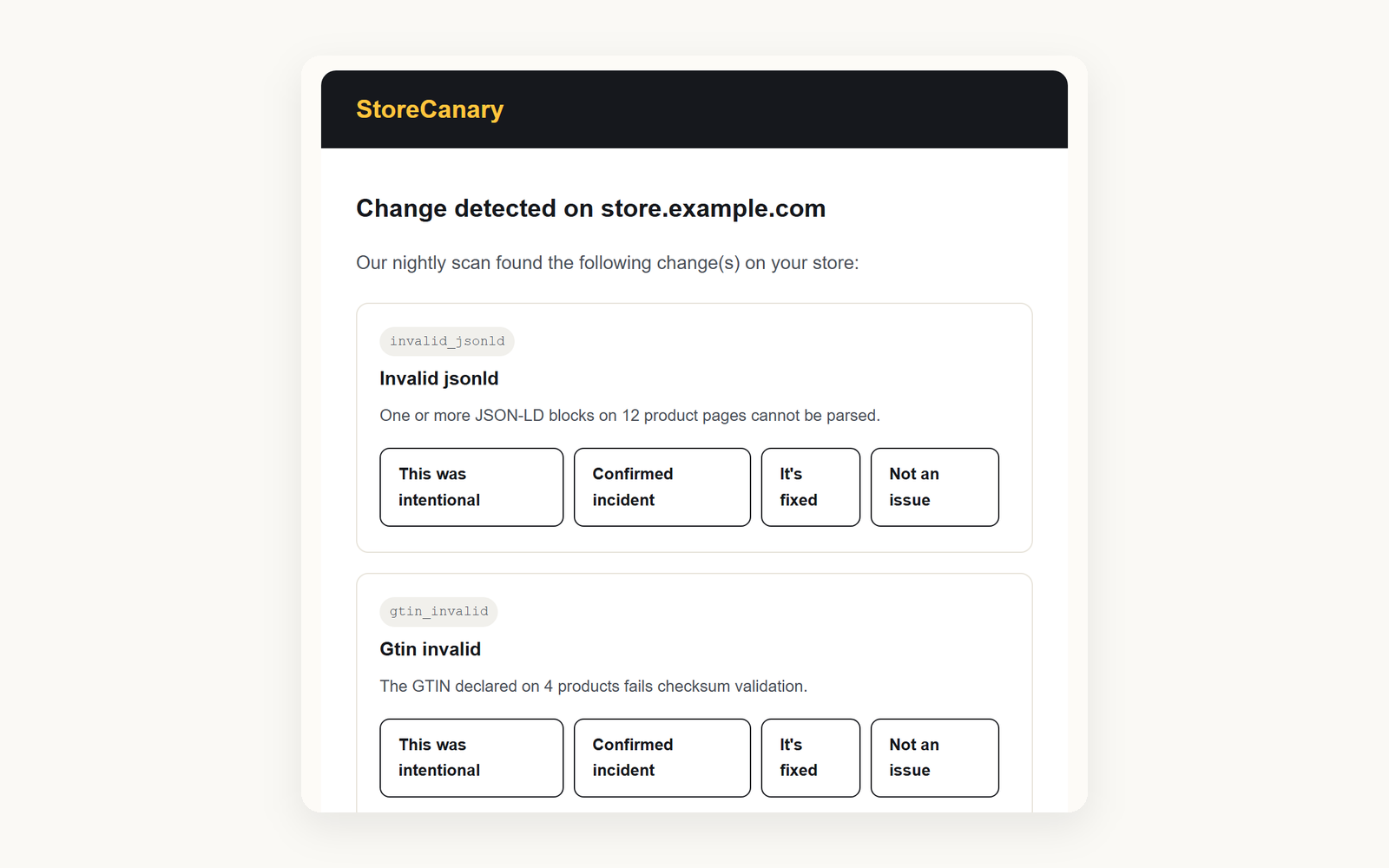
- Alerts only when something changes, so silence means everything is fine and there is no dashboard to remember
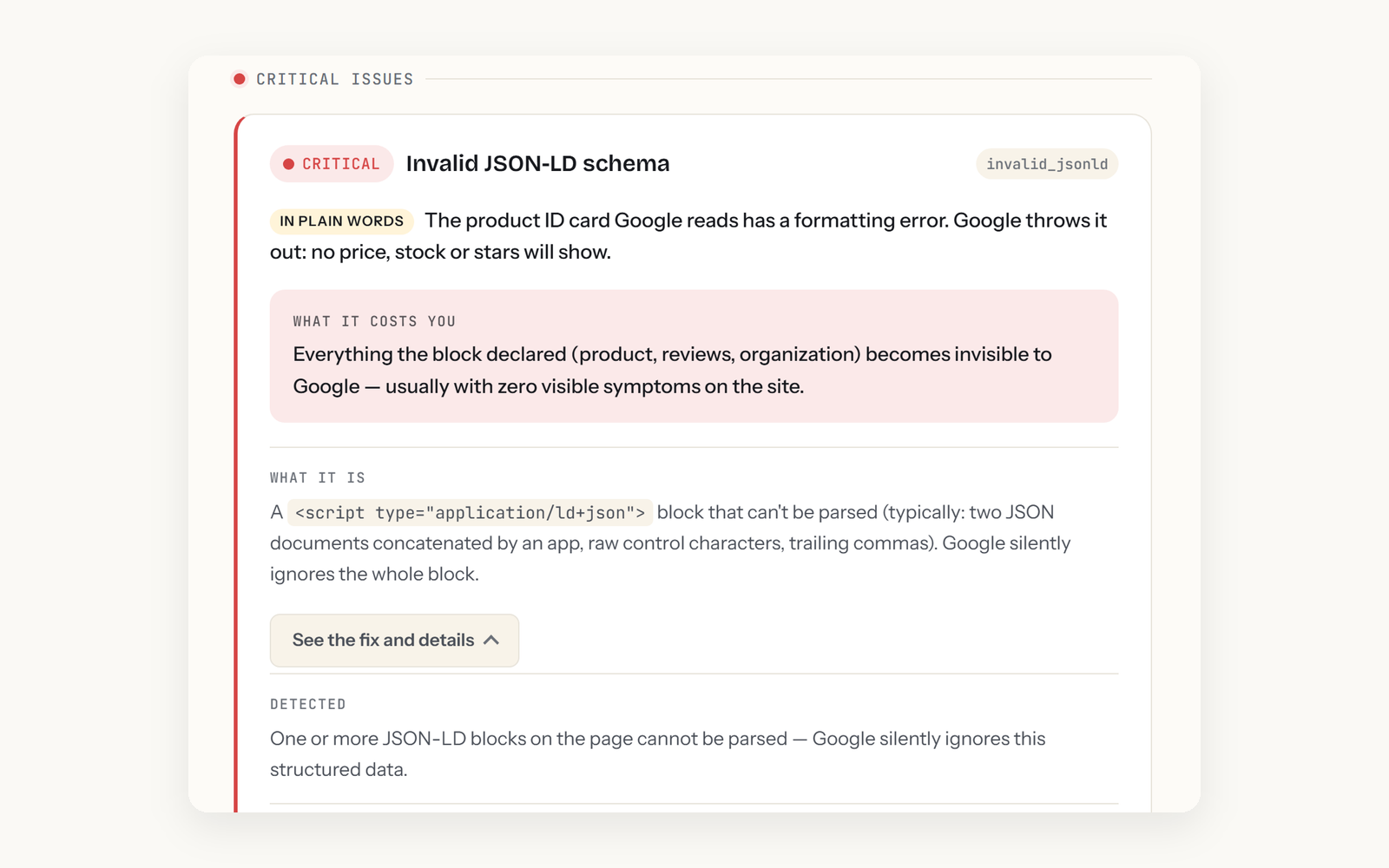
- Every alert in plain English, with its business impact and a step-by-step fix
- Every finding comes with how to verify it yourself in Google's own tools (Rich Results Test, Search Console)
- Free scan with no account and no card: a report on a sample of your product pages in about 2 minutes
- Zero setup: no OAuth, no app to install, no code in your theme, no access to your Shopify admin
- Read-only and capped at 2 requests per second, so it never adds load to your store
Use Cases
- An app update or a theme edit silently flips product pages to noindex, and you find out the same night instead of weeks later in Search Console
- Your structured data declares a different price than the page displays, the number one cause of Google Shopping disapprovals
- Products marked in stock while they are sold out, or the reverse, quietly costing you Shopping placements
- A seasonal or discontinued product page goes offline while Google still has it indexed, bleeding 404 traffic
- You run a store without a technical team, and Search Console tells you something is wrong in jargon but never what to do about it
- You manage several client stores and need to know which one broke last night, without logging into ten dashboards
Comments


Google deindexing is a silent killer for Shopify stores — most merchants only catch it weeks later when traffic graphs drop. Does StoreCanary also catch noindex tags sneaking in from theme updates, or is it purely Google-side indexing? A daily diff of which URLs fell out of the index would be worth the subscription on its own — alerting is table stakes, but showing exactly what changed is what makes it actionable.


The 'alerts only when something changes' framing is the right instinct — the failure mode with most SEO monitoring tools is a dashboard nobody opens after week one. The 73.5% stat on issues found is a great top-of-funnel hook too, since it turns 'maybe you have a problem' into 'you almost certainly do, go check.' Would be curious if the nightly diff catches issues introduced by third-party apps specifically, since that's usually the sneakiest source of JSON-LD breakage on Shopify.


I run an e-commerce store, and the failures that cost me the most were never the ones I could see. The page still loads. The product still looks fine. Meanwhile an app update has flipped it to noindex, or the price in the structured data no longer matches the price on the page, and Google quietly stops showing it. You find out weeks later in Search Console, in jargon, with no fix attached. So I built the thing I wanted: something that walks the catalog every night from the outside, exactly the way Google reads it, and emails me only when something changed. Two decisions I care about more than any feature. No dashboard. A monitoring tool you have to remember to open is a monitoring tool you stop opening. If StoreCanary is silent, everything is fine. That is the whole product. We would rather miss an alert than cry wolf. Every alert ships with the business impact, a step-by-step fix, and how to verify it yourself in Google's own tools. The day you start doubting an alert, the product is dead. Behind the scenes: during calibration in July we ran scans across 12,000+ live Shopify stores. 1 in 2 had a critical or warning issue. 95% had at least one finding. That number is what convinced me to keep building, and honestly it still bothers me. It is early. The free scan needs no account and no card, so the fastest way to judge it is to point it at your own store and see whether it tells you something you did not already know. Happy to answer anything. And genuinely curious what you would want it to watch that it does not watch yet. - Max


The "silence means everything is fine, no dashboard" design is the right call - I built a similar alert-only tool for OpenAI API spend and the hardest problem wasn't detection, it was threshold tuning so real alerts don't get buried in noise during the first weeks. Did early StoreCanary users get flooded with findings on stores that had been quietly broken for months, and did that clear before it hurt trust in the "silence is good" promise?
The "alerts only when something changes" design is the right call — silent failures are exactly what kill Shopify SEO, and most merchants drown in dashboards they never check. I'm curious whether you also catch the reverse case: products that were deliberately deindexed (seasonal or discontinued lines) coming back into the index unexpectedly and competing with current pages?
Premium Products




























Sponsors
Buy

Awards
View all
Awards
View allMakers
Makers
Comments
Google deindexing is a silent killer for Shopify stores — most merchants only catch it weeks later when traffic graphs drop. Does StoreCanary also catch noindex tags sneaking in from theme updates, or is it purely Google-side indexing? A daily diff of which URLs fell out of the index would be worth the subscription on its own — alerting is table stakes, but showing exactly what changed is what makes it actionable.
The 'alerts only when something changes' framing is the right instinct — the failure mode with most SEO monitoring tools is a dashboard nobody opens after week one. The 73.5% stat on issues found is a great top-of-funnel hook too, since it turns 'maybe you have a problem' into 'you almost certainly do, go check.' Would be curious if the nightly diff catches issues introduced by third-party apps specifically, since that's usually the sneakiest source of JSON-LD breakage on Shopify.
I run an e-commerce store, and the failures that cost me the most were never the ones I could see. The page still loads. The product still looks fine. Meanwhile an app update has flipped it to noindex, or the price in the structured data no longer matches the price on the page, and Google quietly stops showing it. You find out weeks later in Search Console, in jargon, with no fix attached. So I built the thing I wanted: something that walks the catalog every night from the outside, exactly the way Google reads it, and emails me only when something changed. Two decisions I care about more than any feature. No dashboard. A monitoring tool you have to remember to open is a monitoring tool you stop opening. If StoreCanary is silent, everything is fine. That is the whole product. We would rather miss an alert than cry wolf. Every alert ships with the business impact, a step-by-step fix, and how to verify it yourself in Google's own tools. The day you start doubting an alert, the product is dead. Behind the scenes: during calibration in July we ran scans across 12,000+ live Shopify stores. 1 in 2 had a critical or warning issue. 95% had at least one finding. That number is what convinced me to keep building, and honestly it still bothers me. It is early. The free scan needs no account and no card, so the fastest way to judge it is to point it at your own store and see whether it tells you something you did not already know. Happy to answer anything. And genuinely curious what you would want it to watch that it does not watch yet. - Max
The "silence means everything is fine, no dashboard" design is the right call - I built a similar alert-only tool for OpenAI API spend and the hardest problem wasn't detection, it was threshold tuning so real alerts don't get buried in noise during the first weeks. Did early StoreCanary users get flooded with findings on stores that had been quietly broken for months, and did that clear before it hurt trust in the "silence is good" promise?
The "alerts only when something changes" design is the right call — silent failures are exactly what kill Shopify SEO, and most merchants drown in dashboards they never check. I'm curious whether you also catch the reverse case: products that were deliberately deindexed (seasonal or discontinued lines) coming back into the index unexpectedly and competing with current pages?
Premium Products
New to Fazier?

Find your next favorite product or submit your own. Made by @FalakDigital.
Copyright ©2026. All Rights Reserved