
SitemapFixer
Why Google crawled your pages but did not index them
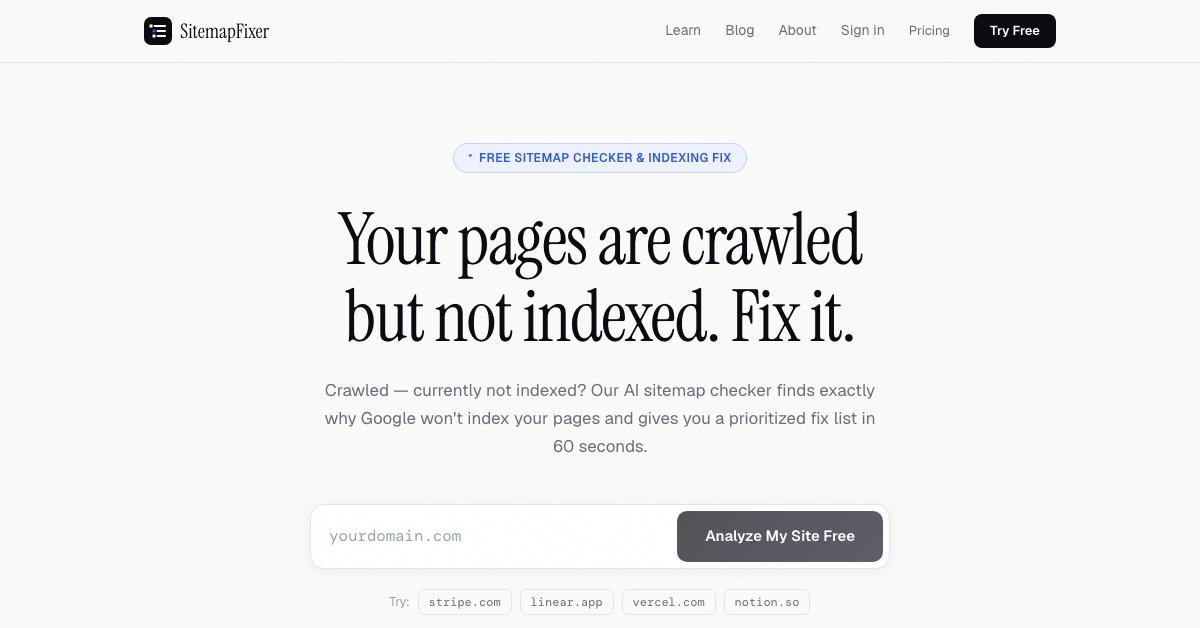
SitemapFixer is built for one specific Search Console message: "Crawled, currently not indexed." Give it a domain and it finds the sitemap itself, checking /sitemap.xml, robots.txt and twenty-plus common paths, then fetches every URL, clusters them, and runs thirty live URL health checks alongside the sitemap structure.
What comes back is a ranked action list rather than a score out of a hundred. Recommendations are generated by a large language model.

Features
Finds your sitemap automatically across twenty-plus common paths
Thirty live URL health checks plus a sitemap structure audit
Catches a noindex tag that survived a staging migration and reached production
Catches duplicate URL patterns where mixed trailing slashes, uppercase paths and underscore variants split one page across several crawlable URLs
Reports broken URLs, redirect chains and canonical inconsistencies
Nine free standalone tools: sitemap finder, XML sitemap checker and generator, robots.txt checker, meta tag checker, canonical checker, hreflang tester and a site audit
Works with WordPress, Shopify, Next.js or anything else
Use Cases
Pages sitting in Search Console as crawled but not indexed
Auditing a sitemap after a migration or a replatform
Finding the noindex that reached production by accident
Cleaning up trailing-slash and case variants that split one page across several URLs
A quick technical check before asking why traffic is flat

Comments


This came out of staring at "Crawled, currently not indexed" across several of my own sites and getting no useful answer from the general-purpose audit tools, which hand back a score instead of a list of things to change. So it does the boring specific checks: find the sitemap wherever it actually lives, fetch every URL, and look for the handful of causes that really do keep pages out, like a staging noindex that shipped or trailing-slash variants splitting one page across four URLs. If it misses a cause you have hit, I would like to hear it.



Crawled-but-not-indexed is the most frustrating status for a new site. Does SitemapFixer distinguish quality issues (thin or duplicate content) from technical ones like stray noindex, canonicals and soft 404s? And does it re-check URLs after a fix so you can see which change actually moved a page into the index?

"Crawled - currently not indexed" is the most annoying GSC status because Google gives you zero explanation, so a tool that runs 30 live checks against every URL in the sitemap is exactly the right approach. The auto-discovery of the sitemap (robots.txt + common paths) saves real time on client audits. Do the health checks include internal link depth and indexability signals like canonicals pointing elsewhere, or is it mostly HTTP-level validation?



Fast & trusted Satta Matka results platform for Kalyan Matka, Madhur Matka & all major Matka markets. Get super fast live updates, charts & daily results at https://vipsattamatka.mobi hy


The "Crawled, currently not indexed" focus is smart — most audit tools give you a score out of 100 that doesn't actually tell you what to fix. I've dealt with this exact issue building SEO checkers myself, and the trailing-slash/uppercase-path duplication you mentioned is a real, sneaky cause that's easy to miss manually. One question: how do you handle sitemap fetching for sites behind aggressive bot protection (Cloudflare challenge pages, etc.) — does the fetch just fail gracefully there, or is there a fallback?

The specific examples make this much easier to evaluate than an audit score. One useful output would be a developer-ready issue: the affected URL variants, the observed headers or canonical tags, and the single proposed fix. Can the report group many affected URLs under one underlying configuration problem so a team does not get hundreds of duplicate tasks?

Separating "Google saw it and chose not to index" from "your sitemap is lying" is the useful split here, because Search Console tells you neither. Do the 30 checks flag near-duplicate programmatic pages, where one template spins up 50 URLs differing only by a model or city name? That is the pattern canonical checks miss.
Premium Products





































Sponsors
Buy
Awards
View all
Awards
View allMakers
Makers
Comments
This came out of staring at "Crawled, currently not indexed" across several of my own sites and getting no useful answer from the general-purpose audit tools, which hand back a score instead of a list of things to change. So it does the boring specific checks: find the sitemap wherever it actually lives, fetch every URL, and look for the handful of causes that really do keep pages out, like a staging noindex that shipped or trailing-slash variants splitting one page across four URLs. If it misses a cause you have hit, I would like to hear it.
Crawled-but-not-indexed is the most frustrating status for a new site. Does SitemapFixer distinguish quality issues (thin or duplicate content) from technical ones like stray noindex, canonicals and soft 404s? And does it re-check URLs after a fix so you can see which change actually moved a page into the index?
"Crawled - currently not indexed" is the most annoying GSC status because Google gives you zero explanation, so a tool that runs 30 live checks against every URL in the sitemap is exactly the right approach. The auto-discovery of the sitemap (robots.txt + common paths) saves real time on client audits. Do the health checks include internal link depth and indexability signals like canonicals pointing elsewhere, or is it mostly HTTP-level validation?
Fast & trusted Satta Matka results platform for Kalyan Matka, Madhur Matka & all major Matka markets. Get super fast live updates, charts & daily results at https://vipsattamatka.mobi hy
The "Crawled, currently not indexed" focus is smart — most audit tools give you a score out of 100 that doesn't actually tell you what to fix. I've dealt with this exact issue building SEO checkers myself, and the trailing-slash/uppercase-path duplication you mentioned is a real, sneaky cause that's easy to miss manually. One question: how do you handle sitemap fetching for sites behind aggressive bot protection (Cloudflare challenge pages, etc.) — does the fetch just fail gracefully there, or is there a fallback?
The specific examples make this much easier to evaluate than an audit score. One useful output would be a developer-ready issue: the affected URL variants, the observed headers or canonical tags, and the single proposed fix. Can the report group many affected URLs under one underlying configuration problem so a team does not get hundreds of duplicate tasks?
Separating "Google saw it and chose not to index" from "your sitemap is lying" is the useful split here, because Search Console tells you neither. Do the 30 checks flag near-duplicate programmatic pages, where one template spins up 50 URLs differing only by a model or city name? That is the pattern canonical checks miss.
Premium Products
New to Fazier?

Find your next favorite product or submit your own. Made by @FalakDigital.
Copyright ©2026. All Rights Reserved