
Sherlock Calls
Your AI call detective for Voice Operations — in Slack
Debugging a failed voice AI call means bouncing between at least three platforms: Twilio for telephony events, ElevenLabs for TTS and audio behaviour, your webhook logs, and often a CRM to understand what happened to the contact. Each system has different timestamps, different call identifiers, and no awareness of the others. Most teams spend 2–3 hours per incident just reconstructing the sequence of events — before they can even start identifying the root cause.
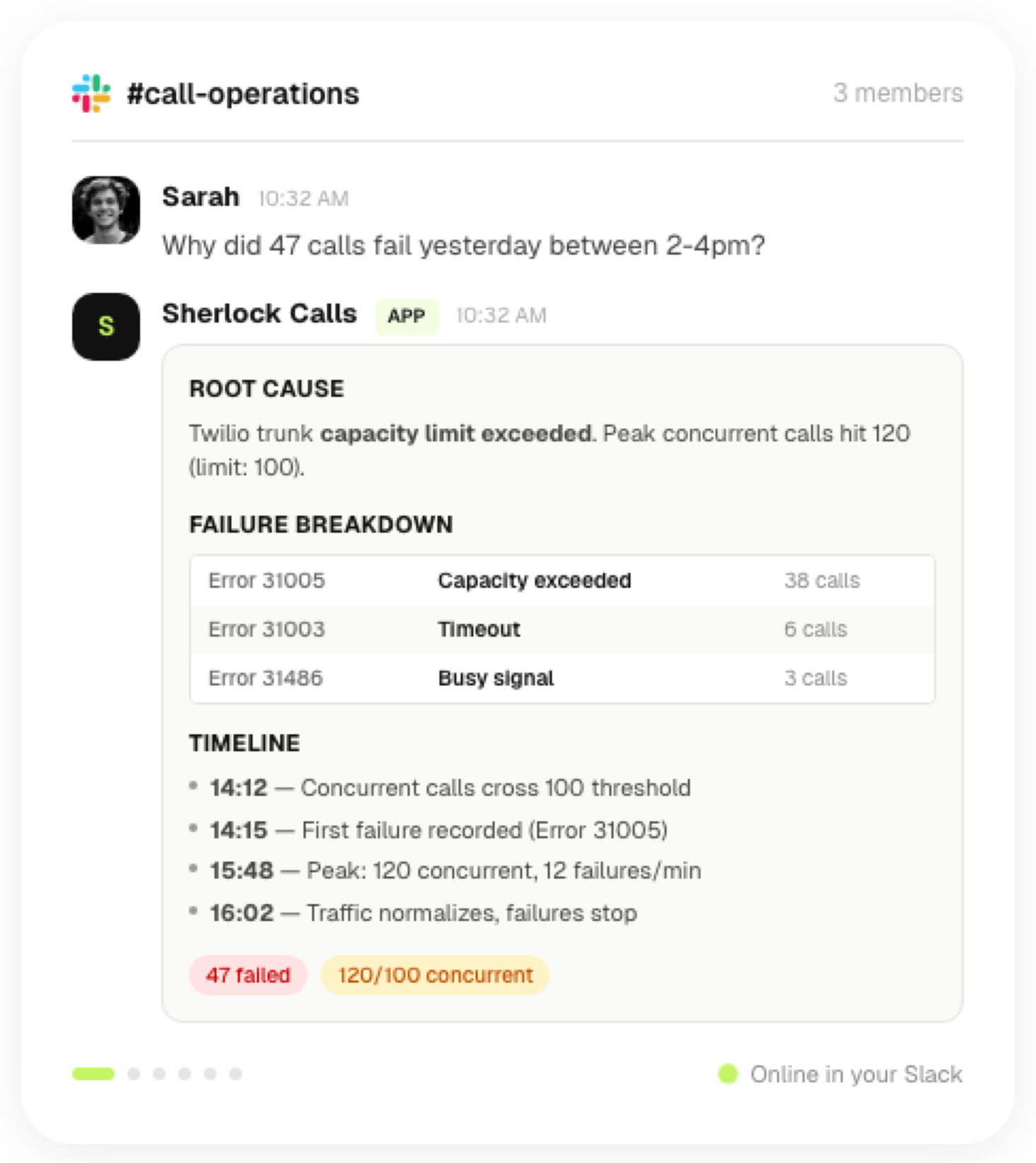
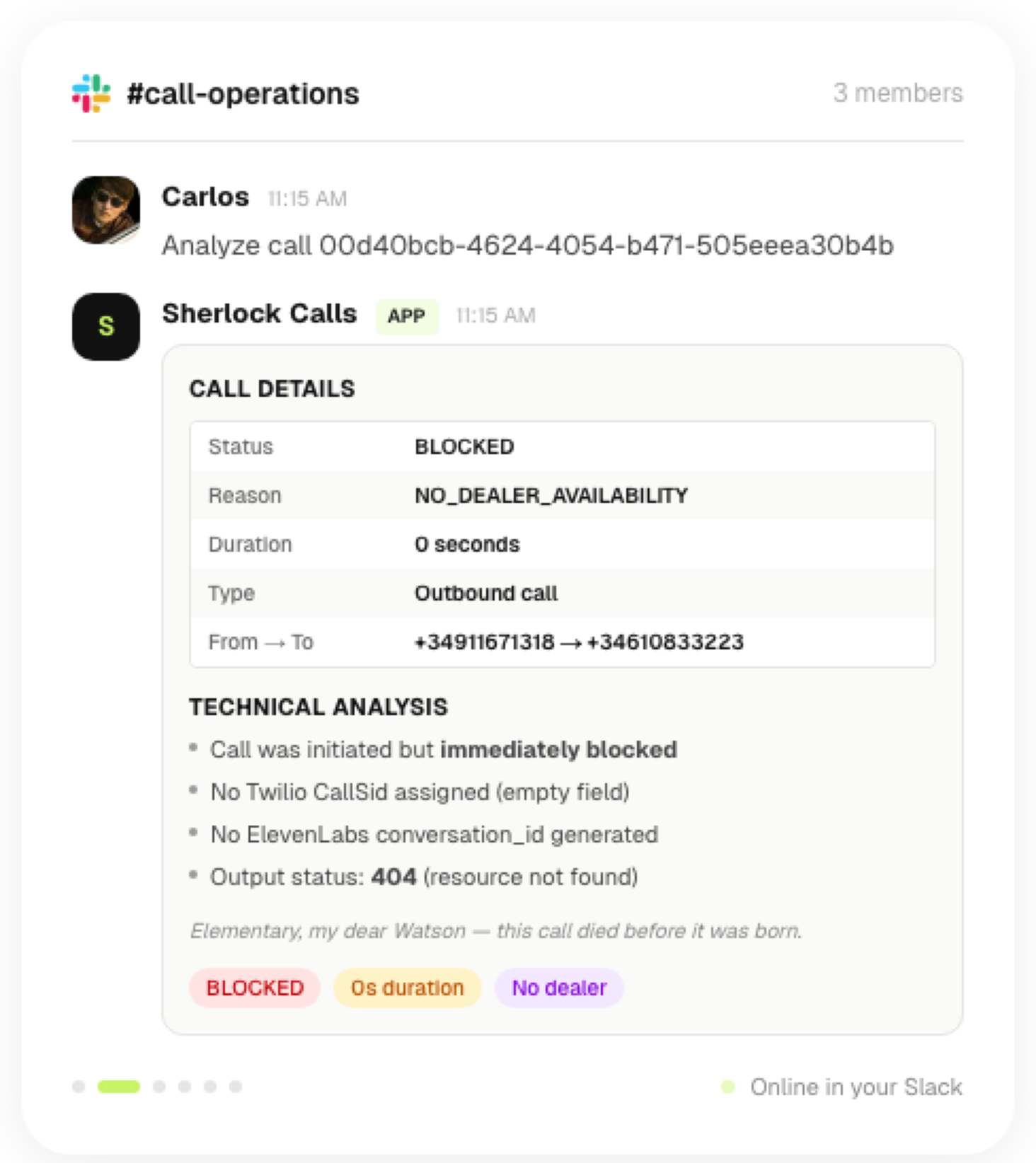
Sherlock Calls connects to your voice stack via OAuth and turns that investigation into a Slack question. Ask "why did calls fail yesterday?" and get back a structured case file in the same thread: a correlated cross-provider timeline, the most likely root cause with supporting evidence, and first checks in triage order. No new dashboards. No code changes. The investigation lives where your team already communicates and works: Slack.
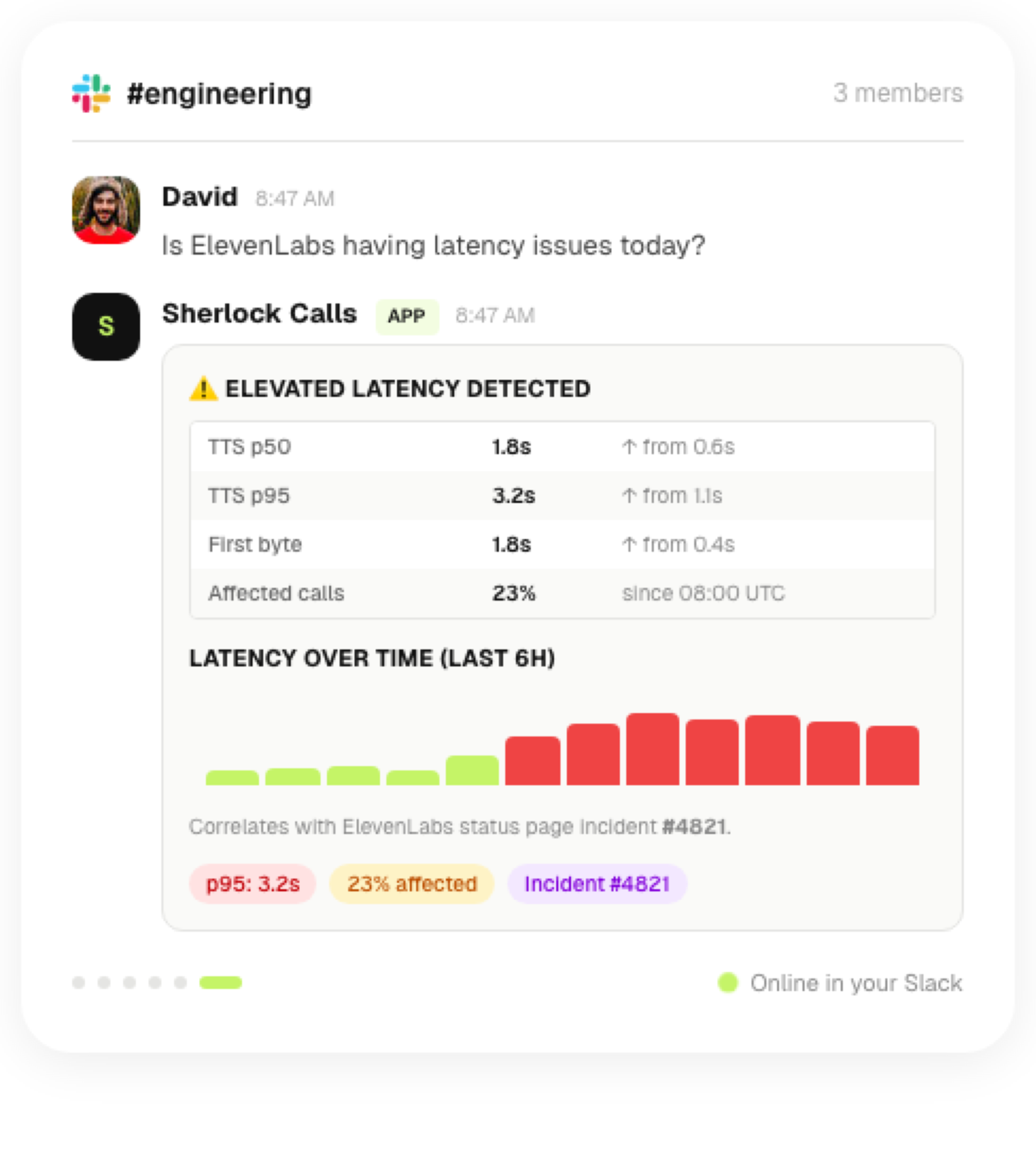
It also answers the less urgent questions that nobody has time to dig into manually: which campaign drove the most qualified calls this week, where latency is coming from across providers, how much a specific call cost across all connected services, whether ElevenLabs is having issues right now. All in plain English, directly in Slack.
Free tier: 100 credits per workspace, no credit card required. Connect in 60 seconds.
Features
- Cross-provider call timeline correlates Twilio telephony events, ElevenLabs TTS behaviour, and webhooks into a single chronological thread so you can see exactly what happened and in what order.
- Root cause analysis surfaces the most likely explanation for a failure with the evidence that supports it, not a list of metrics to interpret yourself.
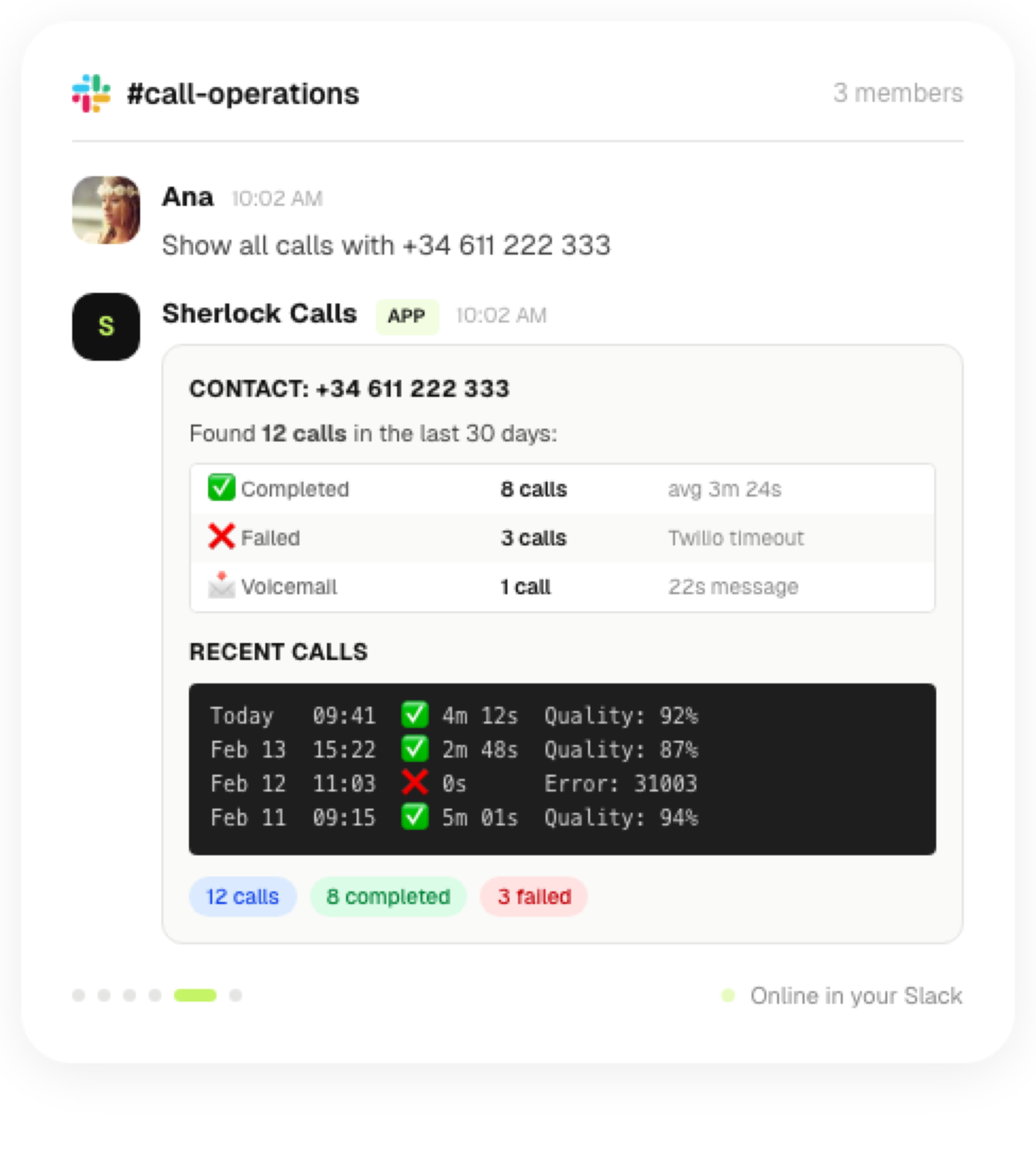
- Transcript search allows you to review hundreds of ElevenLabs conversations by keyword, phrase, or pattern without opening a single dashboard.
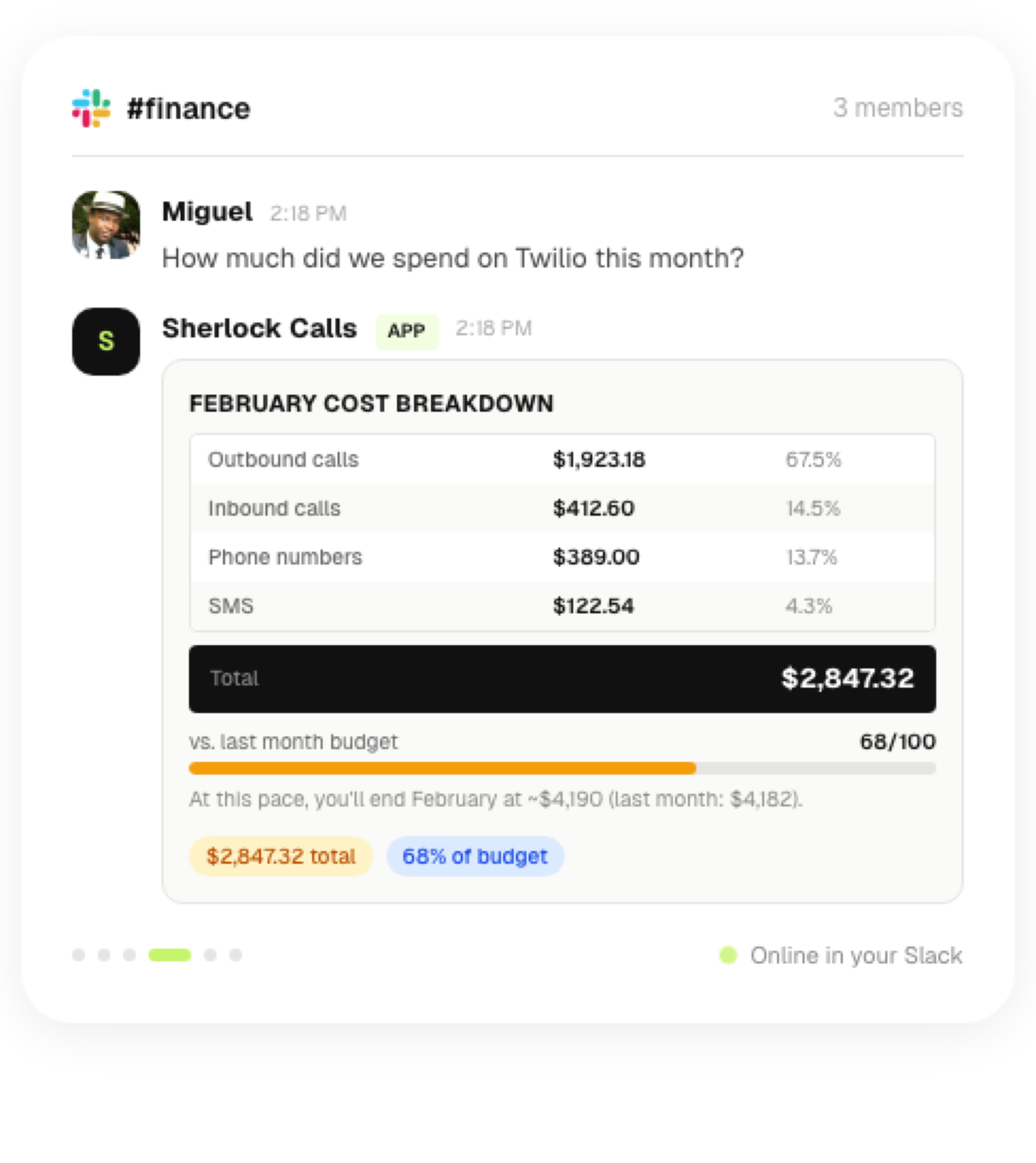
- Per-call cost breakdown shows what each call cost across all connected providers, flags spending anomalies, and tracks trends over time.
- Service health monitoring answers "is ElevenLabs having latency issues right now?" and "is Twilio degraded?" without checking status pages manually.
- CRM enrichment pulls HubSpot, Salesforce, and Dynamics 365 context into every investigation so you know what happened to the contact after each call.
- Marketing attribution connects call outcomes to Google Ads, Meta Ads, and Analytics campaigns to show which campaigns are driving qualified conversations.
- Failure spike alerts notifies your Slack channel automatically when error rates or latency cross a threshold, before your customers start complaining.
- Scheduled digests produce daily and weekly summaries of call volume, failure rates, and cost trends posted directly to Slack
Use Cases
- On-call incident response when calls start failing at 2am, ask Sherlock what's happening instead of opening five browser tabs
- Failure pattern investigation: find out whether yesterday's drop in call success rate was a Twilio issue, an ElevenLabs timeout, a webhook delivery failure, or something else entirely
- Call cost auditing: identify which providers, campaigns, or time periods are driving unexpected spend without building a custom report
- Transcript discovery: find every call where a specific phrase was said, a specific objection came up, or a specific error was mentioned.
- Provider health checks: confirm whether a latency spike is coming from your telephony layer, your TTS provider, or your own backend before escalating to a vendor
- Team handoffs: share a complete Slack case thread with whoever is taking over an incident instead of writing a manual summary
- Weekly voice ops review: let Sherlock post a digest every Monday morning with last week's call volume, success rate, top failure types, and cost — so the team starts the week with context
Comments


We've been building in the GenAI, voice and telephony space for years. Every time a call failed, the debugging process was identical: open Twilio, open ElevenLabs, pull webhook logs, try to reconcile multiple different timestamp formats, and guess at what actually caused the failure. Two to three hours of investigation per incident — and at the end of it you weren't even certain you had the right answer. We kept asking each other why nobody had built a tool that just answered the question. When we looked and found nothing purpose-built for this, we built Sherlock. If you're running voice AI in production and you've ever typed "what the hell happened to that call" into a Slack thread at midnight — this is for you. Free to try, no credit card, takes 60 seconds to connect your stack.


This solves a very real pain point. Debugging voice workflows across multiple providers is messy and time-consuming, so bringing everything into a single Slack-based flow is a strong approach. The “just ask what happened” interaction feels especially powerful — much more intuitive than jumping between dashboards and logs.

This solves a painful, very real workflow issue: context is scattered across Twilio, ElevenLabs, webhooks, and the CRM, and engineers waste hours trying to reconstruct what happened. Turning that whole investigation into a single Slack question is a strong product vision, and the cross-provider timeline plus root cause analysis feels like exactly what incident responders want instead of another dashboard.
I like that you have a clear freemium entry point (100 credits, no card) and a 60-second connection flow. That lowers the barrier for teams who are curious but don’t want to commit engineering time yet. Positioning this as “ask Slack what went wrong” is a strong narrative, especially for teams already drowning in dashboards.

The cross-provider timeline correlation is the real value here — reconciling timestamps across Twilio, ElevenLabs, and webhooks manually is exactly the kind of tedious work that should be automated. Putting the investigation in Slack instead of another dashboard is a strong UX decision since that's where incident response already happens. The per-call cost breakdown across providers is also clever — most teams don't realize how much individual calls cost until something spikes.


This is a really compelling idea — the “ask in Slack instead of opening 5 dashboards” angle immediately clicks. The cross-provider timeline + root cause analysis is probably the biggest win here. Anyone who’s dealt with Twilio + TTS + webhooks knows how painful it is to line up timestamps and IDs, so turning that into a single correlated view (and then summarizing it) feels like a huge time saver. I also like that you’re not trying to replace existing tools, just sit on top and make them usable together — that’s usually where these workflows break. One thing I’m curious about: how reliable is the root cause attribution in messy edge cases (e.g. partial failures across providers)? That’s probably where trust in the product really gets tested.
Premium Products
























Awards
View all
Awards
View allMakers
Makers
Comments
We've been building in the GenAI, voice and telephony space for years. Every time a call failed, the debugging process was identical: open Twilio, open ElevenLabs, pull webhook logs, try to reconcile multiple different timestamp formats, and guess at what actually caused the failure. Two to three hours of investigation per incident — and at the end of it you weren't even certain you had the right answer. We kept asking each other why nobody had built a tool that just answered the question. When we looked and found nothing purpose-built for this, we built Sherlock. If you're running voice AI in production and you've ever typed "what the hell happened to that call" into a Slack thread at midnight — this is for you. Free to try, no credit card, takes 60 seconds to connect your stack.
This solves a very real pain point. Debugging voice workflows across multiple providers is messy and time-consuming, so bringing everything into a single Slack-based flow is a strong approach. The “just ask what happened” interaction feels especially powerful — much more intuitive than jumping between dashboards and logs.
This solves a painful, very real workflow issue: context is scattered across Twilio, ElevenLabs, webhooks, and the CRM, and engineers waste hours trying to reconstruct what happened. Turning that whole investigation into a single Slack question is a strong product vision, and the cross-provider timeline plus root cause analysis feels like exactly what incident responders want instead of another dashboard.
I like that you have a clear freemium entry point (100 credits, no card) and a 60-second connection flow. That lowers the barrier for teams who are curious but don’t want to commit engineering time yet. Positioning this as “ask Slack what went wrong” is a strong narrative, especially for teams already drowning in dashboards.
The cross-provider timeline correlation is the real value here — reconciling timestamps across Twilio, ElevenLabs, and webhooks manually is exactly the kind of tedious work that should be automated. Putting the investigation in Slack instead of another dashboard is a strong UX decision since that's where incident response already happens. The per-call cost breakdown across providers is also clever — most teams don't realize how much individual calls cost until something spikes.
This is a really compelling idea — the “ask in Slack instead of opening 5 dashboards” angle immediately clicks. The cross-provider timeline + root cause analysis is probably the biggest win here. Anyone who’s dealt with Twilio + TTS + webhooks knows how painful it is to line up timestamps and IDs, so turning that into a single correlated view (and then summarizing it) feels like a huge time saver. I also like that you’re not trying to replace existing tools, just sit on top and make them usable together — that’s usually where these workflows break. One thing I’m curious about: how reliable is the root cause attribution in messy edge cases (e.g. partial failures across providers)? That’s probably where trust in the product really gets tested.
Premium Products
New to Fazier?
Find your next favorite product or submit your own. Made by @FalakDigital.
Copyright ©2026. All Rights Reserved