
Seomely
Monitor which of your pages Google actually indexes
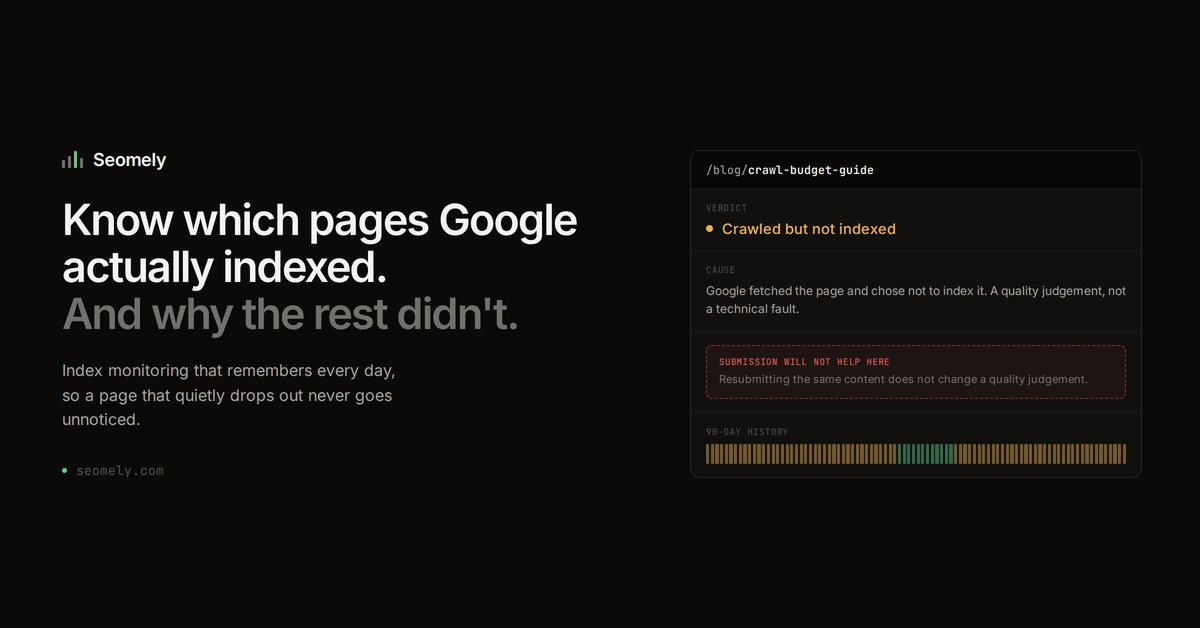
Seomely connects to Google Search Console and records the index status of every URL on your site, every day. Search Console answers the question for today and keeps no history, so when a page that was indexed quietly drops out, you find out months later. Seomely tells you that week, with a plain-English cause and what to do about it.
It also exposes an HTTP API and an MCP server, so agents can query the same records directly.
Features
Checks every URL on your site against Google Search Console every morning
Keeps a permanent, dated record of index status, so you can see exactly when a page changed
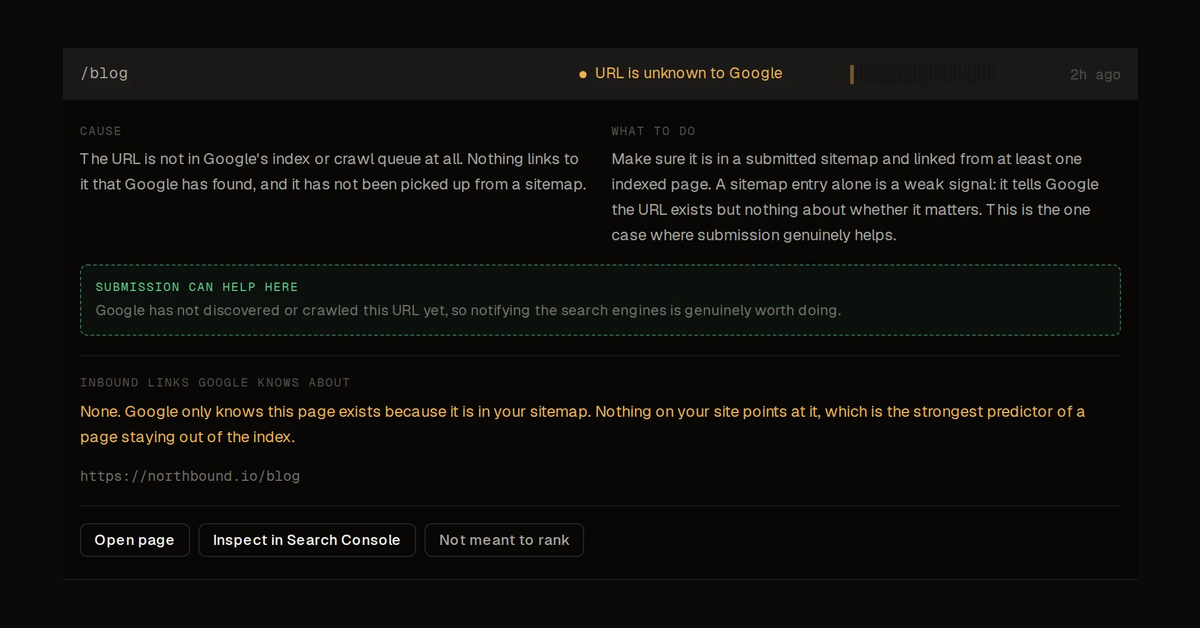
Gives a plain-English cause for every page that is not indexed, and what to do about it
Flags regressions the morning they happen, including pages that were indexed and dropped out
Submits URLs to IndexNow, which reaches Bing, Yandex, Seznam, Naver and Yep
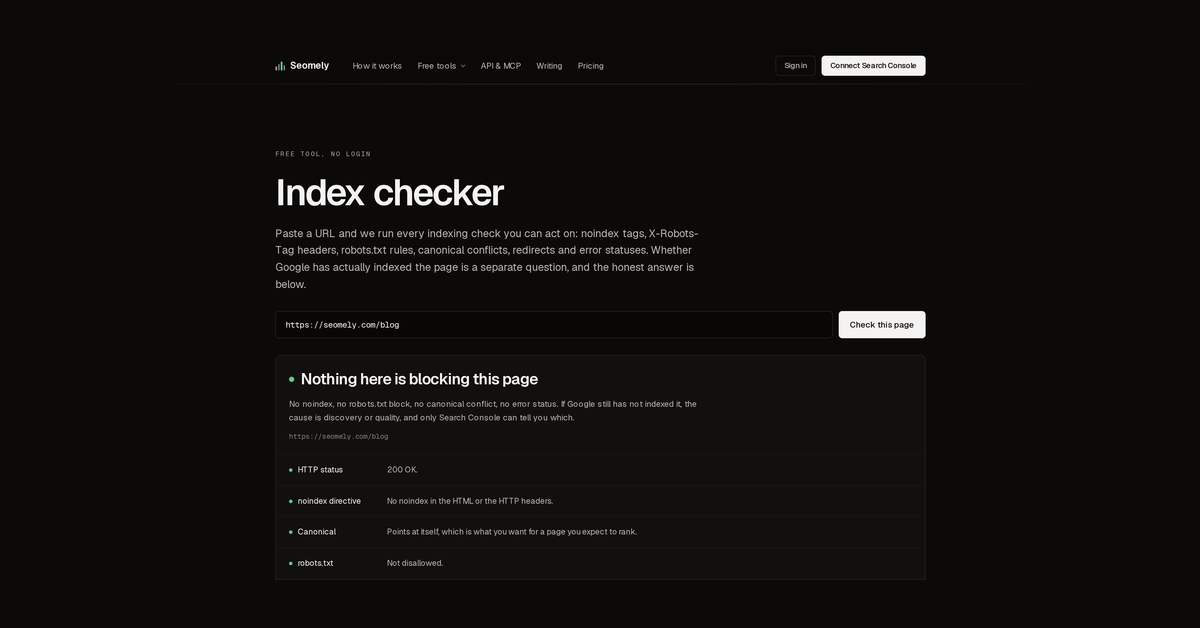
Free tools with no login: noindex, robots.txt, canonical, redirect, HTTP status and JobPosting schema checks
HTTP API and MCP server, so agents can read the same records
Read-only Google access, requesting a single permission and unable to change anything in your account
Use Cases
Confirm the pages you just deployed are still indexed, instead of assuming
Catch a page that quietly fell out of Google before it costs you a quarter of traffic
Find out why a new page is not being indexed, without guessing between noindex, robots.txt and canonical problems
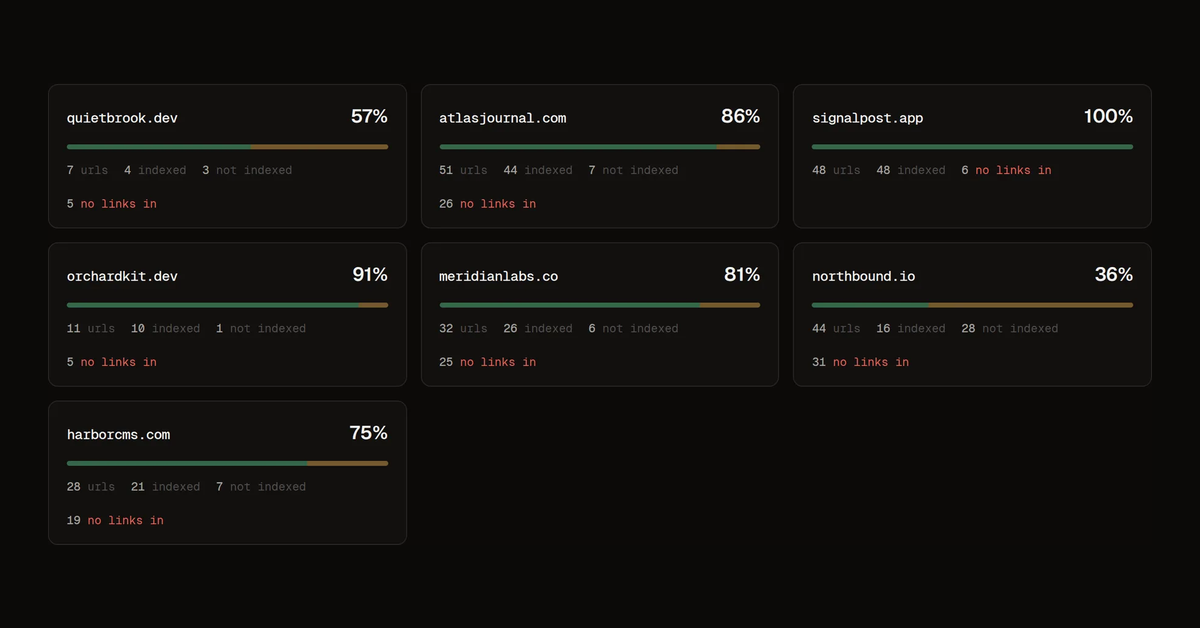
Watch several client sites from one place, with each one's history kept separately
Check whether a job posting qualifies for Google's Indexing API before submitting it
Let an AI agent query your index status directly over MCP

Comments



The dated history is what stands out for me. Search Console shows where a page stands today, so a page that quietly drops out is easy to miss. A question from a site I run in 12 languages with hreflang: do you track each language version as its own URL, and would you flag it if only one language of a page falls out of the index while the others stay in? That's the kind of regression nobody spots by hand.

The paragraph about the Indexing API only really supporting job postings and live-stream events is the most useful thing on this page - most tools in the category quietly do the opposite and show a green tick for a no-op. One thing I'd put in the pricing table rather than let people discover it: the URL Inspection API is capped at 2,000 inspections per property per day, so "every URL, every morning" has a hard ceiling. Past a few thousand URLs the daily sweep has to become a rotation, and how you prioritise it - recently deployed, previously indexed, high-traffic - is itself a feature worth naming. Related: Search Console's coverage data lags a couple of days, so "flags regressions the morning they happen" is really "the morning Google reports it". Saying that plainly would match the rest of the page's tone.


I run a few small sites, and I kept hitting the same thing. I would open Search Console, find a page that used to bring in traffic sitting there as "Crawled, currently not indexed", and have no idea when it had happened. Last week? Three months ago? After which deploy? Search Console answers the question for today and then throws the answer away, so by the time you notice something is wrong, the information that would explain it is already gone. So I built the thing that writes it down. Seomely reads Search Console every morning, records the index status of every URL, and keeps it. The part that surprised me was what I found while building it. Most tools in this space sell "submit your pages to Google" as the headline feature. Google's Indexing API officially supports two content types, job postings and live-stream events, and quietly ignores the notification for everything else while still returning a success response. So those tools show you a green tick for an action that did nothing. That is why Seomely is blunt about its own limits: it tells you when submitting genuinely helps and when it does not. There is a free plan and free tools that need no login, so you can check whether any of this is true before trusting me on it. If you try it and something is wrong or unclear, tell me. That is more useful to me right now than an upvote.

This would've saved me a lot of manual checking — I'm currently going through exactly this with a new site where 13 pages aren't indexed yet, and figuring out whether it's a robots.txt issue, a canonical problem, or just new-domain trust takes real digging in Search Console. Having a plain-English cause per page instead of raw GSC data would cut that time down a lot. The regression alert is the killer feature for me though — losing an indexed page silently is way worse than a new page taking time to get indexed, and I wouldn't know it happened until traffic already dropped. Does the daily check work for sites with a few hundred URLs, or is it built more for smaller sites right now?
Premium Products


































Sponsors
Buy

Makers
Makers
Comments
The dated history is what stands out for me. Search Console shows where a page stands today, so a page that quietly drops out is easy to miss. A question from a site I run in 12 languages with hreflang: do you track each language version as its own URL, and would you flag it if only one language of a page falls out of the index while the others stay in? That's the kind of regression nobody spots by hand.
The paragraph about the Indexing API only really supporting job postings and live-stream events is the most useful thing on this page - most tools in the category quietly do the opposite and show a green tick for a no-op. One thing I'd put in the pricing table rather than let people discover it: the URL Inspection API is capped at 2,000 inspections per property per day, so "every URL, every morning" has a hard ceiling. Past a few thousand URLs the daily sweep has to become a rotation, and how you prioritise it - recently deployed, previously indexed, high-traffic - is itself a feature worth naming. Related: Search Console's coverage data lags a couple of days, so "flags regressions the morning they happen" is really "the morning Google reports it". Saying that plainly would match the rest of the page's tone.
I run a few small sites, and I kept hitting the same thing. I would open Search Console, find a page that used to bring in traffic sitting there as "Crawled, currently not indexed", and have no idea when it had happened. Last week? Three months ago? After which deploy? Search Console answers the question for today and then throws the answer away, so by the time you notice something is wrong, the information that would explain it is already gone. So I built the thing that writes it down. Seomely reads Search Console every morning, records the index status of every URL, and keeps it. The part that surprised me was what I found while building it. Most tools in this space sell "submit your pages to Google" as the headline feature. Google's Indexing API officially supports two content types, job postings and live-stream events, and quietly ignores the notification for everything else while still returning a success response. So those tools show you a green tick for an action that did nothing. That is why Seomely is blunt about its own limits: it tells you when submitting genuinely helps and when it does not. There is a free plan and free tools that need no login, so you can check whether any of this is true before trusting me on it. If you try it and something is wrong or unclear, tell me. That is more useful to me right now than an upvote.
This would've saved me a lot of manual checking — I'm currently going through exactly this with a new site where 13 pages aren't indexed yet, and figuring out whether it's a robots.txt issue, a canonical problem, or just new-domain trust takes real digging in Search Console. Having a plain-English cause per page instead of raw GSC data would cut that time down a lot. The regression alert is the killer feature for me though — losing an indexed page silently is way worse than a new page taking time to get indexed, and I wouldn't know it happened until traffic already dropped. Does the daily check work for sites with a few hundred URLs, or is it built more for smaller sites right now?
Premium Products
New to Fazier?

Find your next favorite product or submit your own. Made by @FalakDigital.
Copyright ©2026. All Rights Reserved