SelfHeal
AI agents build and self-repair your API integrations 24/7
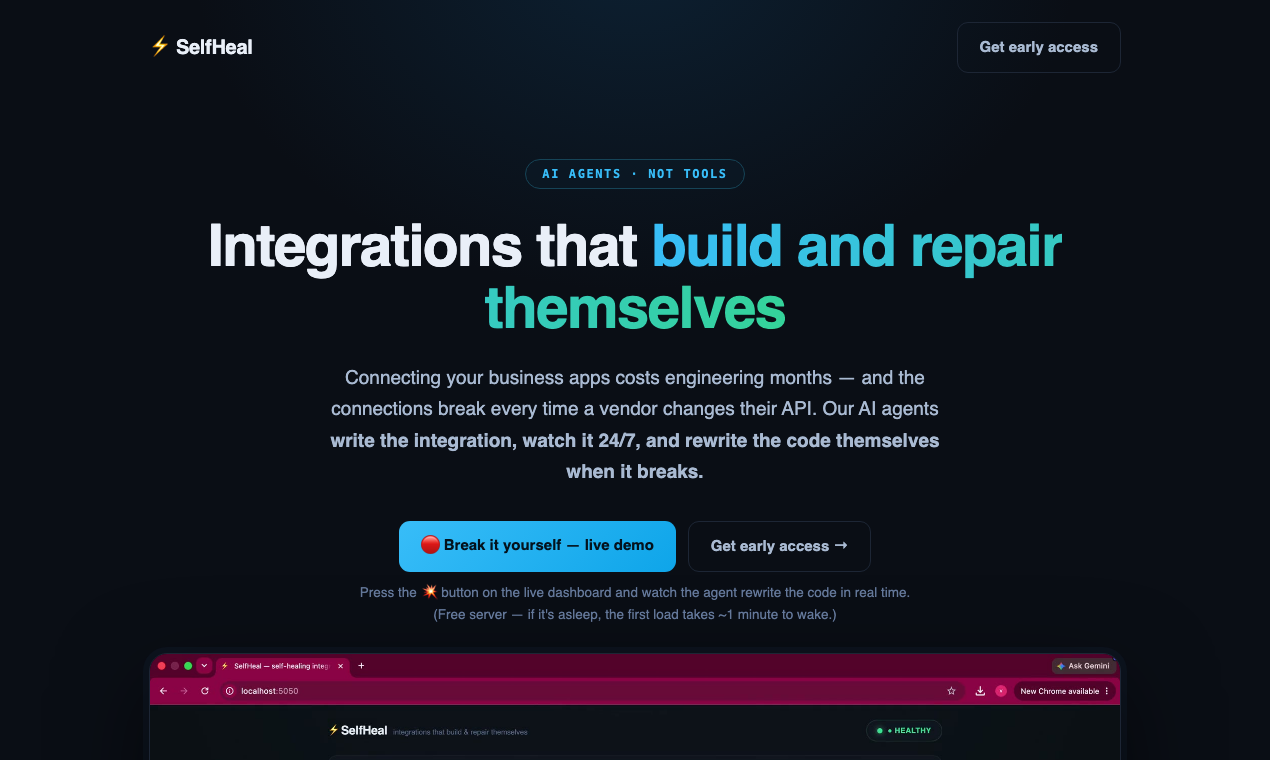
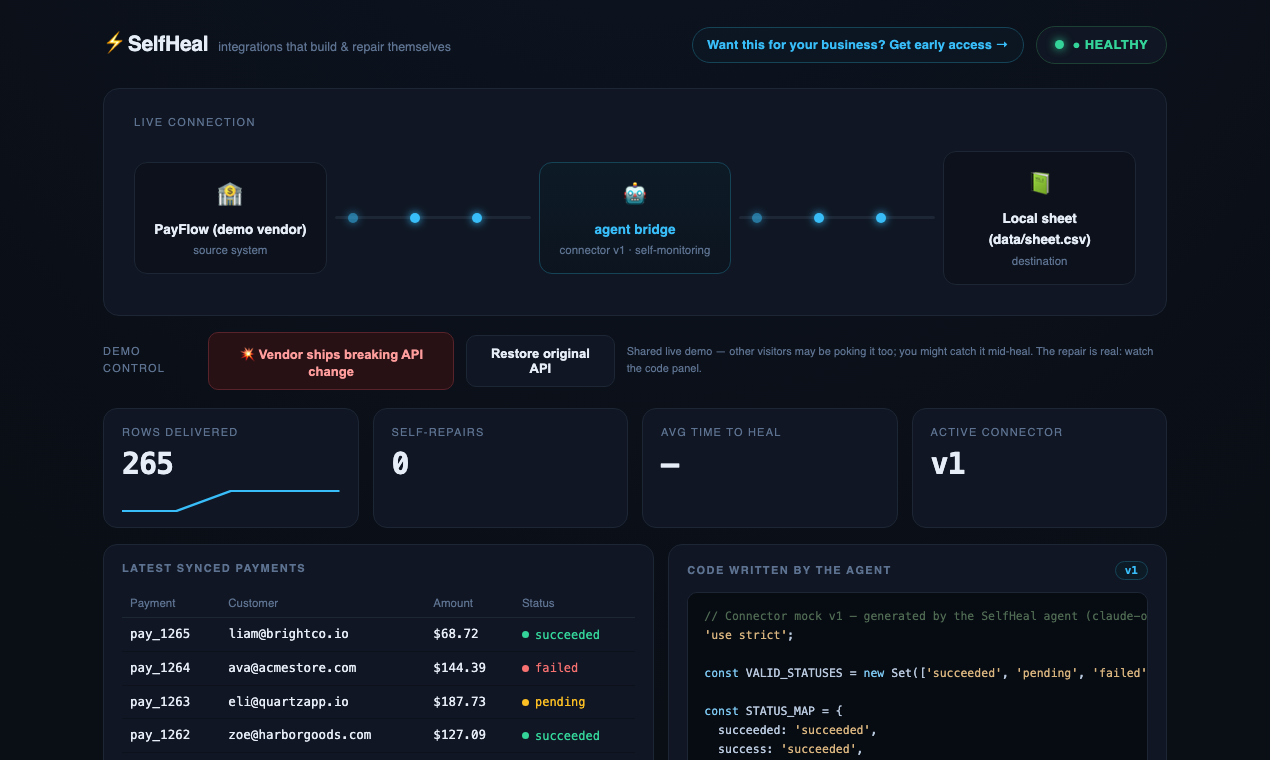
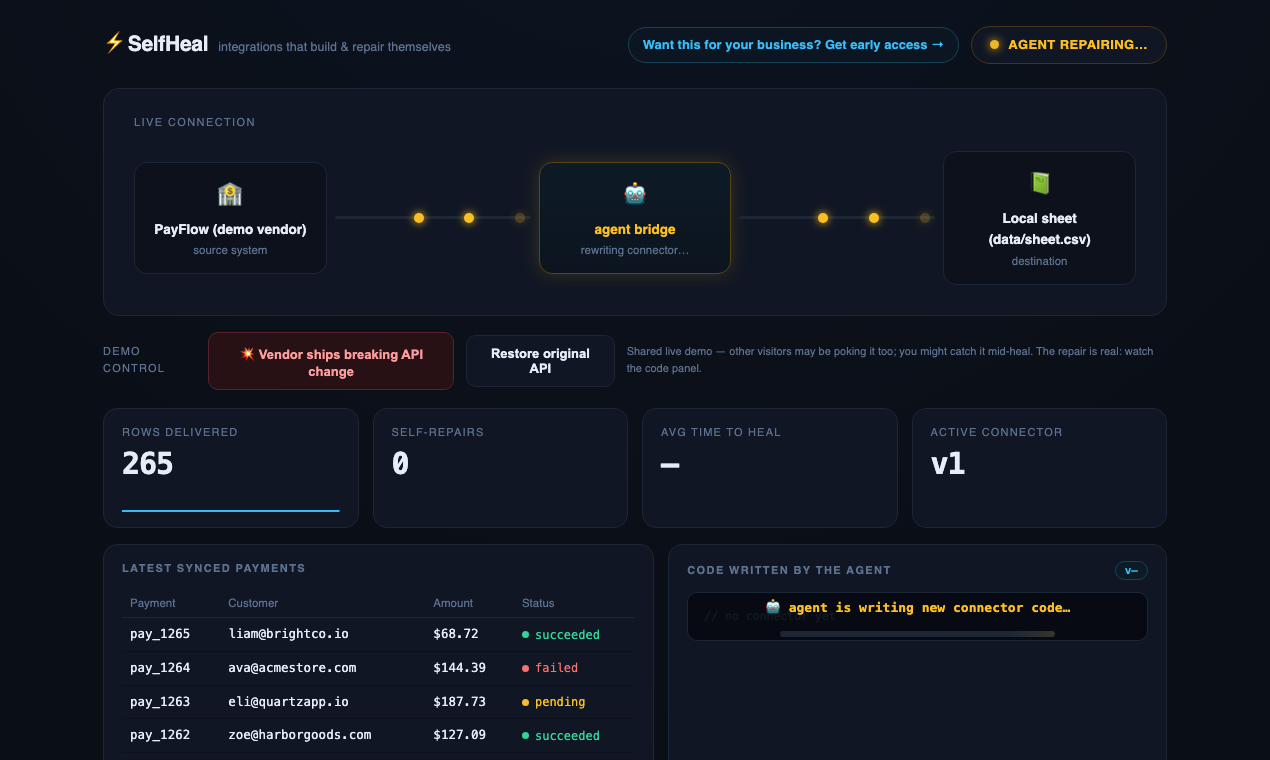
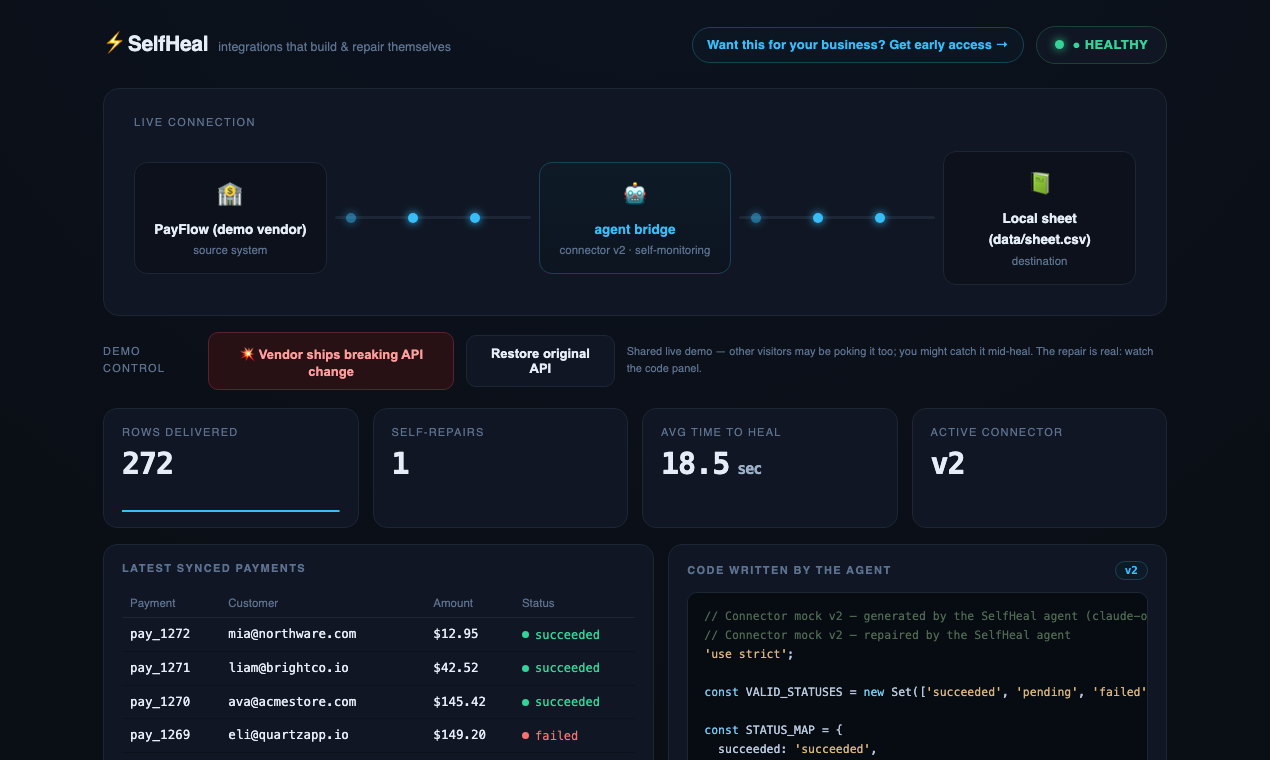
Every business runs on app-to-app connections that break whenever a vendor changes their API - and they usually break silently. SelfHeal's AI agents build the integration, monitor it 24/7, and when it breaks they rewrite the connector code, test it against the live API, and redeploy in ~16 seconds. Every version kept, fully reversible. Try the interactive demo: press the 💥 button, break it yourself, and watch it heal at getselfheal.com.
Features
• AI-built integrations - working connector from a live API sample in ~12s
• Self-healing - broken connectors rewritten, tested, redeployed in ~16s
• Test-before-deploy - strict output contract, fail-closed validation
• Versioned rollback - every connector version kept, one-step reversal
• 24/7 monitoring with visible repair logs
• Interactive live demo - break it yourself
Use Cases
• Shopify/e-commerce stores syncing orders to QuickBooks or Xero without silent data loss
• Payments (Razorpay/Stripe) flowing into Google Sheets or accounting tools
• Bookkeepers and agencies maintaining client data pipelines
• Any small business that pays for automation but can't afford to babysit it

Comments


Solo founder here 👋 Before writing a line of code, I read 40+ one-star reviews of the big automation tools. The same sentence kept appearing: "it worked for months, then silently stopped." One store found 11% of a year's orders had never reached their books. The lesson: people don't distrust automation because they love manual work - they distrust it because broken automation is worse than none. So SelfHeal is built trust-first: every AI-written fix is tested against the live API before deploy, everything is versioned with one-step rollback, and the demo is interactive - you can break it yourself and watch it heal in ~16 seconds at getselfheal.com. Happy to answer anything - and looking for pilot businesses (free during beta, pay nothing until it runs clean for 30 days).


The fail-closed test step and reversible versions are important. When an API changes both its schema and semantics, what prevents a syntactically valid repair from silently writing the wrong business data? Do you support fixture assertions or human approval before production redeploy for high-risk connectors?
The repair loop timing is the right metric to optimize. My question is about the output surface: "rewrite the connector code" is a large trust boundary if that means arbitrary Python. Testing validates functional correctness but a constrained DSL or permitted-operations schema would make the fail-closed guarantee more robust than testing alone can.

SelfHeal has great potential! A few improvements could make it even better. I'd love to share my feedback and suggestions. Email: [email protected]
Premium Products











































Sponsors
Buy

Makers
Makers
Comments
Solo founder here 👋 Before writing a line of code, I read 40+ one-star reviews of the big automation tools. The same sentence kept appearing: "it worked for months, then silently stopped." One store found 11% of a year's orders had never reached their books. The lesson: people don't distrust automation because they love manual work - they distrust it because broken automation is worse than none. So SelfHeal is built trust-first: every AI-written fix is tested against the live API before deploy, everything is versioned with one-step rollback, and the demo is interactive - you can break it yourself and watch it heal in ~16 seconds at getselfheal.com. Happy to answer anything - and looking for pilot businesses (free during beta, pay nothing until it runs clean for 30 days).
The fail-closed test step and reversible versions are important. When an API changes both its schema and semantics, what prevents a syntactically valid repair from silently writing the wrong business data? Do you support fixture assertions or human approval before production redeploy for high-risk connectors?
The repair loop timing is the right metric to optimize. My question is about the output surface: "rewrite the connector code" is a large trust boundary if that means arbitrary Python. Testing validates functional correctness but a constrained DSL or permitted-operations schema would make the fail-closed guarantee more robust than testing alone can.
SelfHeal has great potential! A few improvements could make it even better. I'd love to share my feedback and suggestions. Email: [email protected]
Premium Products
New to Fazier?

Find your next favorite product or submit your own. Made by @FalakDigital.
Copyright ©2026. All Rights Reserved