
SEETO AI
Continuous competitor monitoring — pricing, hiring, docs, in
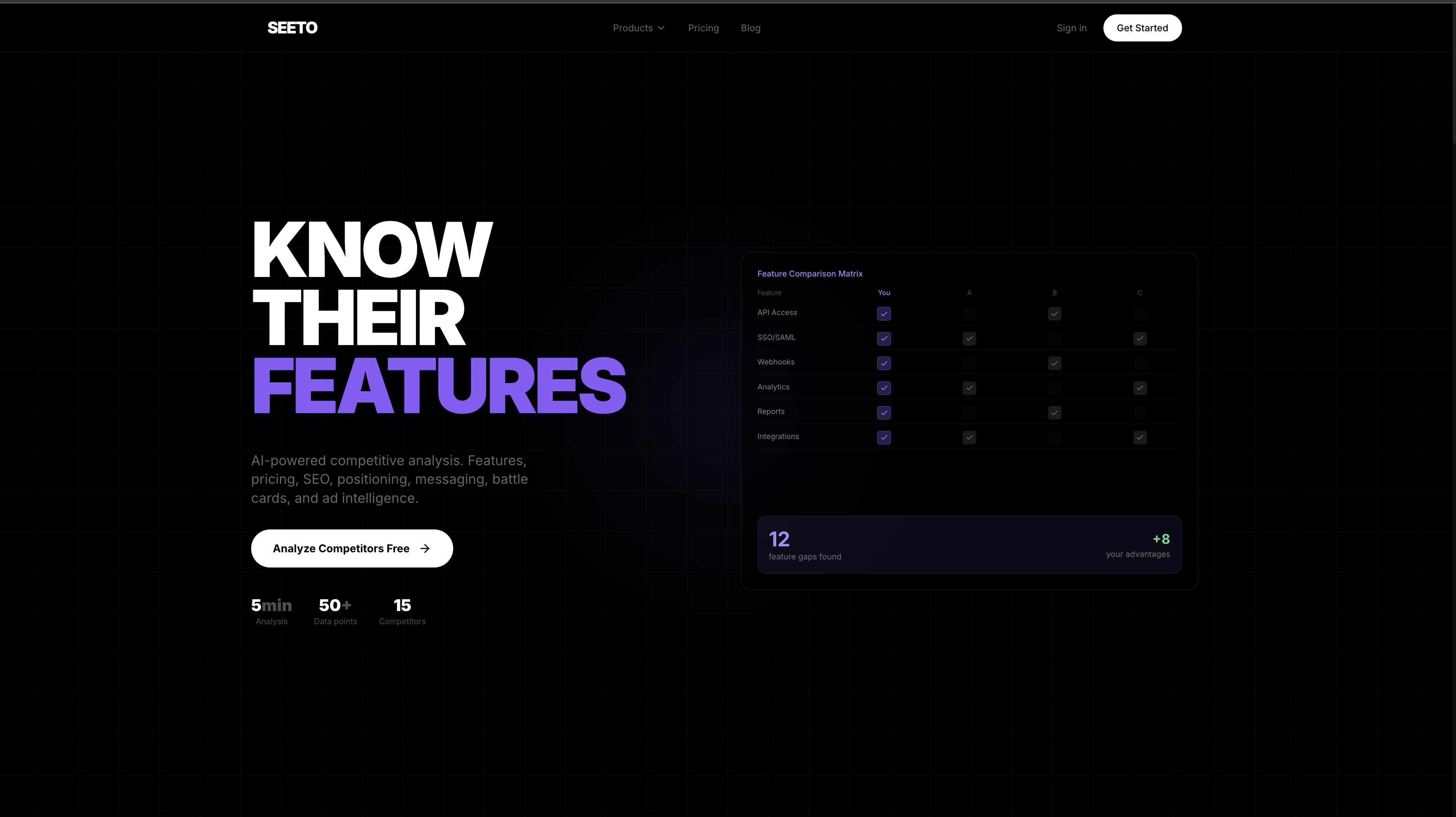
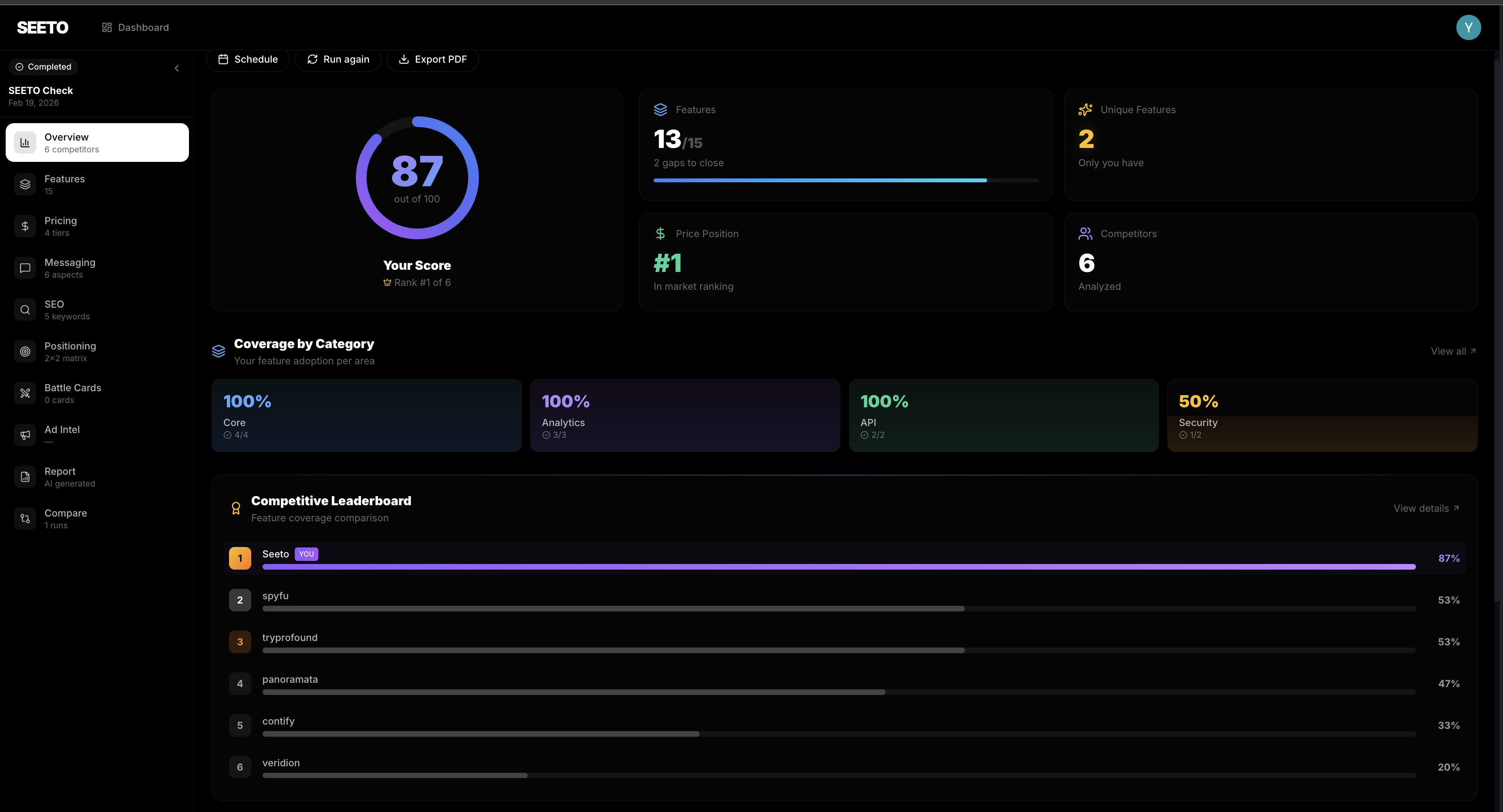
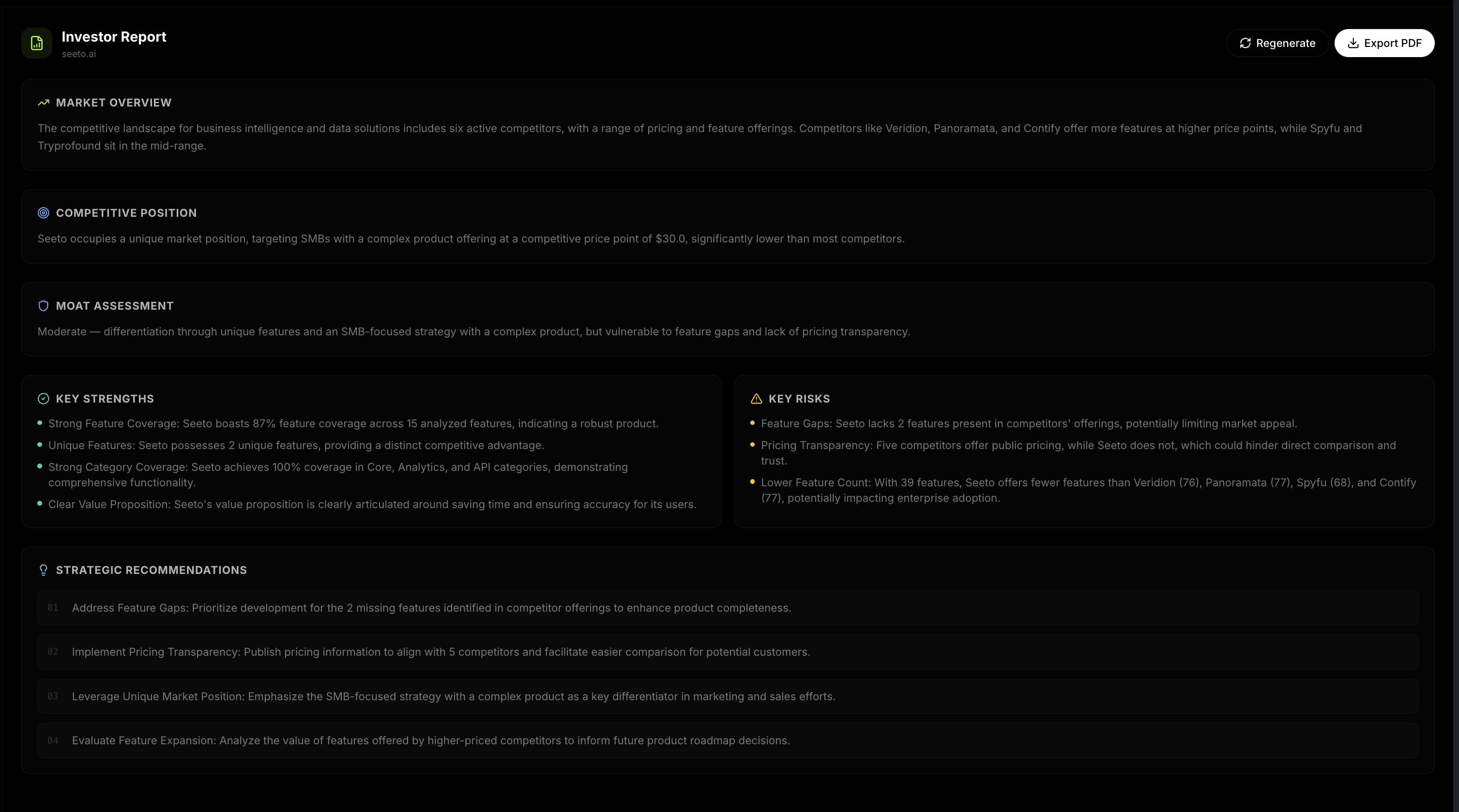
Most CI tools are dashboards full of metrics nobody acts on. Seeto is the opposite. It watches the specific public-facing surfaces competitors actually leak from — pricing pages, hiring posts, integrations, docs, communities, trust pages, podcasts, customer testimonials — and surfaces every meaningful change as a discrete alert.
You don't get reports. You get notifications: a competitor renamed their Pro tier and raised the price 22%, added a Salesforce integration, deprecated their startup plan, posted three enterprise AE openings. Each is one signal you can act on, in your sales call this afternoon.
What Seeto doesn't try to do: replace expert reading. It doesn't pretend to AI-summarize podcasts or generate strategy from thin air. It just monitors the things you'd check manually if you had the time — and tells you what changed.
Built for product, marketing, and GTM teams at B2B SaaS companies. Standard tracks 5 competitors, Pro tracks 15. Free trial, no contract.
Features
competitive intelligence,
competitor monitoring,
competitor analysis,
market intelligence,
pricing intelligence,
competitor tracking,
sales enablement,
GTM,
product management.

Comments


Really like how focused Seeto is on *actionable* signals instead of yet another bloated dashboard. Monitoring real leak surfaces like pricing pages, job posts, integrations and docs is exactly what most B2B teams try to hack together manually. Curious how granular the alerts can get (e.g. specific pricing experiments, positioning tweaks) and how you avoid overwhelming GTM teams with noise. Overall feels like a very practical CI co‑pilot for SaaS.

Love the "signal, not dashboards" framing, most CI tools drown you in metrics nobody acts on, and I appreciate that you're explicit about NOT trying to AI-summarize everything. The hiring-posts-as-signal angle is underrated (three enterprise AE openings = moving upmarket is a real tell). One question: how do you avoid false positives on pricing pages, telling a real price change apart from an A/B test or a geo-specific variant? That's usually where change-detection tools get noisy.


This nails a real gap in B2B competitive intelligence. Most tools drown you in metrics you'll never act on - but surfacing the actual signals that matter (pricing changes, new integrations, job postings, docs updates) is exactly what sales and GTM teams need to move fast. The fact that you're monitoring discrete changes instead of trying to be everything is smart product discipline.




Seeto is a very useful tool for founders, indie makers, and product teams who need a fast and structured view of their competitive landscape. What I like most is that it turns a usually slow and manual process into something much more actionable: competitor features, pricing, positioning, messaging, SEO, and battle cards are brought together in one place. For anyone building or launching a product, this kind of overview can save a lot of time and help make better product and marketing decisions. The ability to start from a simple URL makes the product especially practical. It feels like a strong fit for teams that want to move quickly, understand their market, identify gaps, and sharpen their positioning without spending days on research. A clear and valuable tool for anyone serious about competitive intelligence.

I like how focused SEETO AI is on concrete competitor signals instead of becoming another dashboard full of metrics. Watching pricing pages, docs, integrations, hiring posts, and public GTM changes makes sense because those are the things product and sales teams can actually act on. The “discrete alert” approach feels much more useful than a weekly report. Curious how much control teams get over noise filtering, but the positioning is very strong.
I like how focused SEETO AI is on concrete competitor signals instead of becoming another dashboard full of metrics. Watching pricing pages, docs, integrations, hiring posts, and public GTM changes makes sense because those are the things product and sales teams can actually act on. The “discrete alert” approach feels much more useful than a weekly report. Curious how much control teams get over noise filtering, but the positioning is very strong.
The signal-over-noise approach here is what sets Seeto apart. Most competitor monitoring tools dump everything into a dashboard and leave you to interpret it — Seeto surfaces the specific page-level changes that actually matter (pricing updates, hiring signals, integration additions). The freemium tier tracking 5 competitors is a smart entry point for early-stage teams who need strategic awareness without the full CI budget. Would love to see a digest/summary mode for busy weeks.

The framing here is exactly right — 'signals you can act on today' instead of a dashboard of metrics nobody checks. Most CI tools drown you in data without telling you what to do with it. Tracking pricing page changes is particularly high-signal; that's usually the last thing teams catch manually but one of the most meaningful competitive moves. The hiring posts angle is clever too — competitor headcount growth by role tells you a lot about their product roadmap before they announce anything.
This is a great angle for competitive intelligence — most CI tools bury you in dashboards while Seeto surfaces actual actionable signals from public-facing surfaces like pricing pages, job posts, and docs. The discrete alert approach rather than reports is a smart design choice. Congrats on the launch!


Premium Products





























Sponsors
Buy

Awards
View all
Awards
View allMakers

Makers
Comments
Really like how focused Seeto is on *actionable* signals instead of yet another bloated dashboard. Monitoring real leak surfaces like pricing pages, job posts, integrations and docs is exactly what most B2B teams try to hack together manually. Curious how granular the alerts can get (e.g. specific pricing experiments, positioning tweaks) and how you avoid overwhelming GTM teams with noise. Overall feels like a very practical CI co‑pilot for SaaS.
Love the "signal, not dashboards" framing, most CI tools drown you in metrics nobody acts on, and I appreciate that you're explicit about NOT trying to AI-summarize everything. The hiring-posts-as-signal angle is underrated (three enterprise AE openings = moving upmarket is a real tell). One question: how do you avoid false positives on pricing pages, telling a real price change apart from an A/B test or a geo-specific variant? That's usually where change-detection tools get noisy.
This nails a real gap in B2B competitive intelligence. Most tools drown you in metrics you'll never act on - but surfacing the actual signals that matter (pricing changes, new integrations, job postings, docs updates) is exactly what sales and GTM teams need to move fast. The fact that you're monitoring discrete changes instead of trying to be everything is smart product discipline.
Seeto is a very useful tool for founders, indie makers, and product teams who need a fast and structured view of their competitive landscape. What I like most is that it turns a usually slow and manual process into something much more actionable: competitor features, pricing, positioning, messaging, SEO, and battle cards are brought together in one place. For anyone building or launching a product, this kind of overview can save a lot of time and help make better product and marketing decisions. The ability to start from a simple URL makes the product especially practical. It feels like a strong fit for teams that want to move quickly, understand their market, identify gaps, and sharpen their positioning without spending days on research. A clear and valuable tool for anyone serious about competitive intelligence.
I like how focused SEETO AI is on concrete competitor signals instead of becoming another dashboard full of metrics. Watching pricing pages, docs, integrations, hiring posts, and public GTM changes makes sense because those are the things product and sales teams can actually act on. The “discrete alert” approach feels much more useful than a weekly report. Curious how much control teams get over noise filtering, but the positioning is very strong.
I like how focused SEETO AI is on concrete competitor signals instead of becoming another dashboard full of metrics. Watching pricing pages, docs, integrations, hiring posts, and public GTM changes makes sense because those are the things product and sales teams can actually act on. The “discrete alert” approach feels much more useful than a weekly report. Curious how much control teams get over noise filtering, but the positioning is very strong.
The signal-over-noise approach here is what sets Seeto apart. Most competitor monitoring tools dump everything into a dashboard and leave you to interpret it — Seeto surfaces the specific page-level changes that actually matter (pricing updates, hiring signals, integration additions). The freemium tier tracking 5 competitors is a smart entry point for early-stage teams who need strategic awareness without the full CI budget. Would love to see a digest/summary mode for busy weeks.
The framing here is exactly right — 'signals you can act on today' instead of a dashboard of metrics nobody checks. Most CI tools drown you in data without telling you what to do with it. Tracking pricing page changes is particularly high-signal; that's usually the last thing teams catch manually but one of the most meaningful competitive moves. The hiring posts angle is clever too — competitor headcount growth by role tells you a lot about their product roadmap before they announce anything.
This is a great angle for competitive intelligence — most CI tools bury you in dashboards while Seeto surfaces actual actionable signals from public-facing surfaces like pricing pages, job posts, and docs. The discrete alert approach rather than reports is a smart design choice. Congrats on the launch!
Premium Products
New to Fazier?

Find your next favorite product or submit your own. Made by @FalakDigital.
Copyright ©2026. All Rights Reserved