
Search1API
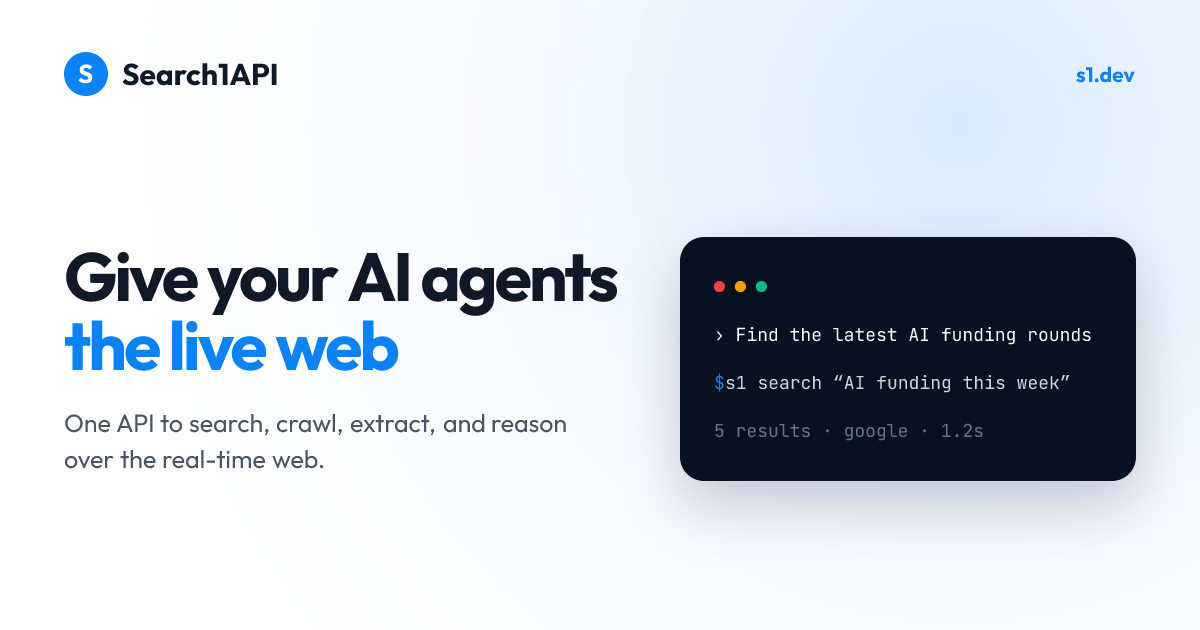
Web search API that gives AI agents the live web
Search1API gives AI agents one API to search, crawl, extract, and reason over the live web. Plug it into any agent via REST, MCP, CLI, or skills — no scraper stack and no glue code.
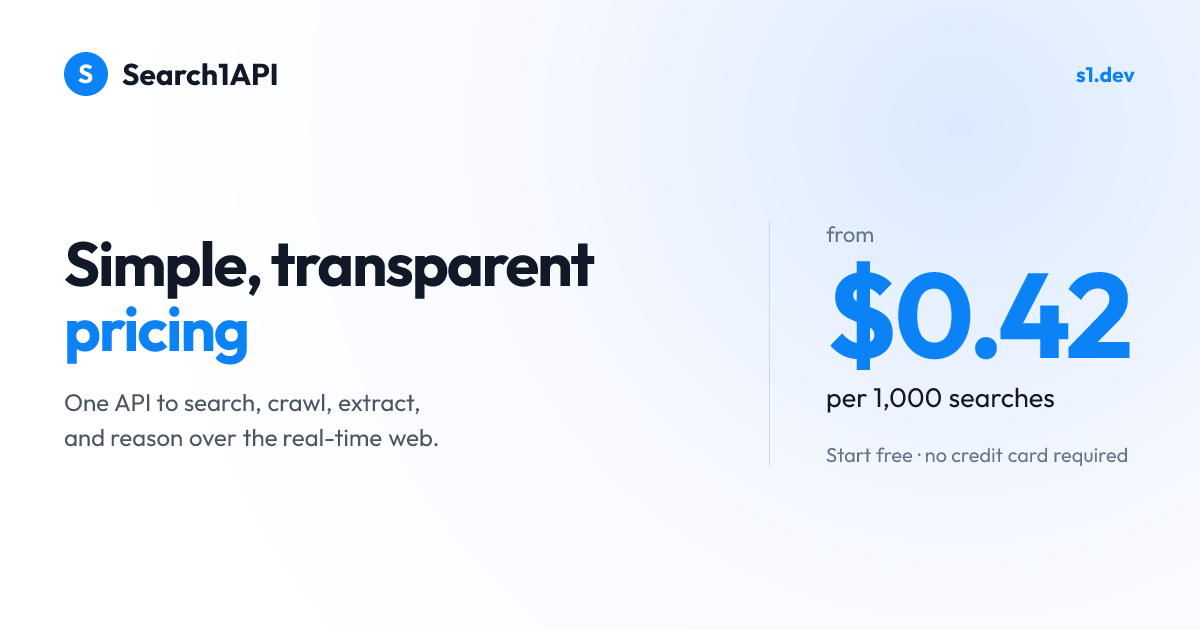
Unlike single-purpose search or crawl tools, Search1API covers multi-engine search, site-adapted extraction, news, sitemap, and trending in one place. Start with 100 free credits at s1.dev. No credit card required.
Features
- Multi-engine web search across Google, Bing, DuckDuckGo, and 10+ more
- Site-adapted crawl with clean markdown extraction
- News, sitemap, and trending topic feeds
- Hosted MCP server plus CLI and agent skills
- OAuth so agents connect without pasting API keys
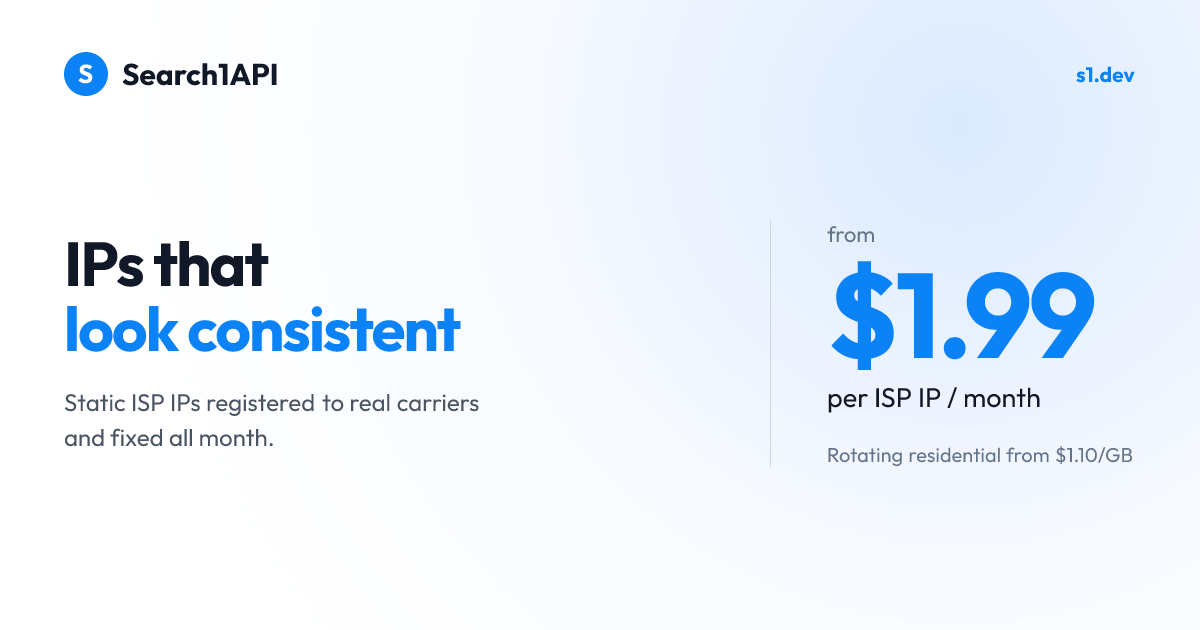
- Optional static ISP and rotating residential proxies
Use Cases
- Give coding agents live web search and current docs lookup
- Ground chatbots and research agents on today's pages
- Monitor news, GitHub, and trending topics in workflows
- Extract clean content from sites that block naive scrapers
- Add search and crawl to custom apps through one REST API
Comments


Strong positioning for agent builders. The useful part is bundling search, crawl, clean markdown extraction, and MCP/CLI access into one surface, because orchestration friction is often the real blocker rather than search alone. I would like to see examples of freshness guarantees and rate-limit behavior for long-running monitoring jobs.
OAuth instead of pasted API keys is the right default for agents, and the markdown extraction matters more than the engine list. Question: do you enforce per-key rate limits separately from the OAuth token? Agent workflows retry aggressively, and without an obvious burst policy a single stuck loop could exhaust a paid quota before anyone notices.

I kept hitting the same wall when giving AI agents live web access: search APIs, crawlers, proxies, and parsers were all separate products. Search1API is the layer I wanted — one API, plus MCP, CLI, and skills, for search, crawl, extract, news, sitemap, and trending. Start with 100 free credits at s1.dev. No credit card. Happy to answer questions here.


The hosted MCP server plus OAuth is the part that stands out — pasting API keys into every agent config is exactly the friction that stops teams from adopting search tools. A few things I'd want to know before switching from a scraping stack: how do you handle rate limits and per-engine failures in the multi-engine search (does it fall back automatically or return partial results?), and what does the Markdown extraction do with heavily JS-rendered pages? Also, is there a cost difference per credit between search, crawl and the residential proxy option? The 100 free credits with no card is a good low-friction start.

The site-adapted crawl with clean markdown extraction is the part I'd find most useful — I run a niche web tool and getting clean content out of hobbyist blogs that break naive scrapers is a constant headache. One question: does the markdown extraction preserve structured elements like tables and image alt text, or does it flatten pages into plain paragraphs? That distinction matters a lot when an agent needs to summarize tutorial or comparison content accurately. Also nice that OAuth lets agents connect without pasted API keys — that removes a real friction point for MCP-based setups.


The site-adapted markdown crawl is the piece I'd actually wire up. We already fingerprint public URLs on a schedule and fire webhooks on content drift, so a clean markdown extract would be more useful than another SERP wrapper. Two questions: can crawl return a stable content hash or ETag so we can skip unchanged pages, and do the 100 free credits apply per crawl or per search call?
The combination of multi-engine search, clean markdown extraction, and a hosted MCP server feels practical for agents that need current documentation. OAuth is a strong touch for avoiding copied API keys. Do you expose one consistent schema across search and crawl results so tool-calling agents can switch modes without extra adapters?

For citation-heavy agents, can a crawl response preserve the requested URL, final redirected URL and retrieval timestamp alongside the Markdown? A minimal response example would help distinguish changed source content from a model-generated citation. I work on TopxAI API integrations and have not tested Search1API yet.
Premium Products


























Sponsors
Buy
Makers
Makers
Comments
Strong positioning for agent builders. The useful part is bundling search, crawl, clean markdown extraction, and MCP/CLI access into one surface, because orchestration friction is often the real blocker rather than search alone. I would like to see examples of freshness guarantees and rate-limit behavior for long-running monitoring jobs.
OAuth instead of pasted API keys is the right default for agents, and the markdown extraction matters more than the engine list. Question: do you enforce per-key rate limits separately from the OAuth token? Agent workflows retry aggressively, and without an obvious burst policy a single stuck loop could exhaust a paid quota before anyone notices.
I kept hitting the same wall when giving AI agents live web access: search APIs, crawlers, proxies, and parsers were all separate products. Search1API is the layer I wanted — one API, plus MCP, CLI, and skills, for search, crawl, extract, news, sitemap, and trending. Start with 100 free credits at s1.dev. No credit card. Happy to answer questions here.
The hosted MCP server plus OAuth is the part that stands out — pasting API keys into every agent config is exactly the friction that stops teams from adopting search tools. A few things I'd want to know before switching from a scraping stack: how do you handle rate limits and per-engine failures in the multi-engine search (does it fall back automatically or return partial results?), and what does the Markdown extraction do with heavily JS-rendered pages? Also, is there a cost difference per credit between search, crawl and the residential proxy option? The 100 free credits with no card is a good low-friction start.
The site-adapted crawl with clean markdown extraction is the part I'd find most useful — I run a niche web tool and getting clean content out of hobbyist blogs that break naive scrapers is a constant headache. One question: does the markdown extraction preserve structured elements like tables and image alt text, or does it flatten pages into plain paragraphs? That distinction matters a lot when an agent needs to summarize tutorial or comparison content accurately. Also nice that OAuth lets agents connect without pasted API keys — that removes a real friction point for MCP-based setups.
The site-adapted markdown crawl is the piece I'd actually wire up. We already fingerprint public URLs on a schedule and fire webhooks on content drift, so a clean markdown extract would be more useful than another SERP wrapper. Two questions: can crawl return a stable content hash or ETag so we can skip unchanged pages, and do the 100 free credits apply per crawl or per search call?
The combination of multi-engine search, clean markdown extraction, and a hosted MCP server feels practical for agents that need current documentation. OAuth is a strong touch for avoiding copied API keys. Do you expose one consistent schema across search and crawl results so tool-calling agents can switch modes without extra adapters?
For citation-heavy agents, can a crawl response preserve the requested URL, final redirected URL and retrieval timestamp alongside the Markdown? A minimal response example would help distinguish changed source content from a model-generated citation. I work on TopxAI API integrations and have not tested Search1API yet.
Premium Products
New to Fazier?
Find your next favorite product or submit your own. Made by @FalakDigital.
Copyright ©2026. All Rights Reserved