
Scribix
Scribix is an AI powered note taker platform
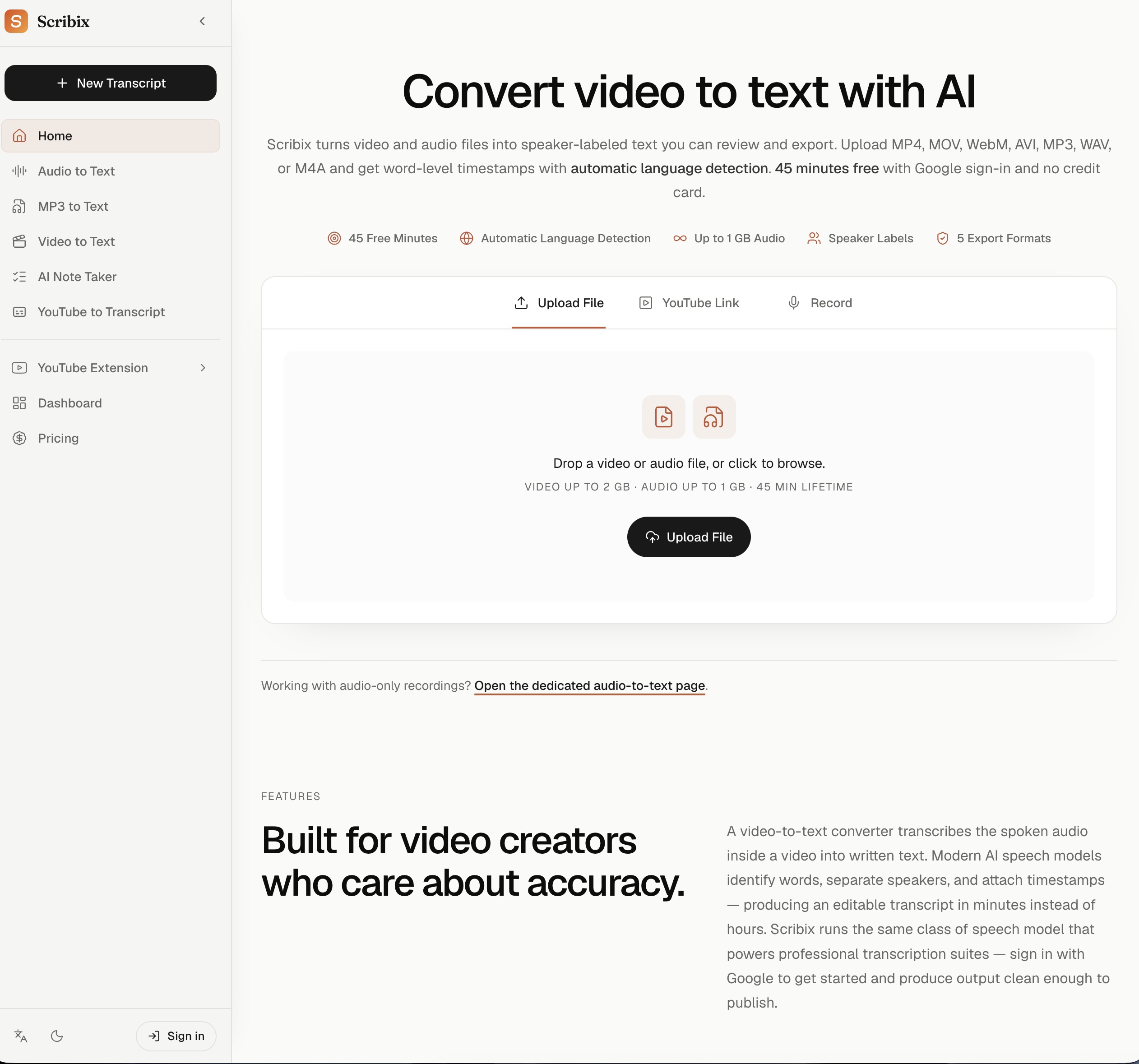
Scribix is a studio-grade AI transcription platform that turns any video or audio recording into accurate, speaker-labeled text in seconds.
Features
- Drop-and-Transcribe Workflow: Upload an MP4, MOV, WebM, AVI, MKV, MP3, WAV, or M4A file — or paste a YouTube/TikTok/Instagram link — and get a full transcript
without configuring anything
- Comprehensive Toolset: Audio-to-text, video-to-text, YouTube transcript, TikTok transcript, Instagram transcript, live recording, speaker recognition (up to 8
voices), word-level timestamps, summarization, translation, and subtitle export
- Professional Results: 99.9% accuracy with seven export formats (TXT, DOCX, PDF, SRT, VTT, JSON, CSV) suitable for journalism, podcasts, research, legal review,
and SEO content
- User-Friendly: No software install — sign in with Google, drag a file up to 1 GB, and get a clean transcript with speaker labels in minutes
Use Cases
- AI Transcription
- Audio to Text
- Video to Text
Comments


Looks like a powerful transcription tool! Handling heavy media files like that is no small feat. If you're ever looking to optimize your web app's UI assets to keep your landing page as fast as your transcriptions, I built CrushSVG (www.crushsvg.net) for local SVG compression. Best of luck with the growth!



Drag&drop for files up to 1GB with no install is a nice touch for anyone running interviews. Question on the 99.9% accuracy claim: how is it measured, WER on LibriSpeech or on your own labeled test set? Curious how the number holds up across non-English languages, and with noisy audio like call recordings with background hum.
Looks like a powerful transcription tool! Handling heavy media files like that is no small feat. If you're ever looking to optimize your web app's UI assets to keep your landing page as fast as your transcriptions, I built CrushSVG (www.crushsvg.net) for local SVG compression. Best of luck with the growth!

Speaker recognition up to 8 voices is the part that would actually decide whether I'd switch tools for this - most transcript AI I've tried starts mislabeling speakers badly past 3 or 4 in a group call. Is that diarization running per-file or does it improve as it learns a recurring group (e.g. the same weekly team call)? The seven export formats covering SRT/VTT alongside the usual TXT/DOCX is a nice touch too - most transcript tools forget that some of us just want clean subtitle files.

Premium Products




























Sponsors
Buy

Makers

Makers
Comments
Looks like a powerful transcription tool! Handling heavy media files like that is no small feat. If you're ever looking to optimize your web app's UI assets to keep your landing page as fast as your transcriptions, I built CrushSVG (www.crushsvg.net) for local SVG compression. Best of luck with the growth!
Drag&drop for files up to 1GB with no install is a nice touch for anyone running interviews. Question on the 99.9% accuracy claim: how is it measured, WER on LibriSpeech or on your own labeled test set? Curious how the number holds up across non-English languages, and with noisy audio like call recordings with background hum.
Looks like a powerful transcription tool! Handling heavy media files like that is no small feat. If you're ever looking to optimize your web app's UI assets to keep your landing page as fast as your transcriptions, I built CrushSVG (www.crushsvg.net) for local SVG compression. Best of luck with the growth!
Speaker recognition up to 8 voices is the part that would actually decide whether I'd switch tools for this - most transcript AI I've tried starts mislabeling speakers badly past 3 or 4 in a group call. Is that diarization running per-file or does it improve as it learns a recurring group (e.g. the same weekly team call)? The seven export formats covering SRT/VTT alongside the usual TXT/DOCX is a nice touch too - most transcript tools forget that some of us just want clean subtitle files.
Premium Products
New to Fazier?
Find your next favorite product or submit your own. Made by @FalakDigital.
Copyright ©2026. All Rights Reserved