
Scalebrowser
Human browser capabilities. Now for AI agents.
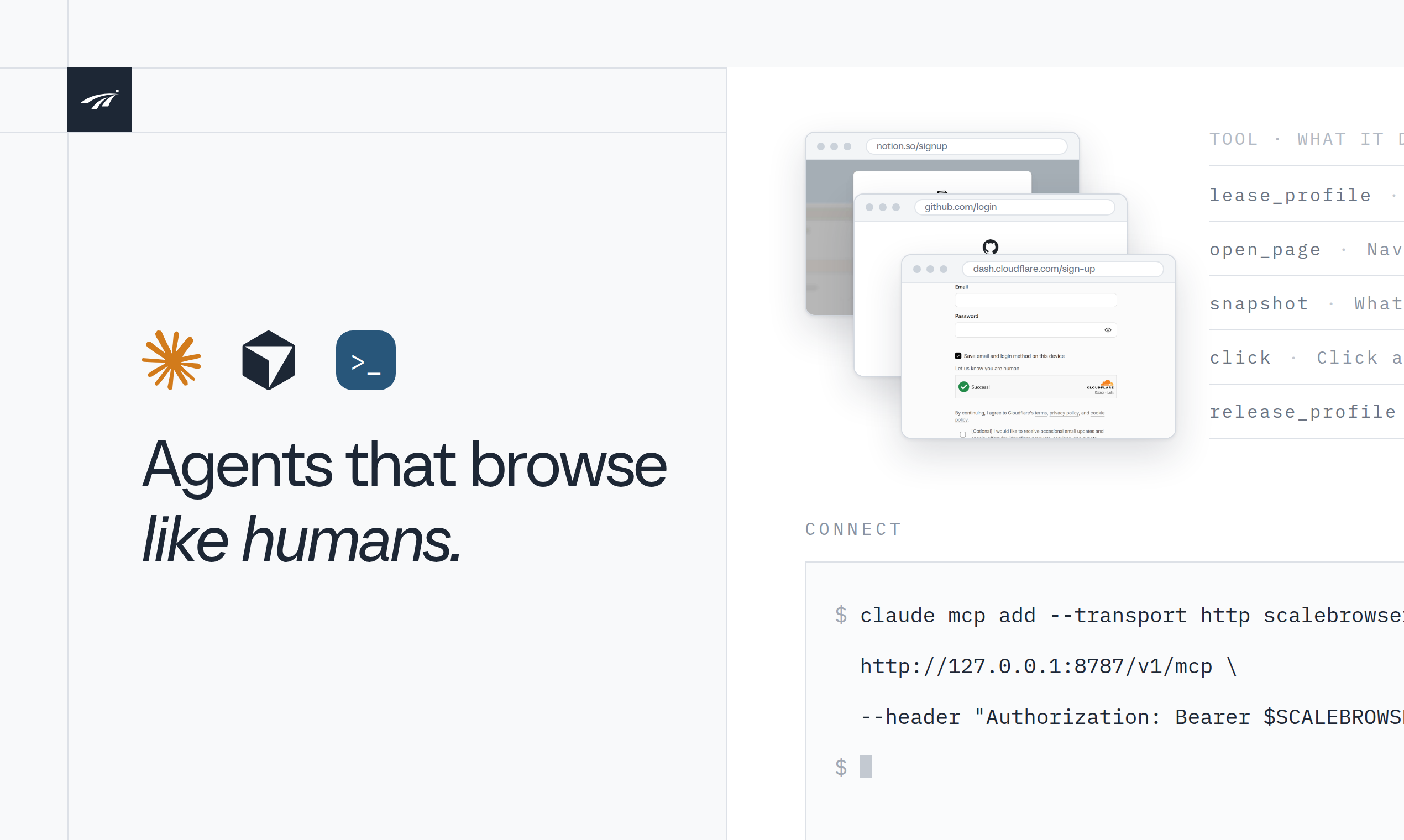
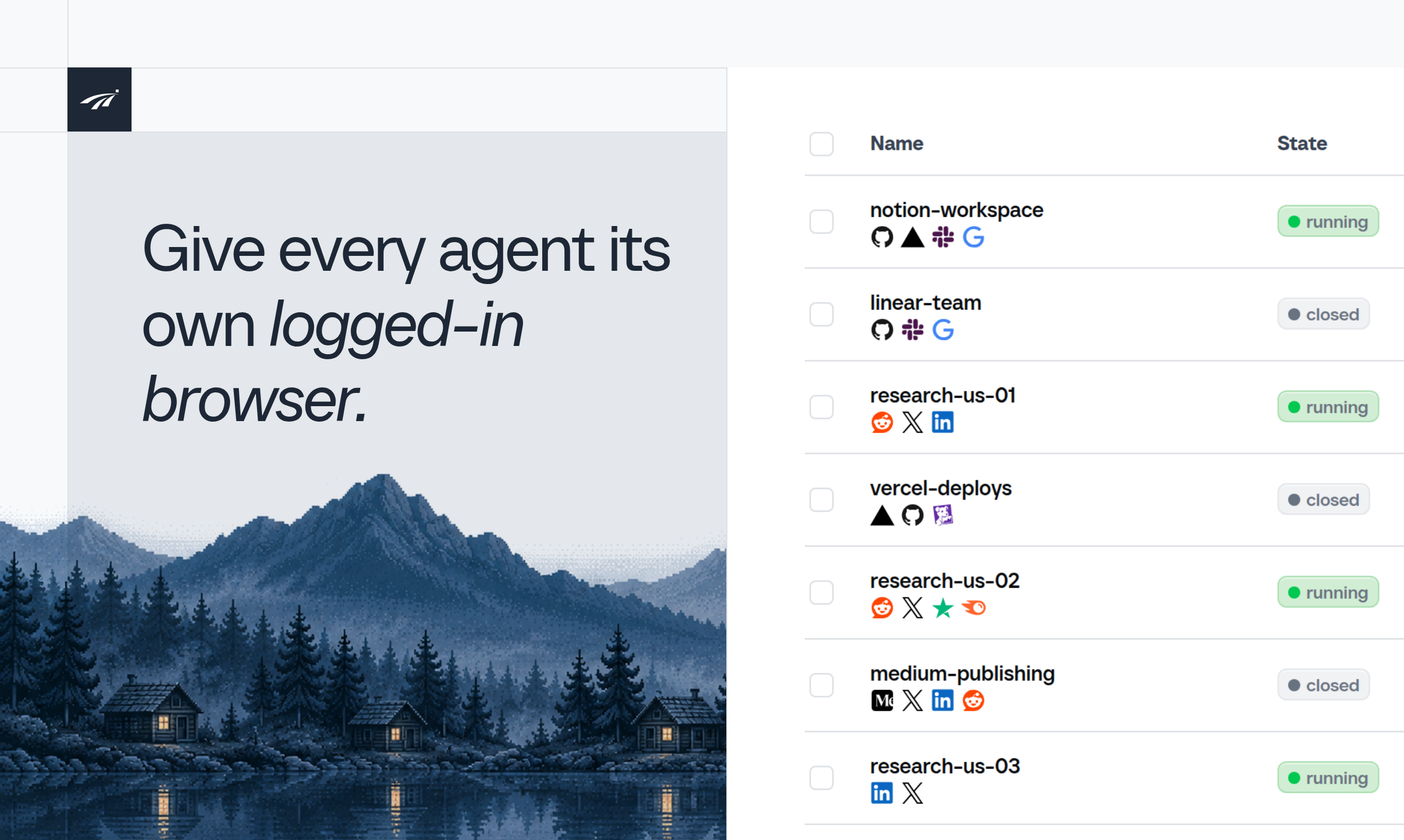
Scalebrowser gives every AI agent its own browser on your own PC. Each one is a profile with its own cookies, sign-ins, passkeys, email address and proxy, so it stays signed in from one run to the next and never mixes with the others. Agents drive it over MCP, REST, the Python and Node SDKs or plain CDP.
It's built on a self-maintained Chromium fork, and every click and keystroke goes through a humanized input layer, so a site sees an ordinary Chrome on an ordinary PC. Want to know what your current setup gives away? The free [check page](https://scalebrowser.net/check) shows it.
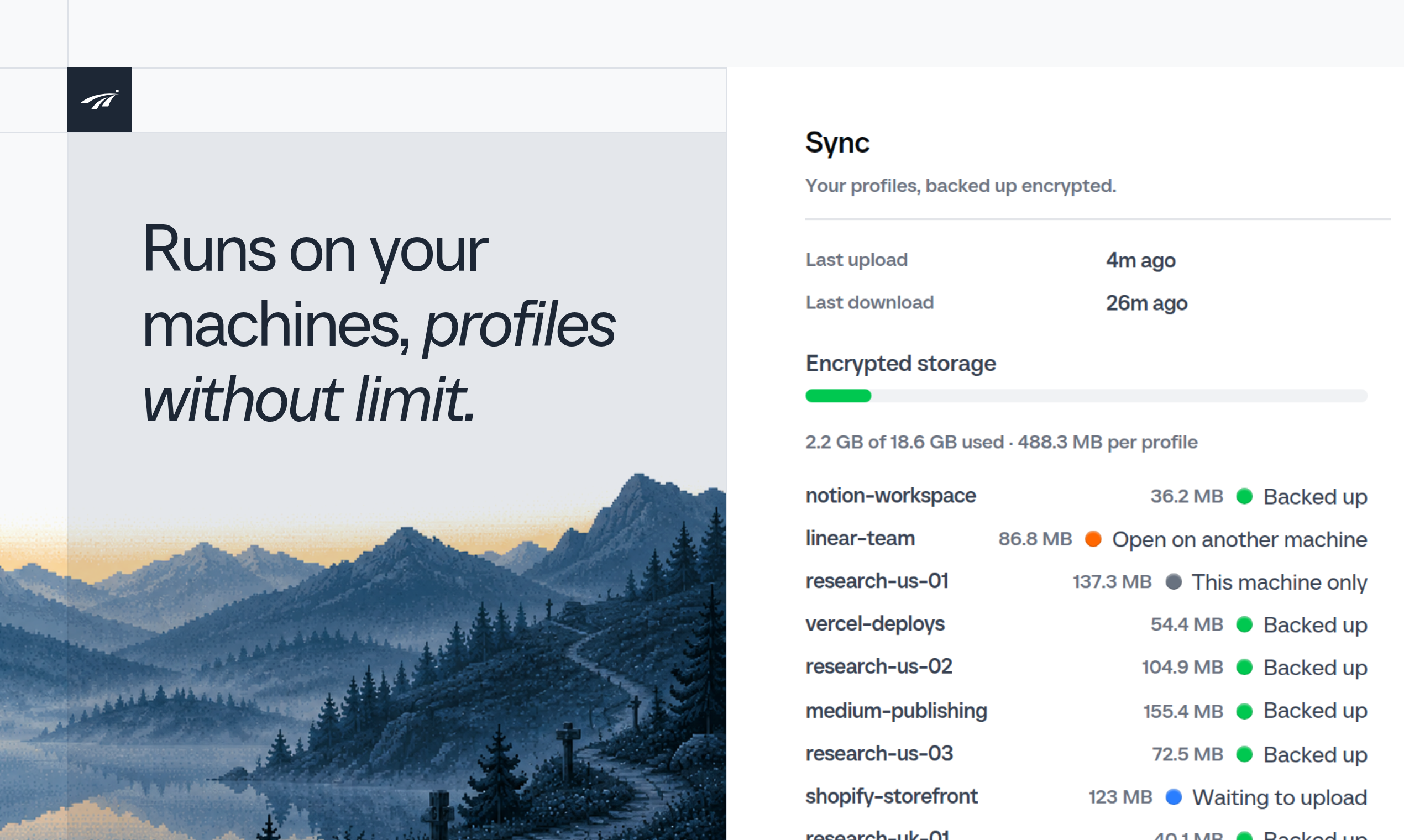
Profiles are unlimited. You pay for how many browsers run at the same moment, from $19 a month, with a 7-day trial.
Features
- **One real browser per agent.** Each profile has its own cookies, saved logins, passkeys, extensions and files. The agent working on a client's Facebook page can't see your LinkedIn.
- **Sessions that last.** Cookies and passkeys survive a crash, an update and a closed window, so the next run starts signed in.
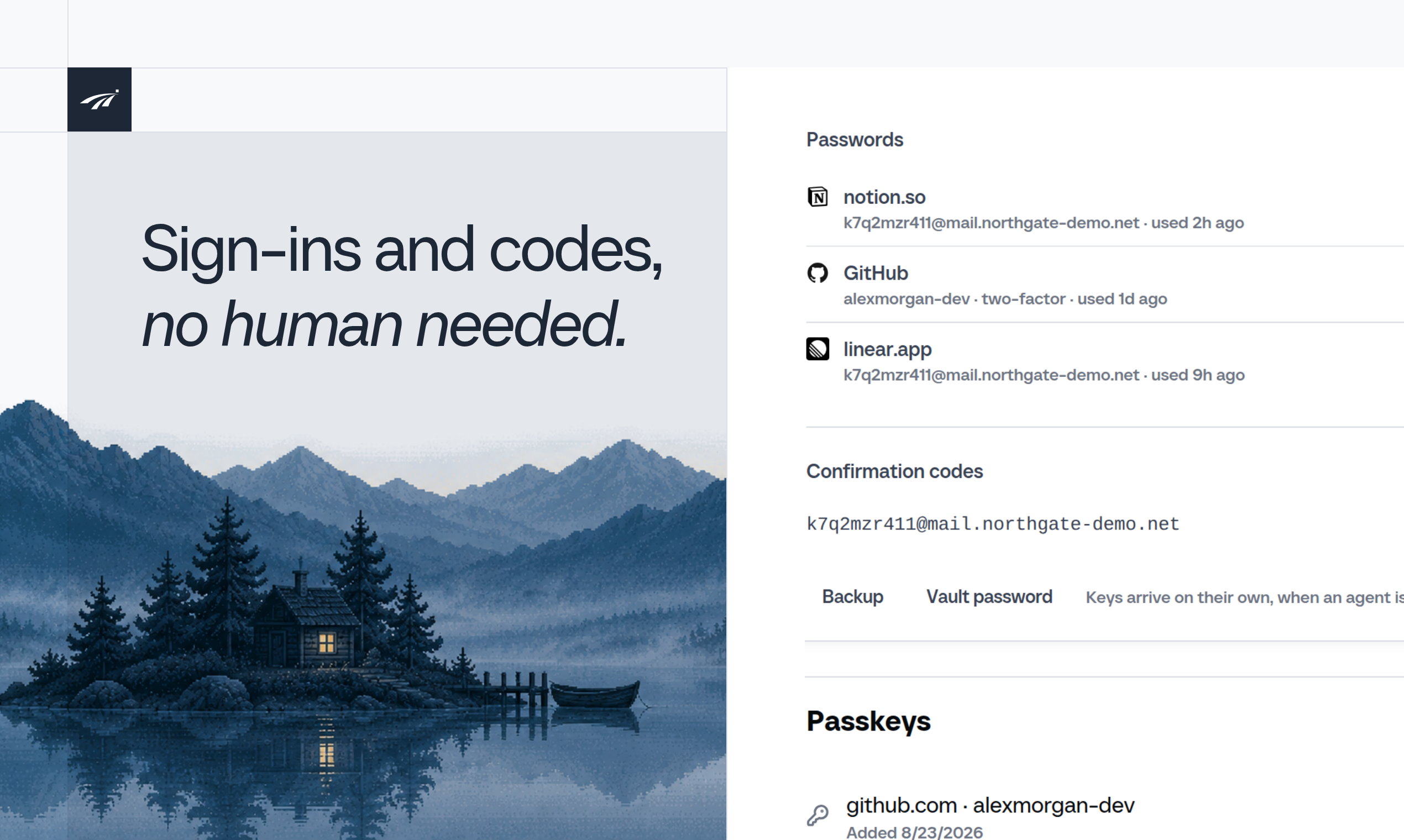
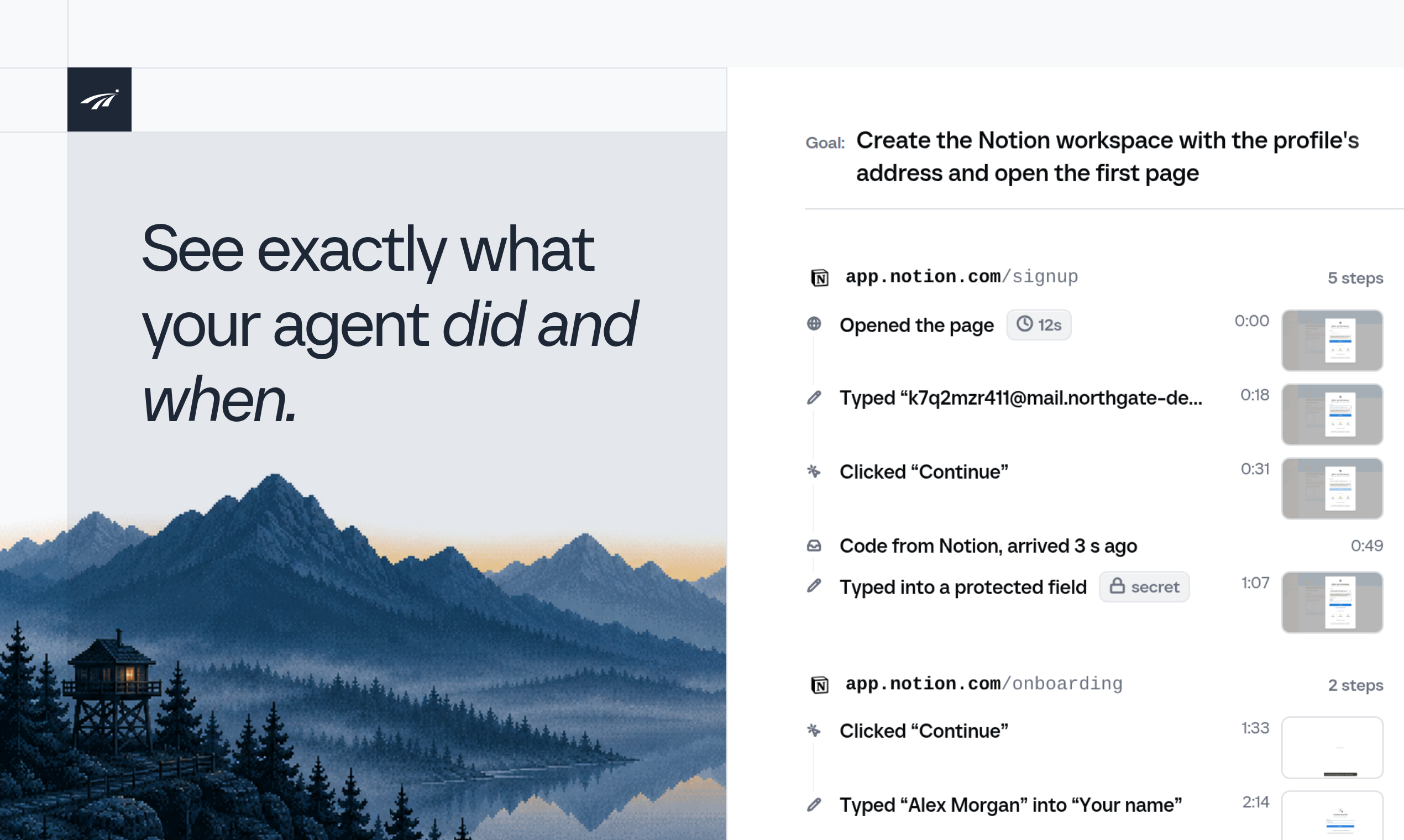
- **Sign-in without handing over the password.** You save it once, encrypted, on your PC. The agent names the field and the password is typed for it, so it never shows up in a prompt or a log.
- **A mailbox for every profile.** Bind an email address to a profile and the agent reads confirmation codes and sign-in links there. A saved authenticator key gives it the six digits that change every 30 seconds.
- **Human input, always.** Every click follows a real pointer path and every key has its own timing. The agent has no way to skip this layer.
- **The page as a list of things to click.** The agent gets the buttons, fields and links with their names, and after each step only what changed. Long runs stay cheap.
- **It answers what the browser asks.** Permission prompts, file pickers, download bars and device dialogs get a reply instead of freezing the run.
- **Captcha solving.** Any captcha get passed with the normal click and key tools, and there's no paid solver service behind it.
- **Record once, replay.** A recording remembers each button by its role and name, so it still finds it after the page has been rebuilt.
- **Every step on record.** Each step comes back with its result and a still image. Passwords and other secrets are blacked out in the picture.
- **Your PC's own hardware.** GPU, screen, CPU and fonts are the machine's real ones, so nothing on the page contradicts itself. Each profile can have its own proxy, and its time zone and language follow the proxy's country.
- **Plugs into what you already use.** MCP for Claude Code, Cursor and other clients, REST, Python and Node SDKs (MIT) or plain CDP.
Use Cases
- **Agents that sign in.** Let an agent work in your LinkedIn, Instagram or a job portal. It signs in with the saved password, reads the confirmation code from the profile's inbox and is still signed in tomorrow.
- **Tools with no API.** Midjourney has no public API and Zillow's MLS listing feed is invite only. The agent uses the website the way you do and brings back text, a file or a picture.
- **One profile per account.** An agency gives every client's Facebook page its own profile, and each agent opens only its own. Cookies, logins and files stay apart from the first click.
- **Work you repeat.** Download the invoice from each vendor portal, open three competitor pages, copy yesterday's orders into a sheet. Do the round once with the agent, then let it repeat it, or put it on a scheduler you already use and it runs every morning.
- **A real browser for your agent.** Claude Code or Cursor opens your staging site in a signed-in Chrome, reads the page and clicks through it over MCP.

Comments


Hi, I'm Davide. I built Scalebrowser on my own. The agent jobs I care about are the annoying ones: log in to a real account, use a tool that has no API, run the same task every morning without showing up as a new visitor each time. Those jobs kept dying before the actual work. The profile came back as a different device after a restart, a login code landed in an inbox the agent couldn't read, a permission bubble sat outside the page, or the model burned its context just reading the DOM. Stealth plugins patch a stock browser from the inside, and cloud browsers keep your sessions on someone else's hardware. So I changed the browser itself. Scalebrowser runs a patched Chromium on your own machine, one profile per agent. Cookies, logins and passkeys stay with the profile, and its fingerprint comes from a single seed, so it starts as the same machine every time. Stored passwords are typed by the browser, so the model never sees them. The part I'm happiest with is the least flashy one. The MCP server gives the model a compact map of the page instead of the raw DOM. In my own benchmark that took 11x fewer tokens than Playwright MCP over 75 steps. Before you try it: - It's a Windows desktop app FOR NOW (Linux & MacOS coming soon) and needs a normal PC. VPS and servers don't work, because the checks flag them. - You bring your own residential or mobile proxy (if you need them). - No free plan. The seven-day trial needs a card, and plans start at €19/month. - 18 captcha types are measured as solved. Arkose and rotation captchas aren't among them. - The product is commercial. The Node.js and Python SDKs are MIT. Where do your browser agents fail today: detection, login, context, or somewhere I haven't seen yet?
Premium Products




































Sponsors
Buy
Makers
Makers
Comments
Hi, I'm Davide. I built Scalebrowser on my own. The agent jobs I care about are the annoying ones: log in to a real account, use a tool that has no API, run the same task every morning without showing up as a new visitor each time. Those jobs kept dying before the actual work. The profile came back as a different device after a restart, a login code landed in an inbox the agent couldn't read, a permission bubble sat outside the page, or the model burned its context just reading the DOM. Stealth plugins patch a stock browser from the inside, and cloud browsers keep your sessions on someone else's hardware. So I changed the browser itself. Scalebrowser runs a patched Chromium on your own machine, one profile per agent. Cookies, logins and passkeys stay with the profile, and its fingerprint comes from a single seed, so it starts as the same machine every time. Stored passwords are typed by the browser, so the model never sees them. The part I'm happiest with is the least flashy one. The MCP server gives the model a compact map of the page instead of the raw DOM. In my own benchmark that took 11x fewer tokens than Playwright MCP over 75 steps. Before you try it: - It's a Windows desktop app FOR NOW (Linux & MacOS coming soon) and needs a normal PC. VPS and servers don't work, because the checks flag them. - You bring your own residential or mobile proxy (if you need them). - No free plan. The seven-day trial needs a card, and plans start at €19/month. - 18 captcha types are measured as solved. Arkose and rotation captchas aren't among them. - The product is commercial. The Node.js and Python SDKs are MIT. Where do your browser agents fail today: detection, login, context, or somewhere I haven't seen yet?
Premium Products
New to Fazier?

Find your next favorite product or submit your own. Made by @FalakDigital.
Copyright ©2026. All Rights Reserved