
Rubric Maker
Free rubric maker with 53 editable templates
Rubric Maker is a free tool for teachers who need a grading rubric today.
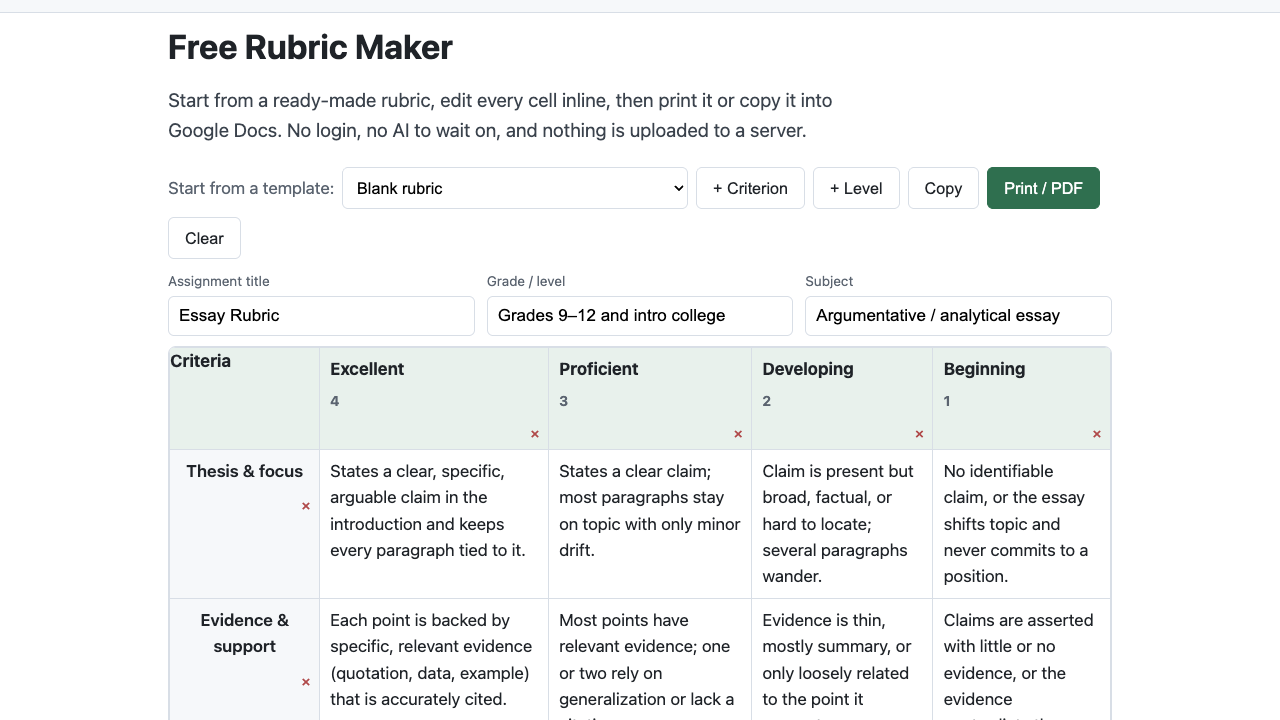
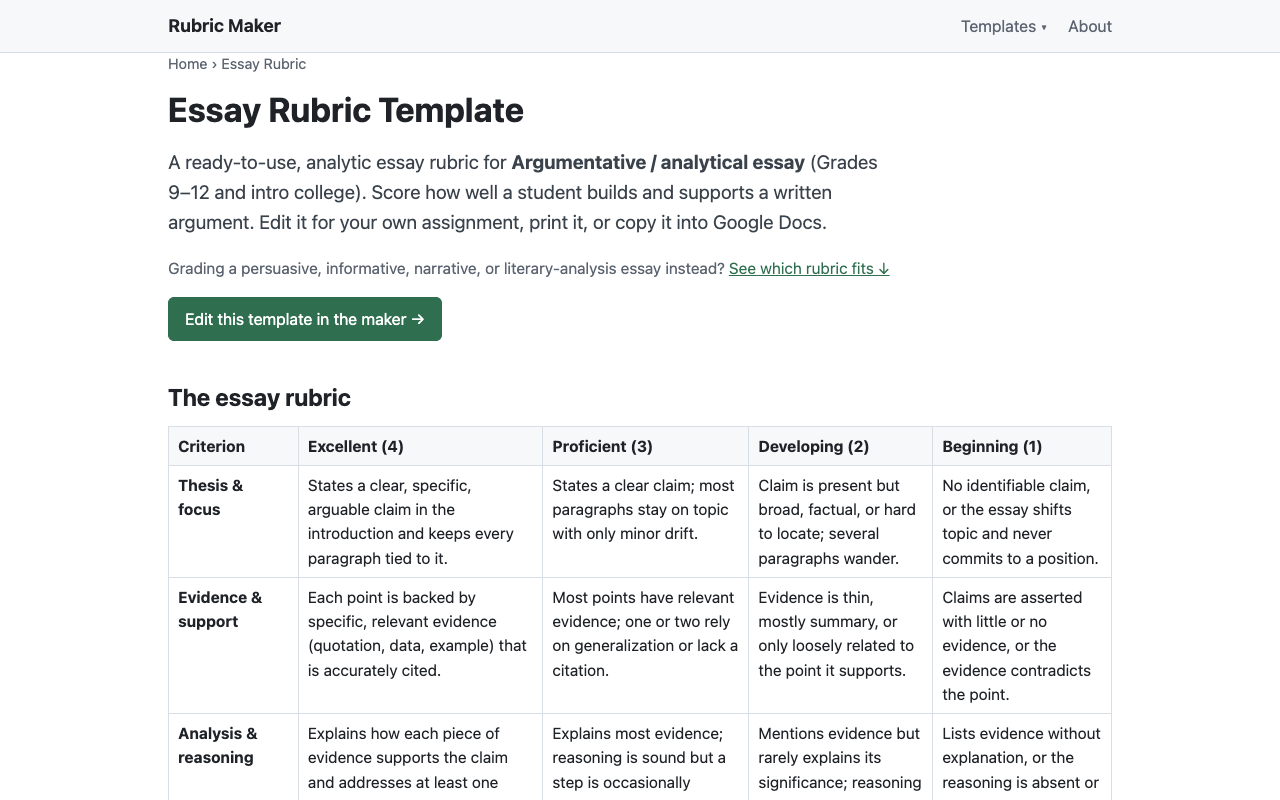
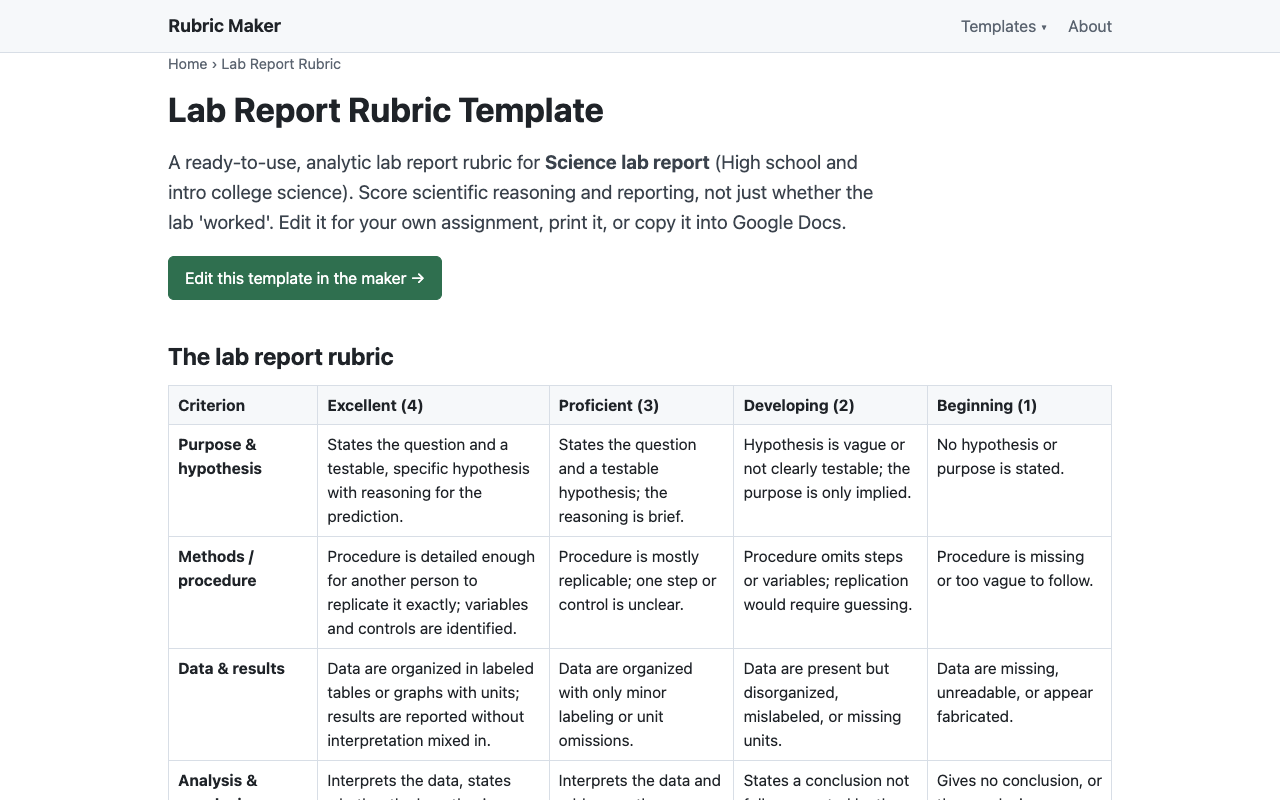
Start from a blank grid or one of 53 templates, including essays, lab reports, book talks, Model UN, and escape room projects. Click any cell to change the wording, add or remove criteria and levels, then print it or copy it into Google Docs.
There is no account and no AI step. The editor runs in your browser, and your draft stays on your own computer.
Each template was written by hand. The descriptors name things a grader can see in the work, and each level differs from the next in substance, not just in adjectives like "good" or "excellent". Treat them as starting points and adjust them to your assignment and grade level.

Comments


Building a grading rubric from scratch takes time - having 53 pre-written templates as starting points saves the initial lift. The value is in templates written by hand with descriptors that name observable work rather than vague adjectives, so they actually guide student effort and grading conversation.
Hand-written descriptors that name what a grader can actually see in the work are the part that makes these templates useful, not just the 53 starting points. A helpful addition would be a one-click export to .docx or a read-only share link, so teachers can hand a rubric to students without reformatting it in Google Docs first.

The hand-written descriptors are the part that matters most here, since most rubric templates just use vague 'good/excellent' levels. Question: can a finished rubric be exported as a shareable link or as a CSV/.docx, or is it print and copy-to-Docs only? Being able to reuse the same rubric across several sections would be handy for teachers.


Descriptors that name what a grader can actually see in the work are the hard part, and it shows the templates were written by hand. A suggestion: a "student view" that turns the same rubric into a self-check list ("my report states a testable hypothesis") would let teachers hand it out before the assignment, not just use it for grading. Any plans for weights per criterion, so each level maps to points?
Premium Products


















































Sponsors
Buy

Makers

Makers
Comments
Building a grading rubric from scratch takes time - having 53 pre-written templates as starting points saves the initial lift. The value is in templates written by hand with descriptors that name observable work rather than vague adjectives, so they actually guide student effort and grading conversation.
Hand-written descriptors that name what a grader can actually see in the work are the part that makes these templates useful, not just the 53 starting points. A helpful addition would be a one-click export to .docx or a read-only share link, so teachers can hand a rubric to students without reformatting it in Google Docs first.
The hand-written descriptors are the part that matters most here, since most rubric templates just use vague 'good/excellent' levels. Question: can a finished rubric be exported as a shareable link or as a CSV/.docx, or is it print and copy-to-Docs only? Being able to reuse the same rubric across several sections would be handy for teachers.
Descriptors that name what a grader can actually see in the work are the hard part, and it shows the templates were written by hand. A suggestion: a "student view" that turns the same rubric into a self-check list ("my report states a testable hypothesis") would let teachers hand it out before the assignment, not just use it for grading. Any plans for weights per criterion, so each level maps to points?
Premium Products
New to Fazier?

Find your next favorite product or submit your own. Made by @FalakDigital.
Copyright ©2026. All Rights Reserved