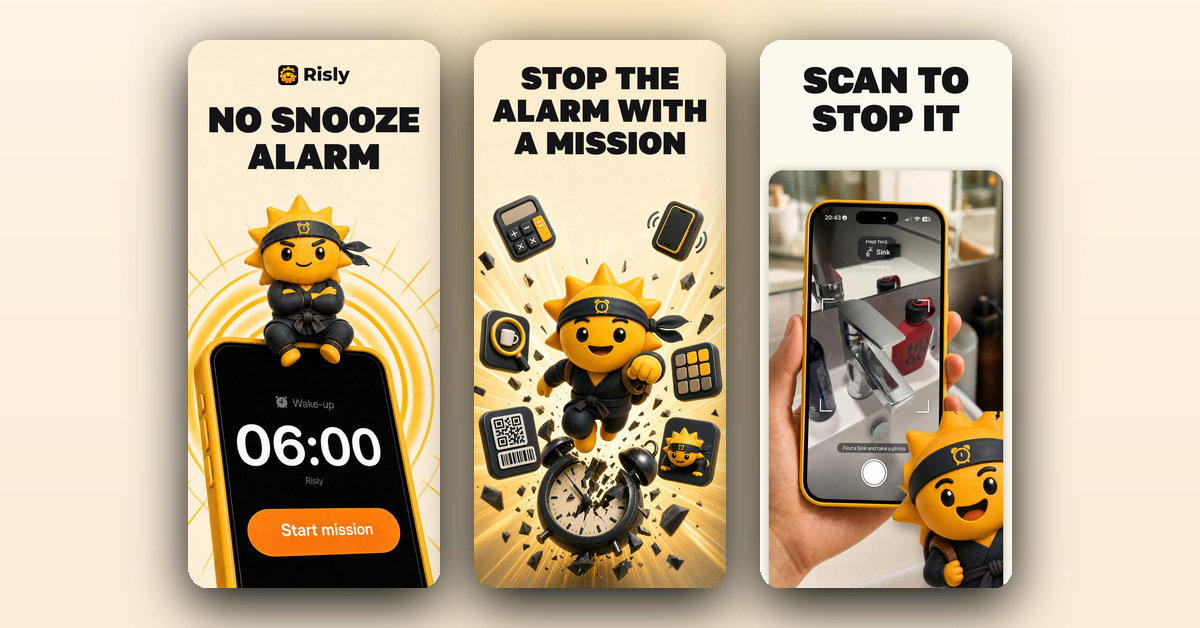
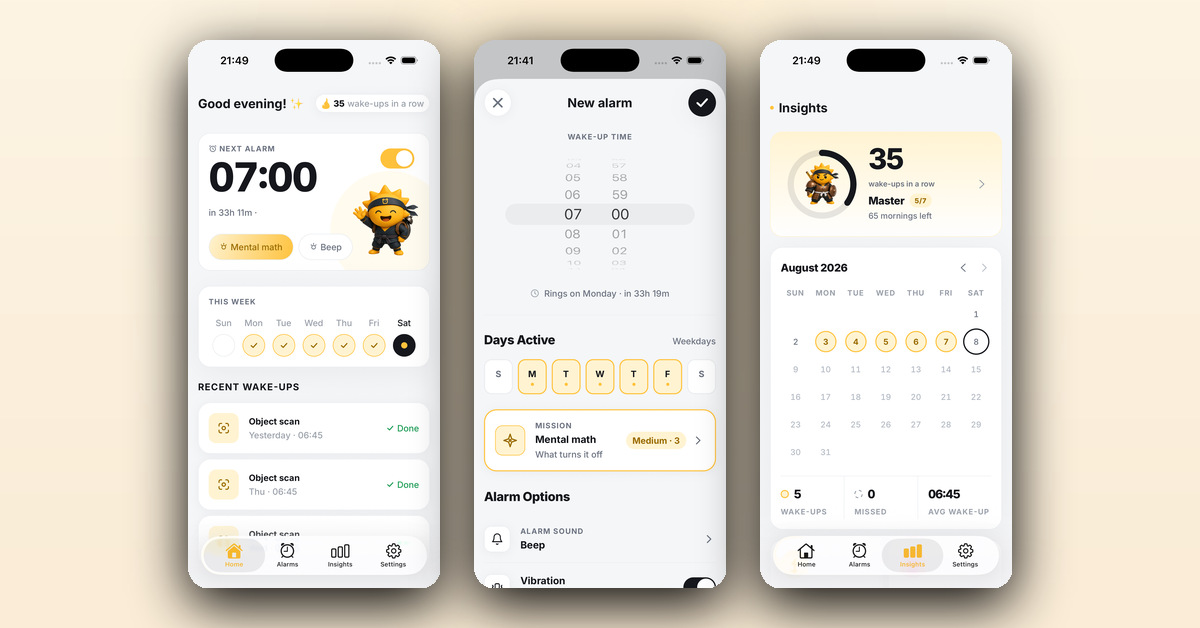
Risly is an alarm clock with missions. When it rings there is no snooze and no dismiss button: you finish a mission to turn it off.
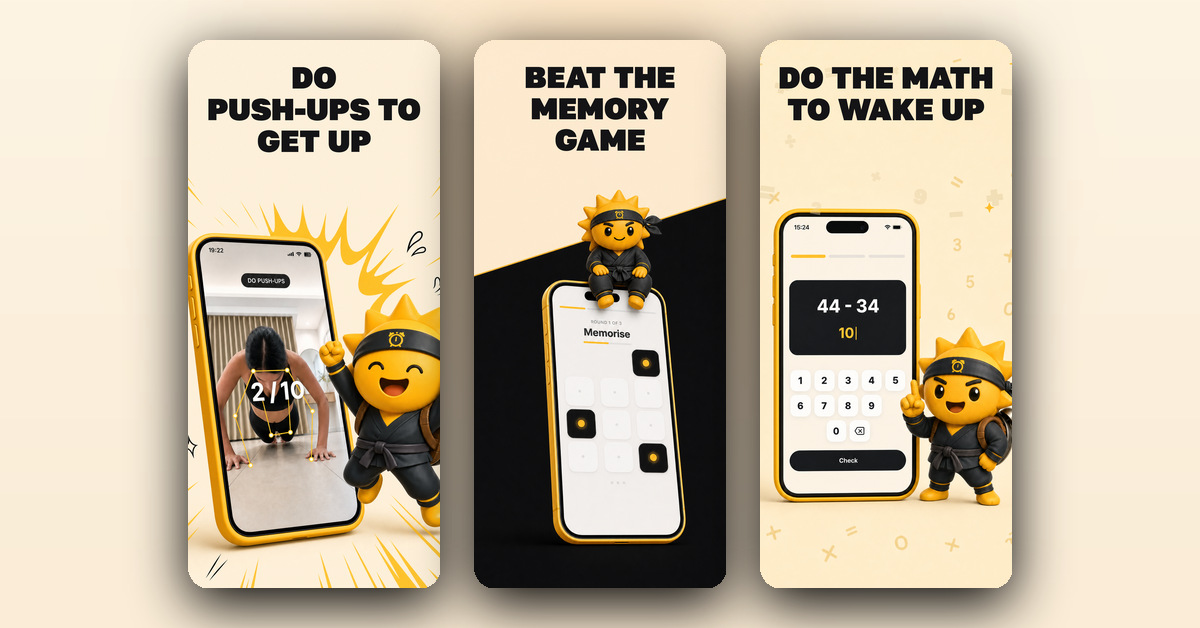
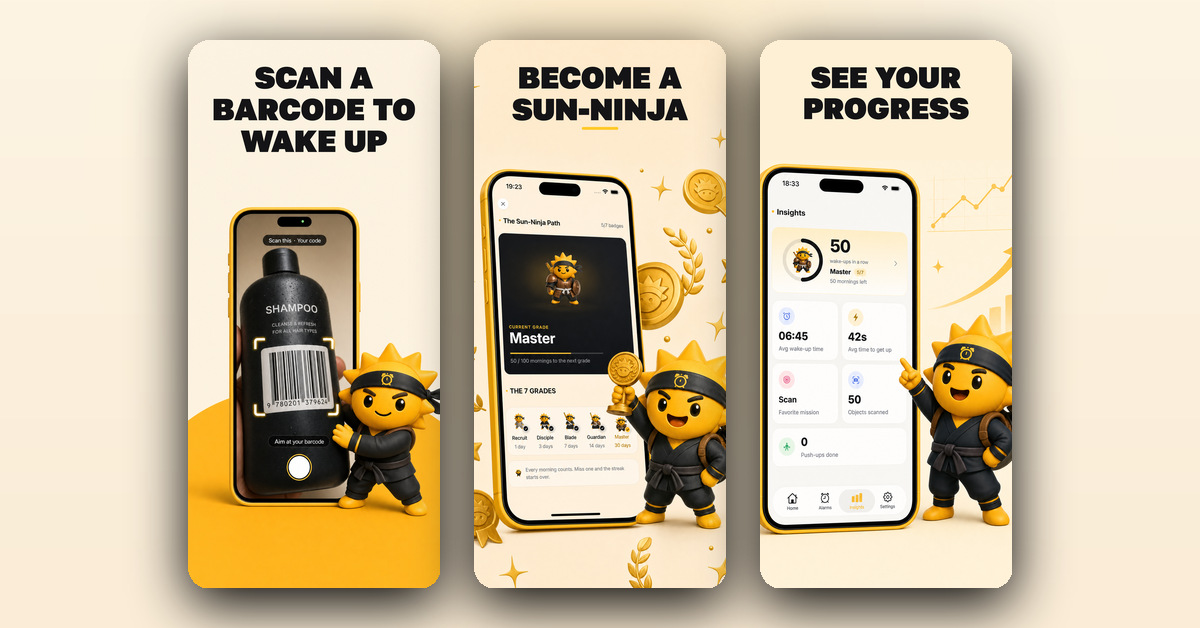
You pick the mission per alarm. Scan an object across the room, solve math problems, repeat a memory pattern, scan a QR code you taped to the bathroom mirror, scan a barcode you already own, shake the phone, or do push-ups while the camera counts your reps.
It is built on Apple's AlarmKit, so it rings through silent mode, Focus and a locked screen. iPhone, iOS 26 and later.
Features
- No snooze button. The alarm only stops when a mission is completed
- Seven missions: math, memory, object scan, QR code, barcode, shake, push-ups
- A difficulty setting per mission, and a different mission per alarm if you want
- Rings through silent mode, Focus / Do Not Disturb and a locked screen (built on Apple AlarmKit)
- Insights: a calendar of every wake-up and every miss, and your average wake-up time
- Streaks, stats and seven grades so the habit is visible
- Available in 18 languages, and no ads anywhere in the app
Use Cases
- You hit snooze five times every morning and lose the first hour of the day
- You have a shift, a class or a flight and cannot afford to oversleep
- You keep the phone by the bed and dismiss the alarm without ever waking up
- You want to be out of bed when the alarm stops, not just awake in it
- You are trying to hold a fixed wake-up time and want the streak to prove it

Comments


Building on AlarmKit is the part that makes this believable — most "mission" alarms are just regular apps that lose to Focus mode at 5am, so ringing through a locked screen is the actual product, not the missions. The risk I'd watch is mission fatigue: whatever the task is, people learn to do it half-asleep within two weeks and the alarm stops working. Rotating missions automatically, or escalating difficulty after a streak of fast dismissals, would keep it effective past the honeymoon period.



I built Risly because I was losing the first hour of every day to the snooze button. I tried the usual alarm apps and kept beating them: dismiss from the lock screen, half asleep, back under the duvet, no memory of it an hour later. So the rule here is blunt. There is no snooze and no dismiss. The alarm stops when you finish a mission, and the missions are things you cannot do lying down: scan an object on the other side of the room, do push-ups while the camera counts your reps, scan a QR code you taped to the bathroom mirror. By the time it goes quiet, you are standing up. The part that took the longest was making it actually ring. It runs on Apple's AlarmKit, so silent mode, a Focus schedule and a locked screen do not save you. That is the one thing that has to never fail, and it is why the app needs iOS 26. Happy to answer anything about the missions, the difficulty settings, or how the streak decides you missed a morning.

Building on AlarmKit is the detail that makes this credible, and I would say it louder. Every alarm app claims it will wake you, and most of them quietly lose to silent mode or a Focus schedule. Naming the framework is the proof. The feature I would want next is already sitting in the data you collect. You track every wake-up and every miss. If you also knew roughly when the phone went quiet the night before, you could show people what actually predicts a miss: usually how late they started rather than how hard the mission was. Right now the app can tell someone they failed. The more useful version tells them they failed on the four nights they started late, and that is a pattern someone can act on without you having to make any claims. One practical worry: push-ups counted by the camera and scanning an object across the room both assume the light is on. What happens at 5 am in a dark room with someone asleep next to you? A dark-friendly mission set would widen this a lot. Requiring iOS 26 will cost you installs for a while. It is worth stating on the page why that is non-negotiable, because "we would rather not ring at all than ring unreliably" is a good answer and people will respect it.





This is actually a clever take on the alarm clock problem. I like that the missions force you to physically engage instead of just making the alarm louder or more annoying. The QR code and object-scan missions especially make the “get out of bed” part feel very practical. Definitely something I’d try if I were a chronic snoozer.
This is actually a clever take on the alarm clock problem. I like that the missions force you to physically engage instead of just making the alarm louder or more annoying. The QR code and object-scan missions especially make the “get out of bed” part feel very practical. Definitely something I’d try if I were a chronic snoozer.

The mission-based approach is a clever way to solve the snooze problem instead of simply making the alarm louder. I especially like the idea of requiring users to scan an object or complete a task before the alarm stops. I’m curious which mission users find most effective for consistently getting out of bed

Smart move leveraging Apple's AlarmKit! Silence/Focus mode bypass is usually the biggest failure point for alarm apps, so seeing that addressed natively builds a lot of trust. Forced physical tasks like object scanning and pushups are exactly what heavy sleepers need to actually get out of bed. Congrats on the launch! 🚀


**[Risly](https://risly.app/?ref=fazier)** is a mission-based iOS alarm clock built on Apple's AlarmKit that forces users to get out of bed by eliminating the snooze button.

The AlarmKit angle is the smart part here. I've tried mission alarms before and they all died the second Focus mode or silent kicked in, so building on AlarmKit to pierce through that actually solves the real failure point. Curious which mission type people stick with longest, I'd guess the math one gets old fast and the shake/push-up ones survive because you physically can't cheat them lying down.

The mission design is clever, but the part that would keep me using it long-term is the insights data. If the calendar already tracks every wake-up and miss, a weekly "your most common miss trigger" summary (late start vs. hard mission vs. low mission difficulty) would turn the alarm from a guilt tool into something that actually adapts. Also — push-ups in the dark at 5am is a real edge case; a "flashlight + voice confirm" mission variant would cover it without needing the camera.
Premium Products
























Awards
View all
Awards
View allMakers
Makers
Comments
Building on AlarmKit is the part that makes this believable — most "mission" alarms are just regular apps that lose to Focus mode at 5am, so ringing through a locked screen is the actual product, not the missions. The risk I'd watch is mission fatigue: whatever the task is, people learn to do it half-asleep within two weeks and the alarm stops working. Rotating missions automatically, or escalating difficulty after a streak of fast dismissals, would keep it effective past the honeymoon period.
I built Risly because I was losing the first hour of every day to the snooze button. I tried the usual alarm apps and kept beating them: dismiss from the lock screen, half asleep, back under the duvet, no memory of it an hour later. So the rule here is blunt. There is no snooze and no dismiss. The alarm stops when you finish a mission, and the missions are things you cannot do lying down: scan an object on the other side of the room, do push-ups while the camera counts your reps, scan a QR code you taped to the bathroom mirror. By the time it goes quiet, you are standing up. The part that took the longest was making it actually ring. It runs on Apple's AlarmKit, so silent mode, a Focus schedule and a locked screen do not save you. That is the one thing that has to never fail, and it is why the app needs iOS 26. Happy to answer anything about the missions, the difficulty settings, or how the streak decides you missed a morning.
Building on AlarmKit is the detail that makes this credible, and I would say it louder. Every alarm app claims it will wake you, and most of them quietly lose to silent mode or a Focus schedule. Naming the framework is the proof. The feature I would want next is already sitting in the data you collect. You track every wake-up and every miss. If you also knew roughly when the phone went quiet the night before, you could show people what actually predicts a miss: usually how late they started rather than how hard the mission was. Right now the app can tell someone they failed. The more useful version tells them they failed on the four nights they started late, and that is a pattern someone can act on without you having to make any claims. One practical worry: push-ups counted by the camera and scanning an object across the room both assume the light is on. What happens at 5 am in a dark room with someone asleep next to you? A dark-friendly mission set would widen this a lot. Requiring iOS 26 will cost you installs for a while. It is worth stating on the page why that is non-negotiable, because "we would rather not ring at all than ring unreliably" is a good answer and people will respect it.
This is actually a clever take on the alarm clock problem. I like that the missions force you to physically engage instead of just making the alarm louder or more annoying. The QR code and object-scan missions especially make the “get out of bed” part feel very practical. Definitely something I’d try if I were a chronic snoozer.
This is actually a clever take on the alarm clock problem. I like that the missions force you to physically engage instead of just making the alarm louder or more annoying. The QR code and object-scan missions especially make the “get out of bed” part feel very practical. Definitely something I’d try if I were a chronic snoozer.
The mission-based approach is a clever way to solve the snooze problem instead of simply making the alarm louder. I especially like the idea of requiring users to scan an object or complete a task before the alarm stops. I’m curious which mission users find most effective for consistently getting out of bed
Smart move leveraging Apple's AlarmKit! Silence/Focus mode bypass is usually the biggest failure point for alarm apps, so seeing that addressed natively builds a lot of trust. Forced physical tasks like object scanning and pushups are exactly what heavy sleepers need to actually get out of bed. Congrats on the launch! 🚀
**[Risly](https://risly.app/?ref=fazier)** is a mission-based iOS alarm clock built on Apple's AlarmKit that forces users to get out of bed by eliminating the snooze button.
The AlarmKit angle is the smart part here. I've tried mission alarms before and they all died the second Focus mode or silent kicked in, so building on AlarmKit to pierce through that actually solves the real failure point. Curious which mission type people stick with longest, I'd guess the math one gets old fast and the shake/push-up ones survive because you physically can't cheat them lying down.
The mission design is clever, but the part that would keep me using it long-term is the insights data. If the calendar already tracks every wake-up and miss, a weekly "your most common miss trigger" summary (late start vs. hard mission vs. low mission difficulty) would turn the alarm from a guilt tool into something that actually adapts. Also — push-ups in the dark at 5am is a real edge case; a "flashlight + voice confirm" mission variant would cover it without needing the camera.
Premium Products
New to Fazier?

Find your next favorite product or submit your own. Made by @FalakDigital.
Copyright ©2026. All Rights Reserved