
RestoreCtl
Prove your PostgreSQL backups actually work
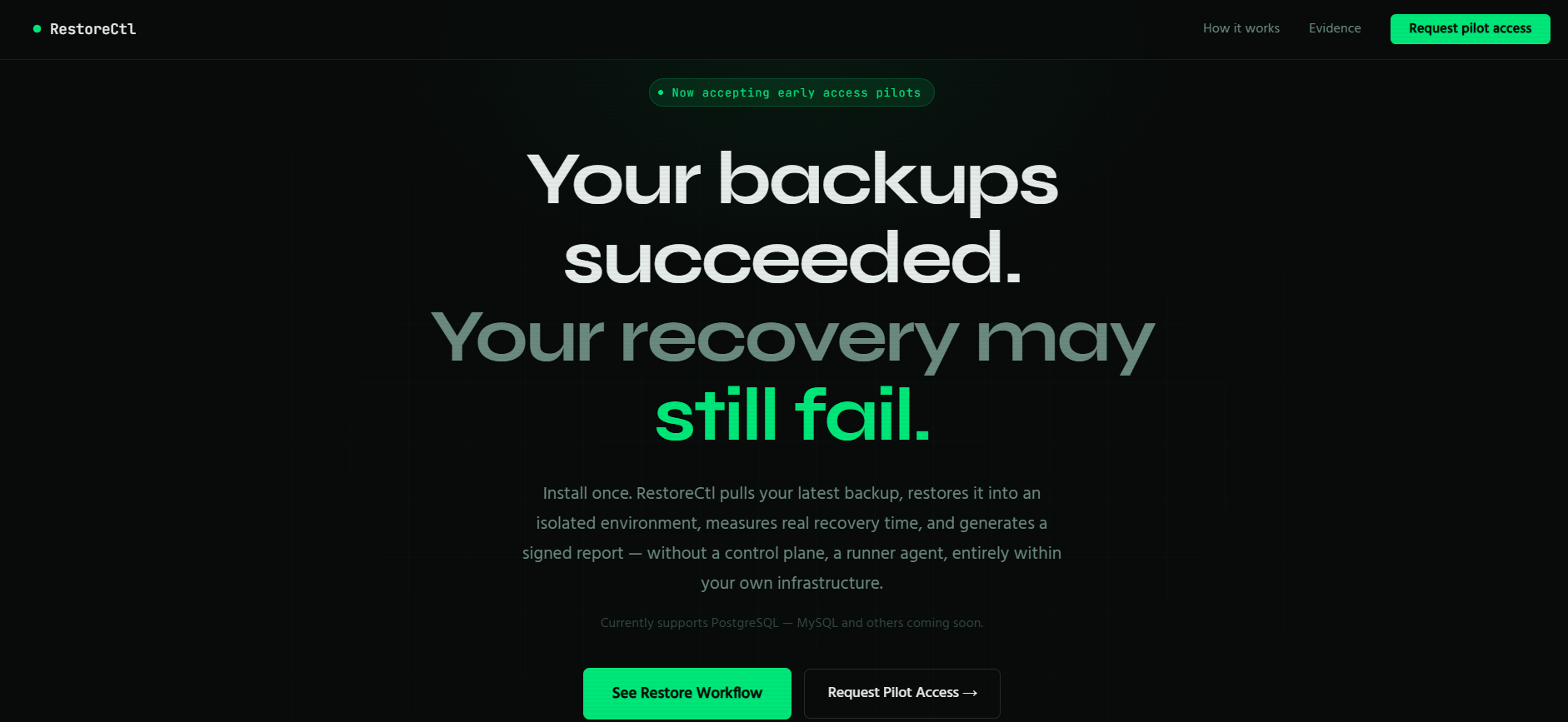
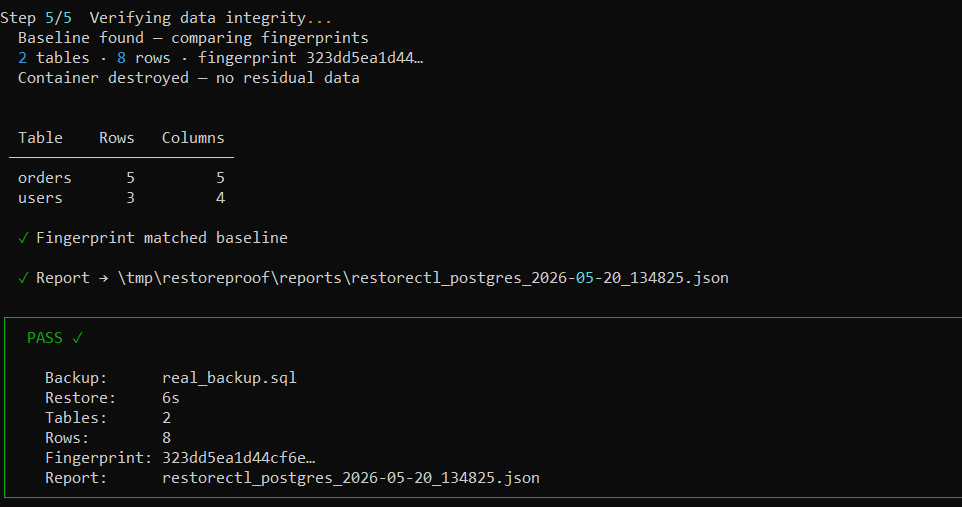
RestoreCtl automatically tests PostgreSQL backups by running real restore drills inside isolated environments.
It verifies backup integrity, measures actual recovery time (RTO), and generates audit-ready recovery reports, entirely within your own infrastructure.
No agents. No control plane. No cloud dashboard.
Compatible with existing PostgreSQL backup workflows, including pg_dump, pgBackRest, WAL-G, and custom backup pipelines.
Features
- Automated PostgreSQL restore drills
- Real recovery time (RTO) measurement
- Cryptographic integrity verification
- Ephemeral isolated restore environments
- Audit-ready PDF and JSON reports
- Works with existing backup pipelines
- Runs entirely inside your infrastructure
- No persistent agents or hosted control plane
Use Cases
Validate PostgreSQL backups automatically
Disaster recovery readiness testing
SOC 2 and ISO 27001 restore evidence
Detect corrupted or incomplete backups
Verify backup integrity before incidents happen
Measure real-world restore performance
Continuous backup recovery verification for production systems

Comments


RestoreCtl started after noticing a recurring problem in production systems: backups were “successful,” but nobody had actually verified whether recovery would work during a real incident. Most teams monitor backup creation. Very few continuously test restore integrity, recovery time, or whether data can actually be recovered correctly. RestoreCtl was built to automate restore drills for PostgreSQL backups inside isolated environments, validate integrity, measure real recovery time, and generate audit-ready reports, without requiring agents or a hosted control plane. Currently focused on PostgreSQL pilots and actively looking for feedback from DevOps, SRE, and platform engineering teams.

Strong positioning: testing the restore path is where most backup plans fail. A trend view for RTO over time and backup size would be especially useful for SRE teams, with alert thresholds when drill duration or verification failures regress. That would make the reports useful for capacity planning as well as audits.

The 'ephemeral isolated restore + real RTO measurement + cryptographic integrity check' combo is the right approach. Most teams treat a successful pg_dump as 'backup done' and never measure actual restore time until an incident forces them to. Audit-ready PDF/JSON for SOC 2 evidence is a smart touch too. Does the measured RTO scale with data volume, so you can see how recovery time grows as the DB gets bigger?

Premium Products




































Sponsors
Buy

Awards
View all
Awards
View allMakers
Makers
Comments
RestoreCtl started after noticing a recurring problem in production systems: backups were “successful,” but nobody had actually verified whether recovery would work during a real incident. Most teams monitor backup creation. Very few continuously test restore integrity, recovery time, or whether data can actually be recovered correctly. RestoreCtl was built to automate restore drills for PostgreSQL backups inside isolated environments, validate integrity, measure real recovery time, and generate audit-ready reports, without requiring agents or a hosted control plane. Currently focused on PostgreSQL pilots and actively looking for feedback from DevOps, SRE, and platform engineering teams.
Strong positioning: testing the restore path is where most backup plans fail. A trend view for RTO over time and backup size would be especially useful for SRE teams, with alert thresholds when drill duration or verification failures regress. That would make the reports useful for capacity planning as well as audits.
The 'ephemeral isolated restore + real RTO measurement + cryptographic integrity check' combo is the right approach. Most teams treat a successful pg_dump as 'backup done' and never measure actual restore time until an incident forces them to. Audit-ready PDF/JSON for SOC 2 evidence is a smart touch too. Does the measured RTO scale with data volume, so you can see how recovery time grows as the DB gets bigger?
Premium Products
New to Fazier?

Find your next favorite product or submit your own. Made by @FalakDigital.
Copyright ©2026. All Rights Reserved