
RepoRanker
Get real code reviews from real developers
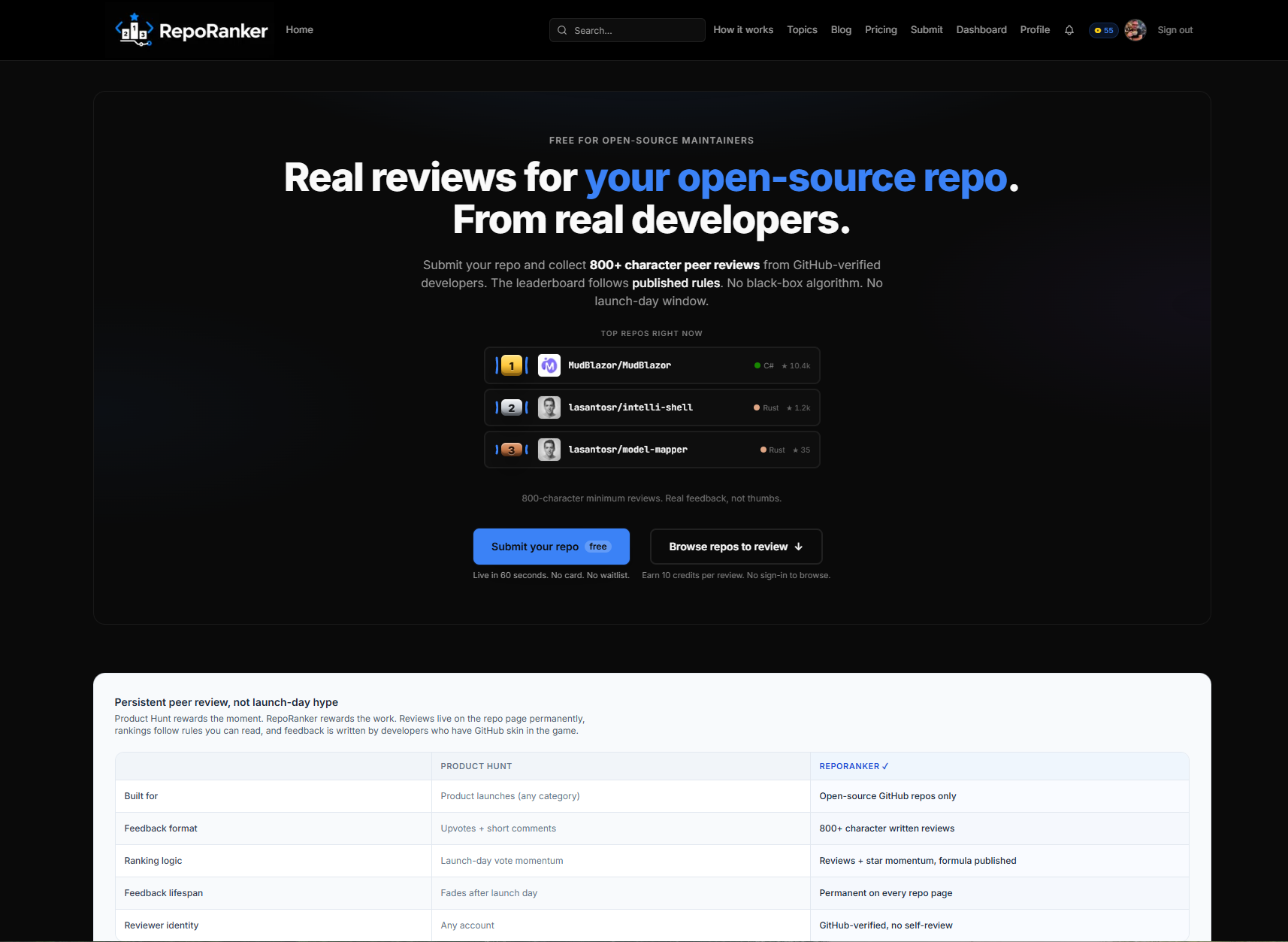
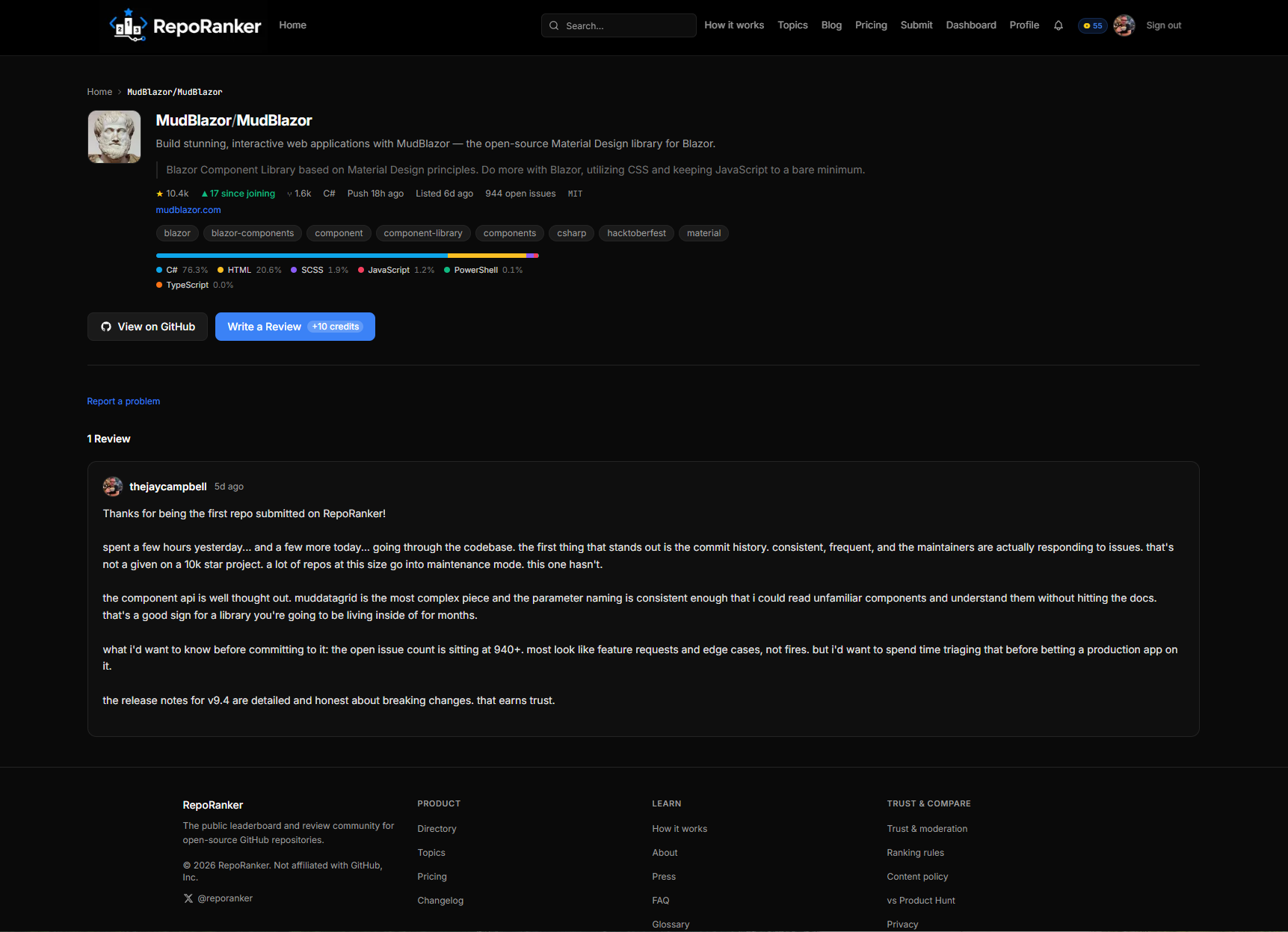
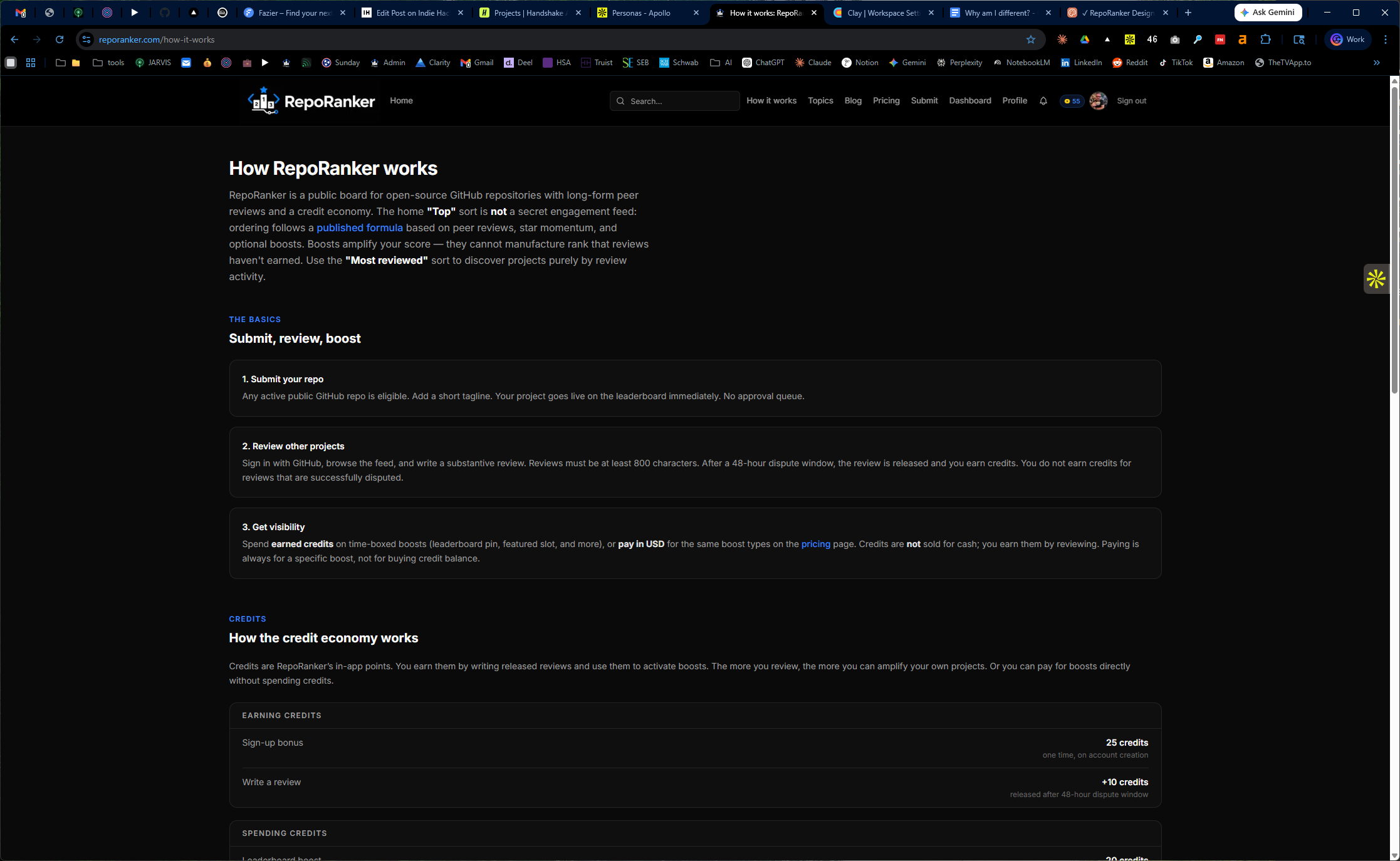
Get real code reviews from developers who actually use GitHub. Submit your open-source repo, earn credits by reviewing others, and use those credits to boost your project's visibility. Reviews require 800+ characters and GitHub authentication — no spam, no drive-bys. The ranking algorithm is fully transparent, published for anyone to audit.
Features
- Submit any open-source GitHub repository for free
- GitHub OAuth only — every reviewer is a verified developer
- Earn 10 credits per approved review
- Spend credits on visibility boosts starting at $2
- 800-character minimum review requirement — quality enforced
- Published, transparent ranking algorithm
- Maintainer dispute window — flag bad reviews within 48 hours
- No self-reviews allowed
Use Cases
- Indie developers who want feedback before a public launch
- Open-source maintainers looking to grow contributor interest
- Developers building a portfolio who want credible peer validation
- Side project builders who need an outside perspective on their code
- Teams evaluating open-source tools before adopting them
- Developers who want visibility without paying for ads

Comments

Hey Fazier community, I built RepoRanker because I kept running into the same problem. I'd ship an open-source project, post it somewhere, get a handful of upvotes, and walk away with zero useful feedback. Just vibes. No signal. I wanted a place where developers could get real, substantive reviews from people who actually write code. Not stars. Not likes. Actual written feedback with accountability behind it. So I built the credit economy around that idea. You earn credits by reviewing others. You spend them on visibility. The people most invested in quality are the ones with the most influence on the platform. That felt right. The ranking algorithm is fully public. You can read exactly how scores are calculated. No black box, no pay-to-win beyond small visibility boosts. Still early days. Would love to know what you think — what's missing, what's confusing, what you'd use it for. Drop a comment or just go submit a repo and tell me how it feels. Thanks for checking it out. Jay


The GitHub OAuth requirement is the right call — it filters out noise immediately and makes every review actually meaningful. Most feedback platforms struggle with quality control, but tying reviews to real GitHub accounts solves that at the source. The credit system is clever too. Forcing reviewers to give before they can boost means the platform stays self-sustaining without becoming pay-to-win. The 800-character minimum is a good threshold—long enough to require genuine thought, short enough that it's not a burden. One suggestion: consider adding a "reviewer expertise" tag based on their GitHub language stats. So if someone primarily writes Python, their review on a Python repo carries a visible badge. Would add another layer of credibility to the review scores. Question—how do you handle repos that are mostly configuration or DevOps focused (Dockerfiles, CI pipelines, Terraform)? Is the review format flexible enough for infrastructure code, or is it primarily aimed at application-level code?
The GitHub OAuth requirement is the right call — it filters out noise immediately and makes every review actually meaningful. Most feedback platforms struggle with quality control, but tying reviews to real GitHub accounts solves that at the source. The credit system is clever too. Forcing reviewers to give before they can boost means the platform stays self-sustaining without becoming pay-to-win. The 800-character minimum is a good threshold—long enough to require genuine thought, short enough that it's not a burden. One suggestion: consider adding a "reviewer expertise" tag based on their GitHub language stats. So if someone primarily writes Python, their review on a Python repo carries a visible badge. Would add another layer of credibility to the review scores. Question—how do you handle repos that are mostly configuration or DevOps focused (Dockerfiles, CI pipelines, Terraform)? Is the review format flexible enough for infrastructure code, or is it primarily aimed at application-level code?



Really interesting concept. Getting peer code reviews from actual developers rather than automated tools fills a clear gap. The GitHub OAuth requirement for reviewers is smart — it adds accountability without creating too much friction. I would love to see a subject-matter tagging system so reviewers can indicate their language specialty, making it easier for repo owners to find the most relevant feedback.


RepoRanker feels like a much more useful alternative to the usual “drop your GitHub repo and get a few likes” launch platforms. I like that reviews require GitHub authentication and a real 800+ character response, because that immediately filters out low-effort feedback and makes the review quality more credible. The credit system is also smart: people have to contribute thoughtful reviews before they can boost their own project, which makes the platform feel more balanced than pure paid promotion. One thing I’d be curious about is whether reviews can be tagged by expertise, such as frontend, backend, DevOps, AI, or design, so maintainers can better understand where the feedback is coming from.

Quotaflow is a useful tool for teams using AI coding agents, LLM APIs, or multiple AI subscriptions who want to improve how their quota and token capacity is used. Instead of letting paid AI resources sit idle or run out unpredictably, Quotaflow helps teams manage temporary access, overflow capacity, and shared AI resource utilization in a more controlled way. For engineering and product teams that care about AI cost efficiency and operational visibility, Quotaflow is worth checking out: https://quotaflow.ai
Really like the concept here. Getting useful feedback on open-source projects is surprisingly hard, especially for indie devs or side projects without an existing audience. The GitHub OAuth requirement and 800-character minimum are smart touches because they make the reviews feel more intentional and less like quick drive-by comments. I also like the credit system since it encourages people to review other projects instead of only promoting their own. The transparent ranking algorithm is probably the strongest part for me — a lot of project directories feel like a black box, so publishing how visibility works builds trust. Curious to see how review quality is handled over time, but overall this feels like a genuinely useful tool for open-source builders.

RepoRanker ~ Community Reactions are live You can now react to reviews on any repo page. 👍 ❤️ 🔥 💡 Click any reaction under a review to add yours. Click again to remove it. Reactions work on owner replies too. Counts update instantly. This is a small thing that adds a lot. Reviewers can now see which of their feedback actually landed. Also: RepoRanker hit #1 Product of the Day on Fazier. Thanks to everyone who showed up for that. Try it: open any repo with a released review and hit a reaction. Sign in with GitHub if you haven't already. reporanker.com

The infrastructure code question from Muhammad is worth addressing publicly — DevOps repos (Dockerfiles, CI pipelines, Terraform) are some of the hardest to get reviewed because most developers don't feel qualified. If you can route reviews by GitHub language stats, that's a genuine differentiator. One angle worth considering: repos that are actively monitored in production carry more credibility than abandoned side projects. A "live in production" badge could add signal to the ranking algorithm.
Shipped: everything you asked for Been working through the feedback from launch week. Here's what just went live: Language filtering — browse by language now. TypeScript, Python, Rust, Go — each has its own leaderboard page with full sort/search/time filters. Language pills are on the homepage too so you can get there in one click. Repo type tags — when you submit (or edit your existing listing), you can now tag your repo as Application, Library, DevOps tool, CLI, or Other. Shows as a badge on your card and has its own filter page at /types/[type]. Live in production badge — check the box when submitting or editing to signal that your project is actively running in production. A small "Live" badge shows on your card. 3× credits for sought reviews — if a maintainer activates the review-request boost, reviewers now earn 30 credits instead of 20 (up from 2× to 3×). The badge and banners make it obvious which repos have this active. All of this was directly from the comments. Keep them coming — this is exactly the feedback loop that makes the platform better.


The credit economy mechanic is smart — aligning incentives so reviewers are also the ones with visibility makes the feedback loop self-sustaining. Curious how you're handling review quality over time as the platform scales. Do you have any moderation or reputation decay built in? I'm building in the job search space and ran into similar challenges with user-generated content quality.
Premium Products



































Sponsors
Buy

Awards
View all
Awards
View allMakers
Makers
Comments
Hey Fazier community, I built RepoRanker because I kept running into the same problem. I'd ship an open-source project, post it somewhere, get a handful of upvotes, and walk away with zero useful feedback. Just vibes. No signal. I wanted a place where developers could get real, substantive reviews from people who actually write code. Not stars. Not likes. Actual written feedback with accountability behind it. So I built the credit economy around that idea. You earn credits by reviewing others. You spend them on visibility. The people most invested in quality are the ones with the most influence on the platform. That felt right. The ranking algorithm is fully public. You can read exactly how scores are calculated. No black box, no pay-to-win beyond small visibility boosts. Still early days. Would love to know what you think — what's missing, what's confusing, what you'd use it for. Drop a comment or just go submit a repo and tell me how it feels. Thanks for checking it out. Jay
The GitHub OAuth requirement is the right call — it filters out noise immediately and makes every review actually meaningful. Most feedback platforms struggle with quality control, but tying reviews to real GitHub accounts solves that at the source. The credit system is clever too. Forcing reviewers to give before they can boost means the platform stays self-sustaining without becoming pay-to-win. The 800-character minimum is a good threshold—long enough to require genuine thought, short enough that it's not a burden. One suggestion: consider adding a "reviewer expertise" tag based on their GitHub language stats. So if someone primarily writes Python, their review on a Python repo carries a visible badge. Would add another layer of credibility to the review scores. Question—how do you handle repos that are mostly configuration or DevOps focused (Dockerfiles, CI pipelines, Terraform)? Is the review format flexible enough for infrastructure code, or is it primarily aimed at application-level code?
The GitHub OAuth requirement is the right call — it filters out noise immediately and makes every review actually meaningful. Most feedback platforms struggle with quality control, but tying reviews to real GitHub accounts solves that at the source. The credit system is clever too. Forcing reviewers to give before they can boost means the platform stays self-sustaining without becoming pay-to-win. The 800-character minimum is a good threshold—long enough to require genuine thought, short enough that it's not a burden. One suggestion: consider adding a "reviewer expertise" tag based on their GitHub language stats. So if someone primarily writes Python, their review on a Python repo carries a visible badge. Would add another layer of credibility to the review scores. Question—how do you handle repos that are mostly configuration or DevOps focused (Dockerfiles, CI pipelines, Terraform)? Is the review format flexible enough for infrastructure code, or is it primarily aimed at application-level code?
Really interesting concept. Getting peer code reviews from actual developers rather than automated tools fills a clear gap. The GitHub OAuth requirement for reviewers is smart — it adds accountability without creating too much friction. I would love to see a subject-matter tagging system so reviewers can indicate their language specialty, making it easier for repo owners to find the most relevant feedback.
RepoRanker feels like a much more useful alternative to the usual “drop your GitHub repo and get a few likes” launch platforms. I like that reviews require GitHub authentication and a real 800+ character response, because that immediately filters out low-effort feedback and makes the review quality more credible. The credit system is also smart: people have to contribute thoughtful reviews before they can boost their own project, which makes the platform feel more balanced than pure paid promotion. One thing I’d be curious about is whether reviews can be tagged by expertise, such as frontend, backend, DevOps, AI, or design, so maintainers can better understand where the feedback is coming from.
Quotaflow is a useful tool for teams using AI coding agents, LLM APIs, or multiple AI subscriptions who want to improve how their quota and token capacity is used. Instead of letting paid AI resources sit idle or run out unpredictably, Quotaflow helps teams manage temporary access, overflow capacity, and shared AI resource utilization in a more controlled way. For engineering and product teams that care about AI cost efficiency and operational visibility, Quotaflow is worth checking out: https://quotaflow.ai
Really like the concept here. Getting useful feedback on open-source projects is surprisingly hard, especially for indie devs or side projects without an existing audience. The GitHub OAuth requirement and 800-character minimum are smart touches because they make the reviews feel more intentional and less like quick drive-by comments. I also like the credit system since it encourages people to review other projects instead of only promoting their own. The transparent ranking algorithm is probably the strongest part for me — a lot of project directories feel like a black box, so publishing how visibility works builds trust. Curious to see how review quality is handled over time, but overall this feels like a genuinely useful tool for open-source builders.
RepoRanker ~ Community Reactions are live You can now react to reviews on any repo page. 👍 ❤️ 🔥 💡 Click any reaction under a review to add yours. Click again to remove it. Reactions work on owner replies too. Counts update instantly. This is a small thing that adds a lot. Reviewers can now see which of their feedback actually landed. Also: RepoRanker hit #1 Product of the Day on Fazier. Thanks to everyone who showed up for that. Try it: open any repo with a released review and hit a reaction. Sign in with GitHub if you haven't already. reporanker.com
The infrastructure code question from Muhammad is worth addressing publicly — DevOps repos (Dockerfiles, CI pipelines, Terraform) are some of the hardest to get reviewed because most developers don't feel qualified. If you can route reviews by GitHub language stats, that's a genuine differentiator. One angle worth considering: repos that are actively monitored in production carry more credibility than abandoned side projects. A "live in production" badge could add signal to the ranking algorithm.
Shipped: everything you asked for Been working through the feedback from launch week. Here's what just went live: Language filtering — browse by language now. TypeScript, Python, Rust, Go — each has its own leaderboard page with full sort/search/time filters. Language pills are on the homepage too so you can get there in one click. Repo type tags — when you submit (or edit your existing listing), you can now tag your repo as Application, Library, DevOps tool, CLI, or Other. Shows as a badge on your card and has its own filter page at /types/[type]. Live in production badge — check the box when submitting or editing to signal that your project is actively running in production. A small "Live" badge shows on your card. 3× credits for sought reviews — if a maintainer activates the review-request boost, reviewers now earn 30 credits instead of 20 (up from 2× to 3×). The badge and banners make it obvious which repos have this active. All of this was directly from the comments. Keep them coming — this is exactly the feedback loop that makes the platform better.
The credit economy mechanic is smart — aligning incentives so reviewers are also the ones with visibility makes the feedback loop self-sustaining. Curious how you're handling review quality over time as the platform scales. Do you have any moderation or reputation decay built in? I'm building in the job search space and ran into similar challenges with user-generated content quality.
Premium Products
New to Fazier?

Find your next favorite product or submit your own. Made by @FalakDigital.
Copyright ©2026. All Rights Reserved