
Relatch
Turn your docs into custom claude & codex skills
Every AI conversation starts completely blank. You spend months teaching Claude how your business runs or Codex how your codebase is structured, only to have to do it all over again tomorrow. Relatch was built to fix this.
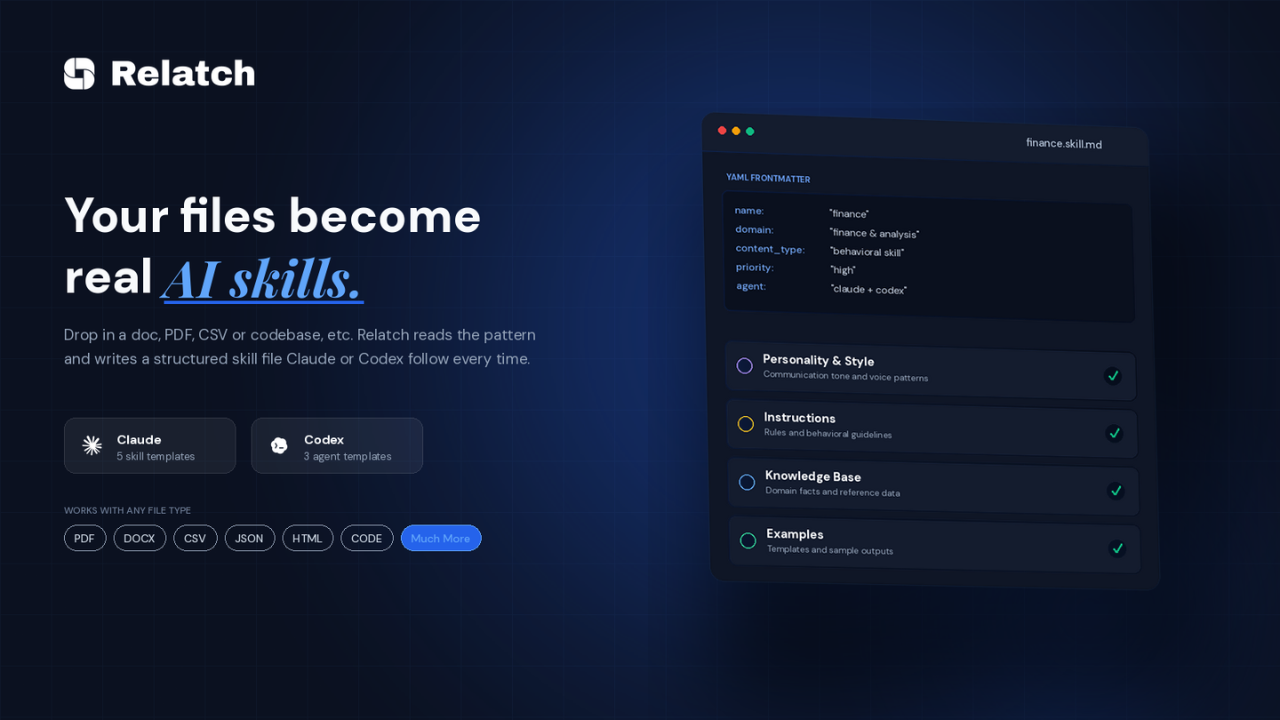
We realized early on that the biggest problem with modern tools isn't that we forget things it's that our AI forgets us. Relatch acts as your AI's persistent memory. You simply upload the documents you already have PDFs, code, style guides, CSVs and Relatch converts them into structured Skill Files. These files install directly into Claude or Codex, bringing your exact context into every session.
While you could technically ask an AI to summarize your files, you usually get generic, useless advice that applies to anyone. Relatch removes that manual iteration. Every Skill File passes through a strict scoring system that rejects vague outputs. Furthermore, we know that different models need different context: Relatch generates persona-driven templates specifically for Claude, and execution-playbooks specifically for Codex.
It’s your knowledge, packaged perfectly for the AI you use.
Features
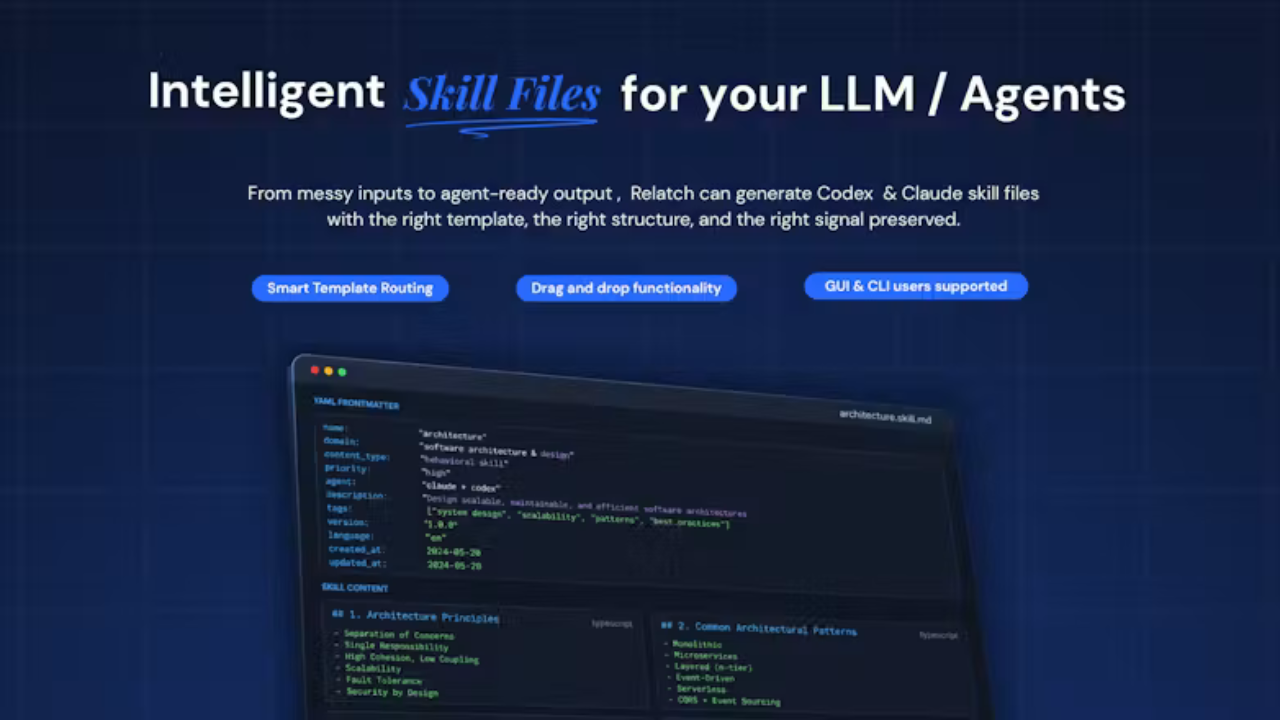
- Document to Skill File Conversion: Transforms unstructured documents, code, and data into structured, AI-ready knowledge files (Skill Files) tailored for Claude Projects and OpenAI Codex CLI.
- Unified Multi-Format Support: Handles a wide variety of file types in a single upload, including PDFs (with scan-based OCR support), DOCX, CSVs, XML, Markdown, TXT, JSON, spreadsheets, notes, and codebase files.
- Model-Specific Formatting: Generates five distinct persona-driven templates optimized for Claude, and three execution-focused playbooks specifically for Codex.
- Automated Knowledge Identification: Automatically identifies the context of your uploads and applies suitable enrichment templates (e.g., persona and voice, codebase intelligence, process workflows, domain expertise, or financial data).
- Smart Extraction & Structuring: Extracts text, tables, rules, and workflows while preserving code structure. It adds YAML metadata, decision logic, and guardrails for highly effective AI integration.
- Strict Output Scoring System: Utilizes a rigorous internal scoring system that automatically rejects and rebuilds vague or generic outputs, ensuring you only receive actionable context.
- Seamless Export Packages: Easily exports SKILL.md files for Claude Projects, and ZIP packages (containing SKILL.md and agents/openai.yaml) for the OpenAI Codex CLI.
- Persistent AI Memory: Removes the need to start every AI conversation from a blank slate by seamlessly carrying your actual rules, style, and processes into every session.
Use Cases
For software engineering teams, Relatch is invaluable for onboarding and maintaining code quality. By uploading existing architecture documentation, coding guidelines, and sample codebase files, Relatch generates a structured execution playbook for the OpenAI Codex CLI. This allows developers to instantly ask their AI coding assistant to generate or review code that perfectly adheres to proprietary standards, completely bypassing the need to manually explain the tech stack in every new session.
Marketing and content teams can use Relatch to enforce strict brand consistency across all written materials. By uploading brand style guides, tone-of-voice documents, and top-performing past articles, Relatch creates a custom persona-driven template optimized for Claude Projects. Writers can then use this skill file to draft emails, blog posts, or ad copy that instantly matches the company's unique voice, eliminating the generic, robotic output that usually comes from basic AI prompting.
Business analysts and operations managers can leverage Relatch to build specialized, context-aware data assistants. Users can upload mixed data formats such as CSVs, JSON files, and internal process workflows in a single batch. Relatch extracts and structures this information with the correct decision logic and guardrails, meaning your AI will immediately understand how to interpret your specific company metrics and run internal reports according to your exact business rules.
Customer support and HR departments can turn their scattered internal documentation into a highly reliable AI specialist. By uploading resolution workflows, policy PDFs, and training manuals, Relatch builds a structured skill file that knows precisely how your organization handles escalations, troubleshooting, or employee onboarding. Agents can plug this skill file directly into their AI tools to draft highly accurate, policy-compliant responses without having to dig through dense company wikis.

Comments




The part that bit me with skill files is not the body, it is the description line at the top. A skill with a well written body still never loads if that one line does not match the way you actually phrase the request, and you only notice when the model quietly ignores it. Does the scoring step check the trigger description too, or only the content underneath it?

Every AI conversation starts blank. You can spend months teaching Claude or Codex how you write, how your codebase is structured, or how your business runs, and none of it carries over to the next session. Relatch was built to close that gap. You upload documents you already have, style guides, codebase files, process notes, financial data, and it converts them into a Skill File, a structured document that installs directly into Claude or Codex and teaches it how you actually think and work. Claude and Codex can technically do this already if you just ask them. That is not in dispute. The problem shows up in the output. Ask either one to summarize your style from raw documents and you typically get something like focus on users, think long term, communicate clearly, sentences that could describe almost any professional. Getting past that takes several rounds of manual prompting, and most people give up before they get there. Relatch exists to remove that iteration. Every output is checked against a strict scoring system before it reaches you, and anything vague or generic gets rejected and rebuilt. Claude and Codex also do not need the same kind of file. Claude responds better to a persona style profile, while Codex needs something closer to an execution playbook, so Relatch builds five different template types for Claude and three for Codex instead of forcing one format onto both. Mixed file types, PDFs, DOCX, code, and CSVs, are handled in a single upload rather than separately. Relatch did not start out this way. The first version was a tool meant to help people revisit saved articles and notes they never returned to. It shipped, and almost nobody came back to it. That failure pointed at a different problem: it was not that people forgot what they saved, it was that their tools, especially AI, forgot them. That shift in understanding is the reason Relatch exists in its current form, as a way to carry what you already know into every AI session instead of starting over each time.

Turning existing PDFs, code, style guides, CSVs, and chats into structured Skill Files is a compelling way to reduce repeated context setup. I especially like the scoring step to filter vague outputs. Can users version and review changes to a Skill File before making it available to Claude or Codex?

How does the scoring step handle conflicting instructions across uploaded documents? For example, an old API guide may say one endpoint while the current spec says another. Showing source references and flagging the conflict for review would make the generated skill easier to trust than silently choosing one.
Premium Products










































Sponsors
Buy

Awards
View all
Awards
View allMakers
Makers
Comments
The part that bit me with skill files is not the body, it is the description line at the top. A skill with a well written body still never loads if that one line does not match the way you actually phrase the request, and you only notice when the model quietly ignores it. Does the scoring step check the trigger description too, or only the content underneath it?
Every AI conversation starts blank. You can spend months teaching Claude or Codex how you write, how your codebase is structured, or how your business runs, and none of it carries over to the next session. Relatch was built to close that gap. You upload documents you already have, style guides, codebase files, process notes, financial data, and it converts them into a Skill File, a structured document that installs directly into Claude or Codex and teaches it how you actually think and work. Claude and Codex can technically do this already if you just ask them. That is not in dispute. The problem shows up in the output. Ask either one to summarize your style from raw documents and you typically get something like focus on users, think long term, communicate clearly, sentences that could describe almost any professional. Getting past that takes several rounds of manual prompting, and most people give up before they get there. Relatch exists to remove that iteration. Every output is checked against a strict scoring system before it reaches you, and anything vague or generic gets rejected and rebuilt. Claude and Codex also do not need the same kind of file. Claude responds better to a persona style profile, while Codex needs something closer to an execution playbook, so Relatch builds five different template types for Claude and three for Codex instead of forcing one format onto both. Mixed file types, PDFs, DOCX, code, and CSVs, are handled in a single upload rather than separately. Relatch did not start out this way. The first version was a tool meant to help people revisit saved articles and notes they never returned to. It shipped, and almost nobody came back to it. That failure pointed at a different problem: it was not that people forgot what they saved, it was that their tools, especially AI, forgot them. That shift in understanding is the reason Relatch exists in its current form, as a way to carry what you already know into every AI session instead of starting over each time.
Turning existing PDFs, code, style guides, CSVs, and chats into structured Skill Files is a compelling way to reduce repeated context setup. I especially like the scoring step to filter vague outputs. Can users version and review changes to a Skill File before making it available to Claude or Codex?
How does the scoring step handle conflicting instructions across uploaded documents? For example, an old API guide may say one endpoint while the current spec says another. Showing source references and flagging the conflict for review would make the generated skill easier to trust than silently choosing one.
Premium Products
New to Fazier?

Find your next favorite product or submit your own. Made by @FalakDigital.
Copyright ©2026. All Rights Reserved