
RankOrange GEO Audit
Free AI-search readiness checks for any public page
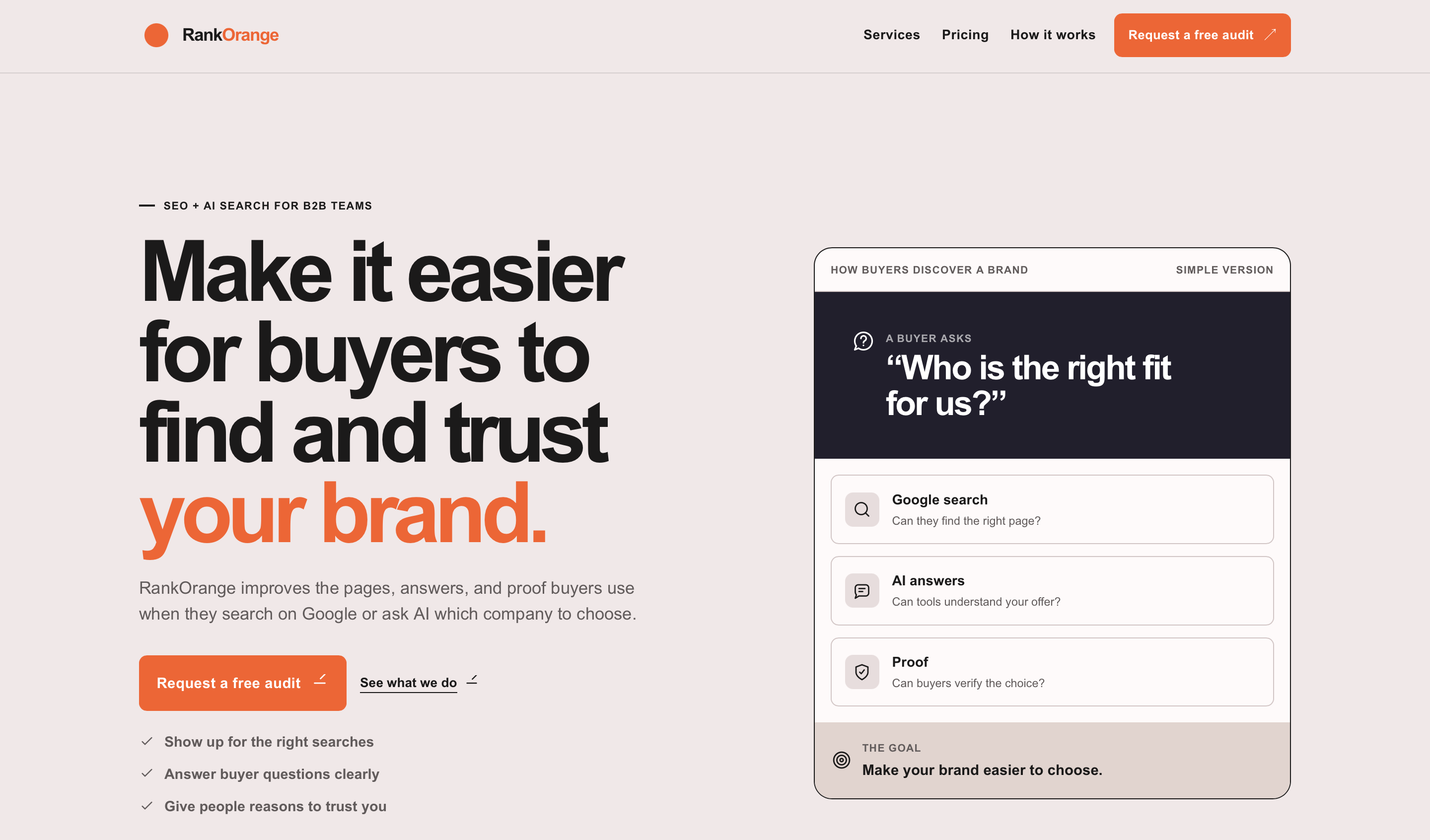
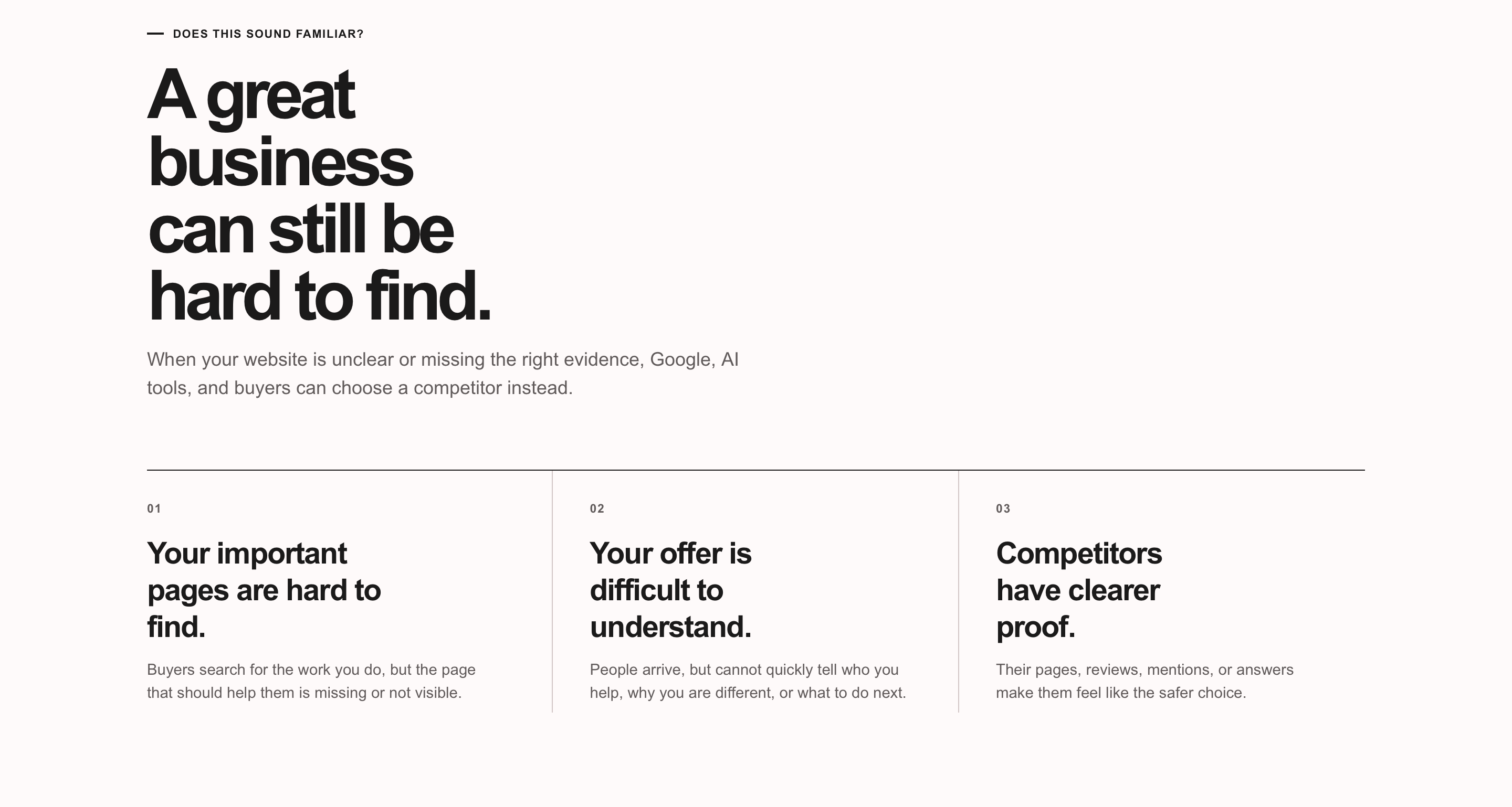
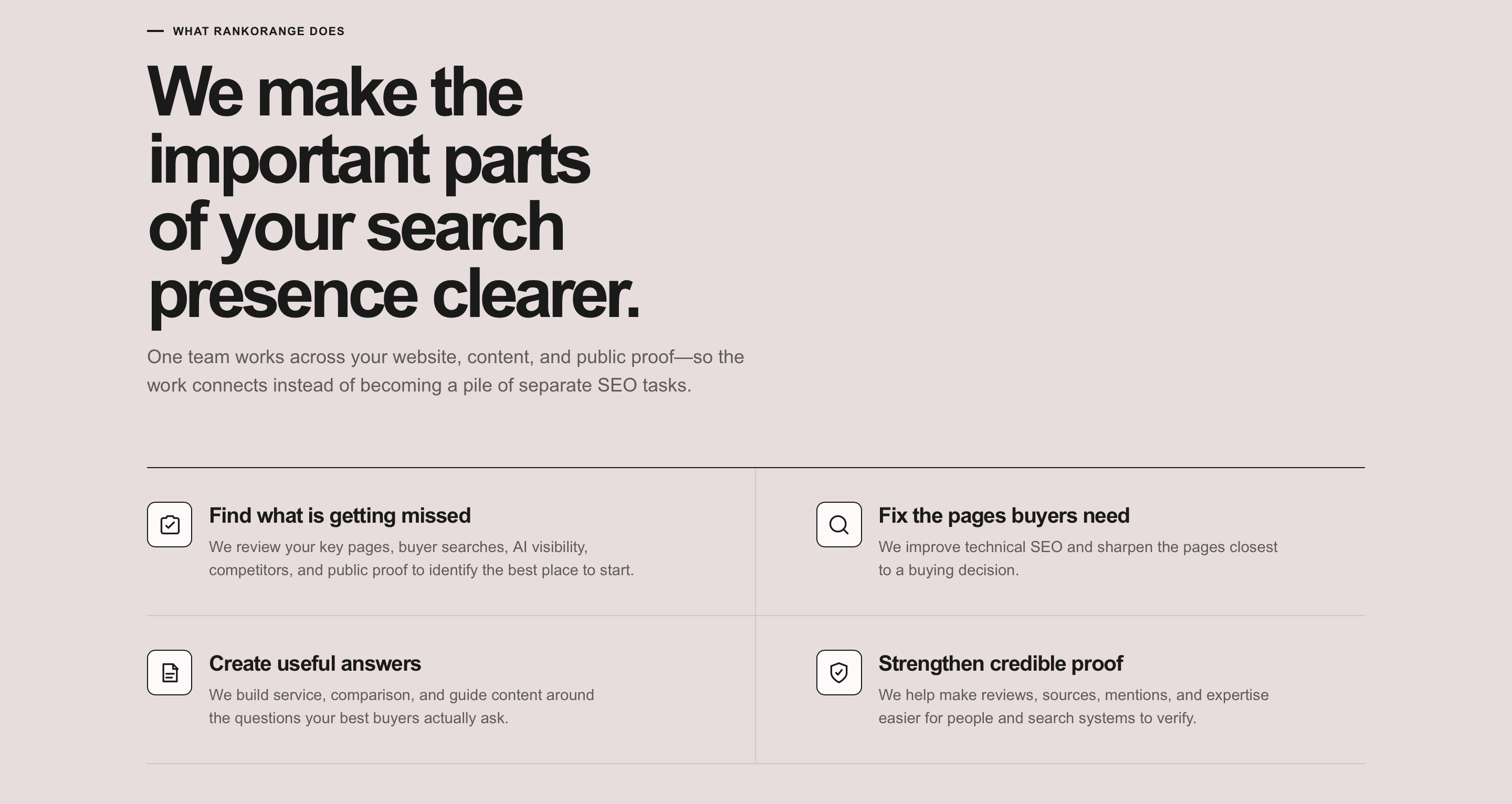
RankOrange gives B2B, SaaS, and expert-led teams a free, no-signup GEO audit for any public web page. It checks crawlability, robots.txt and sitemap access, titles, headings, canonical URLs, structured data, and answer-ready content signals, then returns practical tasks to improve visibility in Google and AI answer engines.
Features
Free public-page audit
No signup or account connection
Crawl, structure, schema, and AI-readiness checks
Clear prioritized recommendations
Use Cases
B2B teams preparing pages for AI search
SaaS marketers auditing product and category pages
Agencies spotting technical and content gaps

Comments


Clean landing page and the value prop is easy to get in a few seconds. After trying the core flow, the main friction was figuring out pricing limits before signing up. A small comparison table (Free vs Pro features) near the CTA would reduce drop-off. Looking forward to seeing how you handle onboarding for first-time users.

Ran a clean technical pass on my own docs subdomain two weeks ago and Google still has 0 of 3 pages indexed, so the check I keep wanting is one that separates technically eligible from actually picked up. Does the audit show whether a page that passes every check ever gets cited, or is that out of scope for a free one page scan?

No-signup is the right call for a first audit - most GEO/SEO tools gate the report behind an email and that kills trial volume. Checking robots.txt/sitemap access alongside structured data and answer-ready content signals in one pass covers both the crawl layer and the content layer, which most tools split into separate products. Like Lenya asked, historical tracking would be the natural next step so teams can see if their fixes actually moved the needle instead of re-running one-off checks.

I like that this looks at both crawlability and whether the content is actually easy for answer engines to understand. One thing I’d find really useful is separating the recommendations into “SEO fundamentals”, “AI/GEO-specific”, and “affects both”. A lot of GEO audits mix things like canonicals, schema, and content structure together, so it’s hard to tell what’s genuinely different from a normal SEO audit. That distinction would make the report much more useful when deciding what to fix first.
I like that this looks at both crawlability and whether the content is actually easy for answer engines to understand. One thing I’d find really useful is separating the recommendations into “SEO fundamentals”, “AI/GEO-specific”, and “affects both”. A lot of GEO audits mix things like canonicals, schema, and content structure together, so it’s hard to tell what’s genuinely different from a normal SEO audit. That distinction would make the report much more useful when deciding what to fix first.
I like that this looks at both crawlability and whether the content is actually easy for answer engines to understand. One thing I’d find really useful is separating the recommendations into “SEO fundamentals”, “AI/GEO-specific”, and “affects both”. A lot of GEO audits mix things like canonicals, schema, and content structure together, so it’s hard to tell what’s genuinely different from a normal SEO audit. That distinction would make the report much more useful when deciding what to fix first.
Ran it on a couple of our content pages. Useful that it flags canonical and structured data in one pass, that is exactly where our AI-citation hits and misses came from: pages with clean FAQ JSON-LD that matched the visible text got quoted by answer engines, pages where the schema drifted from the copy did not. Two things I would add to the checklist: whether llms.txt exists and points at the right hubs, and whether hreflang alternates resolve, since on a multilingual site half the "missing" signals were just the wrong language version being crawled.


Reddy Anna offers quick account access, sports updates, and a smooth user experience at https://reddyannapro.in/



The no-signup audit is a nice touch. I like that it checks both the traditional technical SEO basics and the signals that can affect how a page is understood by AI search engines. Having the results turned into prioritized tasks makes the audit much more actionable than just showing a list of technical issues.




Ran my site through this and got what looks like a false negative: "A readable sitemap was not found" for a sitemap that is there and valid. https://esimlane.com/sitemap.xml returns 200 with Content-Type application/xml, parses clean under a strict XML parser, 875 <loc> entries, no unescaped ampersands. Nothing wrong with it as far as I can tell. I think the problem is size. It is about 604 KB uncompressed because each URL carries six hreflang alternates, so 875 URLs turns into 5,250 xhtml:link nodes. I cut that response at 32/64/100/128/256/512/600 KB and every truncated version fails to parse. It only parses from about 700 KB up. If the fetch reads a capped number of bytes, the document is never complete, so the check fails regardless of the sitemap. That will hit multilingual sites hardest, since the alternates multiply file size. The same URL count with hreflang runs about 6x bigger than a single-language sitemap. Reading to the end should fix it. Failing that, checking for the urlset root and closing tag before reporting would turn a truncated read into an error instead of "missing". The sitemap is not missing, and that is the one thing the check cannot actually see. Can send the raw response and the byte thresholds if you want them.





I like that the audit focuses on things you can actually act on, from indexing issues to canonical URLs and schema markup. It makes it easy to spot what needs attention without digging through multiple tools. Would be great to see a history feature too, so you could track what improved or changed between audits.

The no-signup GEO audit is the useful part: robots.txt, sitemap access, titles, canonicals, and structured data in one pass, then a task list rather than a vanity score. For agency category pages I would want the output to call out which answer-engine crawlers are blocked versus which pages just lack entity markup. A free vs paid comparison near the CTA would also help, since pricing limits were the only friction I spotted in the landing page.
RankOrange GEO Audit came from a recurring problem: teams know AI discovery matters but lack a fast way to see whether a page is crawlable and understandable. We built a free public-page audit that turns robots, sitemaps, headings, canonicals, schema, and answer-ready content into clear next steps. We'd love feedback on which audit signals would be most useful for your team.


Premium Products






























Sponsors
Buy

Awards
View all
Awards
View allMakers
Makers
Comments
Clean landing page and the value prop is easy to get in a few seconds. After trying the core flow, the main friction was figuring out pricing limits before signing up. A small comparison table (Free vs Pro features) near the CTA would reduce drop-off. Looking forward to seeing how you handle onboarding for first-time users.
Ran a clean technical pass on my own docs subdomain two weeks ago and Google still has 0 of 3 pages indexed, so the check I keep wanting is one that separates technically eligible from actually picked up. Does the audit show whether a page that passes every check ever gets cited, or is that out of scope for a free one page scan?
No-signup is the right call for a first audit - most GEO/SEO tools gate the report behind an email and that kills trial volume. Checking robots.txt/sitemap access alongside structured data and answer-ready content signals in one pass covers both the crawl layer and the content layer, which most tools split into separate products. Like Lenya asked, historical tracking would be the natural next step so teams can see if their fixes actually moved the needle instead of re-running one-off checks.
I like that this looks at both crawlability and whether the content is actually easy for answer engines to understand. One thing I’d find really useful is separating the recommendations into “SEO fundamentals”, “AI/GEO-specific”, and “affects both”. A lot of GEO audits mix things like canonicals, schema, and content structure together, so it’s hard to tell what’s genuinely different from a normal SEO audit. That distinction would make the report much more useful when deciding what to fix first.
I like that this looks at both crawlability and whether the content is actually easy for answer engines to understand. One thing I’d find really useful is separating the recommendations into “SEO fundamentals”, “AI/GEO-specific”, and “affects both”. A lot of GEO audits mix things like canonicals, schema, and content structure together, so it’s hard to tell what’s genuinely different from a normal SEO audit. That distinction would make the report much more useful when deciding what to fix first.
I like that this looks at both crawlability and whether the content is actually easy for answer engines to understand. One thing I’d find really useful is separating the recommendations into “SEO fundamentals”, “AI/GEO-specific”, and “affects both”. A lot of GEO audits mix things like canonicals, schema, and content structure together, so it’s hard to tell what’s genuinely different from a normal SEO audit. That distinction would make the report much more useful when deciding what to fix first.
Ran it on a couple of our content pages. Useful that it flags canonical and structured data in one pass, that is exactly where our AI-citation hits and misses came from: pages with clean FAQ JSON-LD that matched the visible text got quoted by answer engines, pages where the schema drifted from the copy did not. Two things I would add to the checklist: whether llms.txt exists and points at the right hubs, and whether hreflang alternates resolve, since on a multilingual site half the "missing" signals were just the wrong language version being crawled.
Reddy Anna offers quick account access, sports updates, and a smooth user experience at https://reddyannapro.in/
The no-signup audit is a nice touch. I like that it checks both the traditional technical SEO basics and the signals that can affect how a page is understood by AI search engines. Having the results turned into prioritized tasks makes the audit much more actionable than just showing a list of technical issues.
Ran my site through this and got what looks like a false negative: "A readable sitemap was not found" for a sitemap that is there and valid. https://esimlane.com/sitemap.xml returns 200 with Content-Type application/xml, parses clean under a strict XML parser, 875 <loc> entries, no unescaped ampersands. Nothing wrong with it as far as I can tell. I think the problem is size. It is about 604 KB uncompressed because each URL carries six hreflang alternates, so 875 URLs turns into 5,250 xhtml:link nodes. I cut that response at 32/64/100/128/256/512/600 KB and every truncated version fails to parse. It only parses from about 700 KB up. If the fetch reads a capped number of bytes, the document is never complete, so the check fails regardless of the sitemap. That will hit multilingual sites hardest, since the alternates multiply file size. The same URL count with hreflang runs about 6x bigger than a single-language sitemap. Reading to the end should fix it. Failing that, checking for the urlset root and closing tag before reporting would turn a truncated read into an error instead of "missing". The sitemap is not missing, and that is the one thing the check cannot actually see. Can send the raw response and the byte thresholds if you want them.
I like that the audit focuses on things you can actually act on, from indexing issues to canonical URLs and schema markup. It makes it easy to spot what needs attention without digging through multiple tools. Would be great to see a history feature too, so you could track what improved or changed between audits.
The no-signup GEO audit is the useful part: robots.txt, sitemap access, titles, canonicals, and structured data in one pass, then a task list rather than a vanity score. For agency category pages I would want the output to call out which answer-engine crawlers are blocked versus which pages just lack entity markup. A free vs paid comparison near the CTA would also help, since pricing limits were the only friction I spotted in the landing page.
RankOrange GEO Audit came from a recurring problem: teams know AI discovery matters but lack a fast way to see whether a page is crawlable and understandable. We built a free public-page audit that turns robots, sitemaps, headings, canonicals, schema, and answer-ready content into clear next steps. We'd love feedback on which audit signals would be most useful for your team.
Premium Products
New to Fazier?

Find your next favorite product or submit your own. Made by @FalakDigital.
Copyright ©2026. All Rights Reserved