
PromptSpend
The LLM price list that shows its sources
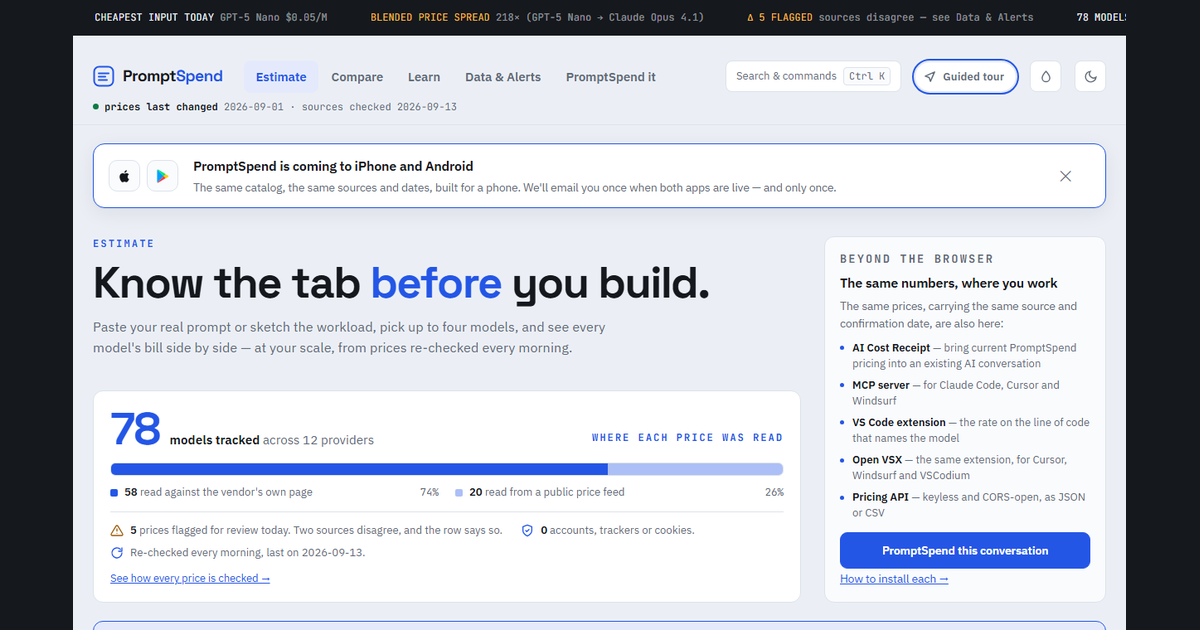
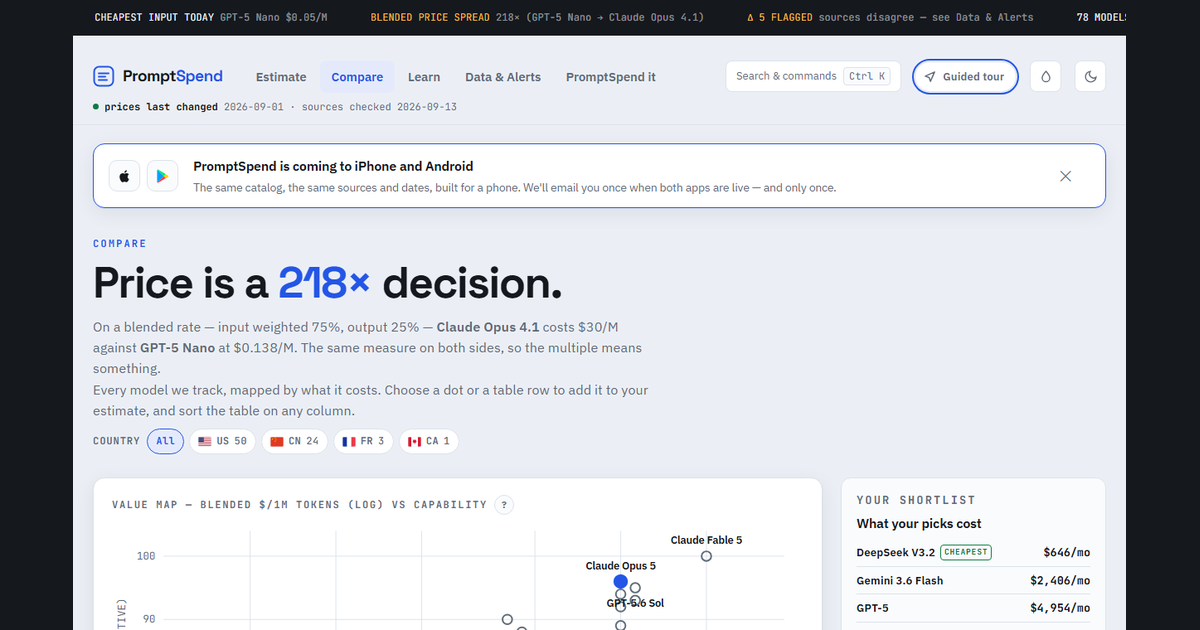
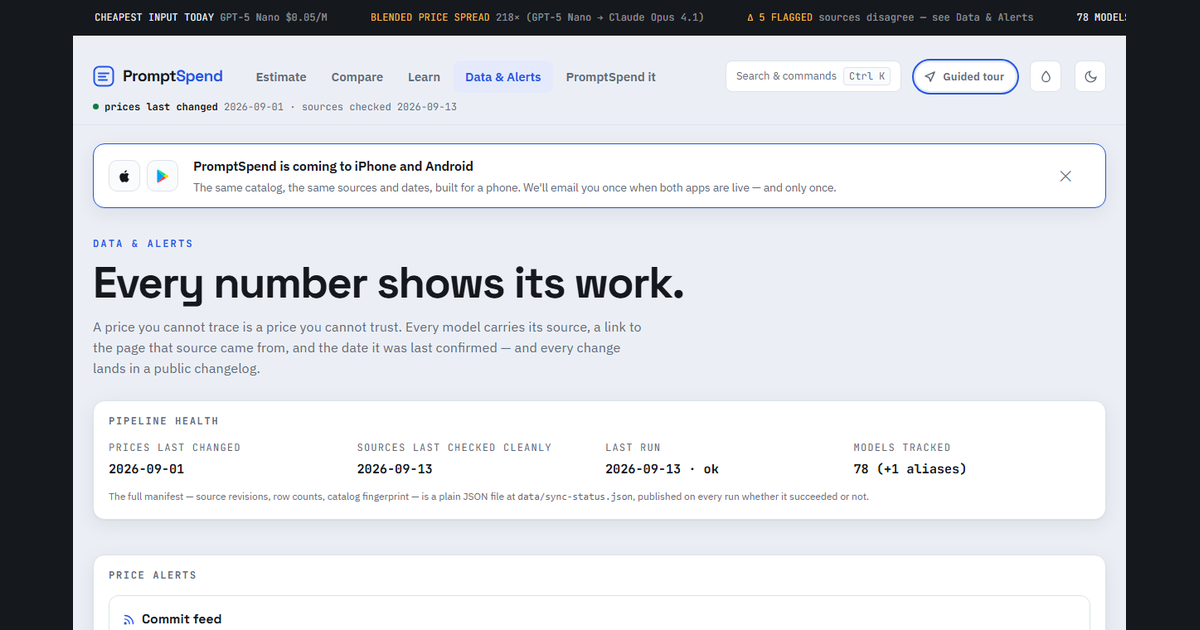
Every LLM cost calculator goes stale the moment a vendor reprices. PromptSpend re-checks its catalog every morning against vendor pages, flags disagreements instead of averaging over them, and shows the source URL and confirmation date on every number. Paste a real prompt or set your scale, compare up to four models side by side, and see the monthly cost — plus the two numbers every calculator gets wrong: compounding chat history and hidden reasoning tokens. Free, no account, open source.
Runs on the web, iPhone, iPad and Android, with a keyless API, an MCP server and a VS Code extension. Pasted text in the apps is counted on the device and never uploaded. Estimates use list prices; they are not bills.
Features
Prices re-checked against vendor pages every morning
Source URL and confirmation date on every price
Compare up to four models side by side
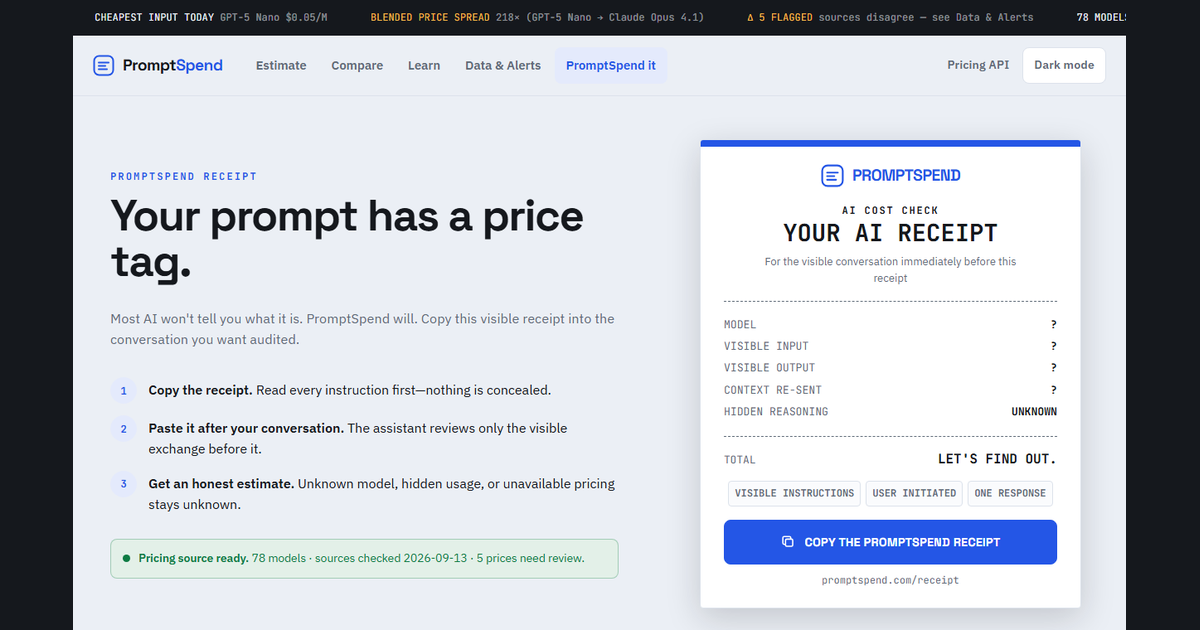
Counts compounding chat history and hidden reasoning tokens
Keyless pricing API, MCP server and VS Code extension
Use Cases
Estimate what an AI feature will cost before you build it
Compare models on your real prompt at your expected scale
Pull current, sourced LLM prices into your own tools via the API or MCP server

Comments






I review AI tools and plans for a living, and stale pricing is the thing I fight most, so a source URL and check date on every number is exactly right. Question: when a vendor quietly changes a price mid-month, do you keep the old figure visible anywhere? Being able to say "this went up on the 12th" would make it useful for writing about pricing changes, not just budgeting.


Showing the source URL and confirmation date on every price is what makes this trustworthy — most calculators go stale the moment a vendor reprices, and flagging disagreements instead of averaging over them is the right call. Counting compounding chat history and hidden reasoning tokens is also the part other tools miss; those two quietly dominate real bills. Two questions: when vendors disagree on a price, how do you decide which figure the estimate uses, and does the comparison separate cached-input pricing from regular input pricing? The keyless API and MCP server would be useful for pulling current prices into my own loop-building workflow.


I ship LLM features at work, and hidden reasoning tokens are exactly where our early estimates were furthest off, so that line alone makes this useful. Two things I'd use: a toggle for batch API pricing (often half of list) and a cache hit rate slider, since prompt caching changes the monthly total a lot when the system prompt is long.

Pricing with a source link and a confirmation date is the detail most comparison tables skip — and it's the one that matters when you're actually budgeting API spend. Counting cumulative conversation history and hidden reasoning tokens is spot on too; those are the two costs people consistently underestimate. Curious how you estimate the hidden reasoning tokens when vendors don't disclose them, and how the MCP server holds up in day-to-day use?
Premium Products
















































Sponsors
Buy

Makers
Makers
Comments
I review AI tools and plans for a living, and stale pricing is the thing I fight most, so a source URL and check date on every number is exactly right. Question: when a vendor quietly changes a price mid-month, do you keep the old figure visible anywhere? Being able to say "this went up on the 12th" would make it useful for writing about pricing changes, not just budgeting.
Showing the source URL and confirmation date on every price is what makes this trustworthy — most calculators go stale the moment a vendor reprices, and flagging disagreements instead of averaging over them is the right call. Counting compounding chat history and hidden reasoning tokens is also the part other tools miss; those two quietly dominate real bills. Two questions: when vendors disagree on a price, how do you decide which figure the estimate uses, and does the comparison separate cached-input pricing from regular input pricing? The keyless API and MCP server would be useful for pulling current prices into my own loop-building workflow.
I ship LLM features at work, and hidden reasoning tokens are exactly where our early estimates were furthest off, so that line alone makes this useful. Two things I'd use: a toggle for batch API pricing (often half of list) and a cache hit rate slider, since prompt caching changes the monthly total a lot when the system prompt is long.
Pricing with a source link and a confirmation date is the detail most comparison tables skip — and it's the one that matters when you're actually budgeting API spend. Counting cumulative conversation history and hidden reasoning tokens is spot on too; those are the two costs people consistently underestimate. Curious how you estimate the hidden reasoning tokens when vendors don't disclose them, and how the MCP server holds up in day-to-day use?
Premium Products
New to Fazier?

Find your next favorite product or submit your own. Made by @FalakDigital.
Copyright ©2026. All Rights Reserved