
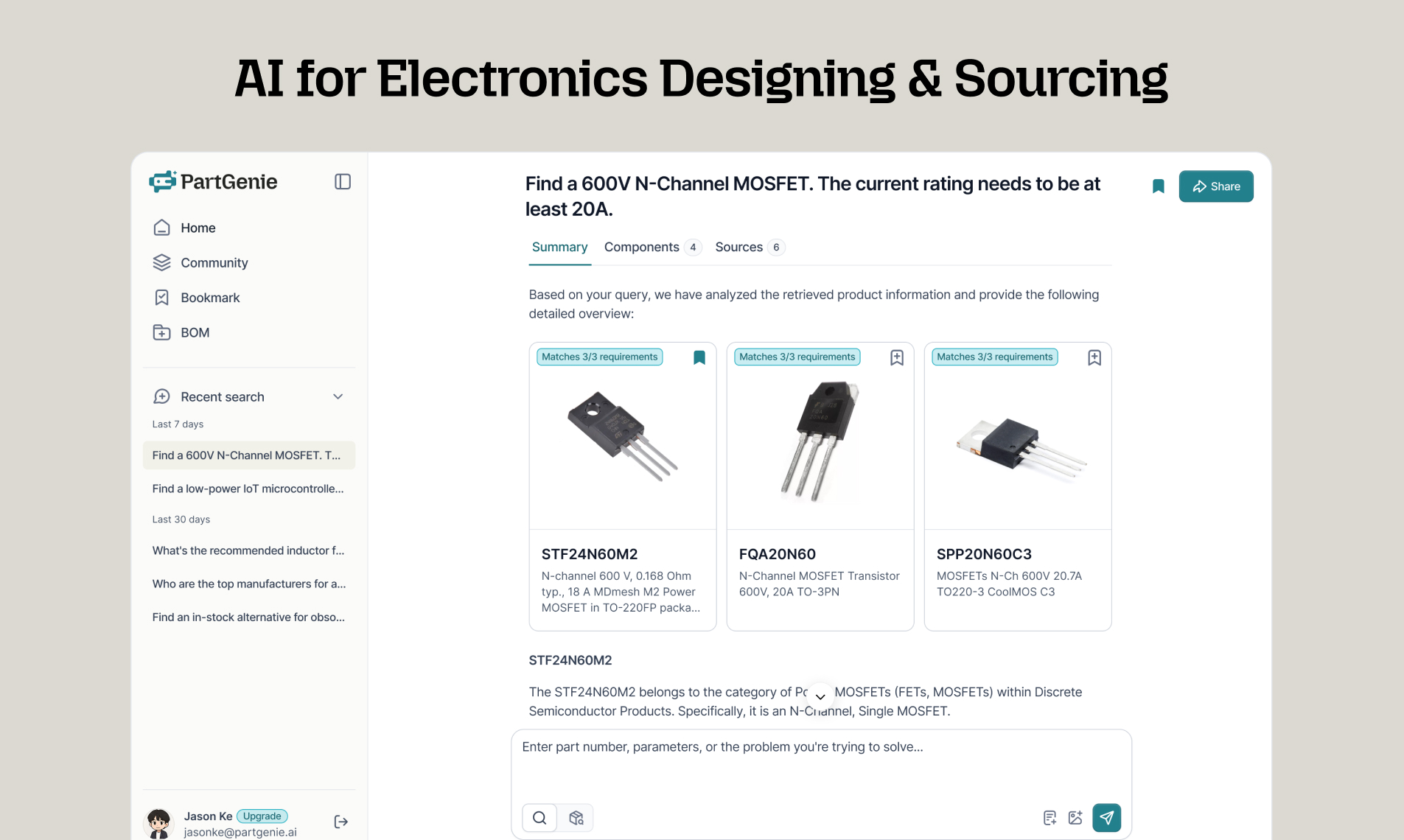
PartGenie is an AI hardware companion for electronics design and component sourcing. It helps hardware engineers, R&D teams, and procurement professionals quickly find the right electronic components and make more informed sourcing and design decisions.
Search across 22M+ electronic components from 7,700+ manufacturers using part numbers or natural-language requirements. PartGenie provides datasheet-backed specifications, ranked alternatives, BOM risk analysis, and sourcing context.
PartGenie also helps engineers analyze datasheets, identify obsolete or risky parts, discover replacement options, and streamline hardware development workflows.
Features
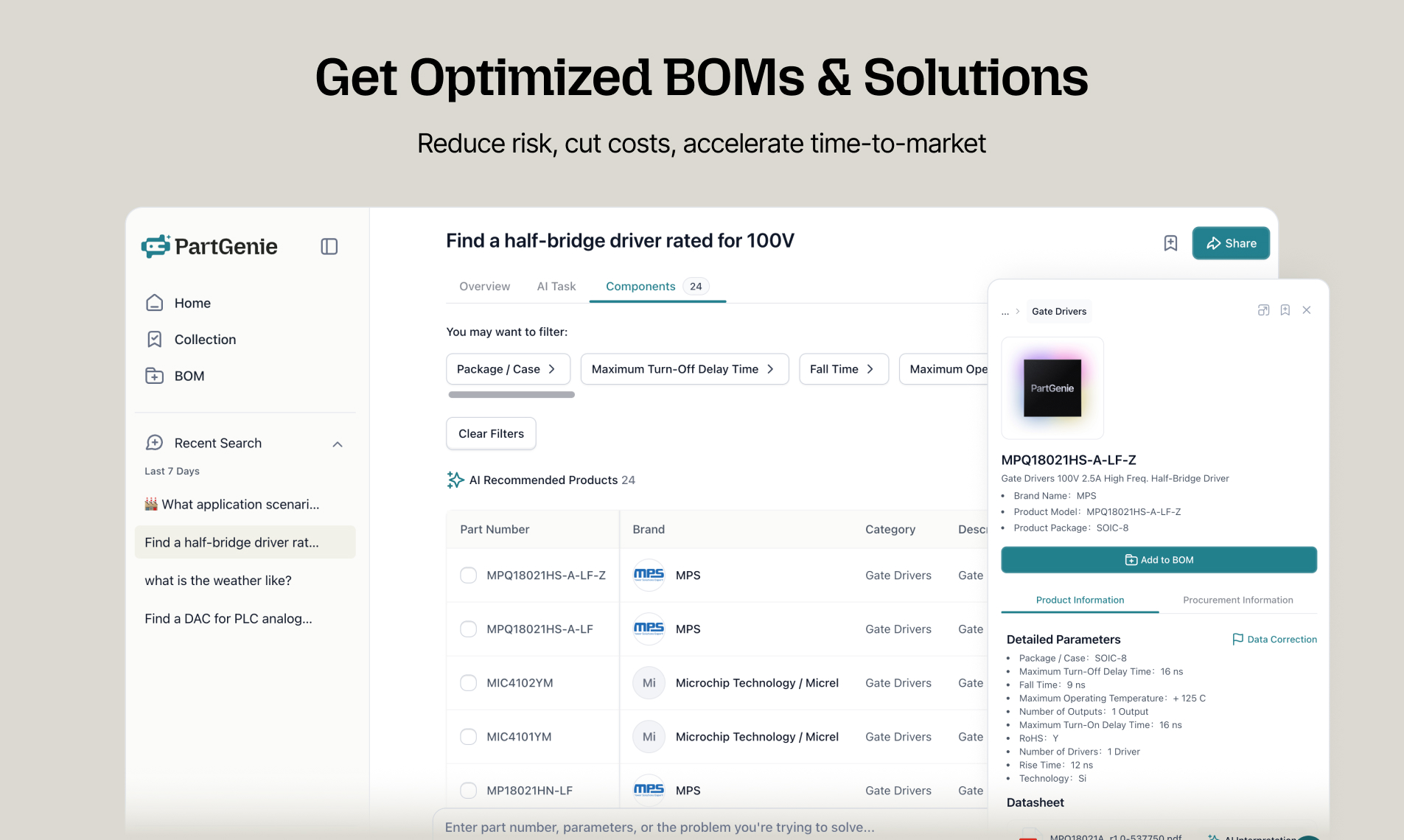
- AI component search using natural-language requirements
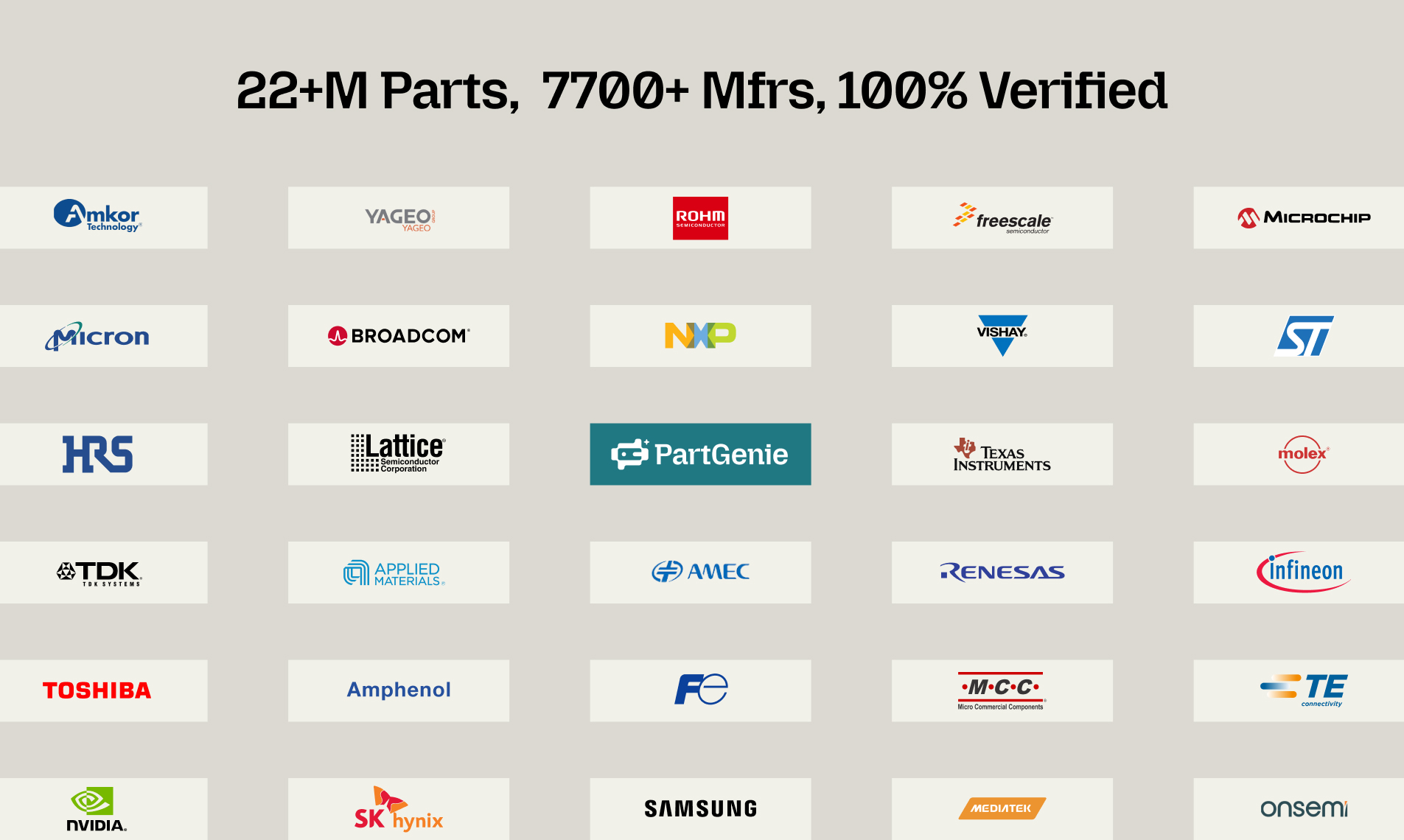
- 22M+ components from 7,700+ manufacturers
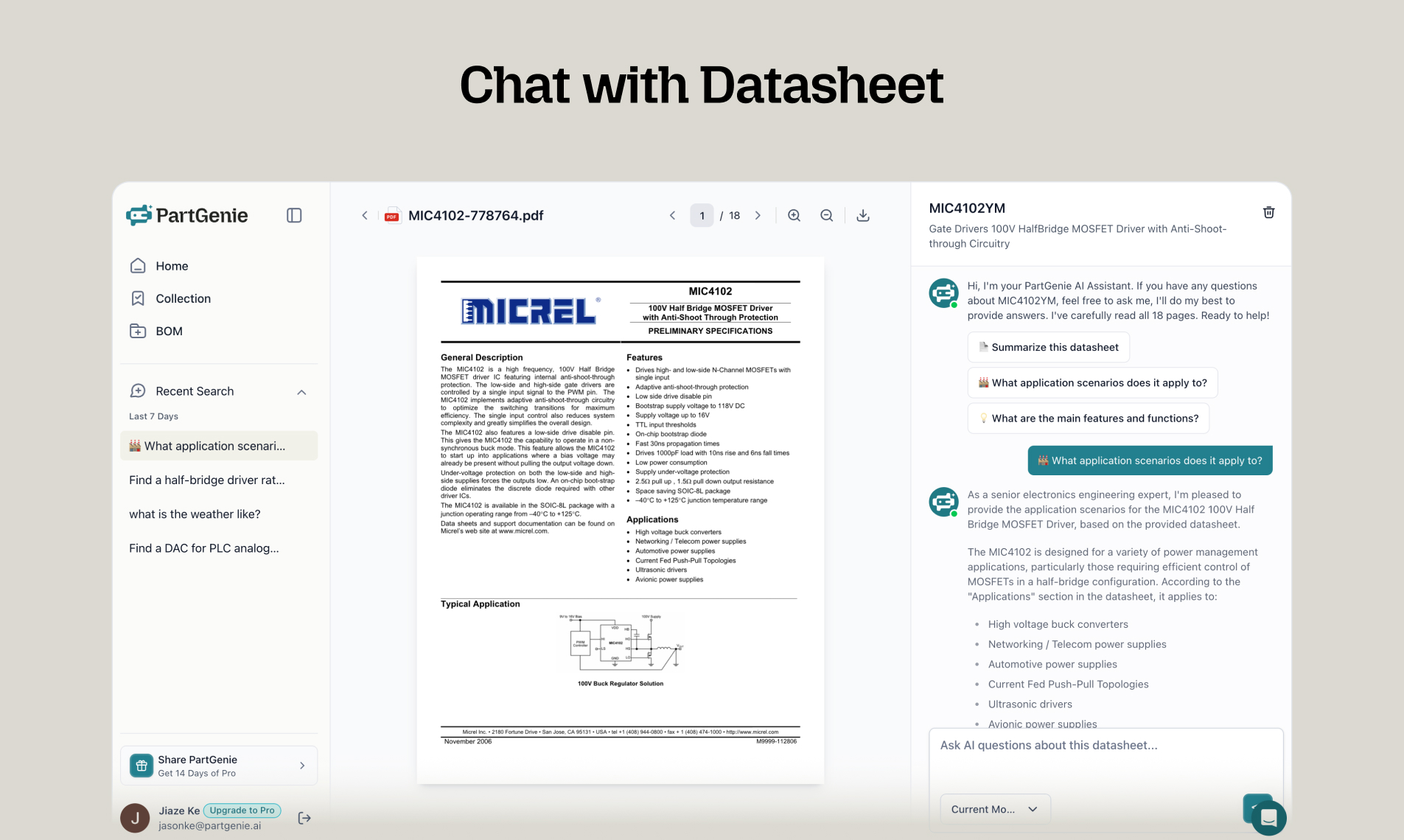
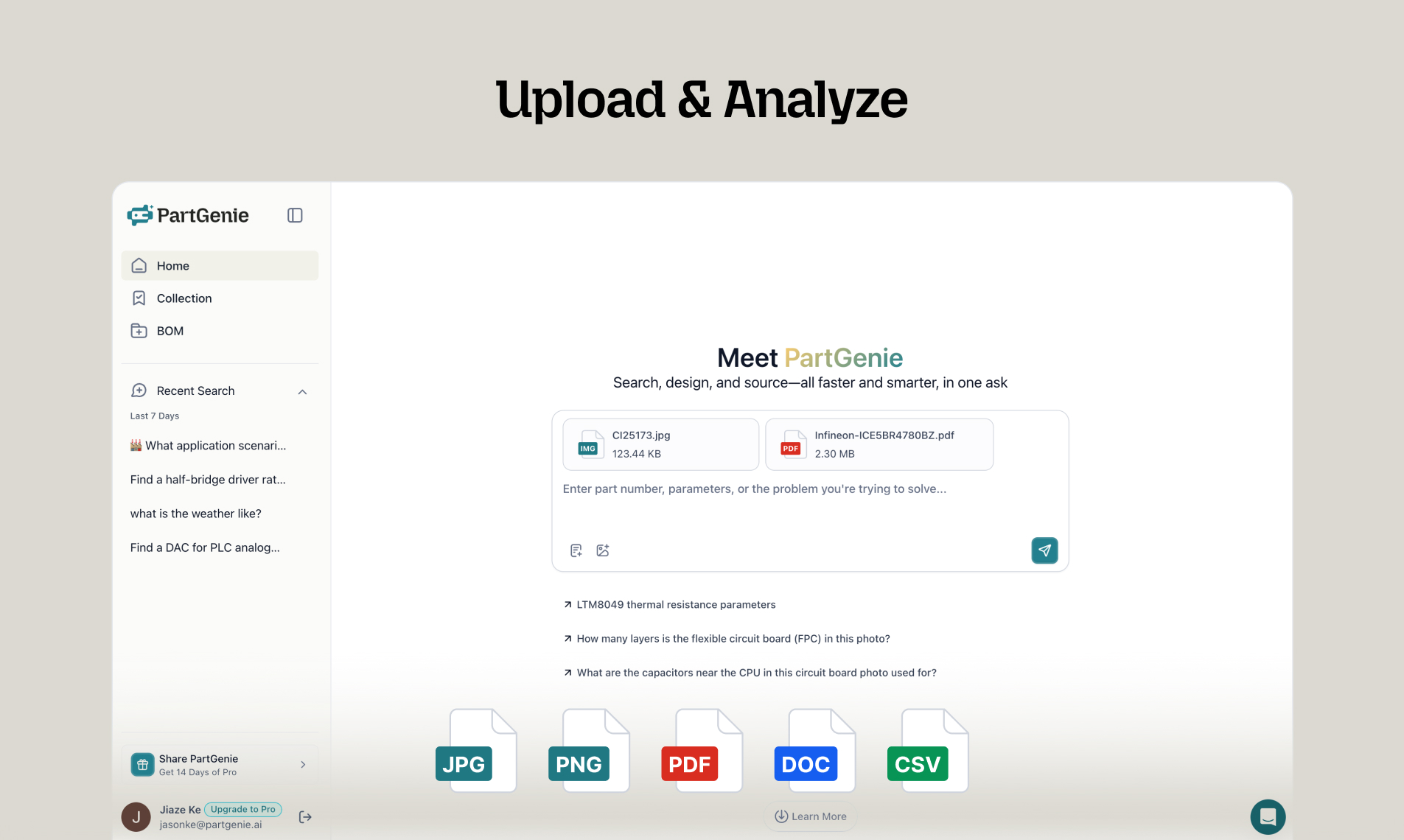
- AI-powered datasheet Q&A and specification extraction
- Pin-compatible and functional alternative discovery
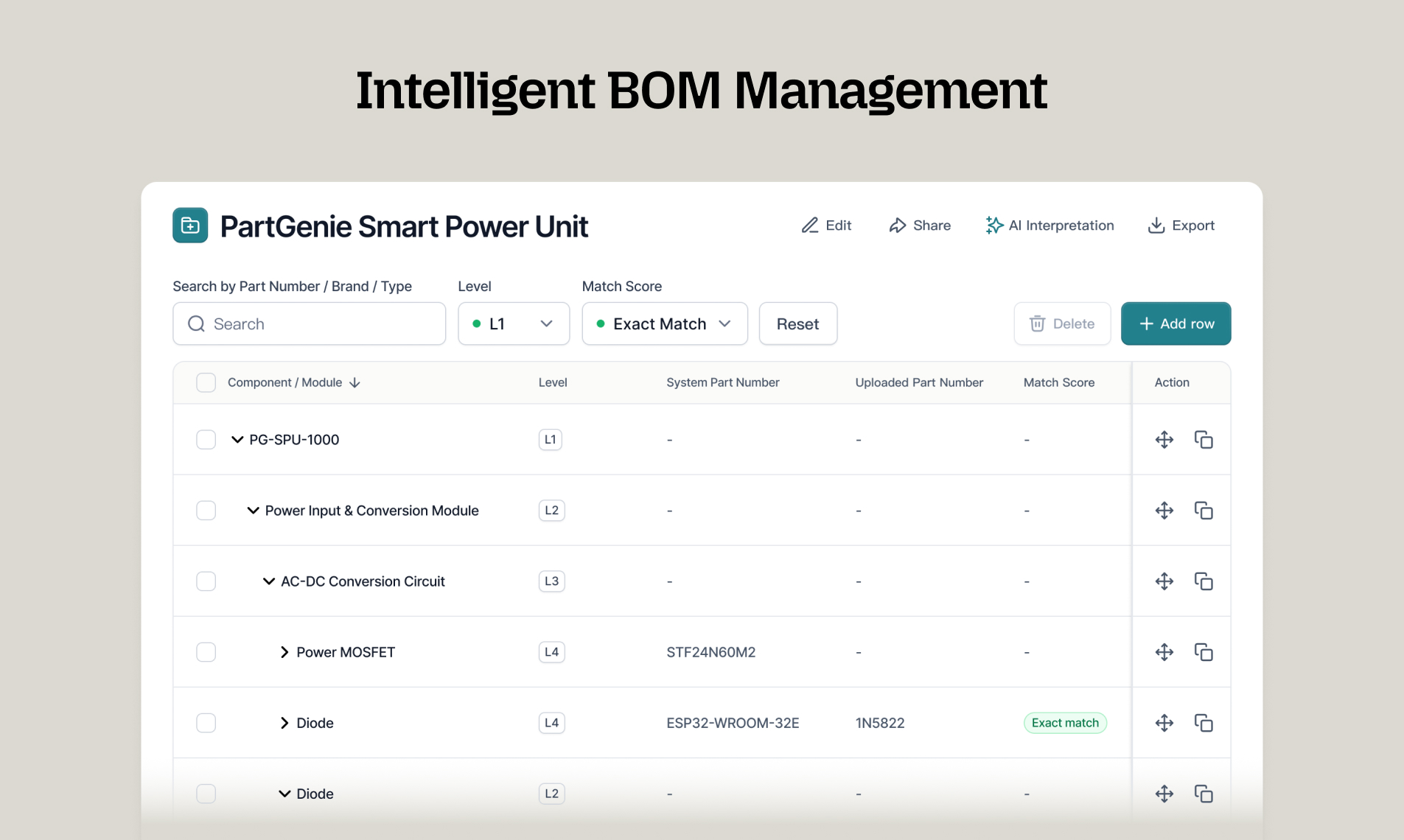
- BOM Health and lifecycle risk analysis
- EOL, obsolete part, and sourcing-risk detection
- BOM import and analysis for CSV/XLSX files
- Component comparison and alternative recommendations
- Hardware design and component selection assistance
PartGenie’s BOM Analyzer specifically supports EOL detection, missing-spec checks, supply-chain risk identification, and replacement suggestions.
Use Cases
- Find components without knowing the exact part number
- Search parts from engineering requirements written in natural language
- Find replacements for obsolete or unavailable components
- Ask technical questions about datasheets
- Extract specifications, pinout, package, and thermal information
- Review BOMs for lifecycle and sourcing risks
- Compare alternative components before design-in
- Help procurement teams respond to component shortages
- Support component selection during redesigns
- Analyze and improve hardware BOMs
Datasheet AI can extract specifications and answer technical questions, while PartGenie’s component pages provide ranked alternatives and datasheet-backed information.

Comments

We built PartGenie because hardware engineers and procurement teams still spend too much time searching for components, reading long datasheets, comparing alternatives, and checking BOM risks manually. PartGenie brings these workflows together with AI — helping teams search components using natural language, analyze datasheets, identify suitable alternatives, and review BOM lifecycle and sourcing risks in one place. Our goal is simple: make hardware component research and sourcing faster, more reliable, and easier for engineering teams.

PartGenie looks especially useful for hardware teams dealing with component selection and sourcing risks. I like the combination of natural-language component search, datasheet analysis, and BOM health checks. The EOL and alternative-part detection could be particularly valuable when engineers need to redesign around obsolete or hard-to-source components. https://zemneo.com/

This is actually pretty useful for anyone who has spent hours digging through datasheets just to find one decent replacement part. The natural language search and BOM risk checks sound especially handy when you’re dealing with old or hard-to-source components. I also like that it doesn’t stop at finding a part. Being able to check alternatives, EOL status, and sourcing risks before starting a build can save a lot of headaches later. I’d definitely give this a try on my next hardware project.

Pin-compatible and functional alternatives are very different risks - one matters mid-layout, the other mid-BOM-review - so the thing I'd want to trust most is whether the ranking keeps them apart. Does it label them separately, and is the pin compatibility read off the datasheet pinout or inferred from spec overlap? For EOL work that's the difference between a suggestion and something you can act on.



PartGenie Your product has strong potential, but I found a few key improvements that could make it even better. I'd love to share my feedback and suggestions—please contact me at [email protected].

So I spent the past year building the version I actually wanted. No signup, no email collection, no registration, no ads on any plan including the free one. You make a poll, share a link, and nobody has to create anything. Not you, not the people answering. Everyone tells me I need to collect emails for this to work and they're probably right. But I get enough email already and I didn't want to be another thing in someone's inbox.
I like the direction PartGenie is taking here. The real value seems to be in reducing the time spent going back and forth between component databases, datasheets etc. Being able to describe what you need in plain language and then compare suitable parts or alternatives could make the early stages of hardware development significantly more efficient. Definitely an interesting tool to keep an eye on.

The component sourcing problem is real and gets worse the more specialized your hardware becomes. Most teams end up with ad-hoc processes: one person knows vendor relationships, another has spreadsheets of part numbers, someone else manages the compliance angle. By centralizing this around natural-language search and automating the datasheet pulling + BOM analysis, you eliminate a huge source of friction. The EOL detection is the underrated piece here - catching end-of-life parts early prevents entire redesigns downstream. If the 22M component database actually stays current and the natural language search works reliably across different part number formats, this becomes the default tool instead of a specialized solution.
Premium Products


























Sponsors
Buy

Awards
View all
Awards
View allMakers
Makers
Comments
We built PartGenie because hardware engineers and procurement teams still spend too much time searching for components, reading long datasheets, comparing alternatives, and checking BOM risks manually. PartGenie brings these workflows together with AI — helping teams search components using natural language, analyze datasheets, identify suitable alternatives, and review BOM lifecycle and sourcing risks in one place. Our goal is simple: make hardware component research and sourcing faster, more reliable, and easier for engineering teams.
PartGenie looks especially useful for hardware teams dealing with component selection and sourcing risks. I like the combination of natural-language component search, datasheet analysis, and BOM health checks. The EOL and alternative-part detection could be particularly valuable when engineers need to redesign around obsolete or hard-to-source components. https://zemneo.com/
This is actually pretty useful for anyone who has spent hours digging through datasheets just to find one decent replacement part. The natural language search and BOM risk checks sound especially handy when you’re dealing with old or hard-to-source components. I also like that it doesn’t stop at finding a part. Being able to check alternatives, EOL status, and sourcing risks before starting a build can save a lot of headaches later. I’d definitely give this a try on my next hardware project.
Pin-compatible and functional alternatives are very different risks - one matters mid-layout, the other mid-BOM-review - so the thing I'd want to trust most is whether the ranking keeps them apart. Does it label them separately, and is the pin compatibility read off the datasheet pinout or inferred from spec overlap? For EOL work that's the difference between a suggestion and something you can act on.
PartGenie Your product has strong potential, but I found a few key improvements that could make it even better. I'd love to share my feedback and suggestions—please contact me at [email protected].
So I spent the past year building the version I actually wanted. No signup, no email collection, no registration, no ads on any plan including the free one. You make a poll, share a link, and nobody has to create anything. Not you, not the people answering. Everyone tells me I need to collect emails for this to work and they're probably right. But I get enough email already and I didn't want to be another thing in someone's inbox.
I like the direction PartGenie is taking here. The real value seems to be in reducing the time spent going back and forth between component databases, datasheets etc. Being able to describe what you need in plain language and then compare suitable parts or alternatives could make the early stages of hardware development significantly more efficient. Definitely an interesting tool to keep an eye on.
The component sourcing problem is real and gets worse the more specialized your hardware becomes. Most teams end up with ad-hoc processes: one person knows vendor relationships, another has spreadsheets of part numbers, someone else manages the compliance angle. By centralizing this around natural-language search and automating the datasheet pulling + BOM analysis, you eliminate a huge source of friction. The EOL detection is the underrated piece here - catching end-of-life parts early prevents entire redesigns downstream. If the 22M component database actually stays current and the natural language search works reliably across different part number formats, this becomes the default tool instead of a specialized solution.
Premium Products
New to Fazier?

Find your next favorite product or submit your own. Made by @FalakDigital.
Copyright ©2026. All Rights Reserved