
Ottermind
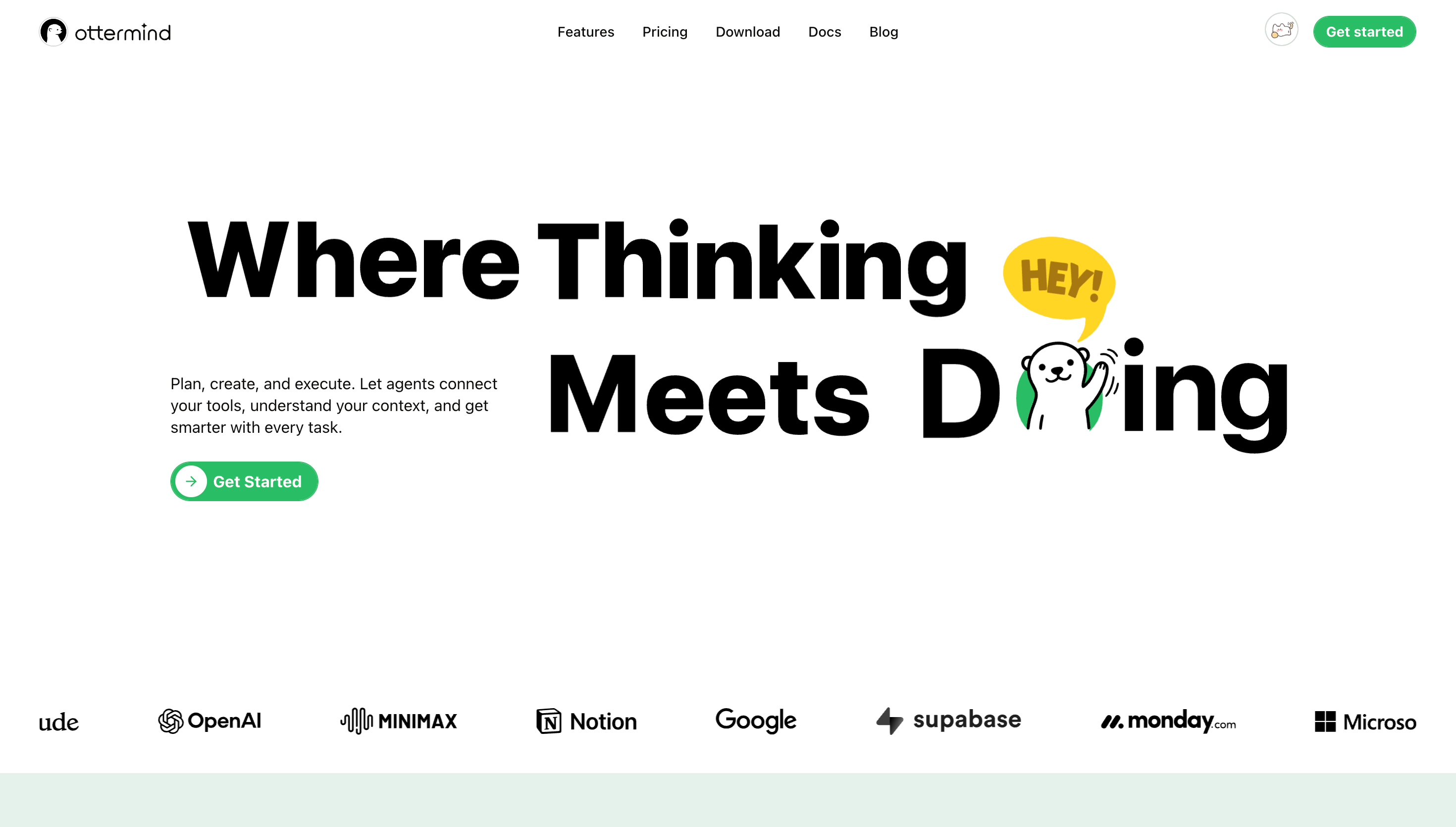
Where thinking meets doing.
Features
Files, decisions, and history stay organized around each project instead of getting buried in a chat thread.
Agents work directly with documents, code environments, plugins, and connected services to carry work through.
Ottermind learns your preferences, patterns, decisions, and recurring context through ongoing collaboration.
Move seamlessly between web and desktop, and let longer tasks run autonomously in the cloud.
When agents hit an error, they inspect the problem, adjust their approach, and keep the task moving.
Complex workflows are broken down and assigned to specialized agents that can work in parallel.
Use Cases
Research market trends, competitors, and user feedback, then turn findings into structured reports.
Organize materials, files, and context into business reports, weekly reports, or retrospectives.
Create GTM decks, pitch decks, product launch presentations, and strategy slides.
Automate daily reports, weekly reports, competitor monitoring, content plans, or customer follow-ups.

Comments


The context-per-project model is what I'd actually use this for. Most AI agent tools are chat-first, so you end up with sprawling threads where decisions, file versions, and failed attempts get lost. By anchoring everything to a project instead, you keep the signal-to-noise ratio high. The autonomous task running + error recovery feels underrated too - most agent tools stop on the first problem and ask you to fix it. Handling retries and adjustments internally means longer tasks can actually complete without babysitting. If the integration breadth (documents, code, plugins, connected services) is real and not just a few common tools, this becomes the actual workspace for knowledge workers instead of another analysis tool. The learning-your-preferences angle makes sense too since iterative work has tons of personal defaults that generic agents don't capture.

Ottermind Your product has strong potential, but I found a few key improvements that could make it even better. I'd love to share my feedback and suggestions—please contact me at [email protected].

The project-anchored context model makes sense as someone managing a lot of scattered submission/content work solo — most of my "research" ends up buried across chat threads I can never find again. Curious how it handles a mix of structured tasks (like a content research pass) versus more freeform back-and-forth within the same project.


The project-anchored context model makes sense as someone managing a lot of scattered submission/content work solo — most of my "research" ends up buried across chat threads I can never find again. Curious how it handles a mix of structured tasks (like a content research pass) versus more freeform back-and-forth within the same project.

Really well put — especially the context-per-project vs chat-first point. Keeping decisions and signal in one project workspace instead of drowning them in long threads is exactly what makes iterative work usable. Same for autonomous runs with retry/error recovery: if a long job can finish without constant babysitting, that’s when AI stops being a demo and becomes real workflow tooling. The “learn my preferences / defaults” angle is also underrated for anything you do repeatedly. We’re building along a similar “project-first, less babysitting” idea on the 3D side with Trilo3D — image → textured models online (GLB/FBX/OBJ/USDZ/STL): https://trilo3d.com. Appreciate you spelling out the architecture criteria so clearly; it’s a great checklist for makers shipping serious AI products.

The "context stays organized around each project instead of getting buried in a chat thread" line hit close to home. As a solo founder running everything myself, I've felt exactly that pain, I lean on an AI heavily for actual coding work through Claude Code, but the moment a task spans research, marketing copy, and follow-up decisions across days, context gets scattered and I end up re-explaining the same background over and over. The parallel-agent-orchestration piece is the harder problem to get right, most tools claim "AI does the work" but really mean one linear chat thread with no real task decomposition. Curious how Ottermind handles handoffs between agents when one's output changes what the next one should actually do, does it replan the whole task graph, or just patch forward from wherever the change happened?


Hello, I was browsing your website and found your platform very interesting. While going through some of the pages, I became curious about how you currently attract new users outside of your website. Are you actively monitoring conversations where people discuss solutions like yours online? I ask because there are often many discussions happening across forums, communities, and platforms where potential users are already looking for services like yours. Is this something your team is currently exploring, or are you focused mainly on direct website traffic? I’d be happy to share a few insights I noticed while researching your niche. Are you interested?

What really stands out to me here is the shift from “AI that gives you answers” to “AI that actually moves a project forward.” Keeping context, files, decisions, and tasks tied to the same project makes a lot of sense, especially for longer workflows where traditional chat-based tools start getting messy. The autonomous execution and error recovery are also really interesting. If Ottermind can consistently handle multi-step tasks without needing constant supervision, that’s a meaningful step toward AI becoming an actual work partner rather than just another interface. Excited to see where this goes! 🚀


Seedance‑25 is an AI video tool for making stories. It turns simple text ideas into short story videos with several different scenes. Characters look the same from shot to shot, and sound matches the video. You can use it directly in your browser. https://seedance-25.studio/
MiniMax H3 AI is an all‑round AI video tool. It makes full short videos, including pictures, people talking and sound effects. You may use its outputs without paying extra fees. It runs in your web browser. https://minimaxh3ai.studio/
Gemini Music is an all-in-one AI music generator that transforms text or lyrics into studio-quality songs, complete with AI vocals, royalty-free licensing, and optional music video creation—all from your browser. https://geminimusic.studio/
Wan3 AI is a professional AI video tool. It makes high‑quality videos from text descriptions or reference pictures. Videos look real,and camera moves smoothly. You can use the videos for business. No extra programs are needed, and it works right in your web browser. https://wan3ai.studio/
Hailuo 03 is an AI video tool for creating movie‑like videos. You can use text or reference pictures and set camera movements exactly how you want. Its outputs have no extra copyright costs, and you can start using it in your browser right away. https://hailuo03.studio/
The project-context retention is the differentiator here — most agent tools lose the thread between tasks, but keeping context while orchestrating specialized agents is exactly what makes a multi-step workflow actually usable. Curious how it handles handoff between agents when a task spans multiple tools, that tends to be where these systems break down.

What impresses me most here is the shift from "AI that provides answers" to "AI that genuinely drives projects forward." Integrating context, files, decisions, and tasks into a single project makes perfect sense—especially for long-cycle workflows where standard chat tools often become cluttered and confusing. Its capabilities for autonomous execution and error recovery are also highly compelling. If Ottermind can reliably handle multi-step tasks without constant human oversight, it would mark a major breakthrough: the AI would evolve from a mere interface into a true partner. I look forward to seeing how it develops further!




Premium Products








































Sponsors
Buy

Awards
View all
Awards
View allMakers
Makers
Comments
The context-per-project model is what I'd actually use this for. Most AI agent tools are chat-first, so you end up with sprawling threads where decisions, file versions, and failed attempts get lost. By anchoring everything to a project instead, you keep the signal-to-noise ratio high. The autonomous task running + error recovery feels underrated too - most agent tools stop on the first problem and ask you to fix it. Handling retries and adjustments internally means longer tasks can actually complete without babysitting. If the integration breadth (documents, code, plugins, connected services) is real and not just a few common tools, this becomes the actual workspace for knowledge workers instead of another analysis tool. The learning-your-preferences angle makes sense too since iterative work has tons of personal defaults that generic agents don't capture.
Ottermind Your product has strong potential, but I found a few key improvements that could make it even better. I'd love to share my feedback and suggestions—please contact me at [email protected].
The project-anchored context model makes sense as someone managing a lot of scattered submission/content work solo — most of my "research" ends up buried across chat threads I can never find again. Curious how it handles a mix of structured tasks (like a content research pass) versus more freeform back-and-forth within the same project.
The project-anchored context model makes sense as someone managing a lot of scattered submission/content work solo — most of my "research" ends up buried across chat threads I can never find again. Curious how it handles a mix of structured tasks (like a content research pass) versus more freeform back-and-forth within the same project.
Really well put — especially the context-per-project vs chat-first point. Keeping decisions and signal in one project workspace instead of drowning them in long threads is exactly what makes iterative work usable. Same for autonomous runs with retry/error recovery: if a long job can finish without constant babysitting, that’s when AI stops being a demo and becomes real workflow tooling. The “learn my preferences / defaults” angle is also underrated for anything you do repeatedly. We’re building along a similar “project-first, less babysitting” idea on the 3D side with Trilo3D — image → textured models online (GLB/FBX/OBJ/USDZ/STL): https://trilo3d.com. Appreciate you spelling out the architecture criteria so clearly; it’s a great checklist for makers shipping serious AI products.
The "context stays organized around each project instead of getting buried in a chat thread" line hit close to home. As a solo founder running everything myself, I've felt exactly that pain, I lean on an AI heavily for actual coding work through Claude Code, but the moment a task spans research, marketing copy, and follow-up decisions across days, context gets scattered and I end up re-explaining the same background over and over. The parallel-agent-orchestration piece is the harder problem to get right, most tools claim "AI does the work" but really mean one linear chat thread with no real task decomposition. Curious how Ottermind handles handoffs between agents when one's output changes what the next one should actually do, does it replan the whole task graph, or just patch forward from wherever the change happened?
Hello, I was browsing your website and found your platform very interesting. While going through some of the pages, I became curious about how you currently attract new users outside of your website. Are you actively monitoring conversations where people discuss solutions like yours online? I ask because there are often many discussions happening across forums, communities, and platforms where potential users are already looking for services like yours. Is this something your team is currently exploring, or are you focused mainly on direct website traffic? I’d be happy to share a few insights I noticed while researching your niche. Are you interested?
What really stands out to me here is the shift from “AI that gives you answers” to “AI that actually moves a project forward.” Keeping context, files, decisions, and tasks tied to the same project makes a lot of sense, especially for longer workflows where traditional chat-based tools start getting messy. The autonomous execution and error recovery are also really interesting. If Ottermind can consistently handle multi-step tasks without needing constant supervision, that’s a meaningful step toward AI becoming an actual work partner rather than just another interface. Excited to see where this goes! 🚀
Seedance‑25 is an AI video tool for making stories. It turns simple text ideas into short story videos with several different scenes. Characters look the same from shot to shot, and sound matches the video. You can use it directly in your browser. https://seedance-25.studio/
MiniMax H3 AI is an all‑round AI video tool. It makes full short videos, including pictures, people talking and sound effects. You may use its outputs without paying extra fees. It runs in your web browser. https://minimaxh3ai.studio/
Gemini Music is an all-in-one AI music generator that transforms text or lyrics into studio-quality songs, complete with AI vocals, royalty-free licensing, and optional music video creation—all from your browser. https://geminimusic.studio/
Wan3 AI is a professional AI video tool. It makes high‑quality videos from text descriptions or reference pictures. Videos look real,and camera moves smoothly. You can use the videos for business. No extra programs are needed, and it works right in your web browser. https://wan3ai.studio/
Hailuo 03 is an AI video tool for creating movie‑like videos. You can use text or reference pictures and set camera movements exactly how you want. Its outputs have no extra copyright costs, and you can start using it in your browser right away. https://hailuo03.studio/
The project-context retention is the differentiator here — most agent tools lose the thread between tasks, but keeping context while orchestrating specialized agents is exactly what makes a multi-step workflow actually usable. Curious how it handles handoff between agents when a task spans multiple tools, that tends to be where these systems break down.
What impresses me most here is the shift from "AI that provides answers" to "AI that genuinely drives projects forward." Integrating context, files, decisions, and tasks into a single project makes perfect sense—especially for long-cycle workflows where standard chat tools often become cluttered and confusing. Its capabilities for autonomous execution and error recovery are also highly compelling. If Ottermind can reliably handle multi-step tasks without constant human oversight, it would mark a major breakthrough: the AI would evolve from a mere interface into a true partner. I look forward to seeing how it develops further!
Premium Products
New to Fazier?

Find your next favorite product or submit your own. Made by @FalakDigital.
Copyright ©2026. All Rights Reserved