
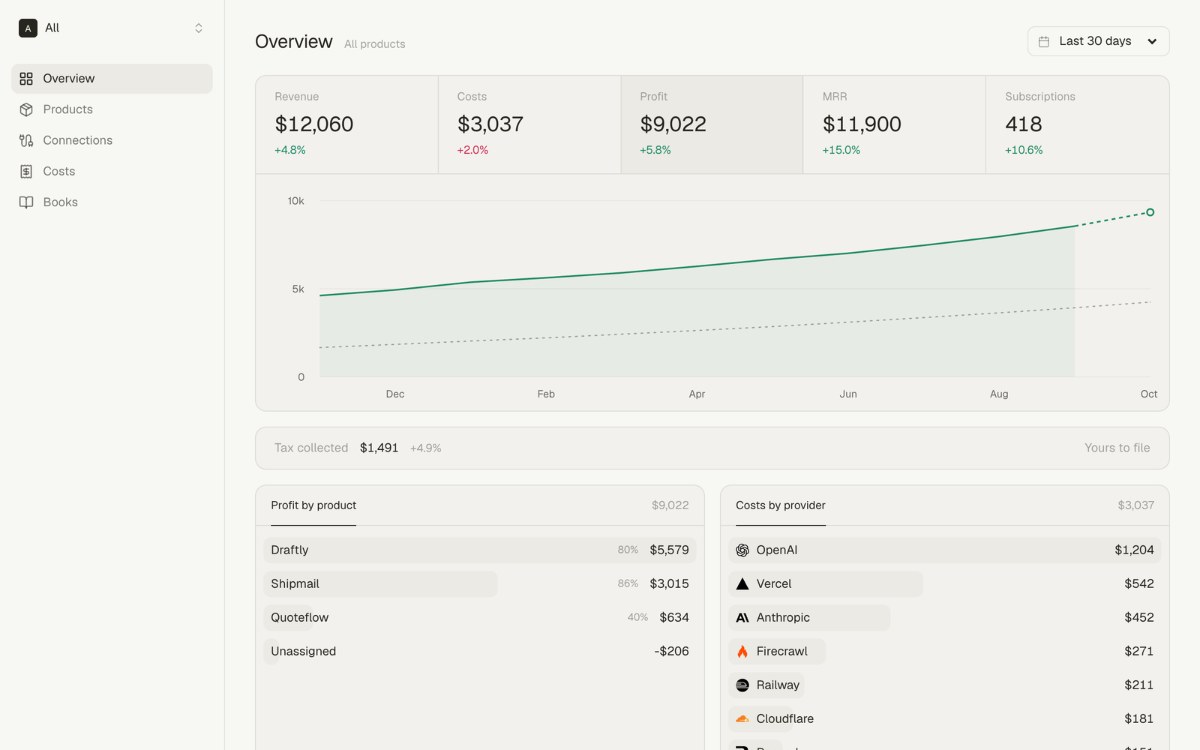
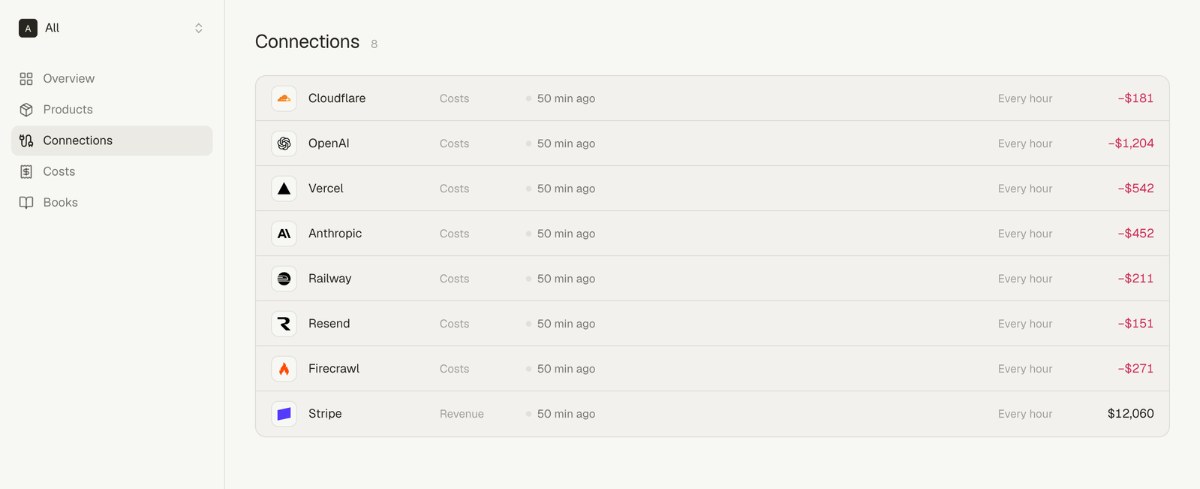
OpenProfit shows what each of your apps earns after its bills. Paste a Stripe key and an OpenAI key, and two years of revenue and token costs fill in, split by product. It reads 19 providers, including Polar, Paddle, Lemon Squeezy, RevenueCat, Anthropic, Vercel, Cloudflare and Railway. Free under $2,500 MRR, MIT licensed, and self-hostable in one Docker container.
Features
Revenue from Stripe, Polar, Paddle, Lemon Squeezy and RevenueCat, net of fees and refunds
Costs by day and by project from OpenAI, Anthropic, Vercel, Cloudflare, Railway and nine more
Profit, MRR and customers per product, with an alert the day a bill doubles
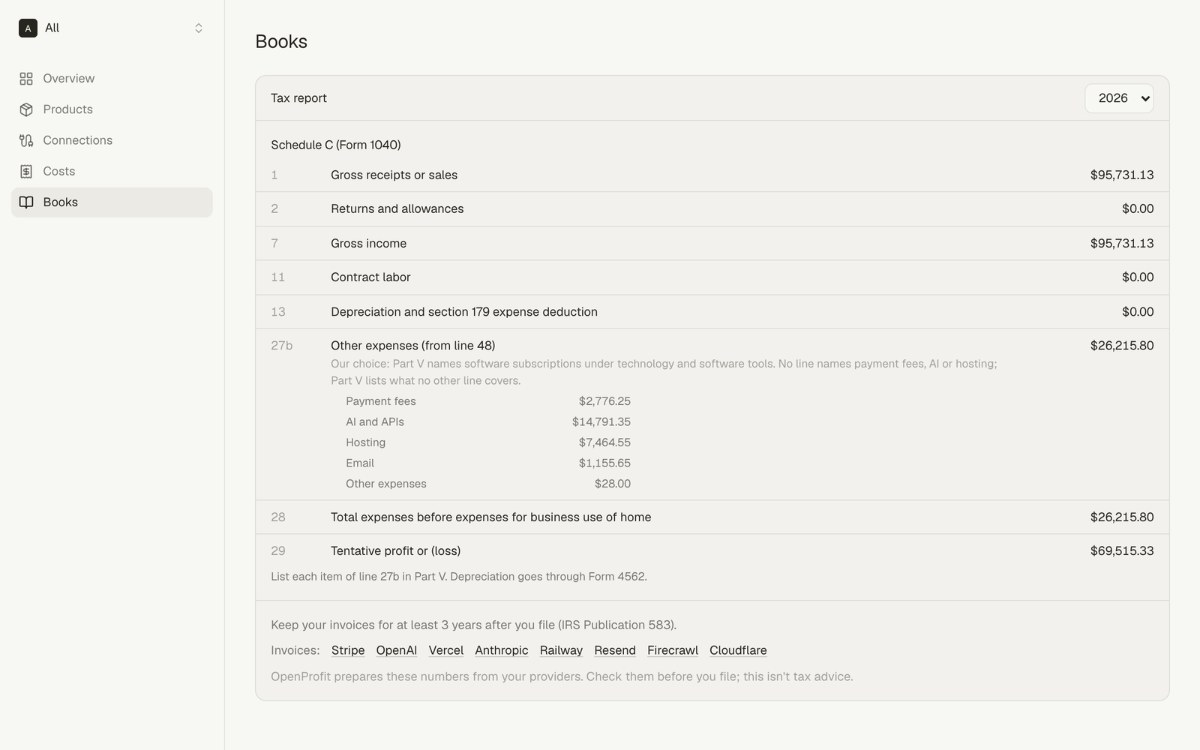
A monthly journal for QuickBooks or Xero, and the year's totals on your tax form's lines
A remote MCP server so Claude or Cursor can read your numbers
Use Cases
You run three apps on one OpenAI account and want to know which one pays for its tokens
You sell an AI wrapper at $10 a month and want to see whether heavy users cost more than they pay
You build in public and want a page that shows net revenue, costs and margin
You keep your own books and need your tax numbers without a bookkeeper

Comments


Splitting token costs per product is exactly what I've been doing by hand in a spreadsheet, so this hits home. Backfilling two years from just a Stripe key and an OpenAI key is a nice touch. One question: when several apps share one OpenAI key, how do you attribute the tokens to each product? By project IDs, or some tagging on the requests?

Hi, I'm Raphael. I run a few small apps on one OpenAI account and one Vercel team, and I couldn't tell which app paid for its own tokens. Stripe had the revenue, each billing page had a slice of the costs, and my spreadsheet was always a month behind. OpenProfit reads both sides from the provider APIs. You map each OpenAI project, Vercel project or Cloudflare zone to a product, and you see profit per product by day, with an alert the day a bill doubles. It's MIT and runs as one Docker image if you'd rather keep your keys on your own server. Which provider should I connect next?




Splitting token costs per product and alerting the day a bill doubles solves a real pain for anyone running several apps on one OpenAI account. How do you attribute costs per project when multiple apps share a single API key: by key, by project ID, or manually? The self-hostable MIT version in one Docker container is a big plus for trust.
Splitting revenue and token costs per product is the right framing, and the alert for the day a bill doubles is a very practical touch. I'd suggest adding a short note on what read-only permissions each API key needs, so cautious users can see exactly what's accessed before pasting a Stripe or OpenAI key.


Useful framing — most tools show revenue, almost none show what's left after bills. One thing I'd want to know: does it follow subscription price changes (upgrades, plan restructures) or does it just take the current per-user price? A single price change mid-year can move "earnings after bills" by 10-20% and that's invisible in a monthly summary.
Useful framing — most tools show revenue, almost none show what's left after bills. One thing I'd want to know: does it follow subscription price changes (upgrades, plan restructures) or does it just take the current per-user price? A single price change mid-year can move "earnings after bills" by 10-20% and that's invisible in a monthly summary.

Question from the Canadian side: my Stripe settles in CAD but OpenAI, Vercel and Cloudflare all bill in USD. Which currency does OpenProfit report profit in, and does it convert each cost at that day's rate or at a month-end rate? Small difference per month, but it adds up over two years of history. Also, "the year's totals on your tax form's lines": is that only Schedule C, or could it map to a Canadian T2125 too?
Premium Products














































Makers
Makers
Comments
Splitting token costs per product is exactly what I've been doing by hand in a spreadsheet, so this hits home. Backfilling two years from just a Stripe key and an OpenAI key is a nice touch. One question: when several apps share one OpenAI key, how do you attribute the tokens to each product? By project IDs, or some tagging on the requests?
Hi, I'm Raphael. I run a few small apps on one OpenAI account and one Vercel team, and I couldn't tell which app paid for its own tokens. Stripe had the revenue, each billing page had a slice of the costs, and my spreadsheet was always a month behind. OpenProfit reads both sides from the provider APIs. You map each OpenAI project, Vercel project or Cloudflare zone to a product, and you see profit per product by day, with an alert the day a bill doubles. It's MIT and runs as one Docker image if you'd rather keep your keys on your own server. Which provider should I connect next?
Splitting token costs per product and alerting the day a bill doubles solves a real pain for anyone running several apps on one OpenAI account. How do you attribute costs per project when multiple apps share a single API key: by key, by project ID, or manually? The self-hostable MIT version in one Docker container is a big plus for trust.
Splitting revenue and token costs per product is the right framing, and the alert for the day a bill doubles is a very practical touch. I'd suggest adding a short note on what read-only permissions each API key needs, so cautious users can see exactly what's accessed before pasting a Stripe or OpenAI key.
Useful framing — most tools show revenue, almost none show what's left after bills. One thing I'd want to know: does it follow subscription price changes (upgrades, plan restructures) or does it just take the current per-user price? A single price change mid-year can move "earnings after bills" by 10-20% and that's invisible in a monthly summary.
Useful framing — most tools show revenue, almost none show what's left after bills. One thing I'd want to know: does it follow subscription price changes (upgrades, plan restructures) or does it just take the current per-user price? A single price change mid-year can move "earnings after bills" by 10-20% and that's invisible in a monthly summary.
Question from the Canadian side: my Stripe settles in CAD but OpenAI, Vercel and Cloudflare all bill in USD. Which currency does OpenProfit report profit in, and does it convert each cost at that day's rate or at a month-end rate? Small difference per month, but it adds up over two years of history. Also, "the year's totals on your tax form's lines": is that only Schedule C, or could it map to a Canadian T2125 too?
Premium Products
New to Fazier?

Find your next favorite product or submit your own. Made by @FalakDigital.
Copyright ©2026. All Rights Reserved