
Omniyond
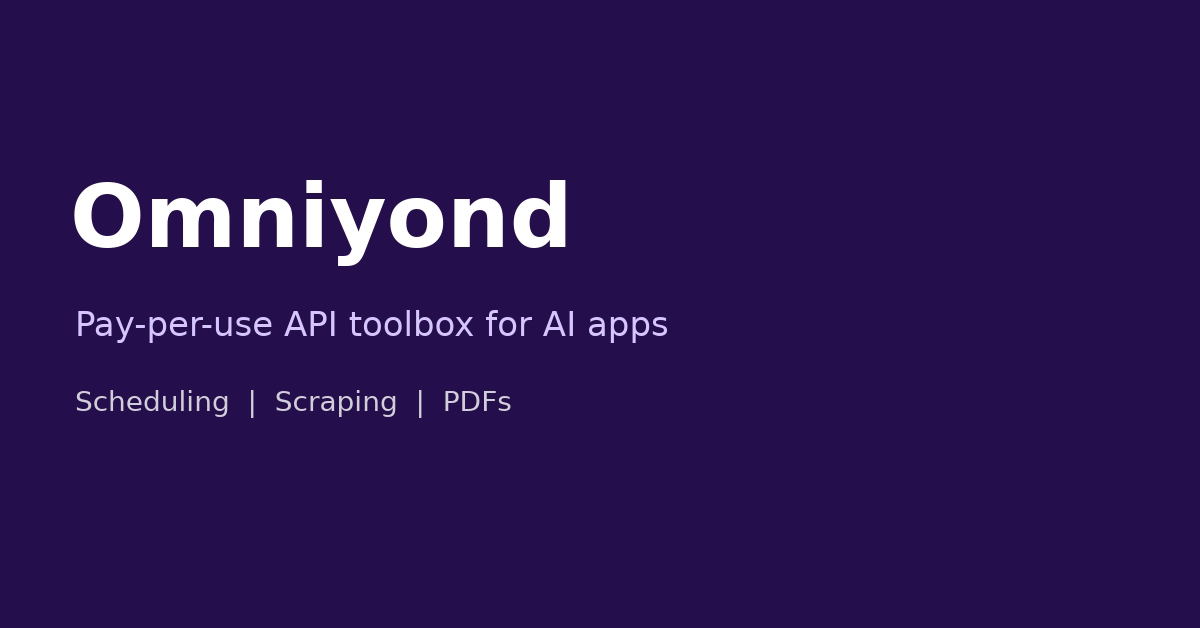
The pay-per-use API toolbox for AI apps.
Features
Scheduling API and MCP tool
Web scraping on demand
PDF generation and extraction
Pay only per call from $0.01
One toolbox for AI app workflows
Use Cases
Add scheduling and scraping to an AI app
Generate or process PDFs without managing infrastructure
Automate browser and data workflows on demand
Prototype tools with predictable pay-per-use costs

Comments





This pay-per-call toolbox looks handy for AI app prototyping. Scheduling API, on-demand web scraping and PDF generation/extraction cover many common automation needs, starting at $0.01 per call. My main worry is cost creep for heavy scraping or bulk PDF jobs. It would help to have clearer rate limits, error billing rules, and MCP tool documentation before building core workflows on it.


For indie devs wiring AI agents to external tools, the pay-per-call model is much easier to justify than a monthly subscription - most agent workloads are spiky, not steady. Two things that would make this a no-brainer for me: does the scraping endpoint handle JS-rendered pages (many agent workflows need SPA content), and is there a per-key usage dashboard so I can set spending caps when reselling the workflow to customers? The MCP integration is a smart move - more agent frameworks are standardizing on it.
The combination of scheduling, scraping, and PDF extraction in one pay-per-call toolbox is the useful part for small AI apps that do not want three vendors. I would want to know whether failed scrape jobs still bill, and whether the MCP tool exposes the same endpoints as the HTTP API so an agent does not need a separate integration path.

Premium Products





























Sponsors
Buy

Awards
View all
Awards
View allComments
This pay-per-call toolbox looks handy for AI app prototyping. Scheduling API, on-demand web scraping and PDF generation/extraction cover many common automation needs, starting at $0.01 per call. My main worry is cost creep for heavy scraping or bulk PDF jobs. It would help to have clearer rate limits, error billing rules, and MCP tool documentation before building core workflows on it.
For indie devs wiring AI agents to external tools, the pay-per-call model is much easier to justify than a monthly subscription - most agent workloads are spiky, not steady. Two things that would make this a no-brainer for me: does the scraping endpoint handle JS-rendered pages (many agent workflows need SPA content), and is there a per-key usage dashboard so I can set spending caps when reselling the workflow to customers? The MCP integration is a smart move - more agent frameworks are standardizing on it.
The combination of scheduling, scraping, and PDF extraction in one pay-per-call toolbox is the useful part for small AI apps that do not want three vendors. I would want to know whether failed scrape jobs still bill, and whether the MCP tool exposes the same endpoints as the HTTP API so an agent does not need a separate integration path.
Premium Products
New to Fazier?

Find your next favorite product or submit your own. Made by @FalakDigital.
Copyright ©2026. All Rights Reserved