
Office Blues
What work actually costs, with receipts
Office Blues publishes free, no-signup tools and first-party open data on what the modern workplace actually costs. Receipts, not vibes.
Features
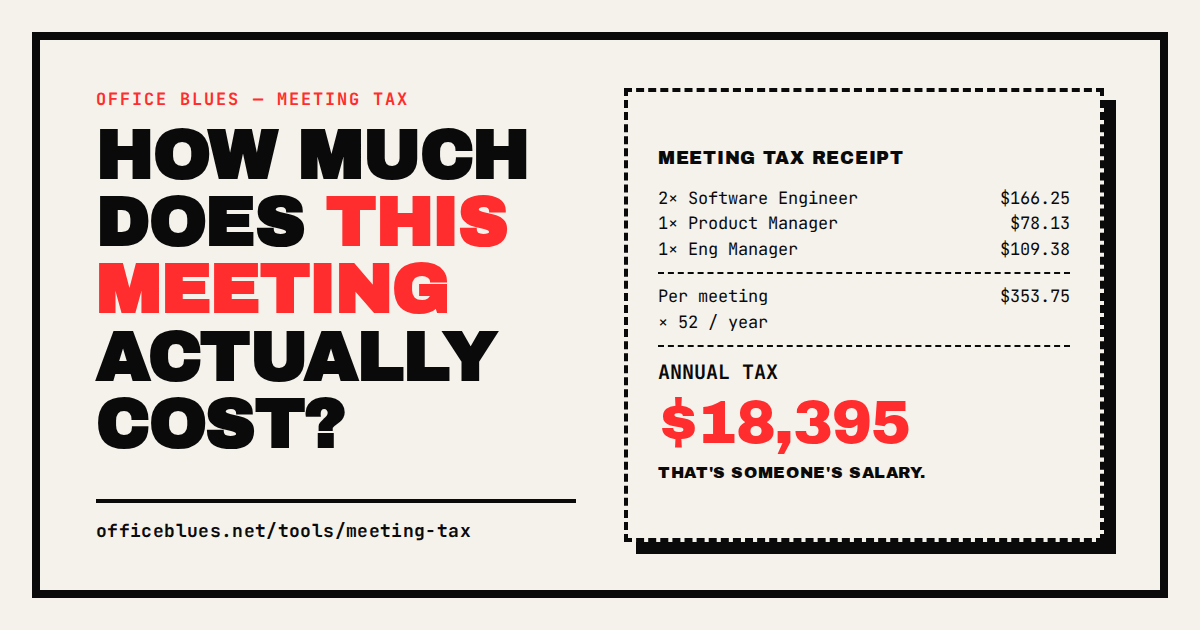
Meeting Tax Calculator: annualized, itemized cost of any recurring meeting
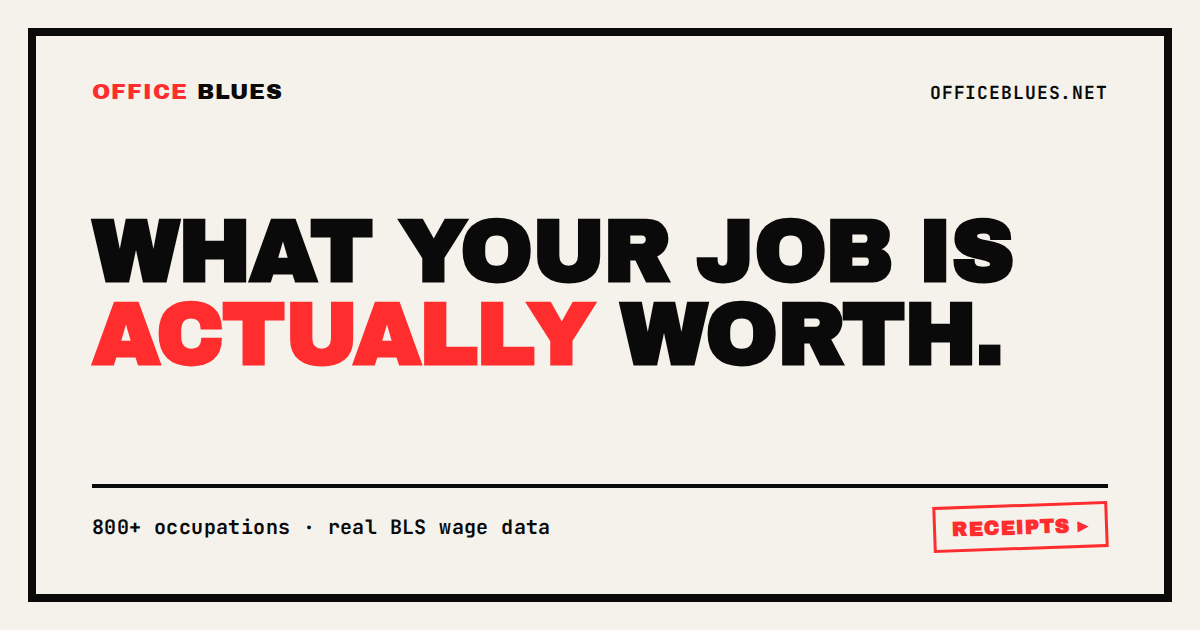
Salary pages built on U.S. Bureau of Labor Statistics OEWS wage data
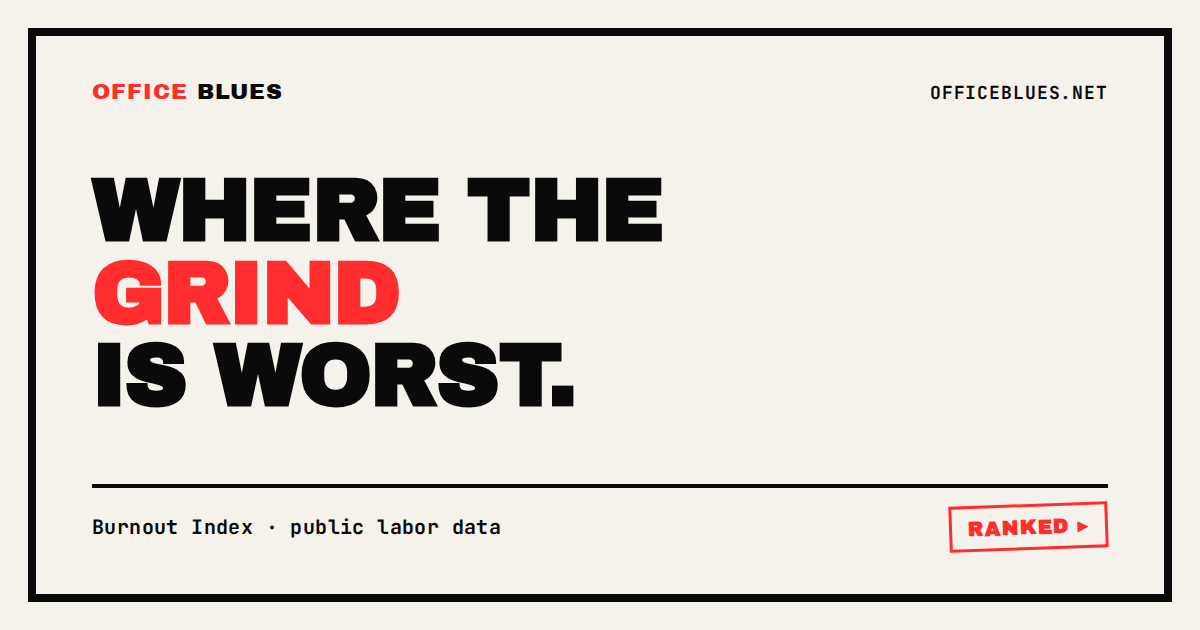
Burnout Index: a cost-of-work lens across 50 US cities
Open first-party JSON endpoints for every dataset
No signup and no email gate on any tool
Use Cases
Put a dollar figure on a recurring meeting before proposing to cancel it
Check what an occupation actually pays before a salary conversation
Compare what work costs across US cities
Pull the underlying data as JSON for your own analysis

Comments



We kept hitting the same argument at work: someone says a recurring meeting is expensive, someone else says prove it, and nobody has a number. So we built the receipt. The Meeting Tax Calculator turns headcount, salaries and cadence into an annualised cost with an itemised breakdown, no signup and no email gate. The salary pages and the Burnout Index came from the same instinct, and every dataset ships as open JSON so people can check the math instead of taking our word for it.
The receipt-style framing is clever because it turns an abstract cost into something people can immediately understand. One thing I’d be curious about is whether the tool can move from “this meeting costs $X” to “this meeting is probably not worth $X.” For example, factoring in meeting type, attendee count, recurrence, and whether there’s a documented outcome could make the number much more actionable. That would turn it from a cost calculator into a decision tool for teams trying to reduce low-value meetings.

Turning recurring meetings into an annualized receipt is a sharp framing because it gives managers a concrete number before debating whether a meeting is worth keeping. The open JSON endpoints add real credibility. A one-page export that teams could attach to an agenda or cancellation proposal would make the result even easier to act on.

Office Blues Your product has strong potential, but I found a few key improvements that could make it even better. I'd love to share my feedback and suggestions—please contact me at [email protected]
Premium Products













































Sponsors
Buy

Awards
View all
Awards
View allMakers
Makers
Comments
We kept hitting the same argument at work: someone says a recurring meeting is expensive, someone else says prove it, and nobody has a number. So we built the receipt. The Meeting Tax Calculator turns headcount, salaries and cadence into an annualised cost with an itemised breakdown, no signup and no email gate. The salary pages and the Burnout Index came from the same instinct, and every dataset ships as open JSON so people can check the math instead of taking our word for it.
The receipt-style framing is clever because it turns an abstract cost into something people can immediately understand. One thing I’d be curious about is whether the tool can move from “this meeting costs $X” to “this meeting is probably not worth $X.” For example, factoring in meeting type, attendee count, recurrence, and whether there’s a documented outcome could make the number much more actionable. That would turn it from a cost calculator into a decision tool for teams trying to reduce low-value meetings.
Turning recurring meetings into an annualized receipt is a sharp framing because it gives managers a concrete number before debating whether a meeting is worth keeping. The open JSON endpoints add real credibility. A one-page export that teams could attach to an agenda or cancellation proposal would make the result even easier to act on.
Office Blues Your product has strong potential, but I found a few key improvements that could make it even better. I'd love to share my feedback and suggestions—please contact me at [email protected]
Premium Products
New to Fazier?

Find your next favorite product or submit your own. Made by @FalakDigital.
Copyright ©2026. All Rights Reserved