
NutriAudit
Check supplement interactions, overlap and max doses free
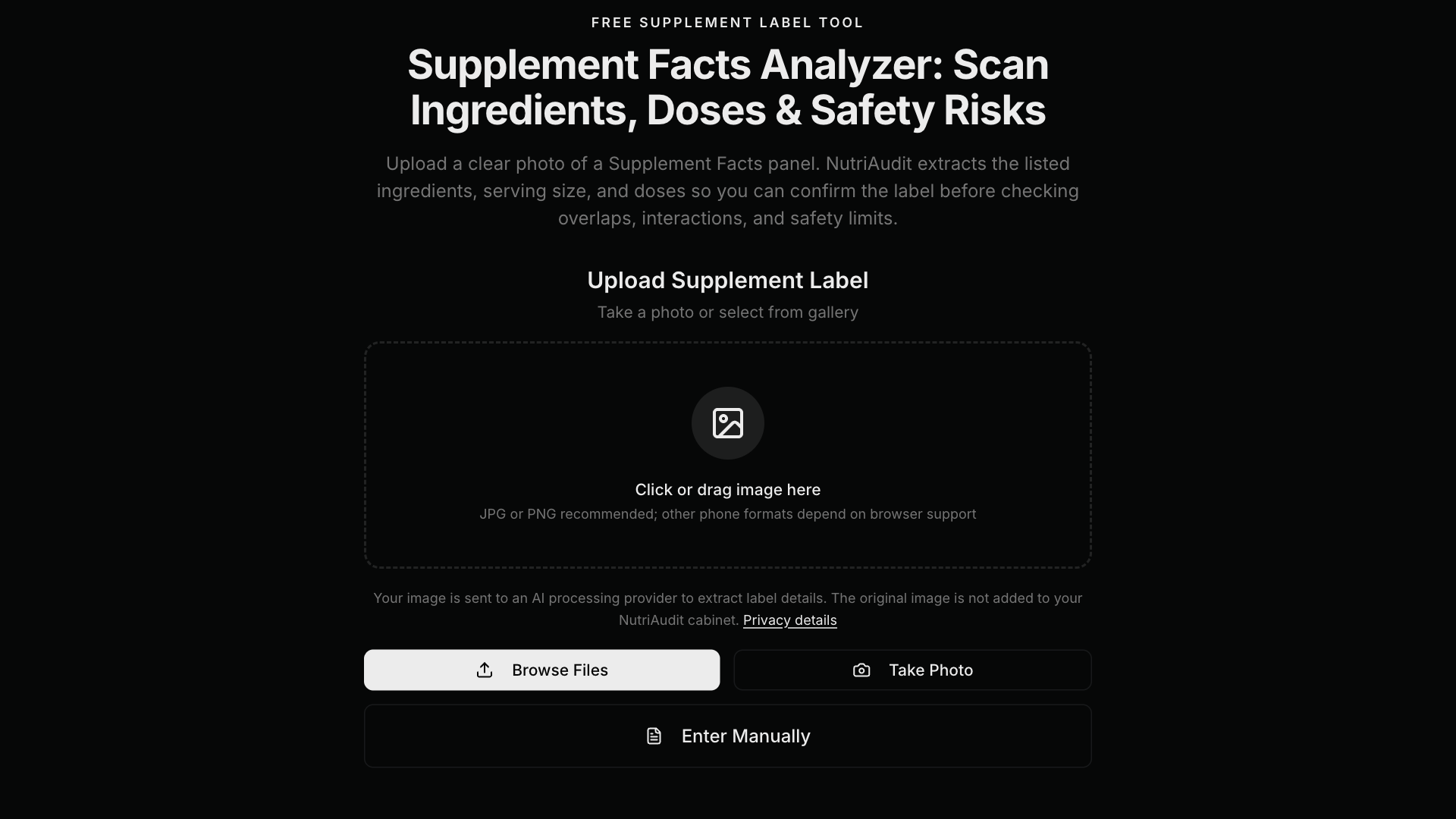
Wondering if your supplements interact? NutriAudit is a free supplement stack checker that reviews documented interactions, duplicate ingredients and combined doses label by label.

Features
- Add products or scan a label
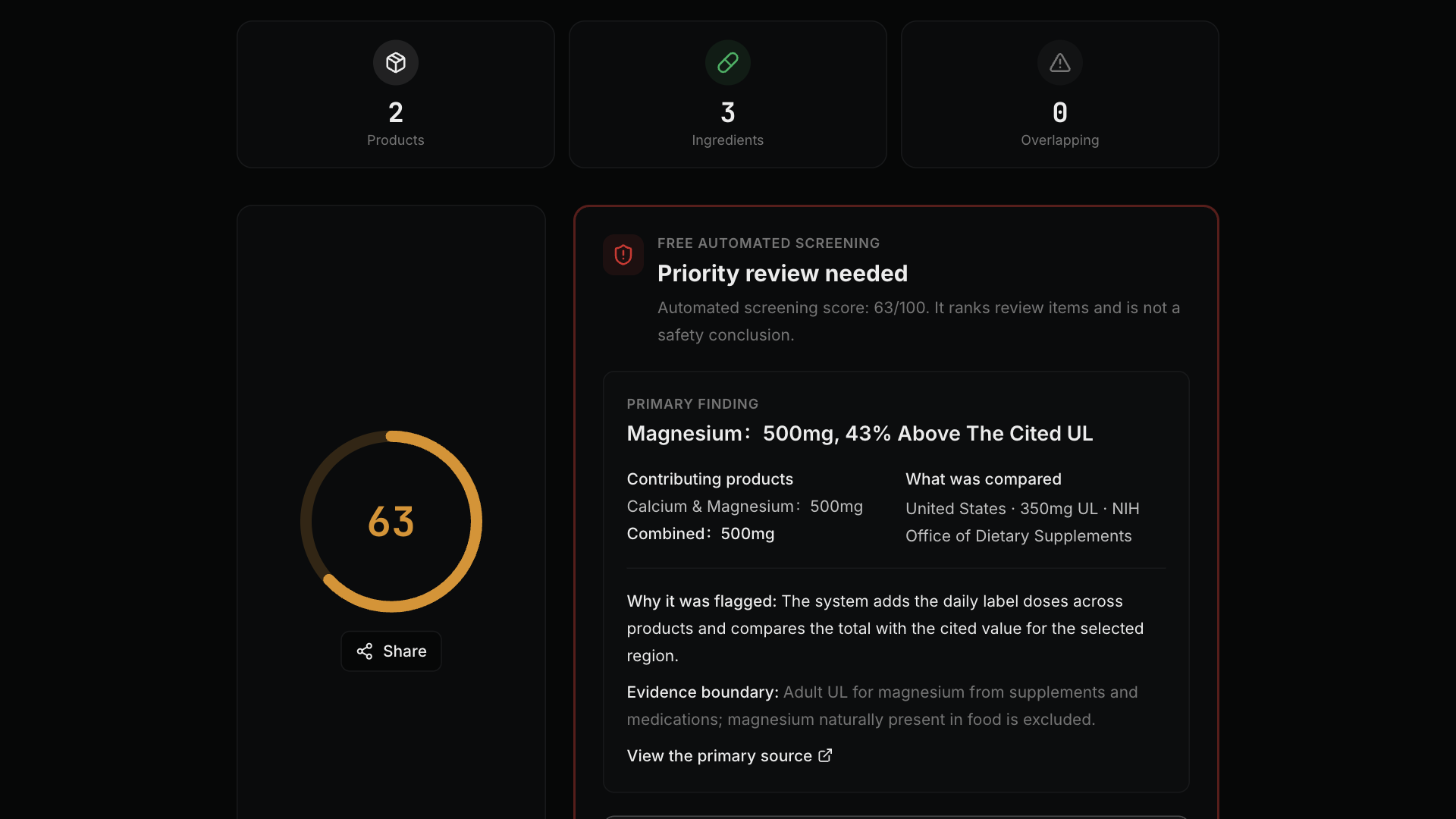
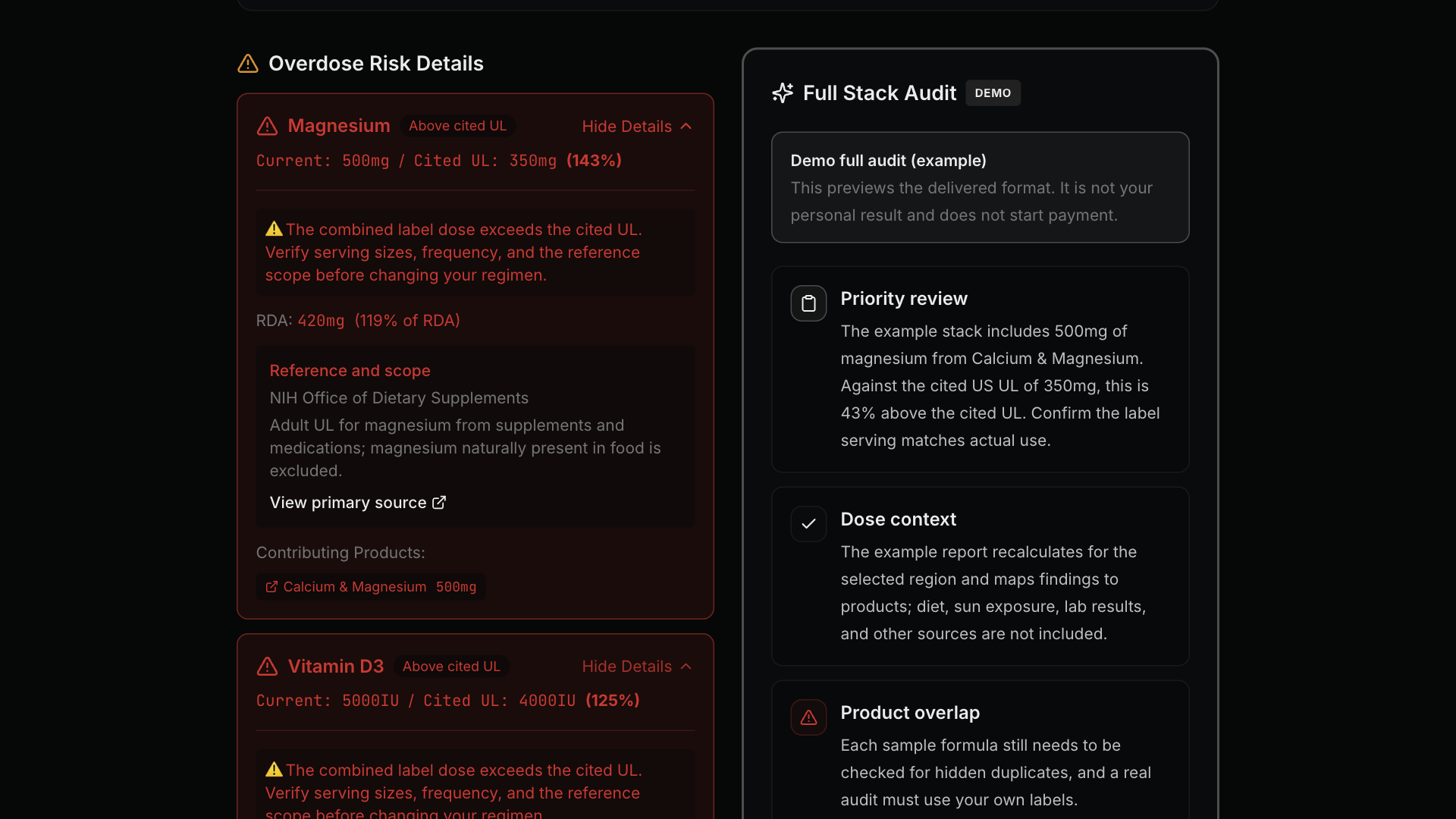
- Totals combined daily doses across products
- Flags duplicate ingredients and vitamin overlap
- Compares intake with regional upper limit references
- Lists documented ingredient interactions
- 0-100 audit progress score
Use Cases
- Review a multi-supplement stack before talking to a qualified professional
- Spot duplicate ingredients across vitamins
- Check combined doses against published references
- Information only, not medical advice

Comments

The label-scan plus combined-dose totals look genuinely useful — duplicate ingredients across products are easy to miss when you take more than one supplement. Do the upper-limit references adjust by region or country automatically, or do you pick a region when you start an audit? I am also curious whether the 0-100 audit score weights documented interactions more heavily than simple ingredient overlap.
The label-scan plus combined-dose totals look genuinely useful — duplicate ingredients across products are easy to miss, and flagging overlap and max doses before buying another bottle could save a lot of guesswork. Would love to see a saved-stack history so I can re-check the same routine after adding a new product.

The part that shows which countries a US, UK or Schengen visa unlocks is the most useful idea here; most checkers stop at yes or no. Two questions: how often is the data refreshed, and do you show the date of the last check for each passport and destination? Visa rules change with little notice, so a visible "last verified" date would make people trust the answer more.



The label scan plus combined-dose totals stand out — most people don't realise their multivitamin and a separate vitamin D pill overlap. Does the audit flag interactions between specific pairs, like magnesium and zinc, and can you switch the regional upper-limit reference (for example US vs EU) when checking combined doses?
Totaling combined daily doses across several products is the part I find most useful, since people rarely add up the vitamin D in their multivitamin plus a separate pill. When a label is scanned, how do you handle ingredient name variants like cholecalciferol versus vitamin D3 when flagging duplicates? It would also help to see which of the documented interactions drives a lower 0-100 score.

Totalling doses across products is the part most people never do, so this is useful. One thing I'd love: timing flags, not just totals. Some pairs are fine in a day but better taken apart (iron and calcium is the common one). A small 'take these at different times' note in the audit would turn it from a checker into something I'd follow every day.
I like that it totals combined daily doses across several products, because that is where people accidentally exceed limits. How do you handle supplements with different forms of the same nutrient, like magnesium citrate versus oxide, when flagging overlap? A short note on which reference source each upper limit comes from would also make the results easier to trust.

The label scan plus combined-dose totals look genuinely useful — most people don't realise how quickly duplicate ingredients add up across a multivitamin and separate supplements. I like that it compares intake with regional upper limits and flags documented interactions, while still making clear it's information only, not medical advice. Would love to see a saved-stack history so I can re-check the same routine after changing one product.

Adding up the same ingredient across several products is something almost nobody does by hand, so the daily total view is genuinely useful. When a label lists a proprietary blend with no amount per ingredient, how does NutriAudit count it in the totals? I'd be glad to make a free feedback video where I add my first few supplements as a new user and point out anything unclear or where I get stuck.

Good that it says "information only" up front. Two things that would make me trust a flag more: show which reference the upper limit comes from right next to it, so I can show my pharmacist the exact source. And how do you handle the units labels mix up, like vitamin D in mcg vs IU, or magnesium listed as the compound (citrate, glycinate) instead of elemental mg? That conversion is where my own totals usually go wrong when I add things up by hand.

Something the thread hasn't touched yet: a lot of people's totals come from food, not only pills. Even a rough toggle like "I drink fortified milk / eat fortified cereal most days" would make the vitamin D and B12 numbers more realistic. A one-page export of the audit would also be handy to bring to a pharmacist.

As a nurse, the combined-dose total is the feature that matters most — most people don't realise their multivitamin and a separate vitamin D can overlap. Two suggestions: a way to save a stack and re-check it after adding a new product, and a clear note on which upper-limit reference (US, EU, etc.) is being used, since those limits differ by region. Really useful tool.

The part that shows which countries a US, UK or Schengen visa unlocks is the most useful idea here; most checkers stop at yes or no. Two questions: how often is the data refreshed, and do you show the date of the last check for each passport and destination? Visa rules change with little notice, so a visible "last verified" date would make people trust the answer more.

Something the thread hasn't raised: upper limits change with life stage, not just region. The UL for preformed vitamin A matters a lot in pregnancy, and children's limits for iron, zinc and vitamin A are far lower than adults'. A family might run a kids' multivitamin plus gummies through it. Can you set age or pregnancy status so the combined-dose comparison uses the right reference, or does it assume an adult?
Premium Products











































Sponsors
Buy
Comments
The label-scan plus combined-dose totals look genuinely useful — duplicate ingredients across products are easy to miss when you take more than one supplement. Do the upper-limit references adjust by region or country automatically, or do you pick a region when you start an audit? I am also curious whether the 0-100 audit score weights documented interactions more heavily than simple ingredient overlap.
The label-scan plus combined-dose totals look genuinely useful — duplicate ingredients across products are easy to miss, and flagging overlap and max doses before buying another bottle could save a lot of guesswork. Would love to see a saved-stack history so I can re-check the same routine after adding a new product.
The part that shows which countries a US, UK or Schengen visa unlocks is the most useful idea here; most checkers stop at yes or no. Two questions: how often is the data refreshed, and do you show the date of the last check for each passport and destination? Visa rules change with little notice, so a visible "last verified" date would make people trust the answer more.
The label scan plus combined-dose totals stand out — most people don't realise their multivitamin and a separate vitamin D pill overlap. Does the audit flag interactions between specific pairs, like magnesium and zinc, and can you switch the regional upper-limit reference (for example US vs EU) when checking combined doses?
Totaling combined daily doses across several products is the part I find most useful, since people rarely add up the vitamin D in their multivitamin plus a separate pill. When a label is scanned, how do you handle ingredient name variants like cholecalciferol versus vitamin D3 when flagging duplicates? It would also help to see which of the documented interactions drives a lower 0-100 score.
Totalling doses across products is the part most people never do, so this is useful. One thing I'd love: timing flags, not just totals. Some pairs are fine in a day but better taken apart (iron and calcium is the common one). A small 'take these at different times' note in the audit would turn it from a checker into something I'd follow every day.
I like that it totals combined daily doses across several products, because that is where people accidentally exceed limits. How do you handle supplements with different forms of the same nutrient, like magnesium citrate versus oxide, when flagging overlap? A short note on which reference source each upper limit comes from would also make the results easier to trust.
The label scan plus combined-dose totals look genuinely useful — most people don't realise how quickly duplicate ingredients add up across a multivitamin and separate supplements. I like that it compares intake with regional upper limits and flags documented interactions, while still making clear it's information only, not medical advice. Would love to see a saved-stack history so I can re-check the same routine after changing one product.
Adding up the same ingredient across several products is something almost nobody does by hand, so the daily total view is genuinely useful. When a label lists a proprietary blend with no amount per ingredient, how does NutriAudit count it in the totals? I'd be glad to make a free feedback video where I add my first few supplements as a new user and point out anything unclear or where I get stuck.
Good that it says "information only" up front. Two things that would make me trust a flag more: show which reference the upper limit comes from right next to it, so I can show my pharmacist the exact source. And how do you handle the units labels mix up, like vitamin D in mcg vs IU, or magnesium listed as the compound (citrate, glycinate) instead of elemental mg? That conversion is where my own totals usually go wrong when I add things up by hand.
Something the thread hasn't touched yet: a lot of people's totals come from food, not only pills. Even a rough toggle like "I drink fortified milk / eat fortified cereal most days" would make the vitamin D and B12 numbers more realistic. A one-page export of the audit would also be handy to bring to a pharmacist.
As a nurse, the combined-dose total is the feature that matters most — most people don't realise their multivitamin and a separate vitamin D can overlap. Two suggestions: a way to save a stack and re-check it after adding a new product, and a clear note on which upper-limit reference (US, EU, etc.) is being used, since those limits differ by region. Really useful tool.
The part that shows which countries a US, UK or Schengen visa unlocks is the most useful idea here; most checkers stop at yes or no. Two questions: how often is the data refreshed, and do you show the date of the last check for each passport and destination? Visa rules change with little notice, so a visible "last verified" date would make people trust the answer more.
Something the thread hasn't raised: upper limits change with life stage, not just region. The UL for preformed vitamin A matters a lot in pregnancy, and children's limits for iron, zinc and vitamin A are far lower than adults'. A family might run a kids' multivitamin plus gummies through it. Can you set age or pregnancy status so the combined-dose comparison uses the right reference, or does it assume an adult?
Premium Products
New to Fazier?

Find your next favorite product or submit your own. Made by @FalakDigital.
Copyright ©2026. All Rights Reserved