
miinideck
Drop an HTML file or ZIP, get a private link in seconds
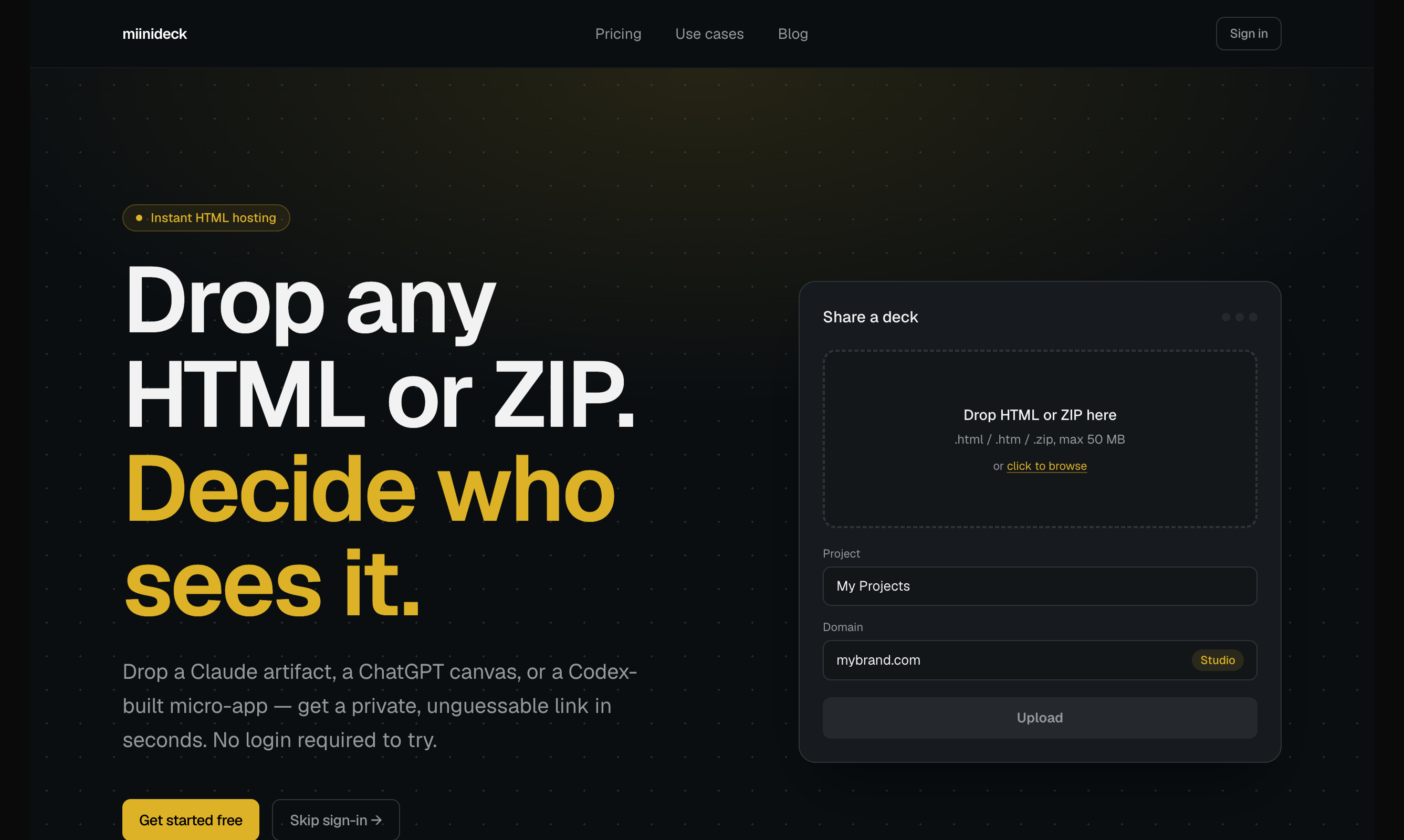
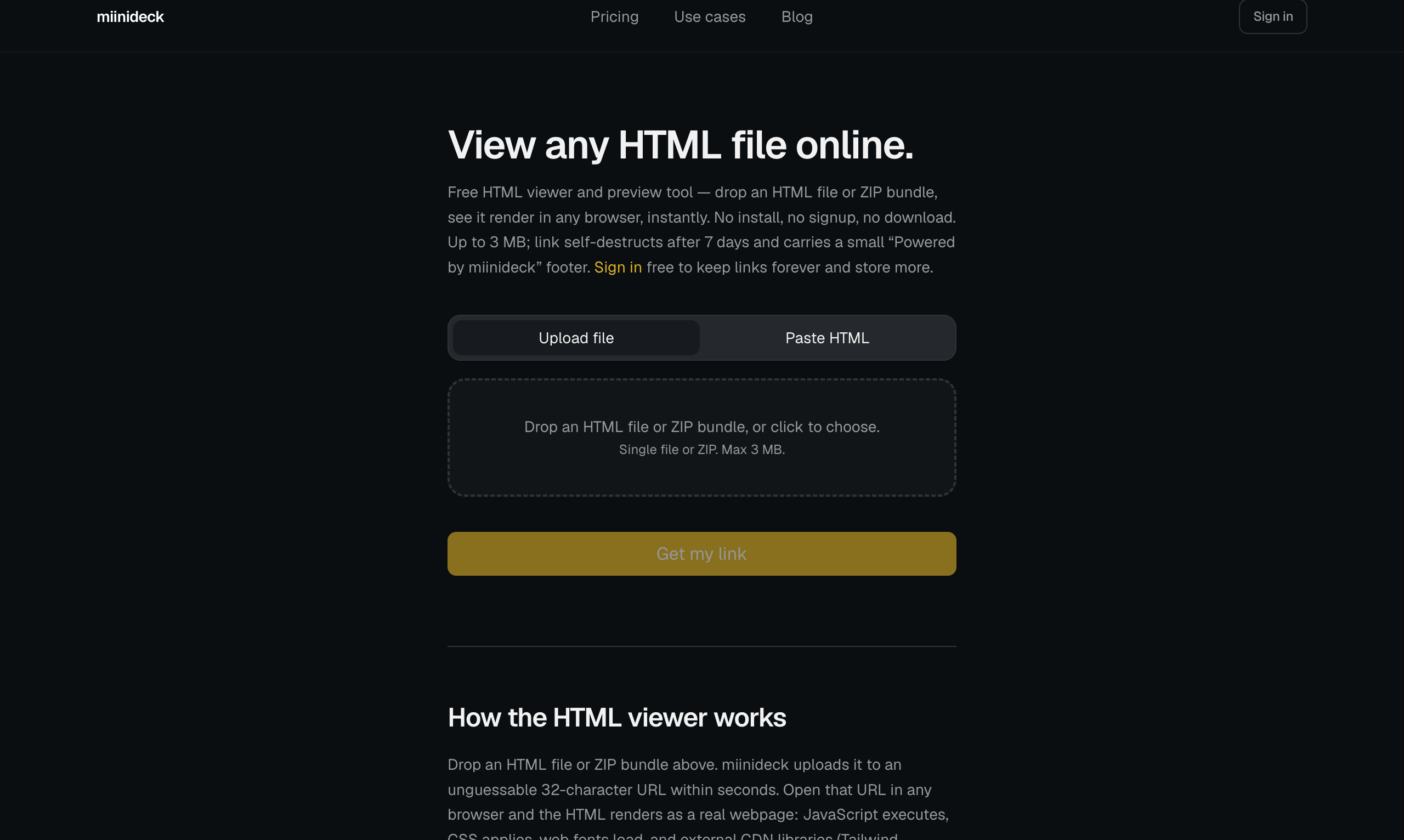
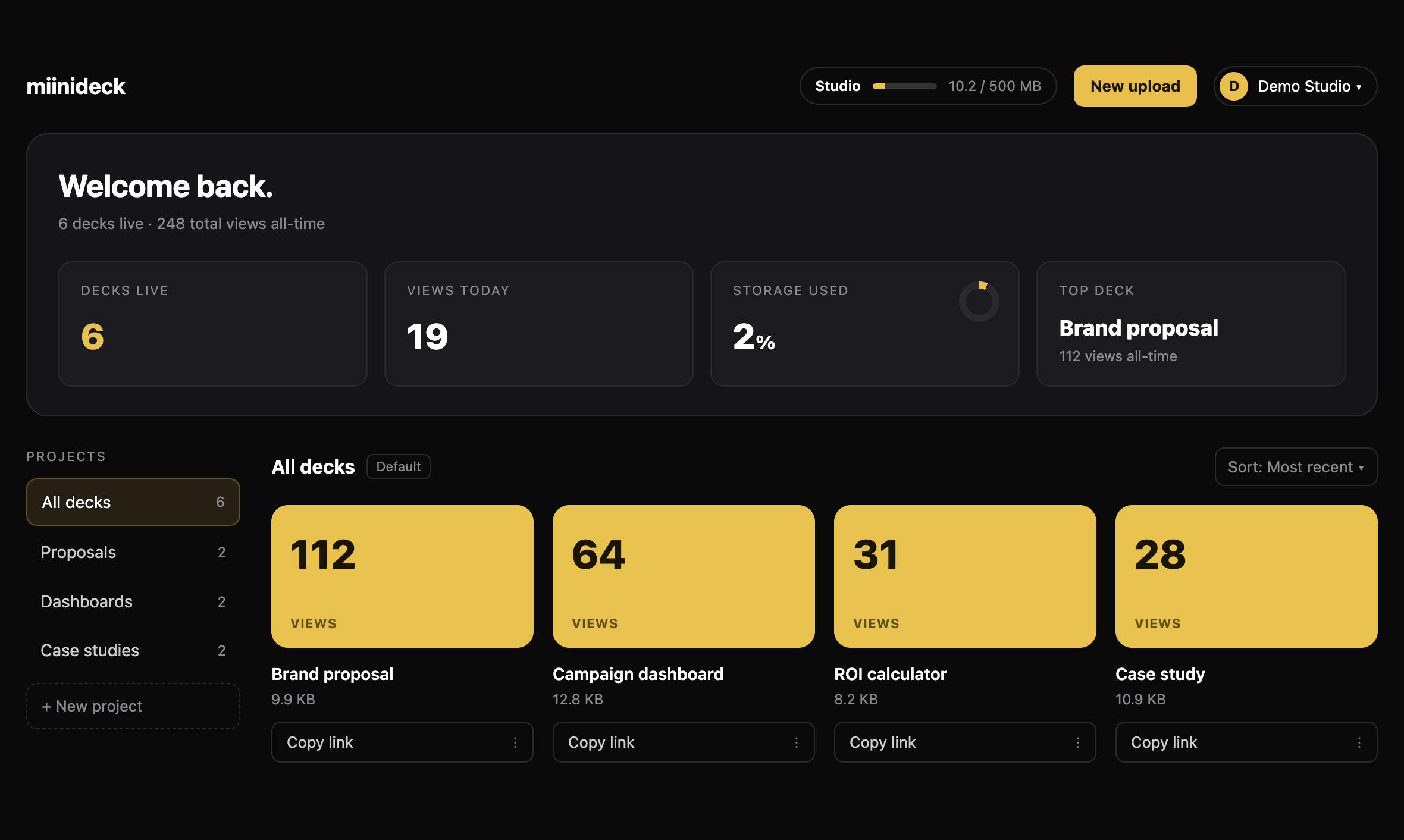
miinideck turns a self-contained HTML file or a ZIP bundle into a private, shareable link in about ten seconds - no build step, no Git, and nothing for the recipient to install or sign up for.
It is for the moment work is finished and has to reach named people rather than the open web: a client deliverable, an interactive report, a prototype, or the working page an AI tool just produced for you.
Links are unguessable and not indexed by default. Password protection and expiry are included on every account tier, the free one included. Re-upload a revision and the link stays the same, so a client's bookmark never goes stale. Viewers can leave comments pinned to an exact element without creating an account.
It serves the static front end of what you build. If your app needs a live backend, a database, or auth, deploy that part on Vercel or Netlify and share the static output here.

Comments




The problem this solves is so relatable — emailing standalone HTML reports always breaks something, and full Vercel/Netlify setups feel like overkill for private deliverables. The fact that the link stays the same across revisions so client bookmarks don't go stale is a huge win. One question: for pinned element comments, does it also support mobile touch targets cleanly, or is it primarily optimized for desktop viewports?



The same-URL-across-revisions promise is the part people will lean on hardest, so two things I'd spell out on the page: what a viewer with the tab already open sees after you re-upload (silent stale copy until they refresh, or a nudge?), and what the page looks like once an expiry date passes. A bare 404 reads as "broken link" to a client; "this link expired, ask the sender for a new one" reads as intentional. Also worth stating the ZIP limits outright - max size, and whether relative asset paths nested a few folders deep resolve as-is. That's the first thing anyone dropping an exported report will want to know before they try it.


As a solo mobile game developer, I usually end up sending WebGL build folders over Drive links for playtesting, and it's always messier than it should be. The password protection plus a link that stays stable across re-uploads would make sharing updated builds with testers much cleaner. Curious whether the ZIP size limits comfortably fit a typical HTML5/WebGL export with assets bundled in.

Keeping one private URL across revisions, while letting reviewers pin comments to exact elements, turns this into a lightweight client-review workflow—not just static hosting. A useful edge case to clarify is what happens to annotations after the HTML structure changes. Do comments remain attached across re-uploads, and is there a version history or rollback option?




I built this because of a small, stupid moment that kept repeating. I'd finish something — a deck, a report, a little interactive thing — and then spend longer figuring out how to send it than I'd spent making it. Email mangles an HTML file. A public host puts it on the open web when only one person was ever meant to see it. And every revision meant a new link and another "use this one instead" message. So miinideck is the boring middle: drop the file, get a private link, send it. The link is unguessable and off search by default, a password and an expiry are there on the free tier, and re-uploading keeps the same URL so nobody's bookmark goes stale. It only serves static front-end files — if what you built needs a backend or auth, that belongs on a real deploy platform and I'd rather say so than pretend otherwise. Would genuinely like to hear where it feels clumsy. That's the part I can still fix.

The 'no account for the client' part is the actual feature here, not the hosting. I build a lot of one-off interactive prototypes, and the number of times a client wouldn't bother signing up for yet another tool just to look at something I made for them is... a lot. Does the private link expire on its own, or is it on you to kill it?

The drop-a-file-get-a-link flow is exactly right for pre-release demos — most teams over-engineer this with a full hosting setup just to show one static page to a client. Two things that would make it a keeper for client work: link expiry or password protection so an unfinished prototype doesn't circulate forever, and the ability to replace the file without changing the URL, since the link inevitably ends up in an email thread already. Curious how you handle relative asset paths inside a dropped ZIP — that's usually where these tools break on real exports.
Premium Products








































Sponsors
Buy

Awards
View all
Awards
View allMakers
Makers
Comments
The problem this solves is so relatable — emailing standalone HTML reports always breaks something, and full Vercel/Netlify setups feel like overkill for private deliverables. The fact that the link stays the same across revisions so client bookmarks don't go stale is a huge win. One question: for pinned element comments, does it also support mobile touch targets cleanly, or is it primarily optimized for desktop viewports?
The same-URL-across-revisions promise is the part people will lean on hardest, so two things I'd spell out on the page: what a viewer with the tab already open sees after you re-upload (silent stale copy until they refresh, or a nudge?), and what the page looks like once an expiry date passes. A bare 404 reads as "broken link" to a client; "this link expired, ask the sender for a new one" reads as intentional. Also worth stating the ZIP limits outright - max size, and whether relative asset paths nested a few folders deep resolve as-is. That's the first thing anyone dropping an exported report will want to know before they try it.
As a solo mobile game developer, I usually end up sending WebGL build folders over Drive links for playtesting, and it's always messier than it should be. The password protection plus a link that stays stable across re-uploads would make sharing updated builds with testers much cleaner. Curious whether the ZIP size limits comfortably fit a typical HTML5/WebGL export with assets bundled in.
Keeping one private URL across revisions, while letting reviewers pin comments to exact elements, turns this into a lightweight client-review workflow—not just static hosting. A useful edge case to clarify is what happens to annotations after the HTML structure changes. Do comments remain attached across re-uploads, and is there a version history or rollback option?
I built this because of a small, stupid moment that kept repeating. I'd finish something — a deck, a report, a little interactive thing — and then spend longer figuring out how to send it than I'd spent making it. Email mangles an HTML file. A public host puts it on the open web when only one person was ever meant to see it. And every revision meant a new link and another "use this one instead" message. So miinideck is the boring middle: drop the file, get a private link, send it. The link is unguessable and off search by default, a password and an expiry are there on the free tier, and re-uploading keeps the same URL so nobody's bookmark goes stale. It only serves static front-end files — if what you built needs a backend or auth, that belongs on a real deploy platform and I'd rather say so than pretend otherwise. Would genuinely like to hear where it feels clumsy. That's the part I can still fix.
The 'no account for the client' part is the actual feature here, not the hosting. I build a lot of one-off interactive prototypes, and the number of times a client wouldn't bother signing up for yet another tool just to look at something I made for them is... a lot. Does the private link expire on its own, or is it on you to kill it?
The drop-a-file-get-a-link flow is exactly right for pre-release demos — most teams over-engineer this with a full hosting setup just to show one static page to a client. Two things that would make it a keeper for client work: link expiry or password protection so an unfinished prototype doesn't circulate forever, and the ability to replace the file without changing the URL, since the link inevitably ends up in an email thread already. Curious how you handle relative asset paths inside a dropped ZIP — that's usually where these tools break on real exports.
Premium Products
New to Fazier?

Find your next favorite product or submit your own. Made by @FalakDigital.
Copyright ©2026. All Rights Reserved