
Melodician
Free intrument chord diagrams
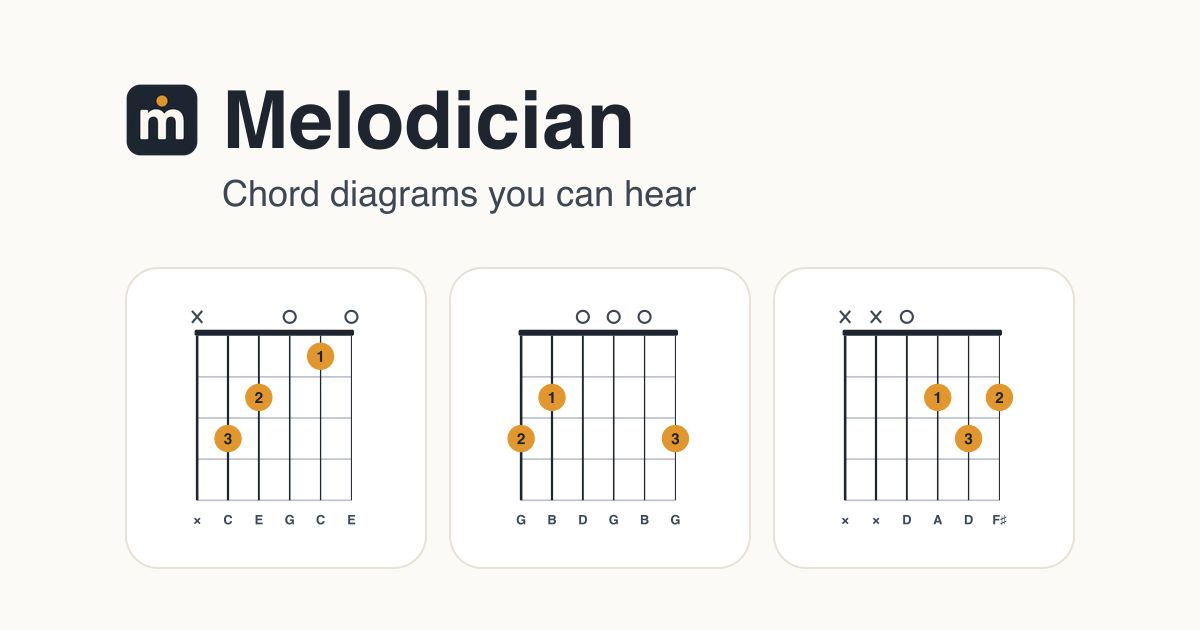
Melodician is a free guitar chord reference you can hear.
Every other chord site gives you a static picture: six lines, a few dots, nothing else. It shows where to put your fingers but never what the chord is meant to sound like, so you cannot tell whether what you played was right, or which string is the one buzzing.
Melodician makes every diagram playable. Tap it to strum the whole chord, or tap a single string to hear just that note, which is how you find the string that is muted. The audio is recorded acoustic guitar, served from the site itself, not a synthesised beep.
116 chord pages, 329 voicings between them, and 190 songs sitting next to the real recordings. No account, no email, no signup wall, no popups. Guitar is live now, with piano, ukulele and bass next, using the same diagrams and the same audio.
Features
- Diagrams that play. Tap to strum the whole chord, or tap one string to hear that note on its own.
- Recorded acoustic guitar, served from the site, not a synth tone.
- 116 chord pages, covering all 12 roots and every common quality, from plain majors down to the ones nobody else bothers with like Edim7 and F9.
- 329 voicings, so you can see the same chord open, barred and up the neck, and hear how they differ.
- An easier version of any shape that needs a barre.
- Finger positions step by step, plus the mistake each shape invites and how to fix it.
- 190 songs that genuinely use these chords, each next to the actual recording.
- Every chord in a song is a link to the page that teaches that shape.
- Left-handed toggle that mirrors every diagram and remembers it next time.
- Printable charts, clean black and white, with the navigation and player left off the paper.
- No account, no email, no popups. Nothing is held back for a sign in.
Use Cases
- Mid-practice lookup. You hit a chord you do not know and want the shape and the sound inside five seconds.
- Learning your first chords. Em, C, G, D and Am, with the finger positions spelled out and audio to check yourself against.
- Chasing a buzz or a dead string. Pick the strings one at a time to find the one that is not ringing.
- Getting past a barre. The easier version of F, Bm, B and the rest, so a hard shape stops being a wall.
- Learning a song. See which chords it uses, hear the record, then open the page for each shape you are missing.
- Teaching. Print a clean chart for a student with nothing on the page you have to explain away.
- Playing left-handed. Every diagram mirrors, and stays mirrored when you come back.
- Writing. Hear what a maj7, sus4 or add9 actually does before you commit to it in a progression.

Comments

Premium Products


































Find your next favorite product or submit your own. Made by @FalakDigital.
Copyright ©2025. All Rights Reserved